1 free read left. Create a free account for unlimited reading + AI research.
Create free accountWhitepaper DiGRA
1 free read left. Create a free account for unlimited reading + AI research.
Create free accountWhitepaperDiGRA
The paper's central premise is that teachers mediate game selection and pre- and post-play scaffolding. Their specific roles remain under-researched.
This paper presents the methodological and theoretical groundwork for a planned study of why language teachers in higher education in mainland China and the United Kingdom do or do not use digital games in their instruction. Its central premise is that the teacher is a pivotal figure in game-based language learning, since well-designed games still require teacher mediation through game selection and pre- and post-play scaffolding, yet the specific roles teachers play remain under-researched. The paper argues that teacher attitudes, knowledge, and experience are likely shaped by cultural context, particularly in China, where a restrictive regulatory environment and a longstanding cultural view of play as incompatible with education create a distinctive setting for educational games.
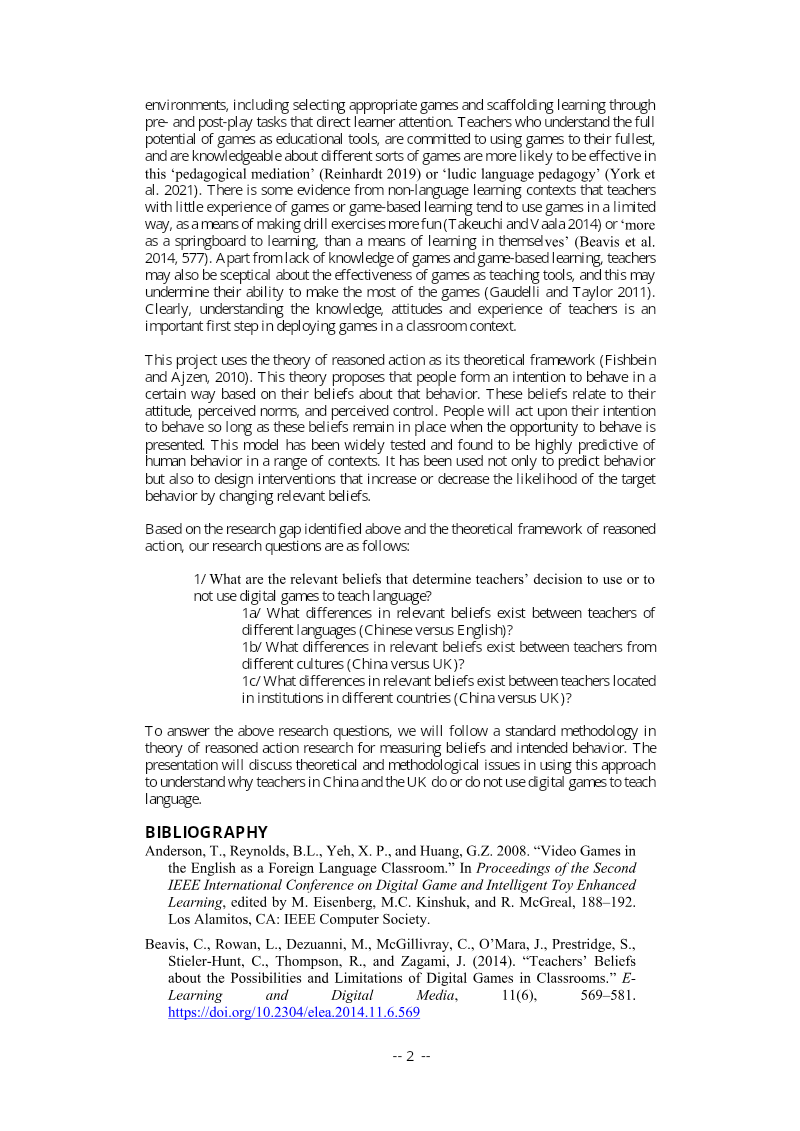
The authors ground the study in the theory of reasoned action, which holds that behavioral intentions arise from beliefs about attitude, perceived norms, and perceived control. Drawing on existing literature, the paper notes that teachers with limited familiarity with games tend to use them narrowly, for instance as a means of making drill exercises more enjoyable, and that scepticism about games' educational value can further constrain their use. Rather than reporting empirical findings, the paper establishes the research gap and sets out its guiding questions, which concern the beliefs that determine teachers' decisions and how those beliefs differ by teaching language (Chinese versus English), by culture, and by institutional country.
The scope of the proposed work is comparative, covering teachers in Chinese and UK higher education institutions, and the paper is an early-phase presentation outline rather than a completed survey. The methodology is described only as a standard theory of reasoned action approach to measuring beliefs and intended behavior, without reported sample sizes or data. The reference list draws on game-based learning, computer-assisted language learning, and Chinese game-culture scholarship, situating the project at the intersection of these fields.

DiGRA · 2026

DiGRA · 2026



DiGRA · 2026



DiGRA · 2026



DiGRA · 2026



DiGRA · 2026



DiGRA · 2026



DiGRA · 2026

DiGRA · 2026



DiGRA · 2026



DiGRA · 2026

DiGRA · 2026
DiGRA · 2026