1 free read left. Create a free account for unlimited reading + AI research.
Create free account
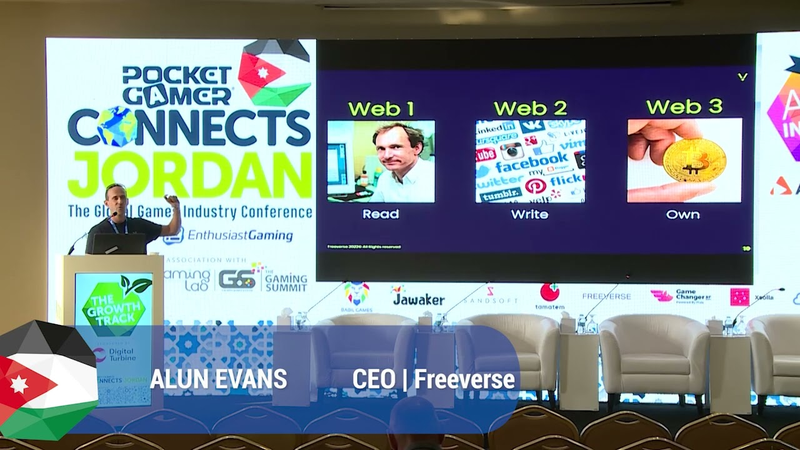
Superstar Session: Living Assets: Evolutive NFTs for Playing Fair in the Metaverse
Key insights
6 takeaways- 01The 2021 NFT market reached $20 billion in sales, highlighting the scale of the sector despite ongoing industry skepticism regarding long-term viability.
- 02Concerns regarding the environmental impact of NFTs are largely outdated, as modern layer-two blockchain solutions now operate with minimal energy consumption.
- 03Evolutive NFTs allow developers to embed metadata directly onto the blockchain, ensuring assets are secure, persistent, and reflective of a player's actual time and effort investment.
- 04Formalizing in-game item trades via blockchain technology allows developers to capture recurring revenue while eliminating the 'gray market' of unauthorized third-party trading platforms.
- 05The gaming industry must shift from speculative play-to-earn models, which risk creating unsustainable economic pyramids, toward 'living assets' that evolve based on active in-game user behavior.
- 06Dynamic NFTs serve as powerful retention mechanics by incorporating features like performance-based degradation or user-generated customization to incentivize consistent gameplay.
Ask AI about this video
Transcript
[Music] [Music] of course one of the things that we've really started to talk about in the last couple of years is the notion of user-generated content and non-fungible tokens we're now going to take a deep dive into this with our next speaker alan evans from freeverse who is going to be looking at living assets evolutive nfts for playing fair in the uh metaverse morning everyone let's start today's session with a question um hands up in the audience if you have heard of marmite that's quite a lot of people keep your hands up if you like marmite
around about half the hands go down so if you're not familiar with marmite it is a condiment you spread it on toast here in the uk it's definitely not vegemite that's what the australians do um and you either famously love it like me or you hate it like my wife and uh the interesting thing is the marmite branding and marketing campaign make a big joke about this right so all the adverts about marmite are love it or hate it and in the games industry we've seen our fair share of marmite moments right so we've seen you know virtual reality goggles love them or hate them uh the free to play movement right love it or hate it console wars love them or hate them even the video game industry itself is a marmite movement everyone in this room probably likes the video game industry but there are plenty of people out in the world that don't like video games just that they didn't like uh home cinema just like they didn't like television just like they didn't like
cinema and they probably didn't even like the book to start off with so here we are in 2022 now with our latest marmite moment which is of course the non-fungible token or the nft i'm lucky to be a part of a what's up group for indie game developers where i live in barcelona and every few days the chat goes bananas with endless debate about nfts and this was a nice image i saw that came up a little a parody of a scene from terminator 2 about what one developer really thought was was you know the devil's spawn right and uh but the cold hard fact is as uh one of the colleagues when i colleagues in the talk a couple of about half an hour ago mentioned that there's just a lot of money going into this right now 21 billion dollars was spent on fts in 2021 and uh like in a lump it is definitely something that's happening there's a lot of money there so what i wanted to do today basically was to just deconstruct a little bit to clear up the confusion about what is an nft why would you want to own one uh why some people are not fans of them and why
perhaps they potentially could have a great future ahead of them so let's start with this and let's clear up some um interesting points about what is an nft and let's start with what an nft is not so an nft is not an image this is probably the biggest misconception that people have about nfts is that they think an nft is an image uh this was a a photo that was or an image a drawing that was made by the british comedian john cleese who drew on a piece of paper and then said there you go there's an nft of the brooklyn bridge right and it's probably the biggest misconception you can associate an image with an nft right but an nfc is not an image an nft is absolutely not any sort of guarantee of ip rights you might have read the the funny story about um some cards who um purchased for quite a lot of money the nft of the lord of the rings book thinking they could monetize that in the metaverse right and of course they didn't just because you own an ft does
not give you the ip rights to whatever that uh that nft represents and in fact those of you remember one of the some of the original sort of nft boom uh stories of which were applications which was cryptokitties the license that was associated with your little digital cats meant that you were only allowed to actually physically print out the image associated with your cryptokitty at a maximum size of a4 paper so every good nft has a license uh some terms and conditions that are attached to it and just owning an nft does not give you any other rights i have some sympathy with this third point some people think nft is a receipt of purchase in the same way that if i buy something in the real world a receipt proves that i am the owner right but in this case the nft is the item you're buying right it's not just a receipt the fact that you own it means uh it's more than just a receipt in that sense and the other thing i want to put to bed as well is that they're bad for the environment some bitcoin some blockchain technology sorry particularly the the early stuff the early bitcoin blockchain network uh
is bad for the environment right in the country that uses a lot of energy and we're no longer far from being carbon neutral at the moment and so i think the blockchain network i saw was sorry the bitcoin network was uh using the same amount of energy as argentina or something but the simple fact is that if you mint an nft on one of the modern layer twos or blockchains like uh polygon or solana right now it will cost the same amount of energy uh as the power taken to uh you know the energy used to power this uh um presentation this uh projector since i started my talk so uh the idea that they're all energy wasting things is i think it should be put to bed so quickly so let's talk about what an nft is and this is an nft that's it right it has a unique id it has an owner and it has some properties right and that record is written to one of the blockchains where it stays there forever right there is no images there is no licenses
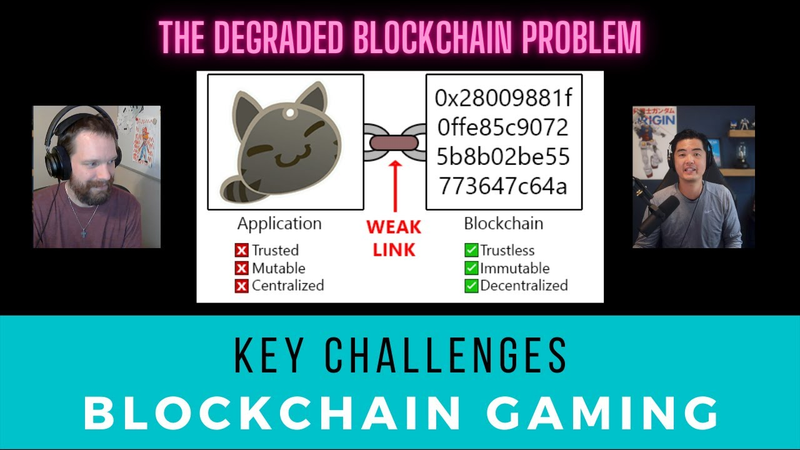
there is no anything that's just an nft it's not a particularly fun nft it's meaningless so let's add it something and let's make a bad nft right so a bad nft retains the id of the individual id of the token it retains the the address of the owner which is anonymous and it has here in its data fields a link to a private server right this is bad why because what happens on some private server is not reflected in the blockchain the blockchain knows nothing about what's happening on a private server that private server whether it's a game server or whatever it is it could uh be it could be taken down uh it could be hacked it could be uh you know it could crash you know and if that happens all the data associated with the nft therefore disappears right that's not so good so this and apologies for the sort of code in the talk but this is what i would consider as a good nft right so it has the id the unique id it has the owner and here we have a selection of
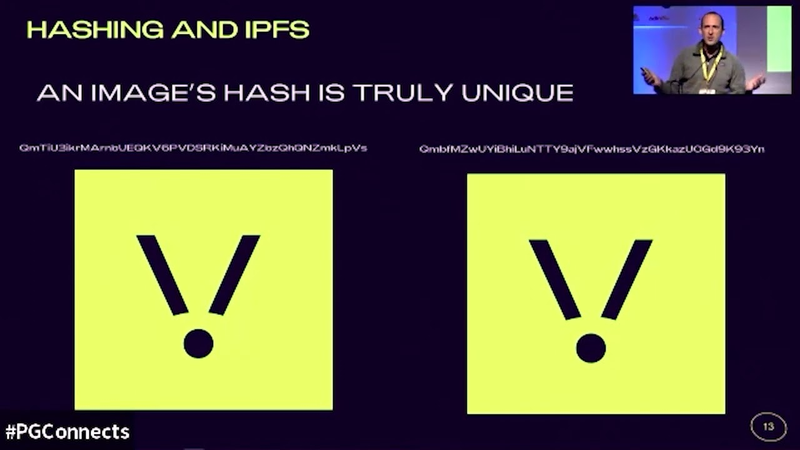
properties that describe that nft right this nft is clearly bob the builder he has some fields right he's very strong strength of 42. and a couple of things i want to point out here yes there is an image associated with that nft right that image is stored on what's called the ipfs the international uh interplanetary file server file system sorry right which is a decentralized file network which if you can store any file essentially forever right it also has a license that says explicitly what you are allowed to do and not to do right and so at a slightly technical level what we do is we associate an image as hash with that nft and we say that this image these two images look identical but one of them has one pixel which is very slightly differently colored so they are not identical and therefore their summary their hash is very very different so if i associate an image hash with nft i'm linking that image with that nft forever what can i do with that image
i associate the license with there as well right i associate some terms and conditions they might say um that the owner of this nft has the right to access or engage or play with certain content within a game it might say might specify very specifically that any images or data or intellectual property are still copyright the original game creator right so as the creator of the nft i have the freedom to associate any terms and conditions that i want with that nft and those terms and conditions if they're well written will guarantee what that nft can and can't do all right so if we've got in our head a little bit what entity actually is and is not why would you want to own one this is a picture of my bicycle uh it's a lapierre zesty i like my bicycles i bought it last year and i now have the freedom to sell it to anybody i want forever price i want i could probably make a profit on it now right because i don't if you know with
the whole covert thing there is a um slow down in the in the availability of bicycle components and so new bikes are quite hard to come by this one's quite hard to come by if i sold it on the secondhand market maybe i could even turn a profit because you can't buy it in shops i can't do this in a video game if i buy an item in a video game i am not allowed to sell it on to anybody else for real money apart from the monetization debate apart from the structure and the economy of the game the real reason this happens is legal it's actually legislative if a game is permitting um the sale of in-game items for real money they are storing on their servers they are being the custodian of items that have real value real money value on their servers on behalf of others and therefore legally they have to become a bank they have to comply with banking legislation and so in fact second life even set up a whole spin-off company called tilia pay to do exactly that to become a bank to enable uh second life users to trade
their uh second life goal for dollars right so what the blockchain does and what nft does is abstract that responsibility of the bank and it allows gamers or allows users to sell items to other people for real money and why shouldn't i be able to do that as a gamer why should i be forced to retain all my items not have the freedom like i bought my bike why can't i have the freedom to sell that bike to somebody else if it were a virtual bike that's my argument here and that i think is what's happening this in the last year the cat is out of the bag where people realizing that you can do this now right um and don't take my word for it like this is what's happening right there is this gray market i'm sure you've heard of uh player auctions and game flip where you can buy in-game items kind of on the gray market right it's against the t's and c's the term conditions of the games um but they're still there right and in fact there was a study a couple of years ago by university in korea which uh measured the uh size of the second-hand trading
market that the gray market uh for trading of in-game items um in mmo games and it estimated it measured that uh there was around about 20 percent of the of the games um economy was locked up in this um gray market of games so for every five million that was spent in the game one million was being spent in this gray market outside which was not being monetized by the game creator it was like dead money in that sense the other thing is the metaverse why would you want to nft no one knows what the metaverse is right and but i think beyond this idea of like fancy virtual vr goggles and mark zuckerberg with his fancy videos um i think what the metaphors is going to be is is how we present ourselves and what is our digital identity in the future internet right and i think part of that is how we present ourselves is what we own right so i've turned up here dressed fairly casually right i came on the tube had i turned up in a ferrari and stepped out in a sharp armani suit you would think of me differently right because i'm
presenting myself in a different way and i think the metaphors are going to be or a key component of the metaphors is going to be how we present ourselves in that in the in these these distributed spaces that we might may or may not be playing in right so i think what we own and nfts are obviously a part of that what we initially are a big thing of that and the final and the weakest point i think actually for why to own an ft is the idea you might make money out of it i say it's the weakest point but it's the one that's made the most impact in the last year and it's perhaps one of the reasons that people don't like nfts um obviously actually infinity mode have had a had a you know a it's been a great hit it's made a lot of money it's quite a fun game um i think it's fair to say that one of the reasons the people to play is they think they can make money out of it right and this leads really to like um why some people think nfts are the devil's spawn are not the future not bad for the industry and that's because um the idea of play to earn which is great in in many respects i think it can work in the short term actually infinity's made it
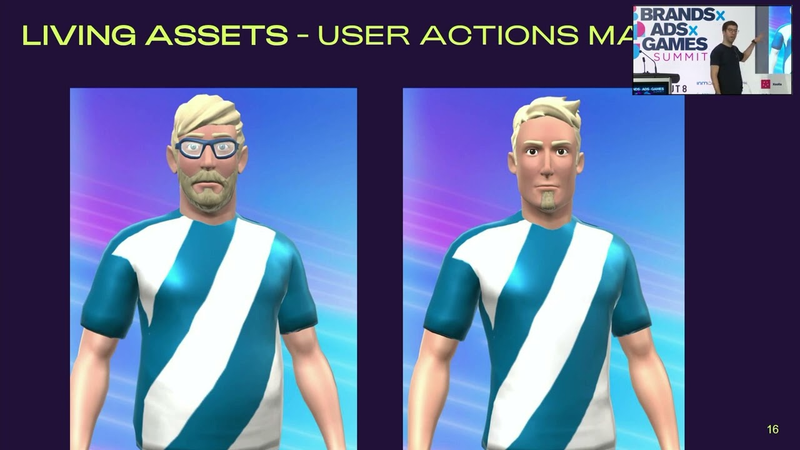
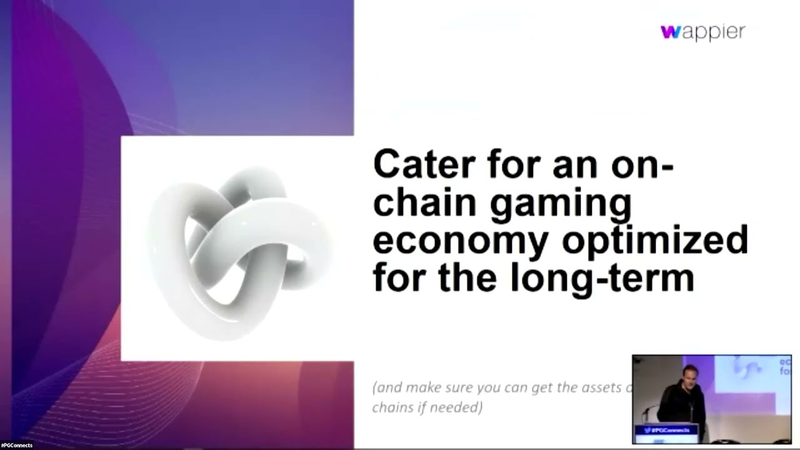
work i know there are lots of people here working on on play to own or play and earn games but i think that the speculation only makes sense uh in the short term right and the reason is is that you have this pyramid of buyers and sellers right um and the buyers are coming in below and they're buying things from the sellers and the sellers are making money but that only works as a model if there is this never-ending flow of buyers as soon as this arrow at the bottom slows down then the whole economy collapses and so an economy person speculation maybe works in the short term right but i'm not sure it's going to work in the long term so how can we address these weaknesses and and and also take advantage of the strengths of this new technology these new approaches one way that we're doing in freebus is the idea of dynamic nfts we call them living assets where what the act what the gamer does with their nft actually affects their properties and therefore affects the market value right so how
i'm using my nft again in the game affects how much someone is willing to pay me for to uh if i want to sell it right and this turned this idea of a passive activity of just collecting and speculating on nfts into this active experience of engaging with them let's run through some run through some examples very quickly right uh imagine that i buy an asset for some money it's a three-star asset i spend some days or weeks playing with the asset to upgrade it level it up like we do all the time with games and then i can sell it on the market and the market value will represent the effort that i have put into using it rather than just me sitting on it and hoping that speculation as to its rarity will push the price up um the other option is the tamagotchi mechanic we actually made it free vs a sort of a proof of concept game called gold revolution it was an mmo football manager game where your football players were nfts and they automatically start getting less and less fit and performing less well in the game if you didn't come back and keep training them now that's a very strong retention mechanic right because
you're incentivizing games to come back to make use of their assets they have in the game but also you're incentivizing them that they don't lose money right because the money um the the value of the nft is being based on how or or how often they're being used right and in fact we saw some crazy high retention values uh when we soft launched that game with only a few thousand users admittedly but uh some crazy high retention values and i think user generated content is really a huge thing right i'm very proudly from south wales uh if i buy a ferrari in a game and i choose to custom paint that ferrari in the welsh dragon flag spending my time and effort to do so um why shouldn't i be outside on somebody else right and somebody uh another welsh person in the in the crowd here might want to buy it from me and then customize it further right and i think this rise of ugc use generated content is really really important i think it's something that's really possible by dynamic nfts or living assets so in summary i think what the user does with their nfts is crucial to
the long-term success like to be able to convert user actions into something of value and rather than just speculation i think this makes it fairer makes it fairer for the gamer makes it fairer for the company and makes it fair for all the stakeholders involved with with that nft and also in the metaverse i also think that as a games industry new ways of driving retention uh for your game and also new monetization models are very very interesting especially when they are enabling you to charge a recurring revenue on those on that gray market which is currently being locked away so what we do at freeverse um we have a platform for uh creating millions of nfts allows child recurring revenue they're very eco-friendly they use very little energy uh you can trade them in crypto or fiat and most importantly what the gamer does with them is reflected in their properties and they can evolve based on how the gamer used them um nfts are definitely a marmite moment uh but uh there's nothing better than a good debate to see if you like it or not we're here in the um on the same floors this talk here we've
got a stand and we'll be here later on so if you want to come and debate it we're happy to do so thank you very much for your time today [Music] [Music] you
Summary
The integration of non-fungible tokens (NFTs) into the gaming industry represents a polarizing shift, often characterized by skepticism regarding their long-term viability and environmental impact. While 2021 saw $20 billion in NFT sales, the prevailing play-to-earn model relies heavily on speculative growth, which risks creating unsustainable economic pyramids. To move beyond this, the industry must transition from passive collection to active engagement by utilizing "living assets"—evolutive NFTs that change properties based on in-game user behavior.
Technically, an NFT is a unique digital record containing an owner address and specific data fields, rather than an image or a guarantee of intellectual property rights. Misconceptions regarding their environmental footprint are largely outdated, as modern layer-two blockchains operate with minimal energy consumption. By embedding metadata directly into the blockchain rather than relying on external, vulnerable servers, developers can create secure, persistent digital assets that reflect a player’s actual effort and time investment.
This approach addresses the "gray market" problem, where players currently trade in-game items on unauthorized platforms, effectively locking value away from developers. By formalizing these trades through blockchain technology, developers can capture recurring revenue while providing players with legitimate ownership and the freedom to sell assets. Furthermore, dynamic NFTs offer powerful retention mechanics, such as performance-based degradation or user-generated customization, which incentivize consistent gameplay. Ultimately, shifting the focus from pure speculation to value-based evolution creates a more equitable ecosystem for gamers and developers alike, positioning digital assets as a foundational element of future digital identity within the metaverse.