1 free read left. Create a free account for unlimited reading + AI research.
Create free account
Superstar Session: Know Your Players, Grow Your Game: A Guide to Live Ops in the Cloud
Key insights
6 takeaways- 01LiveOps transforms games from static products into evolving services, utilizing continuous updates and events to maintain long-term player engagement without requiring client downloads.
- 02Successful LiveOps relies on a cyclical process of design, development, delivery, and feedback, underpinned by analytics that capture telemetry to optimize gameplay, monetization, and server health.
- 03Cloud-based data lakes and machine learning enable developers to derive actionable insights regarding player cohorts, sentiment, and economic balance.
- 04Integrating CI/CD pipelines from the start of development facilitates rapid, secure feature delivery while reducing manual errors and server downtime.
- 05Content delivery networks (CDNs) ensure low-latency updates by caching data at global edge locations, maintaining game responsiveness for a worldwide player base.
- 06Elastic compute services allow infrastructure to scale automatically during high-demand live events, eliminating the need to maintain costly idle hardware.
Ask AI about this video
Transcript
our first session today is a superstar session um from a true superstar marion marion finnegan of aws game tech title of her talk is know your players grow your game a guide to live ops in the clown and i am super excited to get marion's insights so without further ado take it away marion thanks dave thank you very much hi everyone let me share my screen right away and kick this off right hi everyone and welcome to uh this session i'm super excited to be here and today we're gonna have a chat chat about knowing your players engaging them and keeping them around to grow your game because in the end it's always about your players enjoying the game that you've actually made for them before we kick it off let me just
quickly introduce myself my name is marion finnegan and i am senior business development manager for gametech at aws my absolute all-time favorite game was is and probably always will be super mario brothers three but uh to be honest i think it's sell the breath of the world that i'm putting most of my game hours in lately enough about me and without further ado uh let's look at a guide to lifeops in the cloud the games industry has seen an exponential growth in the past 20 years with the last year just being the clip of the iceberg some would suggest that the growth of gaming is linked to the growth of the internet which gave specifically mobile and online games a massive boost it has also led to a significant shift from games as a product to games as the service so from a packaged good that is played for a while to a service that with applications that we engage with over and over again the most successful games of the past few years are mostly
in that area of games as a service and have been in the top list of most successful for quite some time and this is where life comes into the picture which basically means taking care of the game but more fundamentally it's about what happens in the game and how players engage with it it's about providing great experiences that evolve over time motivating players to keep coming back and having law having them long term engaged making sure that the game becomes part of their lives lifeops isn't anything though even early mods or multi-use dungeons use some of the same techniques as today to keep their content fresh and their players happy it's only recently especially with the success of games like fortnite and clash of clans that embraced liveops that there's been a lot of talk about it and attempts to give it a better definition so here is our definition of life
obvious at its heart it's a philosophy that a game will change over time while it's life as opposed to having to release the sequel the expansion pack or any new version of the game itself games using life obs live online and usually start their life either as a download or website rather than in the books while it is important to acknowledge the success of the fortnights and clash of clans of this world when we talk about life ups it's just as important to acknowledge that you don't need to be as big as epic or have as many players as fortnite to actually get results from incorporating life ops into your game but does scotch shell anigens for example they have recognized that the games industry is a crowded and competitive place and they leverage liveops practices to gain a competitive advantage by using back-end automation via website apis and serverless compute to help them locate and build daily challenges for their
players if it happens on a regular basis on a schedule so the players always know when to look for something new they will keep coming back but scott shenanigans does this on a daily basis and that's how they keep their engagement high past the very basic definition of lifeops being a philosophy there are a few things you'll find pretty much in every life of scheme the game is designed and developed with lightfox in mind there is a very strong community building going on around the game it is very common for life events to be hosted in the game data and analytics are absolutely crucial to make decisions about what to update and want content to deliver and last but not least there is content delivered constantly often without having to update the game client binary but enough about the philosophy let's talk about the tech behind it
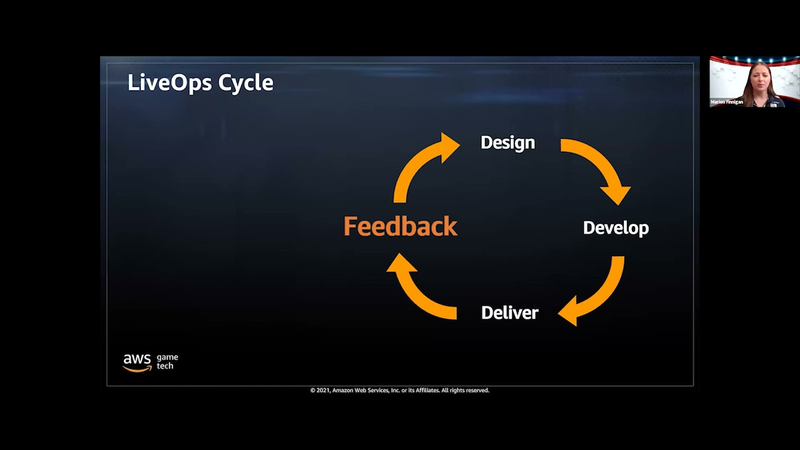
liveops begins long before your game is launched and the sooner you think about the technology aspects behind it the more fun you're actually having building it especially when it comes to player analysis and the build release cycle we'll be looking at several different technologies today to enable life ups in your game with a very strong focus on three specific ones first implementing analytics to help you with designing game features and monetization strategies this is the part where you actually get to know your players the second one is developing an integration and delivery pipeline that enables fast deployment of all of these new features and the third one is delivering those updates quickly and efficiently to your players making sure that you're bringing new content as close to them as possible it might help if you think of lifops as a cycle it starts with design of a feature or game which is then
developed and once ready it's delivered to the players feedback is the force that drives this cycle feedback from analytics is the basis for creating new features and fixing problems developing and making changes which are then deployed so i think you get the whole idea of of the cycle the areas that cloud can be most beneficial to your game are delivery and feedback so if you want to know your players and grow your game collecting data listening to feedback and analyzing the information that you have is absolutely crucial it builds the foundation for making decisions about what to focus on and when to make changes like adding new features or fixing problems and this is where analytics comes in analytics allow you to capture information on all aspects of your game from what players enjoy doing in your game to how they spend money to how healthy your servers are and so on games today are generating
much more data than ever so analytics becomes a key part of the life ops process collecting information and making sense of it is the driving force behind fixing problems before they actually become a real issue and coming up with compelling new ideas for your players to keep them engaged the data can also help you understand where players are actually spending money what part of the game they find most interesting or which part they probably struggle most with and this can help you to tailor messaging and game features to different player cohorts to improve your game and keep your players engaged in a bit more detail here the reasons why you should be using analytics for games so you can use analytics to create more engagement in your game it can help you to improve your game design and optimize your gameplay experience by revealing how your game is actually being played and what to enhance to create a better engagement as an example
you could use telemetry data of player deaths on a heat map which could identify opportunities to improve level design another very important reason to use analytics because monetization this obviously depends very much on the business model of your game whether it is free to play a game with microtransactions or it is a one-time purchase game in any case you can use data analytics to help you monetize better by understanding things like other players that play the most also the ones that are spending the most in-game purchase or maybe there are specific experiences in the game that make your players more likely to spend money on in-app purchases fraud and player investigation is another great use case for analytics like detecting anomalies finding unusual behaviors maybe even using machine learning to detect possible cheating i mean cheating is really disrupting a game experience and it will ruin the enjoyment for other players
and the rest of the community so you really want to make sure you'll be able to identify this fortune behavior quickly and put a stop to it and last but not least we have things like performance and error reporting analytics can help you to improve your game infrastructure and understand important metrics like cpu utilization and memory utilization you can better understand your peak usage time so that you know when to scale your infrastructure or you understand latency which impacts your players experience especially for latency sensitive games like you know for example first person shooter so analyzing error trends can help you identify all of those things remediate them and prevent them from happening again in the future we have developed a game analytics pipeline solution that pulls all your data in one data lake and opens up opportunities to leverage ai and ml services to pull actionable insights from the data the cloud formation template automates
the setup and provisioning of all necessary services for easy deployment for anyone new to cloudformation it's a service that helps you model and set up your resources so that you can spend time managing them and you don't have to spend time managing them and focus more on time spending on your game before we jump into the next service just a quick overview of a few happy analytics customers so for example montreal-based developer behavior interactive they celebrated 12 million players back in 2019 uh they introduced a state-of-the-art data pipeline um using aws jelly button develops and publishes free to play interactive mobile and web games and they are using redshift which is amazon's data warehouse and amazon kinesis for real-time analytics as sony interactive entertainment built its evee fault system as a big data platform to aggregate trans uh transactional activity of users and this
is just to name a few of them so we've just discussed our analytics pipeline now let's look into some of the other services around database and machine learning that allow you to collect data and analyze that feedback as outlined in our example monetization is very important and that includes the economy of your games community and all the in-game transactions which a lot of players just love so understanding how your drops affect that economy is absolutely critical to both maintaining a healthy in-game community as well as managing your financial expectations it is quite a business when you have to farm boss x to get phoenix speaks as drops and then buy miracle water from the in-game store so you can create this wall of hacking so you can farm boss a to get all bear claws and so on okay so let's let's just leave it there for for now and all those relationships can start to get really hard to track as they start to
cascade a creative way of solving this problem is mapping out all the items and their relationships to each other just ignore the eiffel tower and the louvre for a moment you can tweak your numbers and a query can show you the results across your entire economy you could build your own or you can look into amazon neptune as a way to let aws manage the infrastructure for you while you manage the game data natural language processing nlp is a great way to understand critical feedback about players without having to go into every single piece of information it includes references about language people places and it also can capture the sentiment of the feedback allowing you to get a great pulse on how your community is feeling about events about changes about updates or the game overall recommendation engines help you to analyze what person x is playing
and buying and is making recommendations based on this behavior however that doesn't only apply to in-app purchase recommendations um it also applies to other areas of the game like for example quest lines hey looks like you enjoy a stealth approach other stealthy players stack this question out to the end so maybe you should give it a go or you can use it to point players towards items that enhance their performance if you don't fancy building this on your own use amazon personalize a managed service which handles the hardware configuration uh and maintaining uh all the um and provides you with a simple api to query against back to our life of cycle though it's time to look uh to take a look on how cloud can actually help you with frequent and automatic deployment i.e the deliver part of our life upcycle one of the biggest challenges is the ability to deliver new features to players
as quickly as possible not only do new features have to arrive quickly and reliably they also need to be delivered in a way that optimizes costs and maintains security in a way that you players don't even notice continuous integration and continuous deployment cicd pipelines with githubs is an effective way to improve games fix problems and deliver new features throughout the development lifecycle as quickly as possible with little to no server downtime building cicd mechanisms into your process from day one can save you headaches and keep your players engaged from the start rather than making them weight as you stumble through retrofitting your process so one thing that really helps speed up deployment is keeping the amount of updated artifacts to a minimum ci cd creates intelligence and automation around your build process so that when you push that build button
you don't just create that build you have the build exactly where it needs to be so your players can get edited and you're only delivering what's actually been changed one of the main issues we heard from customers about continuous integration for games is usually the size of the game's engine which is between 6 and 11 gigabytes depending on the engine you're using so every time you're making changes you're moving gigabytes of files just for the engine alone whereas in reality there is no need for this obviously unless there is an update to the engine aws can help to decouple the two it enables you to only make the changes that happen in your game pipeline automation also helps to reduce error from your process since you're not constantly manually copying files moving things to multiple destinations and so forth so what can cicd do for your game as already mentioned the first element is to increase the game feature velocity by pushing only certain features as soon
as possible to build an immersive and ambitious experience for your players get ops allows you to use familiar tools like it to manage updates and new game features without having to know the internals of kubernetes since deployments are managed through pull requests any platform nuances that host the game are actually abstracted another benefit is streamlined game operations as with any other type of software game players expect stability and reliability you automatically gain an audit trail of who did what and when to your cluster ensuring stability of the game server host and since access to game server clusters and other infrastructure is limited security is vastly improved so deployment permissions can be managed through aws iam if aws code commit is chosen as your git provider aiming for consistent and
standardized workflows so be sure you're building ci cd in from day one it can be as simple as having a tool like jenkins running the build process and depositing your artifacts in the right targets or you can consider using aws code pipeline a fully managed cd service that help helps you automate those release pipelines back to our life up cycle lifeops aims to make the player not have to sit and wait for content i mean the worst thing that can happen is watching the download percent me to grow don't we all agree ideally they don't even know that the content has changed until they discover it in the game so your players want to download any updates and use them as fast as possible which brings cloudfront into the game so the closer that you can get the data to your player the quicker the binary and data
downloads are going to be amazon cloudfront is our fast content delivery network or cdn ensuring high speed secure downloads of game data to your players and automatically finding the endpoint that is closest to them cdn works by grabbing the data like web application data video files game download files and apis from one central location delivering it to the customer globally with low latency and high transfer speed so it's always quickly available from wherever the data is accessed cloudfront is directly connected to the aws global infrastructure with more than 225 points of presence mostly edge locations in over 47 countries and 90 cities and expanding rapidly the benefits of cloudfront are fast scalable game downloads routinely delivering multiple terabytes per second peaks globally use cases that we come across are for
example using web sockets for chat based functionality as well as content global content collaboration among developers security at the edge is a big benefit with cloudfront especially as games are targets for distributed denial of service attacks with cloudfront you automatically get aws shield standard that provides default protection for ddos attacks and if you use aws origins such as amazon s3 ec2 or elastic load balancer you don't have to pay for any data transfer between these services in cloudfund it helps and optimizes your costs of your application and again a small list of gaming customers that already use cloudfront i mean we've mentioned epic games before using aws to deliver fortnite to more than 200 million players around the globe and perform analysis that helps epic games to improve their game right so back to our live upcycle
let's finish with one more service that supports delivery and deployment and have we started from the very beginning amazon ec2 and auto scaling would probably have been one of the first services to actually mention absolutely crucial when running live events in your game you need to have enough service you could absolutely consider running your own service remember though that when you're working with lifeops you're dealing with huge spikes in usage when you have those kind of events so if you go down the own your own service path you'll have to make sure that you have enough service lying around to actually handle the increased demand and a good number of those servers probably won't be doing much when the event is done so a cloud-based approach where you can spin service up and down elastically based on demand can be a great way to provide capacity while saving money at the same time all right then i'll leave you with a
summary or maybe even a few tips for what it's worth first of all size does not matter whether you are epic butterscotch shenanigans or somewhere in between life ops will bring huge benefits to your game experience secondly do it early avoid the headache of having to retrofit lifehooks into your game make sure you plan for it from the very beginning think about the tech behind it as we said lifeops begins long before your game is launched and the sooner you think about the technology aspects behind it the more fun you're actually going to have building it and last but not least there is absolutely no shame in asking for help if you don't have the time or resources just use a partner come and talk to us we might know of you so with that i want to say jenny thank you for joining my session today i really hope that you got a good overview of how the cloud
can help you with live vlogs if you have any questions or would like to chat i'm around and i've got an amazing team of people attending this event so please please please please be in touch and thanks for joining marion thank you very much what a great set of insights and what an amazing array of services that amazon has on offer it's almost like you were some sort of large company with a bunch of people working on this stuff that's crazy it's hard to imagine um thank you so much for presenting that and thank you to you and the aws game tech team for sponsoring this track today um as i mentioned to start no q a on this session so we're going to roll right into our next talk on lime ops marion thank you so much for joining us and if anybody has any questions uh once again any additional insights on aws tech please find marion in the meet to match system which by the way is an amazing business networking tool if you haven't tapped into it yet you
should you
Summary
Live Operations (LiveOps) has emerged as a fundamental philosophy in the modern gaming industry, marking a transition from games as static products to games as evolving services. This approach prioritizes long-term player engagement by continuously updating content, hosting events, and refining gameplay without requiring players to download new versions of the game client. While popularized by major titles like Fortnite and Clash of Clans, LiveOps provides a competitive advantage for developers of all sizes, allowing them to maintain relevance in a crowded market through data-driven decision-making and automated infrastructure.
The core of a successful LiveOps strategy relies on a cyclical process of design, development, delivery, and feedback. Analytics serve as the foundation of this cycle, enabling developers to capture telemetry data to optimize game design, improve monetization strategies, detect fraudulent behavior, and monitor server health. By leveraging cloud-based data lakes and machine learning, developers can gain actionable insights into player cohorts, sentiment, and economic balance. Furthermore, integrating continuous integration and continuous deployment (CI/CD) pipelines from the start of development allows for rapid, secure feature delivery while minimizing manual errors and server downtime.
Cloud technology is essential for scaling these operations efficiently. Content delivery networks (CDNs) ensure low-latency updates by caching data at edge locations globally, while elastic compute services allow developers to scale infrastructure automatically to meet the high demand of live events without the cost of maintaining idle hardware. By adopting these cloud-native practices early, developers can foster stronger community connections and ensure their games remain dynamic, responsive, and financially sustainable throughout their lifecycle.