1 free read left. Create a free account for unlimited reading + AI research.
Create free account
Democratizing LiveOps: How Leading Studios are Achieving Peak .... - Solomon Lichter, Clevertap
Key insights
6 takeaways- 01The shift to a business-led operational model is a strategic necessity to combat rising user acquisition costs and declining retention in the post-IDFA mobile gaming landscape.
- 02Separating core game development—such as engine maintenance and economy balancing—from daily player experience configuration accelerates time-to-market and reduces resource strain.
- 03By offloading configuration tasks from developers, studios can better allocate technical resources toward long-term innovation and the development of new game titles.
- 04Studios must transition from manual, spreadsheet-driven LiveOps workflows to a dedicated game control layer to eliminate bottlenecks caused by constant reliance on engineering teams.
- 05Democratizing LiveOps allows non-technical product and marketing teams to execute A/B tests, live events, and player personalization in real time without developer intervention.
- 06Integrating lifecycle marketing, remote configuration, and real-time in-game offers into a unified control layer is essential for maximizing player lifetime value and monetization.
Ask AI about this video
Transcript
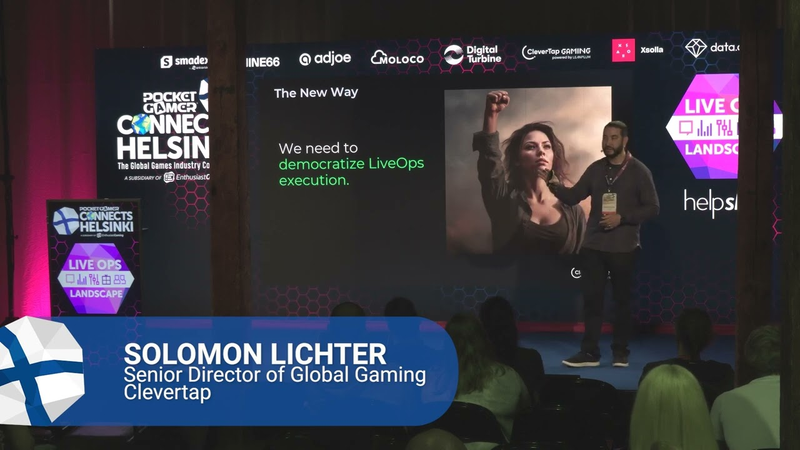
[Music] [Applause] [Music] thank you [Music] the next speaker is going to be talking about democratizing live Ops which is literally the byline in my pitch deck that is literally how we describe a company with Durie we want to democratize live up so I want to have somebody else wants to democratize live box and how leading studios are achieving Peak efficiency in player personalization and we've got Solomon from clevertap who's going to come up and talk to us about Solomon over to you so good to meet everybody I'm Solomon Ruiz slichter of clevertap Gaming a little bit about me I'm the senior director of global gaming and clevertap really is just a fancy way of saying that I oversee Global gaming strategy
from both the go to market and a product perspective I work with most of our largest strategic clients a gaming clients and mid-sized clients really everybody we provide solutions that leading game studios and Publishers use to build deeper relationships and engage with their players ultimately what we're trying to do is drive engagement retention and higher lifetime value so just a little bit about us but enough about us let's talk about you so you've launched a game this is not an easy thing to do if you've launched a game congratulations you've launched a game you found an audience amazing okay that's only half the battle all right and I don't want to trivialize how hard it is to launch a game because it is difficult but now that you've launched the game you have a player base that you need to support and the issue here
we'll talk about this a little bit more in a moment is that it's very hard to keep players you have players some spend a lot a lot a little some spend a lot targeting those players finding out what players to engage with is a difficult thing growing a game is hard you're losing players all the time your Dau is going down players constantly churn now we operate in a tougher macroeconomic environment a post idfa world the cost of CPI is going up higher than your LTV is okay you can't keep up with it so your kpis begin to plateau or Worse dip this is a scary thing it's an existential threat to your business if you're an indie studio for example growing games is hard retaining players is hard um so we'll talk a little bit more about that so what do you do you need to feed the beast by feeding the Beast
we're talking about evergreening the game creating in-game offers new events exclusive experiences that your players can consume but you need to balance that against this Con this uh this ongoing content treadmill right and the treadmill is two things one you have your core Loop you have your new characters game assets and levels all of that need to be managed against the major meta features of the game social systems guilds new progression systems quality of life fixes so it's almost like you have two road maps you're operating in parallel that's a difficult thing to do so your car Loop versus your meta monetizing The Experience doing game design in a thoughtful way that doesn't alienate your best players often your most if you're in a core game players tend to be a little sensitive about being overly monetized you got to be careful that you don't go get flamed on Reddit or whatever that is we won't talk a lot about that here that's more a challenge for the community team right but it's a real thing that you need to
consider and that in and of itself is a challenge and then thinking about how you're going to manage these this feature roadmap of meta versus core Loop is is a difficult thing to do but you need to monetize the game right ultimately the goal here is agility you have to be agile if you're not agile if you can't react quickly you're in trouble right you need to be able to react to these problems derive insights from data and enable your game teams to move with speed and accuracy right slow reaction times and like lagging optimization times once you figure out that something is not working right that's lethal in this market it might have been okay two years ago not anymore every moment of every day you are losing players I don't mean to sound dramatic but that's really what it is and that's what we're talking about here today so
how do we solve this today typically most game makers solve this problem or address this Challenge on an ongoing basis through kind of a really effort intensive manual process that requires this kind of Confluence of resources tactics systems technologies it's a difficult thing but if you're brave and you're courageous this is what you do okay so let's look at some of the complexities in how most uh game makers solve this challenge today spreadsheets who uses spreadsheets here this is one very thank you this is a common solution right is to use these to manage all kinds of things about your game these kind of server uploaded CSV sheets you use them to do everything from from managing basic fatui testing
maybe if you're really Brave use them to manage your in-game economy as you go on and on as you go and progress further these things get more and more complex so you feed these spreadsheets to your back-end engineering team where they have to write code to issue calls to your back end to configure Assets in the game right does that sound like a kind of complex process it's because it is right and I want to give a shout out to anyone in this room who does this any game maker in this room who does this day in day out because you probably think you have no other choice right and it's just the way things are um and so the more advanced your game management becomes the most uh the more advanced and complex your liveops roadmap becomes the more advanced and complex these become and maybe you have like I don't know 50 maybe you have like three Master spreadsheets that go on forever the million rows but this is how people solve these challenges day in Day Out game makers and product managers uh and
we just want to acknowledge that it's it's a challenge right so who would have thought right um using spreadsheets is not the most actual way to manage your game right I know I'm probably blowing your mind right now but it's important to call this out uh you know we love that we love how you know we live in a complex world right and we operate in a complex space But ultimately that complexity slows us down from an innovation perspective from a time to Value perspective a time to Market perspective and it's important to call that out right so how do we do this today how do we solve this challenge today you do what you've always done right you continue to manage experiments run limited time events uh configure your game in a really uh manually intensive way and why again it's just the way it's always been done this is like just something that game makers accept that liveops managers
accept that product managers accept about their job do you want to be a game manager take your medicine right managing your game should not require a Rube Goldberg machine right and I don't want to trivialize this again because we work in a complex space whether you're on the tech provider side or whether you're on the game maker side um and so there's complex solutions to complex problems and if you're a complex game economy to you know the solution to address that economy and Target those players tends to be pretty involved but maybe it doesn't need to be this complicated right so we accept this Your Game Dev team basically is forced to work uh or your product your development team is supposed to work against an endless backlog of tickets
uh for liveops events testing game config tickets and this is in addition to their main core Focus which is game development itself they typically don't enjoy this do we have any developers in here do you guys love this [Laughter] so we want to help you guys out too right ultimately this is a challenge and it creates resource strains intention and delays time to Market and Agility on both the product management side and the dev team side uh it's not the most efficient way to work right again no one's judging the industry for this this is just what it is and it's always been for a very long time and but I think it's important to call out that you know it's not just the it's not just the business itself it's also the business team itself it's the developers too who hate this so shout out to y'all
and around and around we go we lit we work in this Perpetual cycle of requirements Gathering planning spreadsheets updates and development ticket requests it just goes on and on in perpetuity why because this is the way it's always been no one questions it it's just the complexity of working in gaming you know Mobile gaming this is what people accept and so I think it's interesting to call that out right that you know it's hard to Envision a different reality when this is your reality every single day and no one's judging you for this in fact hats off to all of you that go through this beautiful struggle every single day to make amazing games there is a new way to address this challenge you need to empower your business teams so product and marketing teams should be able to own it you know and execute liveops player personalization lifecycle marketing product a b tests
without having to constantly tax your Dev resources you want to free your developers up from day to day game and event requests liberate your technical teams the lifeblood of any gaming studio is innovation of new games and anytime you have your development team focused on this stuff you are taking away from time they could be using to diversify your business and release new games out into the world broaden your portfolio so is it really kind of an existential threat to your business or at least it's going to slow you down in a very challenging and competitive market let your product managers manage the game and liberate your technical teams we need to democratize liveops execution this is the soapbox we stand on right we're going to say this until we're blue in the face we see it over and over and you know honestly we are
engaging more and more on the provider side with lots of technical teams because I feel like the Market's kind of reaching an inflection point now people are beginning to understand there's probably a better way to manage this do we really need our core development team focusing on live Ops event tickets or basic game config tickets is that really the best way to operate or should we put this in the hands of the business people who are closest to the revenues that we're trying to drive as a business democratize live Ops execution so here's a little bit about how it's done product and game teams need a tool that basically provides unprecedented ability to to own the manipulation of the game experience itself in context with the in-game offer as an event in in events in context with where the player is sitting in the overall life cycle all that's really critical in order to do and if you look at this uh if you look at this diagram we're kind of inverting a funnel or
however you want to look at we're inverting a technical stack you look at your game server most of you have some kind of back-end game server managing a lot of the complex logic and assets of the game managing the economy managing maybe PVP uh matchup logic or whatever it is yeah but typically an in-house in-game offer system that you're maintaining and you have some kind of Engagement technology right whether it's your own homegrown or whether you're working with a third-party provider that's a fairly red ocean all of that is then pushing messaging offers and assets down to the client that's the process we're just going through so in this new way you have the game server you have in-game offers you have an engagement or messaging platform of some kind but you also have this final what we call a game control layer the game control layer enables your business team to make those updates to the game
and run those live Ops events in real time without having to constantly go back to for development resources it is essentially a control layer over the game server do you want to run your whole game through that probably not there are some very complex things that you probably want to leave the game server right PVP matchups your broader you know your broader virtual economy management complex assets things like that but for essential configuration of the player experience to personalize that player experience you should give the PMS that ability and this control layer enables you to do that so that's the new way okay so in summary find a technology solution that enables you to push the execution of liveops and player personalization Downstream to the business teams who actually own the monetization goals
Drive autonomy for your game team operational efficiency for your technical teams and speed the value for your entire Studio you can do that if you take this new approach right and it's different and you know there are technical teams we talk to that it makes them nervous right to give the product team this much control but we're seeing a lot of I mean we're seeing better alignment than we ever have between these teams right because ultimately in this environment uh where UA is so difficult you have to really align to make the like the best use of your any in-game experience any game session time that you can as a team and ultimately it's about pushing this down to business users who can own it and freeing up your Technical Resources to be more efficient focus on the core things that they love so that's what we do right we provide a platform for managing what we call the full player experience post UA from lifecycle marketing all the way through mature Elder ritualized player
through liveops lifecycle marketing and then game configuration it's all sitting on a kind of next-gen database called Tesseract which Powers which provides tons of different in-game events and attributes on our order of magnitude anything above any commercial solution and it's a reason we have a big footprint in this space thank you any questions right okay oh you ended quicker than I was expecting so we have we got any questions in the room anyone want to uh so in terms so just if you give us a little bit more information I'd love to know what you're trying I saw a lot in your previous slide you had liveops configuration as one aspect of it you had I can't remember all three things I can get you to go back yeah so like the the three kind of core components that enable that kind of management of the full player experience is life cycle marketing yeah which is kind of like bread and butter like everyone does this is pulling players back into the game typically
with push and email uh getting them through the for two week getting them converted um live Ops so actual in-game offers it's generally thought of as real-time offers that happen at the moment of need while the players in session and then remote config also called configuration well in this context what does liveops to you good I mean genuinely ask the question because I literally have this same conversation with a lot of people yeah as a live because we're specifically a live Ops publisher and yeah very much have our own methodology around this which I won't go into for detail because we haven't got enough time but I'd love to know what you think liveops is so the room understands well at a very at a very high level live apps is the evergreening of the game right it is it is building a game that's forever changing forever adapting to how that player would like to consume it and obviously with a goal towards monetization and that generally actually encompasses both encompasses both uh the in-game offers and the configuration of the game that's really what it is liveops is also testing I mean for me always testing well I think that's true
I mean but for me live Ops is about player experience and it's about um a basic understanding why people want to keep playing and how do you think giving the things that they love and that means events that means promotions that means offers that means all the above but on that note we could carry on this conversation for a very long time I am going to say uh on that note we've got a panel that we're just going to bring up on stage thank you very much for that song and uh and like I say always good to hear about how different people are handling live Ops thank you
Summary
The modern mobile gaming industry faces significant challenges in maintaining player retention and lifetime value, particularly in a post-IDFA landscape where rising user acquisition costs often outpace revenue. To combat churn and plateauing key performance indicators, studios must prioritize agility and player personalization. However, many studios currently rely on inefficient, manual processes—such as complex, spreadsheet-driven workflows—to manage live operations. This reliance creates a bottleneck where product and marketing teams must constantly request support from engineering teams to configure in-game events, offers, and assets, leading to resource strain and delayed time-to-market.
The proposed solution to this operational inefficiency is the democratization of LiveOps. By implementing a dedicated game control layer, studios can empower non-technical business teams to manage player experiences, run A/B tests, and execute live events in real time without requiring constant developer intervention. This architectural shift separates core game development—such as engine maintenance, complex economy balancing, and PvP logic—from the day-to-day configuration of the player experience.
This approach allows technical teams to focus on innovation and the development of new titles, while product managers gain the autonomy to respond rapidly to player data. By integrating lifecycle marketing, real-time in-game offers, and remote configuration into a unified, accessible control layer, studios can achieve greater operational efficiency. Ultimately, this transition from manual, ticket-based workflows to a streamlined, business-led model is essential for studios to remain competitive, maintain player engagement, and maximize monetization in an increasingly difficult macroeconomic environment.