1 free read left. Create a free account for unlimited reading + AI research.
Create free account
Superstar Session: Keys to Success in 2021
Key insights
6 takeaways- 01The 2021 Gaming Report, based on data from over 300,000 games and 60,000 developers, confirms that pandemic-driven engagement shifts have established permanent new gaming habits.
- 02Mobile ad revenue recovered strongly by the fall of 2020 following an initial dip during the early stages of the pandemic.
- 03Contrary to common industry assumptions, games that incorporate advertisements demonstrate stronger long-term retention rates than those that do not.
- 04The distinction between mobile and HD gaming is blurring, indicating that developers should prioritize deeper, more involved gameplay experiences for mobile audiences.
- 05Developers should focus internal resources on core content creation while offloading complex infrastructure needs, such as matchmaking and voice chat, to cloud-based solutions like Multiplay and Vivox.
- 06Seasonal content updates are a critical driver for player re-engagement, and hybrid monetization models are becoming increasingly essential for success.
Ask AI about this video
Transcript
we also have the delight uh to have our uh track sponsors unity for this the monetizer track so basically that's the kind of you know the key area here you know all the key players so let's get a little bit of a word from our sponsor unity so i think we've got a little short video coming up [Music] [Music] [Music]
[Music] that's great stuff so just a little taste of some of the content that's been made in unity enough about me talking let's kick straight off so i think hopefully we've got mri with us um and uh i think you're going to talk to us about um the keys to success in 2021 so uh i'll it's it's always funny for me handing over to somebody speaking from unity when it used to be me doing all the unity speaking well not all of it but quite a lot of it all right over to you tell us all about monetization with you
great thanks oscar that's actually the first time i've seen that particular um unity sizzle trail so very cool stuff in there so hey everyone thanks for giving me a small part of your day to go through unity's 2021 gaming report um i believe it's afternoon over there in the united kingdom but it's quite early for us over here in san francisco so apologies if i yawn at all so my team and i dove into a ton of data from 2020 which was a very interesting year to say the least and we're excited to share some findings with you we hope that there are some insights here and you can use succeed in 2021. on the topic of myself and my team i want to give you a quick introduction so that you'll you know that you'll be spending the next kind of 20-ish minutes with which reminds me i should probably start my time right to make sure i'm kind of on time i lead the publisher operations team over here at unity in san francisco our job is to ensure that all of unity's game developers or publishers are able
to utilize unity's operate solutions products such as full capabilities before coming to unity i worked on several indie titles that you've probably never heard of as well as some aaa games that you may have heard of some things like call of duty and the sims my team has also had a wide breadth of experience from a variety of game studios and related ad tech companies we understand gaming monetization and most importantly how the two of them work together okay with introductions out of the way let's dive into the data we drew the data for this report from four areas of unity's operating solutions business the first is the unity engine itself as well as its ads and analytics platform over three hundred thousand games from over sixty 000 different developers are made with unity which gave us a really wide overview of the industry next we tap into the delta dna platform this is actually unity's premium analytics and engagement platform it allows developers to really deep dive into their game's live data
via things like direct sql access and customer reporting while also letting developers put that data to use through player engagement tools like a b testing campaigns or player messaging such as push notification and emails lastly we tap into two of our other services multiplay and vbox to get insights into how multiplayer games fared multiplayer is one of the most resilient multi-cloud server hosting platforms and matchmaking platforms out there and vlogs is uni's hosted managed solution for voice and text chat all three of these platforms delta dna multiplayer and v box are entirely engine agnostic so you don't have to be made with you need to use them which means that we have data from across the industry so for the rest of this talk i'll also be referring to games as either mobile or hd mobile is what everyone a pocket gamer is likely familiar with mostly ios and android games hd which stands for high definition encompasses playstation xbox pc mac os and other desktop gaming experiences
so even though pocket gamer focus is mostly on mobile gaming there's been more and more overlap between mobile and hd games especially as cross-play between the two different platforms picks up in popularity and cross-play being the ability to play on the phone with someone who's playing on an hd device so with all the data sources we just talked about how much data is there so i'm not going to read through all the bullets on this slide because there's quite a few numbers but it's safe to say there are quite a few billions and millions on here since we really only have 20 minutes together i'm gonna move along but if you're watching a recording of this later feel free to pause here and kind of read through them and one last bit before we start diving into charts we ran a developer survey to get an idea of our representation and coverage in the gaming space specifically around gaming engines and the different ad networks that people use for monetization you can see here that unity is
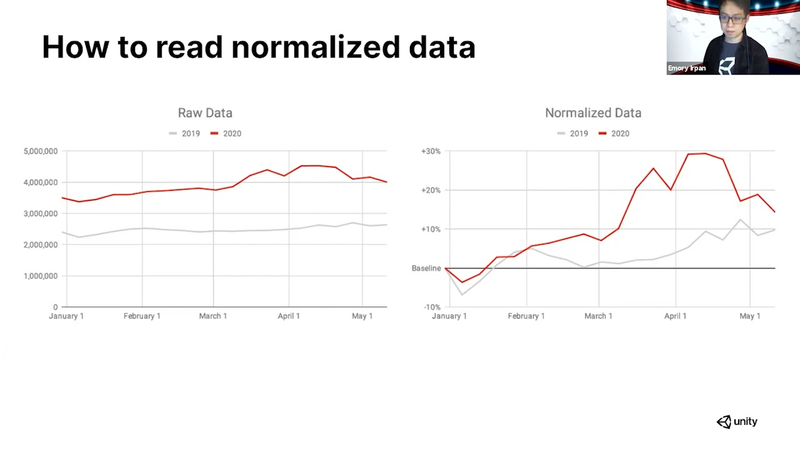
definitely one of the most used gaming engines out there and on the ad network side we also have a really strong market share this gives us some degree of confidence in the data we're about to present so i want to pause here and explain a little bit about how we present our data the chart on the left shows what raw data might look like you can see that while it's pretty readable it doesn't exactly isolate the percentage change when you compare year over year because the beginning of each year starts at a different number than the previous year additionally some data is too sensitive to share raw numbers for so we're actually able to share more data with you guys if we normalize the data down to these percentage numbers the chart on the right shows normalized data that means that on the first day of each year we take that as a baseline which is basically zero percent for every subsequent week of the year the percentage number will be either above or below this zero percent baseline this means that if the line drops below
zero percent it doesn't actually mean that that particular metric decreased it just means that it's lower relative to the first day of the year likewise if a line from 2020 is above 2019's like in this example chart on the right it doesn't mean that 2019 was negative compared to 2020. it just means that 2020 grew faster relative to the baseline and like all things when you look at normalized data you have to realize that the baseline for the subsequent year is actually the end point of the year before so for example the baseline for 2020 here is actually the end point of 2019 and we've seen that gaming kind of increases every year so a lot of the times these lines are just basically all the way up and to the right but when you normalize them just to see what the exact percent changes you might see some dips up and down all right so let's get started we used the week of march 8th to designate when
kovid finished impacting the entire globe as that's the week that many western countries went to lockdown many schools kind of made all their kids go home many workplaces sent all their employees to work from home 2020 we saw the population of gamers continue to rise on mobile when code hit we saw a massive increase in daily active users as more people saw entertainment during the quarantine however as the year went on this bump kind of leveled out once again this doesn't mean that 2020's dau decreased relative 2019 it just means it grew more slowly remember the endpoint of 2019 is 2020's beginning zero percent baseline for hd games the code bump was noticeable as you can see on the chart on the right in march but not nearly as significant however as fall approached and people were still locked inside the pandemic we saw a massive bump in hd game engagement spurred by both some big game launches and next gen console launches both mobile and hd games shared the same
trend during summer months where daily active users drop slightly the warm weather made other outdoor activities still doable despite the pandemic but as the colder seasons kind of set in people around the world retreated back indoors and picked their games back up so what does this mean for 2021 the way that we see it the increase in hd games means that there's continued appetite for the kind of gameplay experiences that hd games have replicating hd games on mobile devices is a trend we're never going to see on the horizon so let's talk about mobile games because pocket gamer is all about mobile in 2020 when cove had hit there was a central bump in mobile gaming ad revenue due to just a sheer number of users who are now playing these mobile games and you can see that over here right past the line in that second week of march um you say a big bump in ad revenue that kind of levels out a little bit well ad revenue growth kind of stagnated a bit immediately after may which is basically when the summer
months kind of set in they picked up and outperformed last year at the star's trend during the summer so the next chart i'm about to show you also highlights one of the reasons for the strong recovery and performance throughout 2020 so the large volume of mobile gaming ads when kobe hit stress a lot of the existing advertising demand and caused cpms to drop below the trends set by 2019's baselines for those kind of unfamiliar with what ecpm is it stands for effective cost per ml and mil is an old way of saying thousand essentially means the revenue that you get per 1000 ads that your users view so after the dip and plateau performance throughout the summer that you can see cpm's actually bounced back up during the fall at an unprecedented rate including 2020 with exceptionally strong performance we saw that basically advertisers were able to kind of retrigger all their campaigns and allocate things efficiently towards mobile gaming which caused a lot of great strong performance throughout the
rest at the end of the year so we also broke down the ad revenue increases last year by app store category so you can see here that all the categories are from the ios and google play stores and all categories also increased our ad revenue growth last year but one and that one is unfortunately sports games sports games suffered a lot last year due to lower traffic sports games tend to gain traffic and users when live sporting events are also occurring without the increased interest under real-world equivalents during the long time period sports games had a kind of a lull period immediately from that spring to summer time when all livestocks were pretty much canceled or put on furlough they did pick up the worst end of the year when they started back up but it definitely missed out a large chunk of the free time that people did have during the summer compared to 2019. and on the topic of mobile game ads one thing that developers always come to us worrying about is how they affect user retention so
last year we did a similar exercise to the one that we're doing this year comparing the retention of games with ads and a retention of games without ads we found that in 2020 games without ads suffered a larger dip on their first day retention than games with ads when compared to 2019 so you can see here day one retention of games with ads drops by about half a percent the day one retention of games without ads actually dropped by almost two percent additionally games with ads continue to show stronger attention than their ads list counterparts across both day 7 and day 30 retention which are just longer term retention numbers that developers are really interested in and overall games showed stronger long-term retention in 2020 when compared to 2019 likely since people have a lot fewer entertainment options available to them during lockdown you can pretty
much play games or watch netflix or movies at home and there's not too much else to do besides work and this really just goes to show that if ads are implemented intelligently into a game they actually can raise long-term user engagement for 2021 we'd urge all mobile developers who have or are looking at mobile game ads to consider and evaluate how to implement those ads into your titles as the myth that they negatively impact retention is very much not true another interesting insight from 2020 was how gaming habits shifted from the weekend to the weekdays we counted monday through thursday as weekdays and friday through saturday sunday as weekend days we then took total gaming traffic for each day and averaged out what percentage of that gaming traffic occurred on weekdays and what percentage occurred on weekends the top chart shows 2019 while the bottom one shows 20 20. as you can see during the summer
months the weekday and weekend lines narrow as kids get off from school and have more free time during the weekdays however 2020s chart on the bottom shows that this narrowing between the two lines happened almost immediately once the pandemic set in across the world and these two lines continue to be much closer to each other than the previous years and they even briefly inverse during one week in may for some reason this means that more people were gaming throughout the week instead of just contouring their gaming on those weekend days probably because they had more free time or were able to just stay at home and were able to pop open those games either in between meetings or right at the end of the workday without having to worry about their long commutes even as schools began to open back up in the fall the gap between weekdays and weekends was much more narrow than it was in 2019 so in 2021 it's probably worth developing and running live games with this shift in gaming habits in mind traditionally gaming developers will often launch a new event on a friday to kind of capture that
overall weekend bump and we'll be reticent to kind of update that throughout the kind of working day weeks because it's a little bit harder to get that return on your efforts but as we've seen here people's habits have shifted a little bit another thing that we investigated was if people changed their mobile gaming habits in particular we segmented out hyper casual and some casual games is what we call commuter games these gear games with short play sessions that encourage pick up and play gameplay and frequently these games are simple to play while you're waiting for the train the bus the subway or even though into small walls at work in between meetings we segmented other apps into mid-core and hardcore games these are games with more involved gameplay like role-playing games rpgs and strategy games in some cases these mobile games even feature similar or identical gameplay to their hd counterparts of the same genre as you can see when the pandemic happened commuter apps really suffered in daily active users
when you compare 2019's extreme growth for commuter apps which is that dotted yellow line on the chart here the difference here is very stark on the other hand hardcore games saw a huge increase in dau when the pandemic started over the course of 2020 that growth slowed down but hardcore games still finished 2020 at a stronger growth rate than 2019. part of this kind of drop off during the year could also be attributed to the significant growth of hd games near tail end of 2020 because after all if everybody's staying home and you can play hd experience on your mobile device or on your playstation or your computer you'll likely go for the more comfortable form factor which is a larger screen but what does this mean for 2021 is that developers should not be afraid of creating more involved gameplay experiences for their mobile games even as the world returns to normal there's likely still going to be some residual appetite for deeper gameplay across both hd and mobile platforms
we also took a look at how mobile game in-app purchases changed in 2020 overall the average number of transactions per paying user increased in 2020. with the pandemic forcing many to stay indoors people's spare entertainment dollars only had so many places to be spent and one of those kia outlets was spending in games the average amount spent per transaction was varied for some game categories that we broke down the average amount actually decreased but we actually saw that was mainly because a lot of games took advantage of all these new users coming into their games and their increased player base sizes and ran smaller purchase amounts to increase that overall conversion rate things like 99 cent starter bundles or like 199 new player packs really kind of put you into this overall decrease in transaction dollar amount per player but some categories like casino games had the best of both worlds which a huge increase in average amount per pair and the increased number of transactions per pair and then for our final few insights i think i've run five-ish minutes left if
my timer is correct uh we want to look at some hd multiplayer games even though this is a conference focused on mobile games there are many mobile games that have taken a leap from some of the hd games books and with its similar features a good example of that are game seasons and associated monetization things like battle passes or subscriptions we took a look at multiplayer games season length in weeks and then fitted them to a normalized curve for these games the average season length was 11.2 weeks which is just under 3 months we've seen multiple mobile games take inspiration from a seasonal model after all when you kind of boil it down seasonal updates are simply a more gamified version of large regular content updates and we've seen everything from casual puzzle games to hardcore rpg games on the mobile now also features seasonal subscriptions to boost our overall monetization so why are regular or seasonal content is so important every developer knows that a live game will constantly lose players over time
due to regular attrition we normalized season lengths of games in our sample cohort and plotted that season length against the peak concurrent users which we use as a proxy for basically overall player engagement from this chart you can see that upon the season is released there is a massive increase in concurrent users all the way up to 12.45 percent however by the halfway point of this season much of that boost actually fades away and they're all the way down to just one percent above of the previous season's peaking current users at that time this rate of decay slows down um as the season winds to a close but ultimately most games will end each season with fewer peak and current users in their previous this is why it's important for developers to build a focus on delivering exciting content players season after season whether it's on mobile or hd regular content updates are key to retaining users in any live game with that in mind it's clearly important to have those regular content updates but content methods are expensive and
development resources are limited we took a poll amongst our multiplayer game developers on using cloud-based solutions like andy's multi-plan vbox for their multiplayer game needs an overwhelming majority agreed that scalability was critical to a multiplayer game but almost 40 of them didn't feel like they had the necessary skills or experience internally to operate those multiplayer games 87 percent of developers really didn't have a strong interest in creating their own matchmaking systems and 47 agreed that they want to extend their multiplayer operations with an external team of experts and when it comes to voice chat almost 70 developers are interested in using a third-party voice service for their in-game voice chat as our experts at vbox can attest to voice chat is not something that is simple to spin up eternally especially at scale you can't just slap it on and hope it will work there's a lot of accuracies that come with scaling and voice across a lot of players so now more than ever it's important to consider where developers should be allocating our limited development resources if the previous chart on seasonal player
engagement was any indication it's clear that a majority of the time should be spent creating new content to consistently engage your players um and let external cloud-based solutions handle the non-core parts of your game so this will help let you scale more quickly and more efficiently and ultimately deliver more value to your players so they can continue playing your game so i want to end this presentation with a few more predictions for 2021 i'm not going to read through all of them but on a high level i'm going to touch on each of these three points so we think that the upcoming privacy changes on ios will impact a mobile ecosystem this is kind of a pretty obvious thing both on user acquisition and on the monetization while this is not entirely a wild prediction we think that mobile developers still have a lot that they haven't prepared for in this area so make sure you check in your ad tracking rate prompts on ios 14 take any kind of early signals and if you have some kind of mitigation strategy for when that rolls out across ios we also think that
cross-platform games between mobile and hd devices is the future we've seen some really strong runaway successes in games like among us and genji and impact that have the same exact gameplay experience across different device form factors like mobile and hd this contributes heavily to a game's overall stickiness and accessibility which is key for live titles and lastly we think that even after the pandemic is over and the world begins to turn again the number network games will remain high we think that some of these newly converted pandemic gamers will form new habits and are really here to stay so this is just part of our larger report on the gaming industry to learn more check on the link here or just scan a qr code with your phone's camera it's been a real pleasure to get the opportunity to speak with y'all today and if you have any questions i think we'll open up the floor now you can always contact your unity account manager or myself to learn more thanks for your time hey that was great really fascinating stuff i mean there's a couple of things in there i like the way you're using hd game rather than
what we used to when we used to call it either aaa or sponsor it don't get messy although it's interesting because i think arguably a lot of phones are actually higher definition than most pcs but that's another subject it's always hard coming up with good terms for these things i only thought particularly this ad thing you know the way the ad retention or games is higher particularly in the early days um i think that's really fascinating particularly i i wanted to check with you on something on that i presume that that data includes all the hyper casual games which inherently have uh high high initial term retention but lower longer term retention is that right yeah so when we take a look at our data we will do basically um i guess percentile bounding so we'll you know bound out the high outliers beyond the 90th percentile but yes that will include a lot of hyper casual and casual games that definitely do have worse longer term retention but even in that case in aggregate that long-term retention is better for games with as then without
and i actually think it could be implying even more because i think it's probably including a lot of hybrid games which is probably going to get the benefit of when they're smartly designed you know the solid kind of seasonal base like the um like season packs you were talking about near the end there as well as the earlier retention boost from having ads so i think it just reinforces again another reason why hybrid monetization is so effective i mean you don't have to agree with me on that one but it just might be my feeling on it i mean i think it's entirely true like one of my favorite hybrid casual games is archero and they've rewarded video ads um in their game quite well um that keeps you kind of going back and you still find value from watching them yeah i think there's something about archer in particular which is i mean archer's got an issue in the mid game where it basically gets to the point where you kind of start to lose the value proposition because there's only so much value in each hero there's no real value in having multiple heroes
um i did a bit of analysis for a game called art and war legions um and it was interesting how they had a similar problem slightly different but they had some similar problems with longer term retention they they managed to get this hyper casual kind can start off a little bit more depth in terms of the hybrid monetization but again i think there's a there's a really big difference in terms of how you run seasonality which takes me to that last diagram you showed about seasonality one of the things i found myself is the predictability of that seasonal update is the most important thing from my personal experience and is there anything in the data that you've seen so far that would reinforce that or contradict that right yeah so we actually saw that games that had their season length let's say be nine weeks we're still updating on that same exact nine-week cadence because like you said um players are expecting certain things when that rolls back around so nobody expects anything for your first two seasons but after you've basically had two and established that
cadence i'm like hey we're gonna update this once a quarter people are gonna expect that update once a quarter and they will uh regular just re-engage on their own even without any prompting for you because they'll be like okay well this is around the time that this game has new updates and content let me go check back in if they've delivered on that so that's definitely a part of it i mean i think it very much depends on the game i mean my personal opinion is that once the course is too long i think it needs to be monthly and back in the early days of mobile when it was first starting out uh in the java days i found very very early on that the shorter the time frame the more people came back more regularly though i was updating content originally once a month and once a week then every day and so the average uh return rate was basically directly you know connected to the time frame that i updated now it won't be the same for every game don't get me wrong but i think it just shows that you know running games as a service is all about understanding the cadence of your audience as much as anything else yeah we've really gone
past that um old-fashioned kind of box model of games for better for worse where you just sell a game for 60 off the shelf and that's pretty much it everything is about live updates now even for single player experiences you want to kind of engage people who bought the game in the past to kind of re-up and take a look at it or you know engage with their game in new ways even those kind of single player experiences can be replayed in ways that people still enjoy no i totally agree and and obviously you know as somebody who wrote the book on games of service it's like i'm going to be very biased on that but one of the things i try to tell people who've got these beautiful one-time play experiences that we we still want them you know there's still a market for them but you've got to manage them as a portfolio as part of a combination of experiences if you're going to sustain the audience because you're still going to set up the expectation of what's coming how frequently and and why people should continue to care and it's very difficult to maintain that with one product um you know and having a you know promise like nine months down the line most
people have stopped playing by there yeah i agree and especially like if you take a look at games where the content comes from the developer themselves it's that constant like uphill battle of making more content before your users basically get bored of your content that you have made and turned out for multiplayer titles people make content for each other if i play against you and i play against somebody else that's different content for me so to say but even in those cases you still want to have new content to reengage both sides of the player and the players they play against overall absolutely totally great um i'm right that was fantastic really appreciate it and please everybody check out that report i'm sure it's gonna be amazing i need to go get it myself so i've just snapped the screen so i've got the qr code um obviously guys feel free to check it out i think um it's really great stuff thanks everybody for uh you know listen to that uh mri brilliant stuff thank you and again thanks for sponsoring
you
Summary
The 2021 Gaming Report, presented by Unity, provides a comprehensive analysis of the global gaming industry’s performance throughout 2020, focusing on mobile and high-definition (HD) gaming trends. The report aims to equip developers with data-driven insights to optimize monetization, engagement, and live-service operations. The analysis draws from a vast dataset encompassing over 300,000 games and 60,000 developers, utilizing information from the Unity engine, ad and analytics platforms, and specialized services like Delta DNA, Multiplay, and Vivox.
Key findings indicate that the COVID-19 pandemic significantly altered gaming habits, driving a surge in daily active users (DAU) and shifting engagement patterns from weekends toward consistent weekday play. While mobile ad revenue experienced an initial dip during the early stages of the pandemic, it recovered strongly by the fall of 2020. Notably, the report challenges the misconception that advertisements negatively impact retention; data suggests that games incorporating ads actually demonstrate stronger long-term retention than those without. Furthermore, the analysis highlights a growing trend toward hybrid monetization models and the importance of seasonal content updates, which serve as a critical driver for re-engaging players.
The report concludes that the future of the industry lies in cross-platform accessibility and the adoption of live-service models. Developers are encouraged to focus internal resources on core content creation while leveraging external, cloud-based solutions for complex infrastructure needs like matchmaking and voice chat. As the industry matures, the distinction between mobile and HD experiences continues to blur, suggesting that developers should not shy away from creating deeper, more involved gameplay experiences for mobile audiences. Ultimately, the data suggests that the surge in gaming engagement observed during 2020 has established new, lasting habits that will continue to shape the market throughout 2021 and beyond.






















Comments