1 free read left. Create a free account for unlimited reading + AI research.
Create free account
Superstar Session: How to Maximise the Game Economy With Ad Monetisation
Key insights
6 takeaways- 01Mobile gaming is the industry's dominant sector, projected to exceed $100 billion in consumer spend in 2020 and generating 1.5 times the revenue of PC, Mac, and console platforms combined.
- 02Engagement metrics surged in early 2020, with a 25% year-over-year increase in weekly time spent on mobile devices and a 20% increase in new game downloads.
- 03The mobile advertising market is projected to reach $240 billion in 2020, with 93% of the top 500 games on Google Play now utilizing in-app advertising.
- 04Monetization performance varies significantly by genre; for example, US casino games account for 22% of total consumer spend despite representing only 4% of total downloads.
- 05Rewarded video ads are highly effective, with nearly 23% of all mobile gamers and 40% of hardcore gamers expressing a preference for this monetization format.
- 06Publishers are increasingly adopting hybrid models that combine in-app purchases with ad SDKs, as the latter has been shown to correlate with higher download growth.
Ask AI about this video
Transcript
next up uh is our superstar session how to maximize the game economy with ad monetization this features lex siddow i hope i've pronounced that correctly from annie who are our track sponsor lexi i should say lexi are you here welcome to the conference it's absolute pleasure to have you here i'm going to get out of the way now um and let you talk to our wonderful viewers amazing thank you for having me i will and now share a presentation great so thank you guys all for having me um i'll take you through
a presentation from app annie on how to maximize the game economy with ad monetization so quick disclaimer um i'll just give you guys a few moments to read that all right um so i'm lexicito so good job on the pronunciation that was really good i'm the senior market market insights manager at app danny i'm one of the lead analysts working with our mobile data and of course get the privilege of dealing with a lot of gaming data which is very fun um annie is the mobile performance standard we help businesses achieve mobile success uh through our data and insights platform okay so first i wanted to kind of take us through a quick uh kind of level leveling the playing field right now just what's the state of mobile gaming and mobile in general um and then specifically looking at h1 so kind of taking it within the covet 19 time frame so mobile is the world's most popular
form of gaming um so we've taken a look at mobile gaming versus all other gaming combined by consumer spend through the app stores um and so this indicates how there's such a big gap between the two and so mobile gaming is about 1.5 x app store consumer spend so that's not even inclusive of the advertising spend through in-app ads um 1.5x all other games uh forms of gaming combined so that's pc mac gaming handheld console as well as home console and in 2020 alone we expect over a hundred billion dollars to be spent on mobile games okay so this is another view uh generally speaking for for mobile so what we see here is kind of taking you through h1 um actually from h2 of last year all the way through h1 of this year and what we can see is that there is generally been an increasing trend in weekly time spent on mobile devices
and then when you get to the new year when during govind we do see this acceleration and ramp up so koben's sort of building on those kind of already existing mobile habits that people are spending more time on their devices and we see that we reached a peak globally in march where we saw that was a 25 increase in the weekly time span of h2 um the weekly average and we saw that during h1 2020 um consumers on android devices spent over 1.6 trillion hours on mobile which is incredibly important for advertising so that's another way another reason why we call out the time spent figure this is another view where we look at markets um kind of impacted by covid in varying phases and it's showing the average time spent per day on your mobile phone so globally we spend about four hours and 20 minutes on average each day on our mobile devices um and that's a lot higher in some markets like indonesia which is topping
about six hours a day for an average um and that's when you start to look at that it's quite impressive because if you consider that you know if we're all sleeping those eight hours a day that we think we hopefully are getting um the average time we're spending those 4 hours and 20 minutes is representing over 25 percent of our daily kind of waking hours um which is pretty sizable and this has grown 20 from 2019 um so kind of seeing that acceleration of about three to four years of mobile habits during the pandemic and when we look at mobile gaming um this isn't looking at the growth in downloads which is the lighter purple and then the growth in consumers spend the darker purple across key markets so we're seeing both um more games being downloaded during this time in h1 of this year versus h1 of 2019 and we're also seeing that morse consumer spend is flowing through the app stores and globally that looks like over 26 billion downloads of new and these are new downloads so it's not including a reinstall or an app update
of any kind it's completely kind of net new download which is 20 growth from h1 of last year and then over uh 37.5 billion dollars spent through just in-app purchases through the app stores and also what we're seeing is that mobile mobile gamers are also looking beyond their go-to game so we've seen an increase in the number of games that are being actively played each month um versus 2019 so that's as high as a 35 percent increase in the number of games being played in markets like india um and it's around 13 in the us so consumers are actively seeking out new games and it's not just playing the same games they've been playing um like candy crush for instance in terms of mobile advertising uh we also wanted to call out the potential market here for consumer spend so in 2020 we forecast for this year that over 240 billion dollars
will be spent on mobile ads in apps and games um games do command a large portion of time spent um and are a mobile kind of leader so we expect to see a sizable amount of this pool there and that's a 26 year-over-year growth from what we saw in 2019 and to kind of put that in perspective with what we see from consumers spend through the app stores this 240 billion is roughly uh 1.7 x the app store spend so we forecast that we'll see a total of around 140 billion dollars in the app stores uh in 2020 this year and now i'll take you quickly through we just launched a new product called game iq so i've got a ton of great insights coming up on some of the really awesome ways you can slice and dice this data and get really granular and see some really interesting trends um but i just wanted to quickly give an intro since it is a new kind of product on what this is and how you can use it um so starting with sort of that problem so historically
we had more core gamers on gaming with the console typically or pc mac for instance um but nowadays we have a lot younger people playing games on a mobile device as well as older people and a lot of hyper-casual or casual gamers um and that's sort of what mobile has done he's democratized gaming which i know a lot of the gaming problems as part of this conference can probably feel and as a part of that there's a plethora of different types of games we have you know within the casual segment alone there's asmr we have word games music puzzle runner sandbox tamagotchi and there's a very long list so it's definitely proliferated into a much bigger uh market with lots of different kind of niches to fit different type tastes and preferences so what that means is that there's naturally questions um that come up while strategizing new launches like uh how can we size up the market opportunities today in the most granular way and for instance you know our match three puzzle games or match
and build puzzle games growing faster and the difference is between those two because when you're launching that new game um it is important to make sure that you're comparing to the market trends that really suit your specific um category of game as well as looking at the larger market overall but having both is really important so other questions are what are the design features uh monetization mechanics that work inside such a game and then you can take that a little bit deeper do starter packs or loot boxes monetize users best in brazil which in-game features drive user engagement the most um so these types of questions were really the impetus for us to to produce game iq which is our new standard in-game classification so we've really we've talked with um had dozens of conversations with some of the leading game publishers in the world and we've created a technically ambitious and massively scalable game classification system where we have over 28 000 games tagged um and what's great is that we can layer this among on top of our kind of leading market
estimates so that people can get deeper value from our from our data and our reports and as a data analyst i will say that um i've you can spend hours and hours of time playing with the data to slice it in the ways that you want and for me um using the game iq data even prior to our launch was um i mean saved me a ton of time and i was able to do a lot of really cool things so from a practitioner this is fantastic um so this is what kind of a high level view right so we've got casual casino core that's the class um those kind of colored bubbles would be the genres you can see we've done quite a bit of tagging of genres and then within those genres we have multiple sub genres so one example is you know within core games we have shooter games but then within shooter there's also we segment by cover fire first person hunting sniper and others so we're getting really deep in the ways that we can analyze this data another part of this is that we have
tags um and this is really cool uh so we have all these different tags where we have categorized by theme or setting like home design games or sci-fi or modern military and we also have ips that are being tagged as well as game play so ar is a tag um auto battle tournaments art style if it's 2d or 3d how realistic it is as well as monetization and that's the focus for the rest of this presentation where we can we look at some of the tags of how games are monetizing and what's awesome is that you can segment by core or casual or casino or any of the genres and sub-genres to really get granular and some really rich insights so as an example um so marvel strike force for instance the default would be that this in the app stores comes up as a role playing game and with game iq what we've done is we've said it's first a core game uh and then it's role playing and then we take it a step further and say it's a turn-based game plus here are 19
different tags of as to different features that are present in this game that can help it succeed and so for the purpose of this this track we've looked at some of the monetization mechanics okay so now i'll show you sort of how um to understand gamer preferences to optimize monetization leveraging a lot of these great insights that come from game iq so this is a really interesting view so we're able to see how gamer preferences vary by region um so as many of you guys would expect when you look at downloads and we segment this by downloads by time spent and uh consumer spend so we see the bulk of downloads come from casual games typically but you start to see variation in these markets so japan south korea indonesia are seeing a relatively higher level of downloads coming from core games in terms of time spent as you'd expect to start to see more time spent coming from core games but still the bulk from casual typically um that changes in japan south korea and indonesia as well
and then when you look at consumer spend we really start to see um that's where core punches above its weight relative to say downloads um but then also what's really interesting here um not only just the differences among markets and how much consumer spend is dominated by say core games versus casual but i'd like to draw your attention to um just casino games in the us so they represent 22 percent of consumers spend in the us however only four percent of downloads so they're really over indexing for that consumer spend factor and that's through the app stores um this is another really cool view um to show sort of how audience attention is changing based on subgenre so the grouping of those those games that kind of all clump together under these subgenres um and we're looking at this from the active users so that kind of um the the breadth of engagement if you will and then the average time per user which is the depth of that engagement on a per user basis
and one of the interesting insights here is that we see um from during h1 of this year compared to h1 of last year uh battle royale really saw strong growth in both um per user engagement and the time each user spending but also in the amount of users so moving a bit from the niche player to an attention leader and a bit more mainstream and then when we look at casual games we can see that casual within the simulation genre the sandbox subgenre actually has seen strong growth again in both the average time per user and the active users the total user base and as a result it's moved from kind of that average performer subject category to the challengers category box that kind of quadrant in the bottom right and again within the casual genre we see um puzzle games and specifically card and board games have seen phenomenal growth in active users so that's another really strong example of a category moving from kind of that average performer area to a challenger
area and really it's not that people are spending a lot more time necessarily which could be something to consider for for growth mechanics going forward but it's that you're reaching this massive audience base here all right um another really interesting view that is really important when considering monetization mechanics as well it's just what features are included in games that are driving engagement so we looked at the top games by time spent and pulled out these features the the competitive um or in core games uh what we saw was that the competitive multiplayer features and events were the most common among the top performing games for time spent um followed by customization leaderboards and builds and click guilds and clans this is different when you look at casino so when we look at casino games leaderboards are the most effective feature for kind of driving that engagement in games and followed by daily
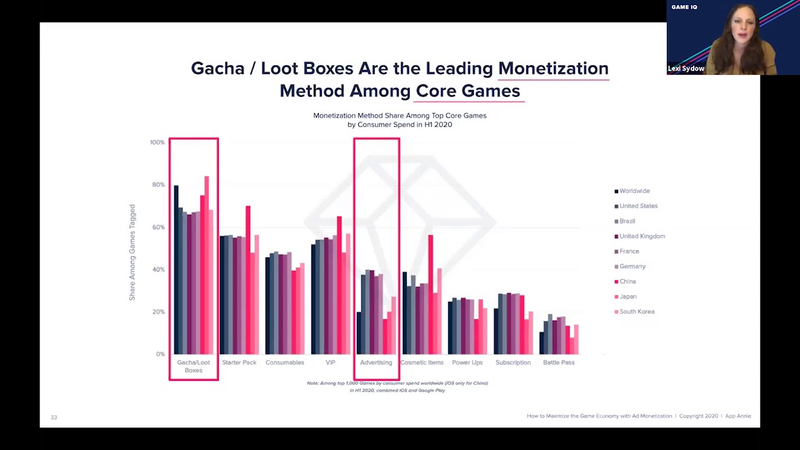
uh and login rewards and then followed by a friend invite and for casual games it's also um there's a little bit left a little bit more variety among those features but customization is the key one followed by leaderboards and events and when we look at monetization methods um this is particularly interesting so this view is where we're looking at the monetization method among core games um so here what we see is that generally speaking across uh the markets analyzed as well as the worldwide view we see that gotcha loot boxes are actually the leading monetization method among core games and advertising is another area that i want to call out because these are the top games top core games by consumer spend so that's consumers spend through the app stores through in-app purchases um and advertising is indicating that kind of hybrid model taking hold um and if we were to do the same analysis among say casual games we'd see advertising be a much bigger component
it might be the leading monetization method among them and another kind of way you can cut this data is to look at it by the country basis so what what what methods are leading in what markets and where are markets over indexing in their use of certain monetization methods um or on the flip side another way to look at it is like which monetization methods are um resonating with core gamers in that market best so in this case in china we see gotcha loot boxes starter packs vip and cosmetic items are particularly um resonating well and are used in many of the top games by consumer spend and then lastly i do want to call out that within the advertising area so games that are all core games that are monetizing through the app stores but then also leveraging advertising um we see that markets like brazil the us uk germany and france are over indexing in their use of advertising alongside in-app
purchases which shows the hybrid model working quite well in those markets however when you look at um kind of those pink bars which is apac markets it's it's not as doing as well or used as frequently um so that's an important characteristic to know in terms of monetization especially if you're a publisher looking to bring your game overseas another view that we have here is how this data when looking at your monetization methods can help you uncover new market opportunities so this is another view similar to the quadrant view we had before but this is a view of monetization where we're looking at active users and revenue so you're able to get a nice view of average revenue per user or rpoo among casual games we saw that the puzzle genre performed particularly well and saw strong growth year over year um kind of hitting into that heavy hitters quadrant a bit farther and then among core we see that rpg is
the one that's actually moved over um the last uh 12 months from a from an arpu leader into that kind of heavy hitter category seeing greater revenue per active user we also can see um based on sub genres or genres and this one is hyper casual how it kind of spreads across different markets um so it's really good to know for publishers looking to gain market share and for instance hyper-casual games uh the us is the number one market for both downloads and spend however represents only 15 percent of total downloads um which is good to note for other publishers looking to um as far as a large global footprint however they do occupy about 40 of consumers spend so that's really important to note try if you're monetizing through the app stores as a hyper-casual game um you'd be remiss to miss out on the uh the u.s market and then we can look at this among sliced by what where
the publish where are the apps coming from where they published so among these markets that we analyzed um many of the hyper casual the top hyper casual games being downloaded come from publishers in france and this is another slightly different view where we're able to look at a sub-genre battle royale within the core class and action genre by downloads and this is specifically showing that in india they're number one by um uh downloads and number 12 by consumer spend um through the app stores oops i actually wanted to call it quickly um we also see more variation among the the publishers of these battle royale games with china and singapore leading the pack um however there is as you can see by these uh brightly colored bar charts so there's a lot of variation there and in the us we actually see u.s publishers kind of occupying a greater relative percentage of those battle royale games and i will run through the last little bit on in-app advertising
so um we conducted a survey of americans on kind of their sentiment towards monetization in mobile apps and games and actually 70 of americans said that they would either prefer just to have ads or have a mix of ads and in-app purchases which was pretty interesting so they prefer that hybrid model we also saw that relative to games um that they had an especially positive attitude towards rewarded video ads around 23 percent of all mobile gamers said that they liked rewarded video ads and that was a lot higher among the hardcore gamers almost at about 40 percent we also saw that for for games that added an sdk an ad sdk um and started to monetize through ads that um they actually saw um downloads and now grow in the months after installing that ad sdk and we'll end on just a couple of uh
kind of market level pieces here so we took a look at the top 500 games on by google play downloads and actually uh 93 of them uh monetized through in-app advertising and a lot of those games are casual games but an important thing to note from the competitive landscape and then also just as a kind of looking at how things are playing out we've seen a lot of research around marketing budgets being reduced during coven and kind of countering that trend is we've actually seen mobile ad placements grow during the pandemic so january to june we saw a 70 increase in mobile ad placement um driven by interstitial ads which grew 205 percent in the us i'm kind of taking over more market share from the video ads and the trend held true when we looked at japan china and south korea um and there was actually stronger growth right there of 105 in growth in mobile ad placements during this time so you can take advantage of the increase in mobile ad placements um that
kind of 70 growth in the us as well as the increase in time being spent on your mobile device um with which basically creates an opportunity where there's actually more kind of disparate data to analyze and optimize if you're monetizing through advertising um and so we offer a new product called app annie ascend that allows you to streamline your ad analytics um head to appity.com if you want more information there and then next steps with some of the game iq data i covered in this um if you want more information on the product head over to bitly slash game iq app annie or if you want our latest report which is free to download and has a lot of great insights some of which are included here um head to bitly slash report game iq we break things down by sub-genre and lots of fun things with the tags thanks lexi that was great um we do have seven or eight minutes left for a few questions um i've got a couple actually um are you you've mentioned that the um the
mobile games community have responded fairly positively to this growth in in advertising for monetization that seems to um uh that that's slightly different to how gamers often react to in-app or in-game advertising in the console pc market why do you think the mobile games community is is more willing to accept in-game advertising that's a great question i think part of it is just i i would imagine it's sentiment um so overall with on a mobile device i think there's a natural exchange that can be um can be made when you you get value for the the service that you're driving whether it's an app or a game um and kind of shifting that cost from the consumer to an advertiser um and that's what we saw when we surveyed americans about mobile ads and the sentiment towards how they're monetized is that the major forty percent um close to or
it was about closer to fifty percent prefer just to see ads than to actually pay through the app store so i think that's part of it um and then as far as within console i i think it goes back to a little bit of um what you're doing right like so freemium is the bulk of of consumer spend and downloads actually for um free and premium for downloads for gaming so you're getting a free game um and so you have to pay for in-app purchases okay yeah that's the question you know you had to buy yeah buy the game itself and so maybe seeing the ads after paying for the game out right doesn't feel um quite as good as if you've you're technically playing the game for free even if you pay for purchases or watch ads in it and um obviously there has been some criticism and analysis of the of the loot box mechanic for monetizing games whatever type of games they are are you seeing any kind of slowdown in desire from games companies to want to have
loot boxes and perhaps switch more towards other monetization um models because of the fear of criticism or legislation yeah i mean i think what we've learned i think in mobile is there is that kind of um legislation or changes are kind of something that you have to be ready for um we are seeing them to be actually the number one monetization method used in core games still across most markets and japan being the highest um as far as the total total games using we are seeing more diversification though in the types of monetization strategies i can't say that they're necessarily switching um for other strategies but i think as a general trend we're seeing um more sort of leveraging other types of monetization methods alongside these um but as far as what we're seeing is there's still a dominant way of monetizing users okay and we've
got in in a similar area we've got a question here from emil fundo factory says how do you gather monetization data on the ad revenue from the loot box side of things he says given that this is generally not something you can see on apparently correct so we what what our game iq product is doing is we've tagged the games that contain um loot boxes but um the consumers spend data that i've cited throughout is actually just through in-app purchases still um so you're right uh we cannot see that direct consumer spend through through the loop boxes but we can show you um the engagement metrics that associate with those types of you know you can filter in our product by games that have loot boxes and then you can look at the engagement over time and also look at perhaps the in-app purchases alongside that um okay um i there's another question here about um what kind of what growing markets could a game developer or publisher be
targeting i noticed when you were giving us the update about the increase in the amount of hours being used the indonesia was was was spending more time on games than anywhere else but is there a a market or a couple of markets or a region that you would advise mobile developers to target when they're looking at additional monetization absolutely i mean we could talk about this at length so a quick summary i guess is i would say brazil is a big market um that we're seeing a lot of growth generally across mobile but also in gaming um definitely a bit higher indexing for core games as well than say western markets like the uk and the us um ultimately i think a big thing as well is it depends on what type of games you're publishing because what we're seeing is that the us for a long time was and it still is in many respects dominated by a lot of casual games um but has moved significantly more
towards um core gaming on a mobile device whereas apac has always been a bit more of a leader in that area um so as far as kind of a the us's you know would be considered a bit more of an opportunity opportunity in a market for core gaming um especially when you start looking at um some of the games that have migrated from say console to mobile um we've seen really successful launches in apac and actually we've seen some really successful launches with like call of duty um in the us so and i think battle royale is a great example of of taking hold in western markets like the us and brazil um so there's we could go on for days on this topic i encourage um whoever asked that question also to look at apenny.com insights we have a ton of free reports and analyses up um that will help there uh but very quick sort of high level synopsis very good and uh one last question which ad formats are proving the most popular
with gamers yeah well i what's interesting is that we've seen um rewarded video be performing quite well but also um a lot of users report that they haven't seen that ad format yet so the sentiment's quite positive especially when you look at um kind of hardcore gaming as well as gamers overall but then a lot of users actually in casual games say they've just never seen it um so that's kind of that area i think of opportunity to potentially trial out with some of those users given the sentiment has generally been quite positive okay lexi thank you so much for joining us this morning thank you also to annie for being our track sponsor um i'm sure um lots of people have made some notes and your and your presentation will be shared with all of our viewers and delegates as well so thank you very much and enjoy the rest of the conference thank you
you
Summary
The mobile gaming industry experienced significant growth during the first half of 2020, largely accelerated by the COVID-19 pandemic. Mobile gaming remains the dominant sector in the industry, generating 1.5 times the consumer spend of all other gaming platforms combined, including PC, Mac, and console. In 2020, mobile game consumer spend is projected to exceed $100 billion. Global weekly time spent on mobile devices peaked in March 2020, representing a 25% increase over the previous year, with users averaging four hours and 20 minutes of daily usage. This surge in engagement is supported by a 20% year-over-year increase in new game downloads and a 35% rise in the number of games actively played per month in certain markets.
Monetization strategies are evolving toward a hybrid model that combines in-app purchases with advertising. While in-app purchases remain a primary revenue driver, mobile advertising is a massive market, with $240 billion in total ad spend projected for 2020. Data indicates that 93% of the top 500 games on Google Play utilize in-app advertising. Consumer sentiment toward this model is generally positive, particularly regarding rewarded video ads, which are favored by nearly 23% of mobile gamers and nearly 40% of hardcore gamers. Furthermore, the integration of ad SDKs has been shown to correlate with increased download growth for many titles.
Market analysis reveals distinct regional preferences and monetization trends. While casual games dominate in terms of total downloads, core games command higher consumer spend and engagement depth. For instance, casino games in the United States represent 22% of consumer spend despite accounting for only 4% of downloads. Emerging markets like Brazil show significant growth potential, while the United States remains a key target for core gaming expansion. To navigate these complexities, publishers are increasingly utilizing granular classification systems—such as those that categorize games by sub-genre, theme, and specific monetization mechanics—to optimize their economic strategies and identify untapped market opportunities.























Comments