1 free read left. Create a free account for unlimited reading + AI research.
Create free account
Superstar Session: Calculating LTV Post IDFA: A Need for Predictive Analytics
Key insights
6 takeaways- 01The loss of granular user-level data following Apple’s iOS 14.5 update has rendered traditional, direct-attribution LTV calculations ineffective for optimizing marketing budgets.
- 02Predictive LTV (pLTV) models replace static, blanket-coefficient methods by utilizing in-app behavioral signals—such as onboarding patterns and engagement depth—to estimate future user value.
- 03Marketers can use pLTV models to generate custom conversion value schemas for Apple’s SKAdNetwork, allowing for the categorization of campaigns by projected profitability despite the lack of deterministic data.
- 04Validation studies show that pLTV models significantly outperform naive, static coefficient approaches when compared against actual post-mortem cohort data.
- 05Beyond revenue, predictive modeling is increasingly used to measure user retention and engagement behavior, providing critical utility for subscription-based mobile applications.
- 06As privacy regulations tighten across both Apple and Google ecosystems, shifting from legacy measurement to probabilistic, behavioral-based analytics is essential for maintaining competitive decision-making.
Ask AI about this video
Transcript
[Music] the next talk is a superstar session um i'd like to invite the stage greg wang from adjust [Applause] and greg's going to talk about calculating ltv post idfa i'm pretty sure there's a lot of people definitely including me who want to hear all about that because this isn't a big problem um so well yeah i'll give this page to you hello this is working yeah superstars are doing words i'll try to
live up to it um hey everyone i'm greg today as you mentioned i'm going to be talking about calculating lifetime value in the world beyond idfa uh it's a quick agenda so i'll do like yeah quick schedule on adjust just to give you what perspective we're coming out this problem from um talking about why ltv is an important metric i know i believe it's not like it's a brand new metric that you've never heard about but why do we think it's so important and what have been the challenges post of pre and post i was 14 and hopefully i'll leave you not with just questions um but with some some solutions that others in the market and ourselves are going about to help solve this problem all right so real quick adjust is a growth marketing analytics platform um really at the core we're trying to give you marketers the ability to understand where your best users are coming from so you can put more money into those campaigns so beyond that we have fraud prevention we have automation but today
we're really focusing on that piece so how do you understand and put these millions of dollars in these big marketing budgets towards the right people in the right campaigns all right so lifetime value a metric you can't get wrong so when we look at lifetime value and how you can utilize it so a lot of people are just going to measure it up against customer acquisition costs right it makes sense the amount of money this user is bringing you over the amount of money actually cost you you want that to be positive so i know that's not a new figure but overall we see that even nowadays you can use it for other things just beyond like health for business but you can also use it to understand within a user life cycle where are they most likely to drop off where are you most likely to want to retarget them to get them back into the app so you can maximize the value out of that user so before i get into the recent challenges on finding ltv i want to go through just
historically why has it been or why is it a little bit more difficult than you might think so overall first off there's no one-size-fits-all so when you look at ltv there's different apps for every campaign you're running users can really be different values to you um according to where they came in so you might see users in a soft launch that have a really high ltv in the beginning because hey you maybe gave them a coin offering makes a lot of sense that they're going to spend money right running into your app and you might say oh hey that early indicator means that they're going to be a really good customer for the lifetime that they play this game but you might also see community-based buildings so one thing we've been really partnering with reddit and other like community-based growth platforms is that hey if you can build trust with an organization across not just that user individually but if they have community users to kind of play off of that's going to be a really big
value driver and maybe they haven't spent the initial big bucks that you did on an initial coin offering on soft launch but they're sticking around for a really long time that might be a really good indicator of lifetime value across their whole lifecycle so it might not just be early activity but it's also all right when you are um over the course of an entire lifecycle how much money they're actually bringing you so with that we now have even more challenges so i mentioned timing so scan post facts scan makes it a lot more difficult to get the granular data that you're used to so first off there's no user level without consent so back in the day ltv could be calculated with just iaps with ad revenue down to the exact user level you know exactly how much that user is bringing you but now you can't actually tie that revenue directly back to a person so
overall it just makes it a lot more difficult to understand how many of those users are actually proving valuable to your app and therefore how how do you know which campaign to spend more money on within scan and i know all of you that have been working with it and loving it data is also not in real time so like i mentioned the whole point of lifetime value as well from a marketing perspective is hey you want to know this early on enough that you can change what you're doing so that you're not just relying on early indicators but you're relying on something to help your business throughout the course so it's again that data is not received in real time anymore like it used to be and then lastly and probably the most difficult part is apple's not really helping you with any of this so they have kind of said hey go out there and create your own schema so how do you understand and how do you do enough research to actually go out about and provide like a an effective strategy so that is where predictive analytics has
been coming in and why a lot of people in the space have been trying to solve this problem so i'll go into a couple of different approaches and i want to say that the justice standing up here and saying we've mastered it but i think it is important to help push the industry forward and have everyone look into this issue that's going to help everyone out in the long term all right so what have savvy marketers been doing with the absence of idfa so the first approach and i don't know who named this the naive approach it wasn't me i thought it was a little weird because it is still a smart way to do things right so you have you're trying to essentially get one coefficient to apply across all your users so you know all right they really brought me this they 60 they brought me this i'm going to divide those use that coefficient across all my blanket users for the campaign and that way i know at least directionally these users are probably going to be making me this anonymous so while that is
definitely a it's better than not doing any sort of predictive analytics uh we found that there's better ways to do it just because people interact with your app in a very different way so it's hard to put one blanket coefficient on them and rely on that to make million dollar decisions so what is solution to so we found that actually layering in app analytics so within event data what are people doing within the app how are they onboarding how are they going through the app where are they actually spending money and changing the actual coefficient while you're running these campaigns is the most effective way to actually get a pltv or projectile tv that you can use further off in the in your marketing campaign so day zero and i'll go into how it works um day zero you'll be able to know hey this campaign project ldv is x all right i know how much i'm spending because those acquisition costs are still easy to get you can just get ad spend through any one of your measurement partners or just
even doing it manually but then you can say hey all right that's how much i'm spending does so much are projected um with someone wanting more money to there because it's a positive ltd all right so we do this in three stages so first stage so right now you can still get all of the event data for all of your users but you just can't tie it back to attribution but what that means is you can use that to make smarter decisions so stage one in this process is just we're collecting all the organic event data from your app we plug that into a model and what that spits out is a suggested conversion value schema so within skid network you set up all your conversion values and actually i can talk to an miu about just really looking into that and understanding and not using the same conversion values that you've been using for the past year and a half and testing those out but within this it actually is a one step in the process so we'll actually give you a conversion value schema back hey this is what you should
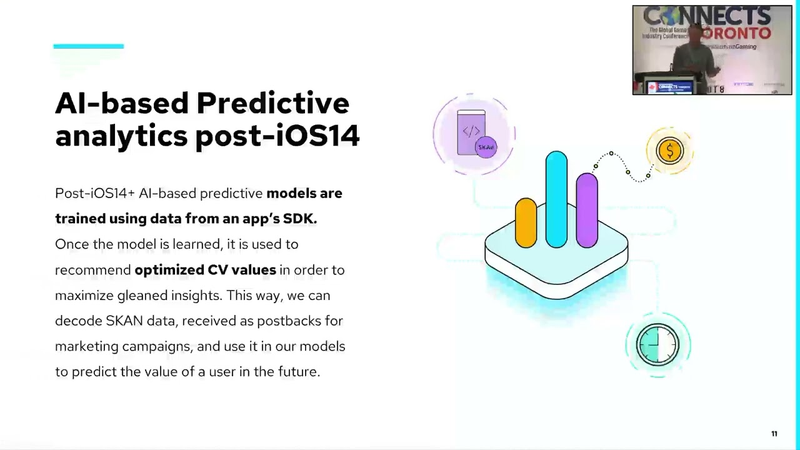
be using and then the stage three is when you're running those campaigns we'll decode those post facts from scan and put it into a dashboard so you can actually use that in different buckets so at the end of the day it's okay what buckets is this campaign falling into so that you can know all right that seems like a pretty accurate or pretty profitable campaign for me all right so there's visual learners out there i also have a chart here um all right so on the left hand side here i'll start in the box so all this data so event data what people are doing inside the app is all class collected by the address sdk which is inside we send that to our servers we put it into the model into the brain and what that sticks out are those conversion values on the very right side and then when you're running these marketing campaigns on ios apple will send us those postbacks we'll decode those postbacks and at the very top there we'll display them in our dashboard as our projected ltv for that campaign
so you might be asking all right sounds pretty good but how do i know if it's worthwhile or worthy to trust um so we know when you're making million dollar decisions yeah you're not going to just trust a number on the dashboard um so you want to know like how how accurate is this so right now with everyone that we've been running this pltv with so it is it's been an open beta we've been doing it for about a year now and we're coming out we're coming out of this open beta but with everyone that we're doing this with we're providing this active accuracy threshold so what are we looking at here so the darker the blue the more users are in that filter so as you can see in the top left at 0 0 it's going to be the most users because as we all know people don't actually do stuff in the app all the time and the majority of users are going to do nothing but within that zero zero you also see that it's a little there's some inaccuracies at the very top just because okay in the
first 24 hours if a user doesn't do anything and then two days later they do make a purchase or they provide revenue with scan limitations we're not going to factor that in but the important part is all of these inaccuracies are localized so in a perfect world this line will be a clear diagonal and all of the factual and predicted ltds will be the same so it'll be 775 all the way across but as you can see in here it's not perfect there's blurry but the line is um it is a it's recognizable as diagonal and that means that right if your predictive is five your actual might be seven it might be three but it's not going to be 12 and it's not going to be one so that's the most important aspect of it is that hey we know it's not perfect it's not going to be 100 accurate but are you able to make decisions based on that we think yes um and so when you
and the nice thing about this as well is you can actually know with a hundred and axi how realistic and how accurate this was postmortem so like i mentioned we get all of that organic event data still so at the end of the cohort you can actually go back and check the work so that's where we're getting this after these practices threshold and this is where you can as a marketer able to go to your team and say like hey this is actually how this performs so when we look at these three lines so we have the blue which is the target which at the end we can actually know that this is actually the ltb of all these users green which is the prediction and then red is that naive approach which i talked about before which is just putting that coefficient across all the users and using that as a blanket approach so like i mentioned it's not perfect but the green ltv estimate is much closer to that blue line meaning it's much more accurate than that naive approach so overall we've found that it is it's usable data
right now to continue to get better and better and with just more limitations on skag coming out uh we just know that it's time to push the boundaries and it's not going to be maybe your only source of truth but within scad we already know you have sky you have consented you have android it's another piece of data that you can use to make accurate decisions all right um so you might also be asking like can i only use this for revenue um and so the answer is no so we know that it's not especially for games it's not always going to be hey i see you know exactly how much revenue so you're going to drive me i mean nowadays i think profitability obviously is more and more important um growth at all costs has kind of been less than just a little bit but you can do this on ltv so this is what i've been showing you monetary value how much how much money this user is actually predicted to bring you but in the middle you can also see you can use this for just understanding how your apps are interacting or how users are interacting with your app maybe you want to make
user behavior user design changes based on that and then the last piece you can also use it on user retention so what's the likelihood that this user is going to stick in my app that'll help me a lot in subscription-based apps or apps where i really want this user to stay for longer than they might in a hyper casual app or something like that so overall information um yeah we've been running this tltv beta it's coming out of ada we think that this is something that's going to be really huge for the next year or two years um and we'd love to chat with you about it if you have any questions but with that any questions i don't know how much time so yeah any questions right pretty much wow with information yeah exactly well i mean
it's kind of more of a question that i have regarding this topic so i mean obviously the whole talk was about the changes on ios what do you think was are there any sort of changes that you think did you predict what happened also on the google side in terms of 5c things yeah i mean google released their news about the privacy sandbox um i mentioned it is remains to be seen exactly what the details are going to be but we know privacy is the future it's where it's all heading i will say that google has been a little bit more willing to take in information from other sources in the industry so i am bullish on it being a little bit more usable at least in the beginning then sky network was um like a year ago when it launched but yeah overall it's going to be there's going to be more privacy changes that's why things like pltv are so important you need to figure out ways to do your marketing without having that user level granularity that you're used to yeah and then it'll make sense basically with the evolution of sort of our online identities to move this way
any other questions all right i think that about wrestling thank you thanks everyone thank you so much
Summary
The mobile marketing industry faces significant measurement challenges following Apple’s iOS 14.5 privacy updates, which restricted access to the Identifier for Advertisers (IDFA). The loss of granular, user-level data has complicated the calculation of Lifetime Value (LTV), a critical metric for optimizing marketing budgets and assessing campaign profitability. Without direct attribution, marketers struggle to connect revenue to specific acquisition sources, necessitating a shift toward predictive analytics to maintain effective growth strategies.
Predictive LTV (pLTV) models offer a solution by leveraging in-app event data to estimate future user value. Rather than relying on a "naive" approach—which applies a single, blanket coefficient across all users—modern predictive frameworks incorporate behavioral signals such as onboarding patterns and engagement depth. By analyzing organic event data, these models generate custom conversion value schemas for Apple’s SKAdNetwork. This process allows marketers to decode postbacks and categorize campaigns by projected profitability, providing a more accurate, albeit non-deterministic, view of performance.
Validation of these models indicates that while pLTV is not perfectly accurate, it significantly outperforms static, blanket-coefficient methods. By comparing predicted values against actual post-mortem cohort data, marketers can establish accuracy thresholds that inform high-stakes budget allocation. These models are increasingly versatile, extending beyond simple revenue projections to measure user retention and engagement behavior, which are particularly valuable for subscription-based applications.
As the industry moves toward a privacy-centric future, including anticipated changes to Google’s ecosystem, the reliance on predictive modeling is expected to grow. While privacy regulations continue to limit user-level granularity, the integration of behavioral analytics and predictive modeling provides a necessary framework for navigating the current mobile advertising landscape. Marketers are encouraged to move away from legacy measurement expectations and adopt these probabilistic tools to maintain competitive decision-making capabilities.