1 free read left. Create a free account for unlimited reading + AI research.
Create free account
Retention Is the New Acquisition – Retention Best Practices From the World’s Biggest Mobile Games
Key insights
6 takeaways- 01The mobile gaming industry loses approximately 90% of acquired players within the first 30 days, resulting in billions of dollars of wasted acquisition spend annually.
- 02The methodology of using real-time, personalized interventions to drive retention is effective across both mobile and blockchain gaming sectors.
- 03Games24x7 achieved a 50% increase in player lifetime value (LTV) by implementing an automated, data-centric retention framework.
- 04Maximizing LTV requires shifting to real-time engagement strategies that identify and address specific player friction points, such as difficult levels or early churn indicators.
- 05Transitioning from manual, engineering-dependent campaign management to low-code, drag-and-drop platforms allows marketing teams to scale from dozens to thousands of concurrent player interventions.
- 06Empowering marketing teams to independently deploy, test, and manage campaigns removes engineering bottlenecks and significantly increases organizational velocity.
Ask AI about this video
Transcript
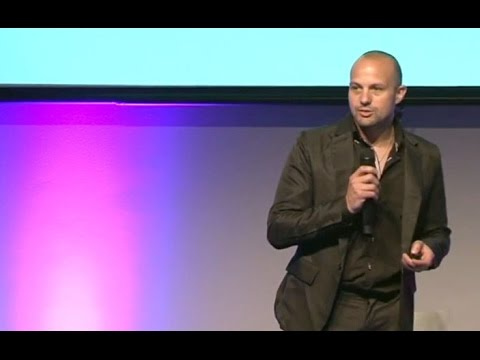
Good afternoon, everyone. Um, nice to see everybody in person. Great. Well, thank you. Um, I'm going to talk to you about one of my favorite subjects, uh, retention. I've been in gaming for my entire career. I started actually in, way back to date myself, in CD-ROM gaming, and then I built one of the world's first ever online casinos, uh, back in the mid-90s. In some form or the other, I've stayed involved in the online gambling space to this day. Um, along the way, I've been involved in every type of game, from uh, recently
blockchain, to mobile, to social gaming, social casino. The common thread along this entire period was the focus on retention. That has always paid off very nicely, uh, for me and for our businesses. If I could figure out how to use this. There we go. Um, thank you. So, let me start off with a stat that I like to share. Now, this stat is not for the games and gambling industry as a whole, it's just for mobile gaming, right? But, you know, it's something that just always, uh, leaves me stunned when I hear it, but as an industry last year, we spent $15 billion on acquiring players, right? By day 30, roughly 90% of those players are gone, right? I mean, just think about that. We basically wasted $13.5 billion on player player acquisition. Why can't we improve the retention uh, on these players? And so, you know, I'm also a small
partner in the largest gaming company in India, which recently achieved unicorn status. It's called Games24x7. Games24x7 is involved in the real money skill gaming business predominantly. And we have a huge retention team, and I used to talk to the retention team and ask them, "Why can't we improve our numbers?" And the answer was always that, "Hey, we have tons of ideas, but we're always blocked, and it's hard to get our campaigns live and and bring them, you know, to fruition." And that's where I'm going to focus this this talk on. Um, but Games24x7 um really achieved this level of success simply because of its focus on on retention. We are effectively a data science company that's applying our talents to the games space. Um Snapper, which is the solution that Games24x7 is using that I'll talk a little bit about. Um, we have a booth
out here. I hope you come and see what we're doing. We're in public beta now. And amongst our early clients is one of the largest blockchain games in the world, uh Splinterlands. So, let me get into at Games24x7, what's our strategy? Now, this is a bird's-eye view. To get into details would be more time than we have available right now. Um, but first everything begins with where are the opportunities, right? Where are there players who aren't being fully monetized? Are there people in the early life stage um who aren't quite converting? People who are active, but we could make them even more active? People who are starting to show signs of churning? And really identifying these cohorts that have what I call unrealized potential. Once we have that, and and there's we have 30 monthly active players. So, once we've identified these different cohorts, um then we get into the process of the creative process. Okay, what are the interventions that we can take to
get these players to monetize better? And so, that is what I call turning potential into kinetic, right? Um and that comes down to a lot of things. This is just a high level here, but what's the messaging? Someone's stuck at level three and they want to get to level four, right? And we pick up on that um programmatically. How do we push them past? What kind of offers do we need to give them at what time, right? Once we build kind of the campaign for the logic, then we go through our data science team and we look at the data from our past campaigns, of which there are tens of thousands. That data is all cataloged and organized, and we use that data to optimize the current campaigns, to predict our ROI, and then make a go or no-go decision that are we going to actually run on this campaign, is it worthwhile? Now comes the hard part, right? So, great. We figured out what we want to do to cause a change in behavior. Now we just have to build the campaign, right?
And here's where challenge and pain points begin. Marketing team goes to the engineering team and says, "Hey, this is my spec." Engineering team's always busy, um and it takes weeks if not months before they can implement these campaigns. Um of course, once the app is released and pushed out, guess what? There's a change request, and we're back at square one. So, that's what I'm going to talk a little bit more about and what the specific pain point Snapper is looking to solve. Um In complicating this fact for the engineering team is these campaigns aren't just simple things, right? They're designed to uh measure and attribute what it was the exact impact of each campaign. That, you know, this campaign produced what kind of change to our retention, what kind of change to our LTV, and we have to avoid all kinds of confounding factors in in designing that. Our primary endpoint is always just LTV. Um, obviously retention is a huge component of that.
So, in the early days, you know, all this happened manually. Um, in a given calendar year, we maybe launched, best case, a dozen, maybe I think in one year we'd launched two dozen retention campaigns. Um, now we have anywhere from hundreds to thousands running concurrently at any given time targeting micro cohorts, right? We've fully automated the whole process of building campaigns, and it that process has gone from weeks or months of work to literally sometimes minutes or at the most hours. And it's improved our organizational velocity, um, simply by allowing the marketing team to move independently of the engineering team. So, let's get into a little bit of this. I mean, the impact here, you know, uh, it's self-explanatory, but it's been huge. I mean, this is a nine-digit business that you're talking about in terms of revenues that has had a 50%
gain in LTV by following this strategy. So, now this is not meant to be read in detail, of course, but it's just to give you an idea of an example of an actual campaign that we're running. Um, Rummy Circle.com is the flagship product for Games24x7, and this campaign is what's called a progressive money multiplier. Hey, first day, whatever you win, you'll get some bonus on top of your winnings. Play a second day, you'll get a little bigger bonus, and that goes on for the first 7 days. But, it's pretty involved. There's some logic with that. So, normally this spec would have gone to the engineering team. Now, with Snapper, this campaign can be built in a few minutes uh, uh by marketers themselves. This is what it looks like, right? I'll show you an example of this. It's a little hard to show you how this is all put together in slides, so that's why I invite you to come to our booth and see an example of that. But, how many of you have heard of uh Scratch from MIT?
I see a handful of you. Um you know, it's a programming language that was developed for kids. This is Scratch for marketers, right? This It's a very powerful language, but it's built built on the same framework. And essentially, you drag and drop the blocks, construct your workflow very fast, you hit run, your campaign is live, you're getting real-time analytics, and you're in business. So, this next slide it shows you just an animation we put together if you're unable to stop by the booth, what it feels like for one of our marketers to build this type of campaign, right? You can see they're dragging over blocks for AB testing, to publish different types of content to uh different cohorts, they can build audiences right within this. It's a pretty straightforward thing, and there's no programming experience required. So, let me just take kind of a little survey here. Um how many people are mobile game developers in this group?
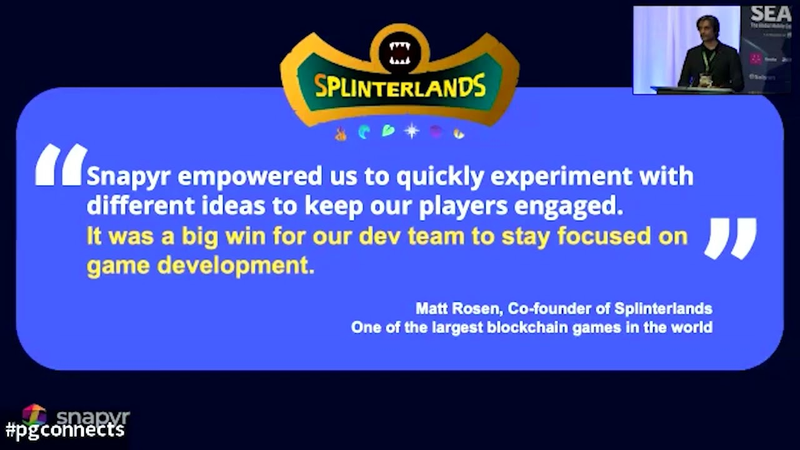
Okay, most of you. And how many of you are actively running engagement campaigns in your mobile games of those of you who raised your hand? Yeah, so just about maybe I see about 10 or 15% of the group that raised that. And of that group, what percent of you might run engagement campaigns if it was just a lot easier to do it and you didn't have to go through the uh engineering process? Just a rough show of hands. Um I see a handful of more hands. Um Yep, that I mean that that's what we see across the board as well. Um and here's a quote from, you know, one of our early clients, uh Splinterlands. You Many of you may have heard of it. It's uh it's a phenomenally successful blockchain game. Matt is the co-founder of Splinterlands, and you know, this was the biggest win for them, and it allowed them to grow to the level that they are, that the dev team stayed focused on game development, bug fixing. Marketing went off and looked at
the entire attrition cycle of players, and was able to create interventions or campaigns that impacted each of those life stages. So, that's really it. Uh pretty simple presentation. I wanted to leave some time for Q&A. Um Any questions? No. Would you say that the type of campaign approach is suitable for VR games? Going forward in the Um in all honesty, so for a VR platform, uh the there I think the answer is yes, but uh the reason I'm hesitating a little bit is what are the communication channels to the player, right? So, you know, some of my friends, they run a platform called Sandbox VR, if you're familiar with that. Um so, Sandbox VR has your
email as a touch point, right? So, if you have been a regular customer of theirs, and now you haven't shown up for a year, that's a very simple campaign where they can try to re-engage you. But a platform like Snapper really shows its capabilities on kind of real-time games. Hey, this guy was playing every single day. Now, something has changed, and he's not, or he's stuck on level three, or something of that nature, right? It's it's very real-time in its nature. So, I I I do think the use case for VR is more exploratory at this point versus mobile games and blockchain games where there's a very clear and and huge use case. Yep, my pleasure. Um, cool. Any other questions? Yep.
Yeah, so there's what it does now and what, you know, our road map permits. I'll talk about the vision first. Um, yeah, so the vision is that yes, you can create all types of actions. You can have messaging actions, communicate with people through push, email, text, Discord, whatever. Um, but also have offer actions. If you're a blockchain game, hey, I want to give this guy an NFT. I haven't seen him, I give him a card as kind of an offer. So, I publish an NFT straight into his or her wallet. Right? So, and that could also take place in type of in a mobile game where I'm giving you some in-game currency or something like that as an offer. So, there's a offers engine component. Um, and then what you talk about is part of I think a a later term in in our road map, which is that essentially we call an endpoint in the game and say, "Hey, this player needs XYZ intervention." But
then it's up to the game to actually deliver upon that. Whether that's kind of modulating the difficulty of the level level downwards. Like, "Hey, it the level's too hard and this guy's going to churn off if you don't simplify it." Or sometimes the other way, is modulating it, you know, upwards. Um, but obviously the Nike goes outside the scope of the platform. It's the platform rests on notifying Does that answer your question? Okay. Cool. Any other questions? One back. Yeah, actually if you don't mind repeating that once that'd be helpful. Oh, yeah. Sorry about that. So, um when it comes to different campaigns being put together, uh sometimes campaigns require art assets. And would this just tie into some sort of art asset repository or something like that that they can plug and play?
Gotcha. So, um even right now, which again come come and take a look, uh but building your creatives within the campaign are all done on platform. Uh so, you know, there's a full push notification designer, there's a email designer, SMS designer. As we create more channels, there'll be designers for each of those. But also, if there are external repositories for those, we'll we'll be able to connect and support those external repositories and push from from those.
Summary
The mobile gaming industry faces a significant challenge regarding player retention, as approximately 90% of acquired players churn within 30 days. This high attrition rate results in billions of dollars in wasted acquisition spend annually. To address this, the industry is shifting its focus toward sophisticated retention strategies that treat player engagement as a data-driven science. By identifying specific player cohorts—such as those stuck on difficult levels or showing early signs of churn—developers can implement targeted interventions to increase player lifetime value (LTV).
The core strategy for maximizing LTV involves transitioning from manual, engineering-heavy campaign management to automated, real-time engagement. Traditionally, marketing teams were often bottlenecked by engineering dependencies, limiting companies to a few dozen campaigns per year. By utilizing low-code, drag-and-drop platforms that allow marketers to build, test, and deploy campaigns independently, companies can scale to thousands of concurrent interventions. This shift in organizational velocity enables teams to respond to player behavior in real-time, such as offering rewards or adjusting game difficulty to prevent churn.
Evidence from Games24x7, a major mobile gaming company, demonstrates the efficacy of this approach. By adopting an automated, data-centric retention framework, the company achieved a 50% increase in LTV. This methodology is applicable across various sectors, including mobile and blockchain gaming, where real-time data allows for precise, personalized interventions. While the application of these tools in virtual reality remains exploratory, the primary takeaway for the broader industry is that empowering marketing teams to execute complex, automated campaigns without constant engineering support is a critical driver of sustainable growth and revenue optimization.
















Comments