1 free read left. Create a free account for unlimited reading + AI research.
Create free account
Reinventing the Discovery Process
Key insights
6 takeaways- 01Studios must shift to a player-centered discovery process that mandates rigorous validation of game concepts, mechanics, and art styles before full-scale production begins.
- 02Development teams should utilize detailed, data-backed player personas—developed alongside behavioral research firms—to map psychological traits and motivations directly to monetization and design strategies.
- 03Using validated personas as actionable data points accelerates production timelines and fosters internal team alignment by reducing the need for costly late-stage iterations.
- 04This structured, empirical approach serves as a financial safeguard against high industry failure rates by ensuring that every creative design choice is grounded in a validated user need.
- 05The methodology provides a scalable framework that allows smaller development teams to identify and capture specific market niches with the same precision as larger studios.
- 06Integrating big data analytics into the discovery phase allows studios to replace generalized assumptions with targeted experiences that align with specific, sustainable market opportunities.
Ask AI about this video
Transcript
our next talk which is um reinventing the discovery process with uh francis from 10 square games who i think is just joining us now are you there francis hello yeah hi can you hear me yes i can hear you fine perfect um yeah we're starting to run over a bit into your time so i'm just gonna leap out let you get on with it um people if you do have any questions do drop them into the q a or the chat window and i'll ask them towards the end of the session but for now um up to you francis perfect thank you for the introduction rick i'm going to show you the presentation so here we go so yeah uh on beautiful 10 square games i'm francis the ux
designer for the new studio that we just opened in warsaw a few months ago and what i'm going to show you today is a part of our journey as a new studio but now we reinvented and rediscover the discovery process so what's the discovery process so the discovery process is actually what enabled us to answer the big question so the big question might be which kind of game do we want to make so this question is a question that every game developer faced at least once for the life and i think we got an interesting answer um an alternative point of view that we want to share with all of you so the first ingredient of this discovery process is the team we called ourselves the argonauts because we like to explore and experiment and aim for something innovative and different so as a new studio transfer game enable us to have a really interesting organization and structure that enable
us to experiment new methodologies of designing and brainstorming failing because it's part of the growth and at the same time bringing value by inserting in a common gaming design process some some kind of instruments or design thinking that usually came out from other markets so i give an example our team is really composed by a various amount of people that has various backgrounds not only mobile gaming but also casino big data analysis uh workshop interaction with people and pc console games so we believe that a big part of our knowledge is also useful for the gaming industry despite not being directly involved in the mobile gaming so what's the question again how to make a game but the real question that we want to answer is where should we start so this is the first obstacle that we faced and as a studio we decided to focus to put our heart of the
operation on the player so we want to design with the player creating what we call a player center studio so we add some pillars that we envision for this kind of studio so the first pillar is that we need to understand what are the needs that the player needs to satisfy so for example does he needs to fill a gap or boredom is he kinda sad so we need to show him up so those kind of needs not really related to the game are really interesting and we should totally focus on them how existing is are treated by other games so for example he's already entertained by playing puzzles because he likes logic and other stuff so we can actually see already what are the solutions that he already tried and enjoyed or maybe not enjoyed and at the same time as i mentioned before we want to think outside the box so outside this market outside the mobile gaming what are the needs that other things are actually targeting him so for example uh he wants to be entertained so he will
use um streaming service specific streaming service so you will learn the interaction with the streaming service so other things e-learnings whatever even trending those are all information that are still part of the player even if you don't want to think about the player outside the game but as a studio we really find value in focusing on those and at the same time of course as a business we want to see if this is a self-sustainable demographic so if there is a value if there are players and we can invest in them and we can make a decision that this is the player that we want to focus on and start our operation so to do that uh i want to introduce you to uh methodology that is called validation so our team of big data analysts actually created a fast validation process so we internally pitch concepts so we answer the question what we're doing and why we're doing and they are really supported by
business scenarios and business cases so what the what the team brings to us the data team is the toolkit so we call it toolkit but it's actually a different setup set of tools and data that they bring to us and they can cross compare our information about our concept to trending on social media for example what movies are coming out recently so you know exactly if this topic is going to be expiring really soon is already passed and so on music and other trainings that usually you shouldn't think about game but we still believe since we are designing around the player that this is still part of his interest and of course after we have dissolved information we can decide if we want to proceed with that we have maybe we have more than one idea and we decide when should we start them which one should be started first and so on uh but then we are talking still about having the player in the middle of our
so who are my players so i want to introduce you to methodology that we use uh it's really using other design let's say branches in tony gaming especially in ux in other fields so personas personas is a methodology that we really invested on and the goal of it is to focus exactly on reaching and interacting with the right player what does that mean persona so i give you a super fast overview so personas are simply talking fictional characters so you give them a name you give them an age a gender a nationality and you build on it like you're building a character for a book right you give him a job you give him a background of history of family and so on so what's the goal of building this fictional character you can write you can ask the right question so again i give you an example it's way easier to design or talk about something if you're referring to a person that you know that you can visualize
with a face on the name despite talking okay let's make a game for 25 years old player european i mean this is so vague and with the personas you can actually start to think okay michael really likes to play this kind of thing in the evening so it's really more direct at the same time we can understand the needs the dreams and the pain points i will go back to this point later but we really need to think what are the things that is suffering for maybe are things that we totally need to avoid because he may he or she will be super angry when you will face this thing in a game or maybe we can make something that might bring some relief on his needs on his dreams so this is a good point another big chunk of benefits of the personas are avoiding general assumptions so assumptions are really a bad thing uh is because assuming something uh is not really supported by data because assumption is really bad specifically if you want
to target players if i assume that a player will play just a specific kind of game because of his gender it's wrong because people trans they pass every month there are new changes new behaviors on the people even our personas we need to interview them from time to time because as i said outside the game there is a life going on and we need to be updated with their life so general assumption is usually something that we want to avoid and will make us our game our design quite more organic and built around the player and of course we need to target the right audience because if exactly find those personas in on real people so let's say we find a base of 100 player that we can test and they exactly fit the personas it's way better than throwing the touch to 1000 people and only 20 of them are the players that we are designing for this is way more interesting in our opinion and at the same time it will make us focus more on the design so
as a business then when you have the personas you you cross check it with the market landscape so you can actually check where the motivation and the expectation overlap when the person where the personas and the revenue are distributed in the market so we can find value for the business we can find value in specific genre because personas can play different genre i want to remember that persona can be used so we can have different range and of course we can decide which kind of investment we want to make maybe we want to see a niche in the market that we want to push in maybe we see big players in a market and we want to avoid them because we don't have their services it depends exactly on the structure and on your goal as a team so we had a partnership with 12 trades and 12 traits is a big company that treats personas and they manage to create amazing um overview and dashboards about those personas so i'm going to show you
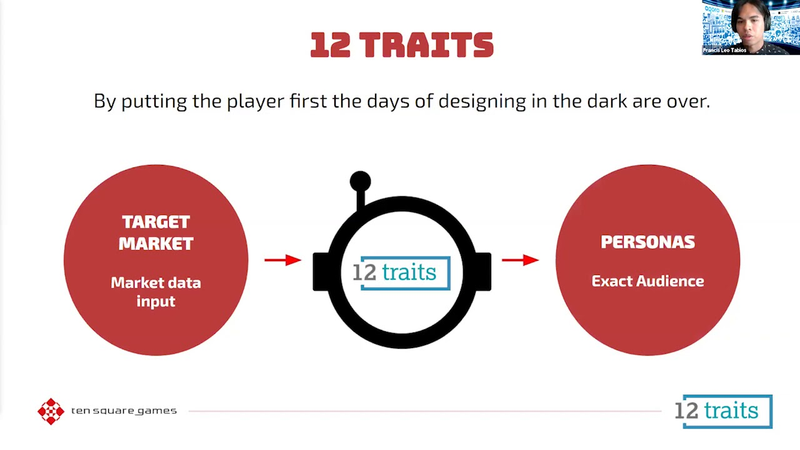
exactly what we do so how we work with them so with 12 threats is that we bring them a target market so it means that we gather information about the market that we want to tackle so for example we give them a subgenre or we give them a really vague kind of list of games that we want to analyze and once we give them to 12 traits they are able to create a dashboard of personas which tackles exactly real people that will be divided in personas which are the exact audience i'm going to give you an example just to tackle a little what they're going to do so when you have a trait when you have personas you can actually maximize the design so the design is really focused on the user so the initial look when you design it which is really important for mobile games the first seconds of the game we can directly answer the question that the persona will ask our player what's my goal what do i get if i play this game and by knowing their names we can actually provide them a correct initial
look same thing for the mechanics the core mechanics we can design exactly mechanics that resonates with their personality that they can play that they are able to understand instantly and then they are able to enjoy at the same time we can add secondary mechanics because some players can multitask and we can analyze them by analyzing the traits of the personas and then long-term commitment how do we do how do we manage the retention so maybe we can push on the pain points of the persona by bringing some relief in the long term so the player will feel pleasure and keep playing our game and and so on so i give you again what kind of traits we are going to show so this is just one of the multiple traits that 12 traits bring to us so this is the competitiveness so the competitiveness is really divided in different things so we have avoidant competitive activity as you can see the personas are divided in a big group called all players with
which is an average of the five players that are there so by giving them a list of games or subgenre they exactly track down a whole group of persona that can be divided also in five different personas as you can see they're really different those those personas so they some of them can be really independent while some of them can be totally dependent some of them really like competitiveness and so on so you can actually even start to be more precise you can tackle only one or two personas of the group because the rest is not really bringing value to the gameplay that you're investing on so how do you want to use the traits outside uh outside analyzing them so once we bring those data so imagine this is just competitiveness we have way a lot of other stuff like health dreams pain points focus goals and so on so we can actually use them in uh in different ways so for example if i tackle the values and we discover that family is a big value
for them we can decide that we need to build a co-op mode or add friends to my list to play together if in the personality we see that is really impulsive we can actually push to putting timers in the game because he will jump into the action as soon as he sees something like a timer or a condom we can actually put some glowing offers because it will attract it and it will tap it instantly because it's a person really impulsive or if you tackle the motivation we can see that it's really flexible and you cannot really easily accept changes or variation of the game so we can actually test if we want to introduce new features in the game and we shouldn't be afraid because one of the core motivation is flexibility and so on apart from the design using 12 trades and the personas are really useful for other things i give an example art style so instead of pushing a cool art that you think is trendy you you can actually test the art style with the persona directly so what we did was to draw exactly the same environment
so a house a tree and a character in five different styles and we send them to those personas and the average told us that this is the specific art style is the most liked and the one below is the one that we should totally avoid so we actually understood it exactly directly without losing any time what kind of art style we shouldn't invest in and then we can move on specifically to the personas so each art style can be really focused on a specific persona and actually this is just the tip of the info that cultures provide us you can actually also see which of those are style is really noisy for them which of them is bringing them calmness which of them is really distracting them which of them is really better for the game but they would like it more for the promo or something like that so so on and so on you can die again so why we are we using personas why we think it's really value so we have of course any benefits apart from the one that i told you so we can actually target directly the
needs of our players by having those insights so those are not data those are not assumptions those are data you can treat them usually as data as numbers then we can actually create real actions that can enhance the experience because as designers and with the partnership with cultures we can actually think about specific gameplays that can tackle specific needs and we have this methodology had a big impact for our team so we are a better team because we are aligned we design exactly talking about the same people the same personas in our head in our heart we are faster because we don't lose time by testing stuff and reiterating because we are faster and then we also have better metrics so before launching the game we already have a solid base of foundation that can support our idea so how to make the right game so as i showed you before the innovation where does it stand for in our studio so as argonauts we believe that the core of
the operation is our validation process that enables us to expand and test so personas is just one of the tools that is in our toolkit of methodologies uh we have design sprint we have art and films testing and so on and we're going to introduce even more toolkits for this expansion and then we can deep dive so we did that by providing specific prototypes so maybe we prototype with video we prototype slice prototype our whole f2a prototype and so on depends on the concept because each game has different needs depends on what do you want to test and what kind of test do you want to do with the personas that we are trying to do but this is just this more fraction of innovation so in the big picture uh as a company as a studio of course we have the whole structure of ideation and market support that support our ideas as a business case and of course the valuation and the iteration should come from us i
give an example so we evaluate even after we got all the data if we want to continue with this idea or not it's up to us and it's up to us on how we want to be creative and use those personas in many different ways so we are still exploring iteration what does it mean after you analyze the personas in the market maybe you realize that the game that you initially pitch is not really working so much but you really like the personas so all the research the data the art style that you tested and you got a result it will not be wasted you can still use it to make another game because personas are personas it means those are real people they have a wide range of games so you can design totally another game without losing all the research that you made and you can still have all the valuable information from the beginning and then we can decide uh you can decide all together if you want to invest on those ideas if you want to kill them and if you want to reiterate them is a pretty iterative process and we believe that this is uh
just the beginning of our of our whole journey as uh as a new team as are gonna so as i mentioned before this studio is really newly open and we are really happy about the results that we are bringing to you so what are the next milestones of our studio so first thing we will expand this whole process of design not only for the first concept but also for the whole journey means that we are going to tackle also soft launching global launching live ops and so on we want to keep personas always on the focus not only when you design the game at the beginning so we want to expand our expertise of course we as i mentioned before we have various expertise and backgrounds and we are tackling the goal to be more curious and tackle other experts to have collaboration with us other students other companies to share knowledge other people if they want to join our team we can have discussion about that and fast validation of new ideas we don't want to be stuck in one idea at the time that will take
years ideas of an expiration window frame so we want to be really fast the faster that we are but still super optimized the better ideas we will have and we want to make a really tailor-made ux experience for the whole game so using personas will be just the first step but we want to design with the player having workshop with them and so on and of course smart prototyping as i mentioned before each prototypes for each idea will have a specific focus so maybe one idea would want to resonate more about the mood and feel so we will do a video prototyping some ideas have are just like other games but have a specific mechanics that differentiate us from all the other games so maybe we want to just test the specific mechanics so we're doing also this kind of smart prototyping that enable us to be more innovative and edgy in the market and yeah so this is just as the title mention is just the tip of the iceberg and this is just the beginning of the journey but we are really glad of the results that we got
and i was really glad to share these things with you today so this is my email if you want to connect with us for free and i really thank you for the attention give it back to you eric yes thank you that was really interesting talk um definitely interesting to hear about the the that idea of personas and building up your your idea of the the the market before you you go out there and um actually that kind of leads sort of into my first sort of question that i have um and if anybody in the audience has any more questions please do drop them in the q a i see we've already got one and we'll get to you shortly um so i was kind of wondering like how early on do you start looking at personas when you're sort of looking at working on a game like do you do you identify a market you want to make a game for or do you are you starting working on a game and then going okay now we want to send this to a certain we want to see who this is going to work for and tailor it to them exactly so there are different methodologies for this kind of process so as a new team we introduced the personas
as a methodology really in an early stage so at the beginning as a guinea pig of our studio we had a specific expertise and idea supported by market and case studies and we had an idea of the players but it was really vague so with the support of 12 traits we targeted exactly the personas after we had the initial pitch of the idea after that we actually were able to redefine the current pitch but what we are doing now is exactly as i mentioned before once you have the personas you can decide if you want to use them for other games or maybe your intuition tells you that you want to target total different games and this is another process as you mentioned before it it can actually work you can introduce personas after you focus you can you need at least an input that is really strong could be a genre a subgenre or some let's say trending games that have something in common you can already deliver those to build a persona of course the more you
put as an input the more precise it will be but it's a thing that you can actually put in early stage as long as you have at least a strong base because it's uh it's an investment though having those research so you shouldn't start exactly with those but it should be a thing that you should have in the first weeks sure um and so i know a lot of the people who come to this conference are from like small one-man two-man teams or so on do you think it's is it still a viable option for these kind of small indie teams to invest their time into the building the personas and identifying the market like this thoroughly i really believe that this is uh this is a good opportunity also because i think that personas is a way i'm talking as ux designer not only for the gaming industry as ux designer in general uh personas is a methodology that really helped us uh as ux designer in early stages and even if you don't have the support of big data having at least an idea of the needs of the player made
made allow you as a small studio to find the niche that you want to insert your game in it's about finding the right slides because there is this there is also the big market with big competitors but if you have the opportunity to find something that other companies don't want to invest in because it's a specific niche maybe you can make let's call it the indie game but really targeted for a specific mechanic and persona and i i found this way interesting even for small studios because they can actually try those uh really interesting out of the box mechanics in my opinion cool um we do have a couple of questions from the audience and uh if you are watching please do throw them in uh we've got an anonymous attendee we'd like to know how do you market test colors used in ui have you tried a b test for different colors and notice that a specific color palette does better okay so it depends exactly on how do you want to do that so we have of course normal a b
testing that we do with different color palettes or you can also say uh color is a hard topic because it really depends on the specific outside of the person and on the device actually that you're playing with so it's not really that specific but if we want to broad the topic on art at this point uh personas are really useful if you don't have an idea of the art and you just have different really different from each other styles and it's really vague but you want to focus in and you already know that you have a target and you should go on with it but for more generic let's say i have a radius style i have already a theme and i just want to test if color a is better than color b a b testing that we're doing can be actually as i mentioned before those personas provided by twelve trades are real people they're just divided in those clusters but we can take those colors red color red one or two and test exactly with those people and we can check them
but again as i mentioned i think color is really more uh physical condition so but art can be tested with those specific people and you can be really precise in this case uh and i guess you've got to taking particularly with colors you've got to take into consideration like color blindness and making sure that everybody is able to see them um so yeah um uh we've got a question here has there been a time where the insights from personas turned you to the wrong direction and if so how did you handle that oh yeah it wasn't that they turned us to the wrong direction so personas are like human being they give you a big amount of data so a lot of things that you might need or not need so it depends so sometimes uh personas made us uh think that there is a specific mechanic and it was really that we wanted to focus on and that was a big pro at the same time
as i mentioned before before tackling personas we already started the concept before tackling them and we had some i mentioned before of something related to those players and we already designed something that we realized later that was wrong was the wrong focus so personas got us to the right track the opposite way getting us from the from the other track is depends on how you read it so in our way we try to design each mechanic in each feature seeing the peaks of the traits we don't consider all of them some of them are average we just consider when someone is really given example it's really independent it's really competitive or someone doesn't really like um team play those things can actually uh be our main focus while if we start to focus on all the traits and try to build exactly the game that makes us uh track all the cases even the one that's really average this will make us lose i will not say track but time
this is uh we are talking about being efficient and being really fast in a in a good way so we are learning how to read exactly the right data on it and it's really useful i think cool um we've got a question here from giovanni um and maybe we can sort of figure this one out i'm not entirely sure what the the question is here um from market intel to ideations of pitching sessions how close is the scope and how do you conduct the ideations yeah sure so yeah from additional marketing so it's the step before uh the persona so exactly when we do the pitching we just don't do pitching because we have an interesting idea of course that should be part of it and interest and passion about it of course but we have exactly a really cool team of data analysts that has experience on big data and we try to focus of course our internal market uh team in uh
in tsg is really supporting us in providing providing us the data that we need so we can build exactly a static is on that what our data analysts are doing that is uh an extension of that is providing us the innovation curve i call it like that so they can find exactly the the curve where there is going to be a bubble that is not going to explode soon or when there are where the trendings are going to aim for i give an example maybe soon there will be the time for sci-fi because of cyberpunk or dune coming and do we want to invest in this maybe it's too it's too late because you need one year to develop it in one year everything will be over so those kind of things are really the edge of the innovation data analyst that we have but the the whole process before it really is really supported by big data about gaming mechanics and analyzing exactly where the market is investing and which games are trending and which mechanics are differentiating them between each other so yeah there is a
big support before and then yeah we are free based on those data to build different concepts and validate them great um right i think that's really all we have time for because our next speaker is here and ready but thank you so much francis uh if anybody has any questions i'm sure they can reach out to you through meet to match and and so on and you're gonna be around for the rest of the conference okay thank you everyone for attending and thank you rick for the warm introduction and cooperation so yeah feel free to contact me and i'm really glad to be here and bye and enjoy the rest of the event everyone awesome you too thanks very much for joining us you
Summary
The modern game development landscape requires a shift toward a player-centered discovery process that prioritizes rigorous validation before full-scale production begins. By integrating cross-industry design thinking with advanced big data analytics, studios can move beyond generalized assumptions to create highly targeted gaming experiences. This methodology centers on the construction of detailed, data-backed player personas, developed in collaboration with specialized behavioral research firms. These personas map specific player motivations, pain points, and psychological traits directly to core mechanics, visual aesthetics, and monetization strategies, ensuring that development efforts remain aligned with sustainable market opportunities.
Utilizing these personas as actionable data points rather than abstract concepts significantly enhances operational efficiency. By validating game concepts, art styles, and mechanics early in the development cycle, studios can accelerate production timelines, foster internal team alignment, and mitigate the financial risks associated with late-stage iterations. This structured approach allows developers to identify and capture specific market niches with precision, providing a scalable framework that remains effective even for smaller teams seeking to innovate within a competitive global industry.
Ultimately, the transition toward a data-driven discovery model serves as a critical safeguard against the high failure rates common in game development. By grounding creative decisions in empirical behavioral insights, studios ensure that every design choice serves a validated user need. This disciplined strategy not only optimizes resource allocation but also increases the likelihood of long-term commercial success by ensuring that the final product resonates deeply with its intended audience from the moment of launch.