VideoTwo & a Half Gamers
🎮 How to build playables that actually convert by Matej Lancaric
25 Feb 202630 min video
Transcript
Prioritize this when you are building the pipeline because top games make around 60 playables a month which is insane and I know the top games are spending way more money than pretty much half of our subscribers but still try to build the pipeline that allows you to create at least five playables a month. That's an good start. Ice [music] drops knowledge made of golden ice with ads making those coins rise up designs worlds chasing the sky with a two and a half gamers the midnight [music] crew talking UA advers and game design too mat feeling shak bringing the insight [music] we're rocking those vice till the early daylight master eyes on the prize tracking data through the cyerspace skies feeling [music] stacks colors like a wizard in disguise jack to the highest two and a half gamers talking smack [music] slow hockey sick got your back ads are beautiful they Make the way. Click it fast. Don't [music] delay. Uh-huh.
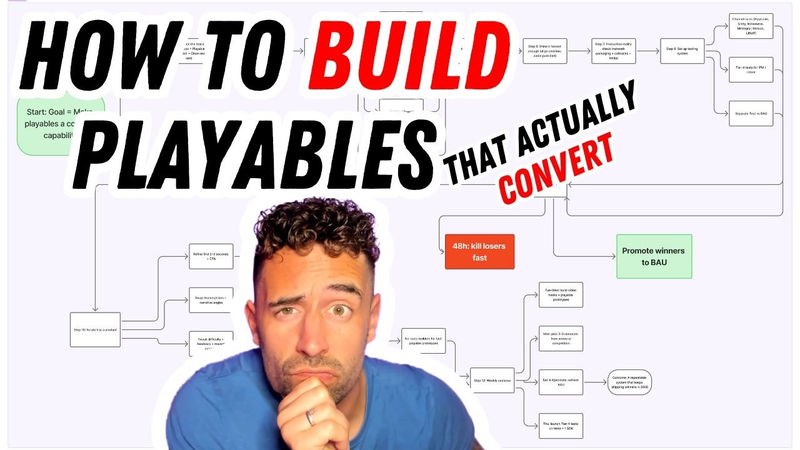
Uh-huh. Aha. [music] Ah. [music] Ah. Ah. Hello everybody. Welcome this week's solo episode. And today I'm going to talk about how to build playable ads that actually convert. And I I know you like diagrams and stuff. So I built pretty much this so you understand how how I think about playable ads but actually built uh a proper presentation for you guys because uh this is quite important. And uh please stay with me until the very end. I'm going to actually build a playable ad while recording this episode. So, what's the agenda? This is going to be a teaser for my upcoming and most anticipated playable Bible, which
is going to be released soon. Well, soonish. Well, should be next week, but you never know. So, I'm going to talk about uh the embracing the shift, the player trends, templates, and how to build and what to build and test playables. and then how to iterate and scale. And again, as I said, build the playable during the recording. I'm going to also show you one quick case study. Uh because why are we here in 2026? Playables are the that you need to run outside of outside of Facebook, Google, and Tik Tok. So, it's mandatory. If you don't have playables, you can't scale. That's it. Thank you very much for listening. See you next time. Okay, jokes aside. So why is this really important and why are we talking about this? It's pretty pretty much very very obvious. There's so many different case studies and I have some there are others like you can see here with Unity Play works testing tool that
were that was able to cut playable testing cost by 60%. You need to kind of think about this in 2026 and even in 2025 when all these kind of uploving rise started we need to think outside of Facebook, Google and Tik Tok and we need to add SDK networks into the into the mix and when you do that labels are default unfortunately or fortunately you can't do anything about it also playables are going to open new invent mentaries and also increase the conversion rates. Obviously, these days when you're as a player watching an ad on up at Unity or Iron Source or whatever, you're watching a 60-second ad. Well, because it converts and then afterwards you are presented by a playable where you spend another 30 to 60 seconds. Well, I know it might be annoying, but this actually converts
because if you're kind of spending more time in the creative unit video plus playable, you're more more likely to actually convert. So, think about this and also think about building a playable but in terms of most probably like building a system. And what I mean by that this is if you are building playables and you're starting with like SDK networks if you build only one play if you build only one playable that's not going to be enough. So think about it in way building a playable and then immediately thinking about iterations. So you build first playable but then you create three or four iterations on top of it because well you already built the base base one uh which took you two or three weeks or four depends on who you work with but then at the same time you kind of iterate with like endless possibilities. So what are the actual trends these days? Well, I was always talking about
how playables should always represent the game and the game play interesting of the events. Anyway, so you you should definitely combine the videos with playables as a playable um end card. That's the the actual that is working really well right now, but also use playable as a standalone ad unit. It still kind of converts well and brings stable performance. Think about it in a in a way that you need to stay or make players stay in the playable for 60 seconds because the the thing is there is a high correlation between the duration of the playable and actual success or like the better performance. So think when you're building a playable think about it in the way that you need to be able to present players like playable with a five to 10 clicks and you know it doesn't really need to represent the game play. I mean obviously there were the times where we were talking about
uh how it should be one seamless experience so whatever they see in the video they should be kind of experiencing in the in the video uh in the playable. I don't think that's the case anymore but I mean that's I would start there and then expand to other other playable concepts. So that's one side of the coin and the other one is pretty much building playables from templates that are available out there which is super easy thing to do and uh that should be also one part of the whole playable equation and then we have different games and genres and then there are different playable concepts that are definitely working well. So Forex is resources. We are seeing Kingshot playables all the time, tower defenses and even some some pixel flow adaptations of the the different playables. For example, for merch games, we see a lot of food merge or mini games in the playables and also sorting stuff. And even even here we see for white out survival even they using for example 3x3
puzzles. So again, it can be anything that you think about in the in terms of the playables and this is actually trending. So you know before you actually start so you're always checking the trends, but you should always think about the emotion and the connection to the playable has to your game and kind of align on that experience and expectation flow as well. So again, you most probably should try to adopt a playable or be as close as your gameplay mechanic, but then you see Forex games or even puzzle games I'm going to show you later, they're using anything that converts, anything that scales and it's working quite well. So you know, try bit of both. So, when I'm talking about the actual templates,
there are templates that are working better and worse. There's so many different Oops. So many so many different uh mechanics uh that you can actually pick from. Again, it needs to be engaging and intuitive. It should as soon as players land into the playable template, it needs to be quite evident that they know what they're trying what they're doing. And there are different templates that work better for for different games. Obviously, I know I showed you white survival and their 3x3 puzzle, but most probably the 3x3 puzzle is going to work a little bit better for casual games. Then we have, let's say, a fighting game. I'm pretty sure we can start with 3x3 puzzle, but if we go for choosing a character, that would most probably work a little bit better. So, try to find templates that are a little better fit for for the game and the genre that
you're looking looking for to build the playable at. But also, since the playable template is really easy to make, you can go wild and more playables is always better. So how to actually build one? So what is the anatomy of the successful playable ad which is optimized for for UA performance? Again this is like the I would say the base unit. Again as I as I'm having here it should be a seamless user experience from video to playable which doesn't matter anymore but this is the baseline. Quickly hook the player. Show him or her the tutorial. very intuitive instructions. Let them play the core loop. Play around with this five, seven clicks and then present strong call to action afterwards. This is very important. Again, build in mind or have in mind that you need to build the playable for 10 clicks. What does it mean? It needs
to be really emotionbased and you need to hook the player right at the very beginning and still motivate the player to stay within the playable for 10 clicks which is not easy because then after five clicks if he or she get bored well then you lost. Think about it in this way. And then from here you build for diversity templates fake ads mini games whatever else. this, let's call it the tutorial or the game core loop playable. This should be the baseline always and then you expand from there, right? You should always show only the game play. Well, unfortunately, this is not true anymore, but it was true a couple years ago when mini games didn't really work, but we didn't see so many fake ads/ mini games in the videos anyway. So now doesn't matter really. So again, think about it. Diverse portfolio of UA playables. It's very similar to UA
channel diversification in here. Always different playable concept is going to bring a different play different player persona or audience and you most probably want to have diverse portfolio of the users afterwards. So building a playable it's actually easier said than done because I'm always when I talk to different companies they always think let's just take tutorial from the game and then just wrap it into HTML 5. Well it works on paper but it doesn't really work in reality. Every ad network and every channel has very different requirements. And also this is very important. The playable ad needs to be under two or 5 megabytes depends on the network. You can't always wrap your high quality, high production value game into 5 megabytes of playable. It's always going
to look way worse. But I mean there are still there are still things that you can polish obviously but you can't really put your 50 megabyte background into a playable and think oh this is going to work. Well not really. You need to compress all the assets and that's why it's going to take some time to really like let's call it polish or just have a production ready playable and kind of reality check what you expect and what you can get for a playable. There's also like there's a lot of technical requirements. Again, it's it's really different from one ad network to another. Think about it when you're building a playable because that's going to change your your mind and how you actually build it. And then when you have a playable like how do you actually test it? So build this playable testing flow which again looks really intimidating but it's not and it it gets better. So this whole testing starts with the like selecting the best performing video before integrating the
playable. So we have five different videos. Then we pick the video winner and then with iterative approach we select obviously the most effective video and then combine it with different playables that we created. Then from this let's call it the first phase. We pick the best performing combination which is the video plus playable winner and then use that one as a control group for the next phase of testing and then we go and rinse and repeat. This structure supports like kind of datadriven decisions and also you know look at the best performing video concept plus well best performing combination of video and playable with the highest ROAS and the pretty much IPM and the the engagement metrics pretty much it right and then you go from the beginning then when you have a new video winner then you again rinse and repeat and it looks way worse than
it actually is in the real in the reality but surprise Surprise, surprise. Since the Appalin is the top channel for most of the games I manage, the the testing structure is a little bit simplified. I mean, the whole logic is pretty much the same because you still need to have a combination of videos and playables, but they they're creative sets, which helps with testing. And for AppLin, you add new creatives and the new creative sets. The algorithm gives it 5% traffic from the start, which then gets a boost. And if it performs well, then it starts to get more and more traffic. If it doesn't, then these playables or play video playable combinations are going to die anyway. You have some, you have video and then a few different playables on the right and then we can test it against each other. Very much simplified simplified structure for testing playables. So again, as I mentioned at the very
beginning, think about building playables as a system or a workflow. You start with one and then you iterate that one to eternity. Pretty much you can always iterate with different pace, more or less enemies, difficulty, you know, rewards, different things, like building different buildings. It depends on what what your game is all about, different skins, themes, you know, you can really think about it as like iterating a video pretty much. first three seconds change that the onboarding change the call to action but obviously improve based on the real performance data I know it's really obvious but people still forget about this again very important small tweaks and then you can change the whole performance of the of the playable very easy well and then prioritize this when you are kind of building the pipeline because
top games make around 60 playables a month, which is insane. And I know the top games are spending way more money than pretty much half of our subscribers, but still try to build the pipeline that allows you to create at least like five playables a month. That's a good start. If you can't really go about that, make this a habit just to create one or two and be consistent with that because there's not nothing worse then create one or two playables and then nothing but in like next 6 months build this muscle and do those reps. It's really hard but it's going to be very rewarding for for your campaign performance. And I mean you can use all the AI tools and no code tools uh which you can leverage the AI for scripts you know variants and even asset generation
obviously or use no code builders aka playable maker for playable prototypes but no AI can build a playable from scratch and wrap it around the actual like um ad network requirements. So you can build a you can build a playable let's say concept with AI but you still need to export and prepare it for all the ad networks which are again as I said have very different requirements. So think about it no AI can do do this yet but we're getting there so don't fall for it. No AI can build an an actual playable for you yet. So then as I said you need to establish a monthly cadence which is again really hard but is really rewarding. How can you do it? Well you always check on a weekly or monthly basis trending mechanics trending mechanics or trending games. That's why that's why you have all the different
games and I can show you for example we have pretty much royal kingdom using so many different concepts we have here which is pretty much like a boat whatever and then combination with the actual match tree mechanic. Then we have some some other playables which is a block blast playable. Again, not really super gameplay oriented, but again working well. It's really diverse. We have Oh, what do we have here? Oh, it's looks like an gates mechanic from last war or anything which is a little bit more like fighting oriented. It's this is not really much in the game that much, right? So you always try to check what's working. Here's another block blast playable. And we have then tower defense playable. Interesting. So and this is just like the last 30 days.
New creatives only royal kingdom from sensor tower. Thank you very much sensor tower for supporting. See so you can always check this. Then we also have we also have match villains which are doing very interesting stuff and we can we can see it here again as I mentioned pixel flow at the very very beginning. Why do you need to do this? Oh wait, it's actually a game that is scaling quite rapidly these days. And why not to adapt this game mechanics and use it in the playables that we have as a combination with our game play and an actual game that is scaling like crazy which then you can kind of anticipate this this can work well because people are people love this mechanic. So this is how you can you can easily easily use it or just check these mechanics and games and turn them into playables. So easy, right? I mean not
really, but at least you know what you can do. So then we have the case study. So we have this game where we ran a lot of static images which really worked well and then we wanted to add up plain into the mix but we didn't have playables. So we're thinking okay so what should we do now? Well how about taking the best performing best performing static image and turn it into 3x3 puzzle. We saw the puzzle 3x3 puzzle trend working really well in August. I think it was for Hobby Wittle Defender. It was working well for White Out Survival. It was working for Evony. So, it was working for so many different different games. There was like, you know what? Let's try this. Let's try it out and see if we can make this work for for our game as well. And guess what? It was working really well. So 5x the to spend and pretty much turn this into a
absolutely huge profit generating campaign on apploving iOS. So one quick and easy playable which is a playable template as well that I mentioned very beginning that can really turn the ship around in the the actual campaigns on Apple. Okay, questions, please put them into the comments because now now you're going to your pants. No, jokes aside. So, how should we how should think about creating a playable? So, I I'm I went to playable maker.com. So, you can you can also join if you want. I use a unicorn uh code and you can get 20% discount. But anyway, uh you can you can sign up in the show notes on the the link, but let's go an easy way. Let's just go here and then create a template. So, I'm going to build. So, there's like so many
different templates. Whatever. Sushi merge, video carousels, slots, wheels, upgrades, merge, game hooks, sorting, blog blast, IQ, big puzzles. There's like 150 templates, whatever. So match free and upgrade. Obviously there are some unicorns right there. Here interactive options which is taken from the tile survive best performing. So okay but whatever. So I have a fighting game. So I want to go and and have like a character selection which is easy and I know this can work well. Let's see the volume here. So I mean obviously this absolutely doesn't look like anything I want to see. This is not really the the character, but here we have different characters and scenes and we can play around with text, buttons, circles, whatever. So all of this is obviously customizable. So let's say I want to customize the button. I go
here asset catalog. Here we can do whatever else. Change the text if we want. Let's say we can pick this one then change the actual actual font a good button to move this here. So everything is pretty much customizable, right? So, but I want I mean I just want to go into template editor and then open the project or just go here just for time being. Let's just load my previous project. So, okay. So, I guess I said fighting game but here see this looks a little bit better right. So, let's try to use this again. So,
we can change the character. I want a different image. I obviously want else. Okay, let's just use this girl. We can select. Perfect. Let's just go. We can move this here. We change the the button to what was here. It's this button is different. I want you easy U text button is this one. Great. But we need to change also this. Perfect. But also pointer is different. So we use a different pointer. This one. Perfect. Oh, wait a second. I need to change the
background. Okay, background image. This is the background I want. Perfect. See, is actually looking a little bit better. So now we also need to change the actual button on the right hand side which I think it generate. This is the right one. Perfect. This is the left one. Awesome. Let's just go and then change this for the left. So see it's actually pretty easy to let's say uh let's see here left one is maybe a little bit different but we can we can change this as we want animate this. So what do I have here? Choose your hero. Perfect. So choose your hero text is here. Choose your hero. Awesome. I want this. I think this is a
little bit different. Let's move it slightly down. This character could be a little bit bigger. We can Yeah, I think this is fine. Okay. So, this is the third. Well, this the first character. Second character. Let's just also, you know, let's let's let's build it build it whole again from from scratch. So, here we have the image. There's the stage. Perfect. Let's also change the character right here. And the image we go and change this one for for this. Okay, perfect. Let's do this one again. A little bit bigger. Looks great. Okay. Animated text. So let's try choose your hero again and it's left it's white a little bit down. Perfect. Then we do
buttons and change the buttons again from right here is the right one. Great. Let's change the left button. So you you can see you can even generate assets with AI or use the generated assets that you have here. It's all in the actual catalog afterwards. And then I mean this one is not really exactly the same as the last one but it's serves the purpose here. Let's do button and different I want this and then I want to change I want you to create bigger. I mean most probably this is too big. Yes. I know it's actually not as big, but I want you button should be a little bit bigger here. Perfect. I can make this one a little bit smaller. And here, choose your hero. Okay, I need to change the pointer for
this. Great. And we should be good to go. Perfect. Looks like we have So, okay. Looks like how it we have the app store URL here. Google play URL here. First scene, second scene, third scene, chooser hero. Amazing. What do we do to what do we need to do now? And actually export the playable. You see compress assets because it's 11.8 mgabytes which is way bigger than we should be having. So all these are too much. So we need to hit compress because playable maker does it for you. Maybe we we need to do it few times but I know it should be fine. Should be good. Okay, perfect. Because the stage is big, the characters are also big. Okay, so we need to compress one more time, I guess. Continue. And we need to compress this. Yes, let's try to compress it again because it needs to be
less than 5 megabytes. Okay. So, we can after compressing this, we can build the the playable and then go from there. Easy as that. And then we just wait until the whole playable is ready. So, here we go. Can stop sharing now. And oh, here we go. It's the playable is already done. We can share the preview and download the playable ads for for different ad networks. So easy as that. So pretty much if you have any comments, any questions, please share them under the video. And be sure to check out the Playable Bible when it comes out if you want. Also sign up for the Playable Maker. And see you next time. Bye-bye.
Auto-generated captions from YouTube — names and numbers may be misheard.



















Comments