1 free read left. Create a free account for unlimited reading + AI research.
Create free accountArticle New Zealand Game Developers Association
1 free read left. Create a free account for unlimited reading + AI research.
Create free accountArticleNew Zealand Game Developers Association
Of this total income, 97% was derived from the export of digital products and services.
The 2021 New Zealand Interactive Games Survey, conducted by the New Zealand Game Developers Association, provides a comprehensive analysis of the nation’s game development sector. The research, which includes data from 63 interactive, virtual reality, and education tech companies, highlights a period of significant growth alongside emerging competitive threats. During the 2020 lockdown period, the industry expanded its workforce by 30%, adding 222 full-time equivalent jobs to reach a total of 969 employees. Despite this momentum, the sector faces substantial risks, specifically from aggressive tax incentives in Australia and ongoing border restrictions that limit access to international talent.
Financially, the industry generated $276 million in revenue during the 2021 fiscal year, with 97% derived from exports. While earnings remained relatively stable compared to the previous year, studios reported challenges related to unfavorable US Dollar exchange rates. The sector demonstrates high productivity, averaging $285,000 in earnings per employee, with a compound annual growth rate of 34% since 2014. However, the concentration of success is notable, as the 12 largest studios account for 91% of total revenue and 77% of the workforce. Among these major players, 58% expressed interest in relocating operations to Australia to leverage more favorable tax environments.
Looking ahead, studios anticipate creating 331 new positions in 2022, with a significant demand for artists and visual effects technicians. The primary obstacles to this growth include a shortage of experienced staff, international travel limitations, and difficulties in securing early-stage funding. The industry remains heavily reliant on global markets, particularly the United States and Europe, and continues to prioritize the development of original intellectual property as a key differentiator for long-term sustainability.
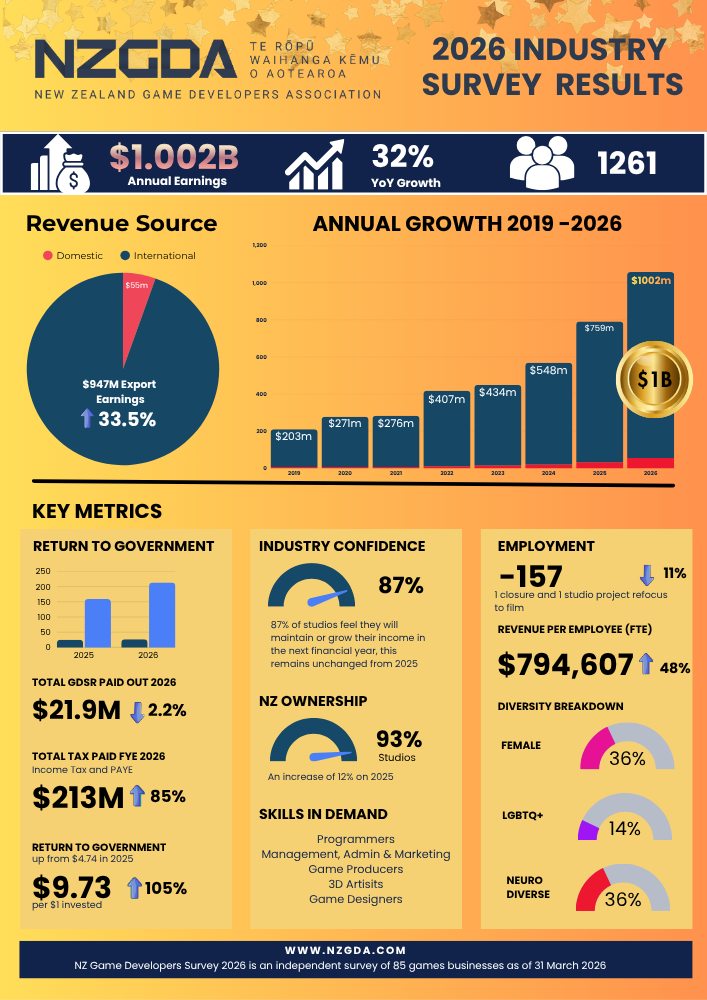
New Zealand Game Developers Association · 2026
New Zealand Game Developers Association · 2026
New Zealand Game Developers Association · 2026

New Zealand Game Developers Association · 2026

New Zealand Game Developers Association · 2026


New Zealand Game Developers Association · 2026

New Zealand Game Developers Association · 2025

New Zealand Game Developers Association · 2025

New Zealand Game Developers Association · 2024

New Zealand Game Developers Association · 2023
New Zealand Game Developers Association · 2021

New Zealand Game Developers Association · 2020
Jason Schreier · 2026