1 free read left. Create a free account for unlimited reading + AI research.
Create free accountWhitepaper DiGRA
1 free read left. Create a free account for unlimited reading + AI research.
Create free accountWhitepaperDiGRA
Law No. 15.211/2025, the 'Digital ECA', was sanctioned in September 2025 and takes effect in March 2026.
Penalty. The law authorizes fines of up to R$ 50 million per violation.
This study examines how Brazilian players interpret and contest Law No. 15.211/2025, the "Digital ECA," as it applies to Genshin Impact's "Wishes" gacha system. The authors argue that regulatory discourse around loot boxes is not purely legalistic but is shaped by political and cultural context, particularly Brazil's ongoing debates over internet governance, censorship, and gambling. The law, sanctioned in September 2025 and taking effect in March 2026, bans loot boxes for minors, mandates age verification and default privacy protections, and authorizes fines of up to R$ 50 million per violation. The work positions Brazil as a Global South perspective in regulatory debates long dominated by European and East Asian jurisdictions.
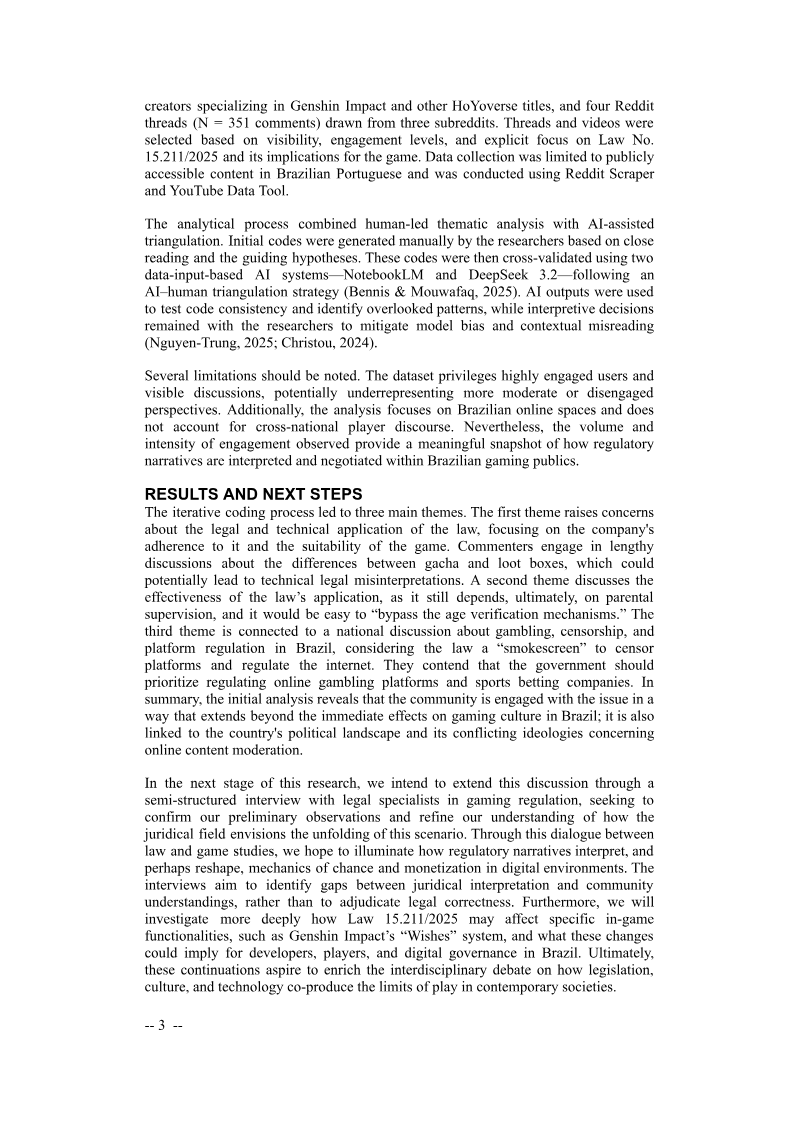
The methodology combines a close reading of the law against the game's Terms of Service and Privacy Policy with a netnographic analysis of Brazilian Portuguese-language discussions. The dataset includes 422 YouTube comments from two videos and 351 Reddit comments from four threads across three subreddits. Coding was conducted manually and cross-validated with two AI systems, with interpretive decisions retained by the researchers. The authors acknowledge limitations, including a bias toward highly engaged users and a focus limited to Brazilian online spaces.
Three main themes emerged from the analysis. Players debated the legal and technical distinction between gacha systems and loot boxes, raising the possibility of misinterpretation. Commenters doubted the law's effectiveness, noting that enforcement still relies heavily on parental supervision and that age verification could be easily bypassed. A third theme linked the law to broader national anxieties, with some participants viewing it as a pretext for censoring platforms and regulating the internet while arguing that regulators should focus on online gambling and sports betting.
The authors conclude that community engagement with the law extends well beyond gaming culture into Brazil's political landscape and its conflicting ideologies about content moderation. Planned next steps include semi-structured interviews with legal specialists to identify gaps between juridical interpretation and player understanding, and further investigation of how the law may specifically affect the Wishes system and the broader relationship between legislation, culture, and technology in shaping digital play.
Each row is a game or company this document names, each column a document, oldest first. A mark means that document names it. Select a row to see those documents.

DiGRA · 2026

DiGRA · 2026



DiGRA · 2026



DiGRA · 2026



DiGRA · 2026



DiGRA · 2026



DiGRA · 2026



DiGRA · 2026

DiGRA · 2026



DiGRA · 2026



DiGRA · 2026

DiGRA · 2026
DiGRA · 2019