1 free read left. Create a free account for unlimited reading + AI research.
Create free accountArticle Newzoo
1 free read left. Create a free account for unlimited reading + AI research.
Create free accountArticleNewzoo
This figure represents a modest 2.6% year-over-year growth.
The global PC and console gaming market is experiencing a period of decelerated growth and shifting engagement patterns, characterized by a significant decline in average playtime and intense competition from established, evergreen titles. While the market reached $93.5 billion in revenue in 2023—a 2.6% year-over-year increase driven largely by the PC segment—the rapid expansion seen between 2015 and 2021 has largely subsided. Projections suggest a modest 2.7% compound annual growth rate through 2026, with future gains expected to rely on console install base expansion and new hardware releases.
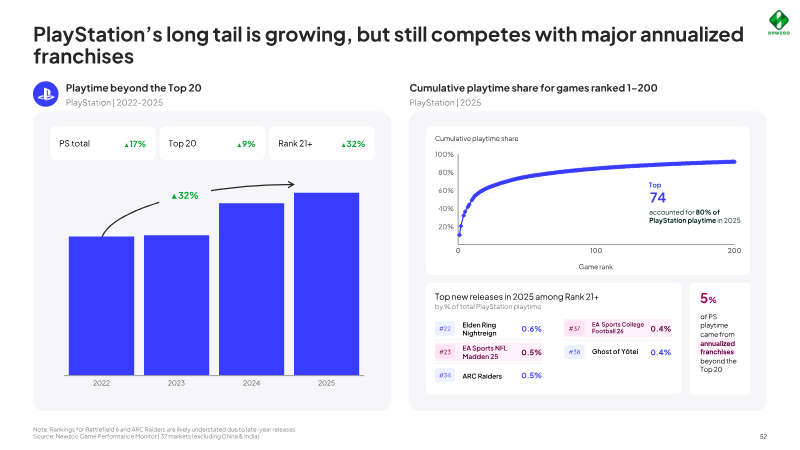
A primary challenge for the industry is the contraction of player engagement. Average quarterly playtime on PC and console has fallen by 26% since early 2021, with nearly all genres seeing a decline in user activity. This environment is dominated by long-standing titles; games released over six years ago accounted for 61% of total playtime in 2023. Platform-scale games like Fortnite and Roblox continue to command significant market share, effectively acting as "behemoths" that compete for a finite pool of player hours. New releases face a difficult landscape, as only a small fraction of titles launched after 2022 capture the majority of player spending and engagement.
The market is increasingly defined by a "zero-sum" dynamic where premium game sales often cannibalize time and revenue from live service projects. While new games launched after 2022 saw a slight increase in their share of total playtime, this growth is heavily concentrated within annual franchise releases. Consequently, studios face mounting pressure to secure player retention against a backdrop of aging, content-rich titles that benefit from established user bases and robust, ongoing development pipelines.
Newzoo · 2026

Deconstructor of Fun · 2026

The Game Business · 2026