Transcript
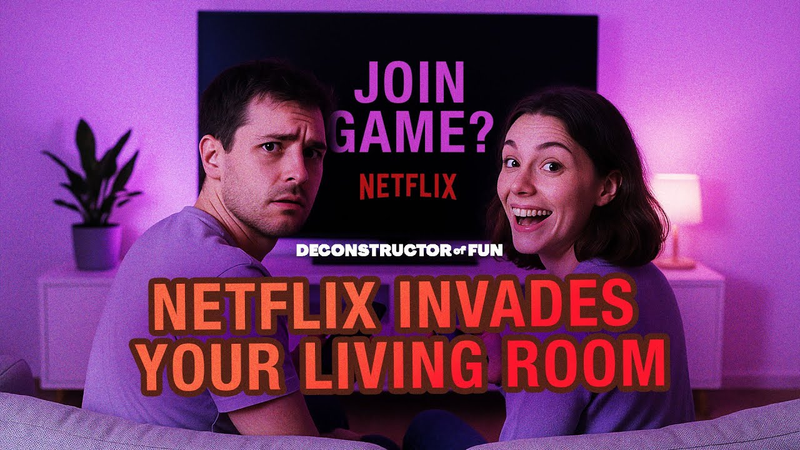
[Music] talking about screwing the push. Let's talk about Netflix 2.0. The announcement in short was that that Netflix is back, baby. Like it's Netflix games is is rolling. It's shipping and the new thing that they're shipping are party games. So, I watched the video with the co-CEO, Mr. Greg Peters and he talked on Bloomberg interview that the challenge still remains that a large portion of people just don't know Netflix offers games. So it's a long-term strategy guys to keep telling them about games and shipping new ones and talking about it. So now in this talk the phone was the problem because you have so many things on your phone and kind of games on Netflix is not that thing. So, they're going to take the living room and they're going to introduce party games that you can play on your phone on the TV device inside your house. This is so
revol revolutionary. I've never heard of anything like this. And they are essentially taking the battle into the living rooms. And you know, I was listening to this and a reporter of course didn't challenge this CEO that you know, it launched its first game in 2021. So, it's been a few years that they've been promoting this on their platform and they have been promoting it on the front screens and you can kind of argue that Discovery is hardly the problem. Maybe the product market fit is the real problem. You know, everybody knows that Netflix does live sports right now. They got that real quick. Like everybody knows you get boxing on on Netflix. They had to do one fight with not even a real boxer and and you got it. So the big question here remains what is the product market fit with these party games because Apple has done this for a while. Like you go to Apple store and they promote this. You can even get a controller. It's on your Apple TV. Samsung smart TV has been offering this as well. You can use your
Samsung phone. You can install the apps. You can you can do this. So to me this sounds that they're pivoting to something that sounds much easier than it is. I am worried because Netflix 1.0, the one that spent $3 billion on on on essentially releasing Steam ports and dead freetoplay games that kind of like to me showed that this perhaps an organization that will not always win. And so I all the best to them in this battle, but I'm scarred by Netflix 1.0. So Chris, what's your take? I'm far more supportive of this Netflix 2.0 approach. This actually makes sense. This feels like more of their wheelhouse to me, right? And I think what they really just need is like the Stranger Things of interactive, something that's like super compelling that people really get engaged with, right? I think pushing the envelope on interactive and social on smart TVs makes sense, right? rather
than distributing licensing junk on mobile or doing stupid deals with Take 2 regarding GTA. But imagine if they build like a network of social party games and that builds engagement and retention. That's what they need, right? And it lives outside of traditional gaming to some degree. It's completely different different vertical altogether. Now, the mention of Xbox cloud gaming is stupid. No one cares. I don't know why people are discussing that anymore. But I I still can't understand why they can't make the stuff more popular. Maybe it's just because the content is not popular. So maybe you awareness, I mean, for for the Netflix user base. I do think it's going to take, like I said, a Stranger Things type experience that reaches the masses, I guess, um, to get this as more as part of what the expectation is from the customer. Maybe they could buy Jackbox Games and do the [ __ ] obvious thing they should have done 10 years ago as they try to rebuild it. How much could they possibly be
worth that Netflix would not write a check to just solve this problem? Or at least I don't know. That's a bet I would take rather than what did they pay 50 million for GTA.
Yeah, exactly.
For a one-year loan.
[ __ ] pissing away.
Yeah. Well, hold on. Hold on. We need to be positive. We need to be positive. This is a very positive thing. They're taking positive steps. They're big IPs. Legos in here. Tetris Time Warp like they didn't Pictionary. Love it. Love to see it. And only that Netflix games with a lowercase G, that new strategy slaying. And we know that because K-pop Demon Hunters came in their stupid Roblox experience like a week after it launched. That was positive. It was still stupid experience. It wasn't separately branded. It was with inside the Netflix world. So, I'm sure they can spin up things in that world or that experience quicker than like a separate skew. But, they still did something. And they announced a Fortnite deal, right? They announced a Fortnite deal where K-pop Demon Hunters is going to be coming to Fortnite as cosmetics. Also big [ __ ] win. Things that you can move quickly on that have low marginal cost like capital. This is the most
viewed Netflix show movie of all time already. Incredible incredible results. Capitalize on it.
Yes, absolutely. So, I think these are all very positive things. Of course, not for Netflix games with a capital G. That's still a failure. This seems like branding play. Uh and I think like now they're moving on to the next set of problems which I do think is a much more interesting problem set which is like for instance what do I do on the controller side right so they have the Netflix app controller and if you look at sensor tower numbers the number of active users on that game controller is about 1 million compared to 30 million MAU in the United States so like talk about failure I don't know why you wouldn't just build this into the core Netflix app experience I don't think it's that [ __ ] hard but whatever I think this is ultimately a positive thing like let's get to that second layer of problems like Remember, they have a million devices they have to like optimize for. That was a big problem with the interactive stories. Remember the Black Mirror interactive story that they recanted? They moved away from this.
Oh, how how could you forget it?
So, there there are real problems to solve. I wouldn't ignore those, but like this feels like the obvious plays
besides Ethan's Bridgetton match and Emily and Paris dressup game.
Okay, first of all, that's a great idea. Those are totally
They haven't gotten worse ideas, Laura. Like, they become better ideas. Well, the thing about buying Jackbox, why would you do that to Jackbox? I feel like they already have this kind of down pat. Like Jackbox has been doing this for ages, and I feel like Netflix is just kind of picking up. Ah, and then also, I don't know if you've played there, uh, what was it? Acron, Revenge of the Squirrels. Um, Revolution Games has been doing this, too. There's a theme in this episode when we're talking about games. It's like late to the party. In this case, late to the Jackbox party, late to the using mobile as your main controller party, but this has been done forever. And like I mean the combination would have been more interesting like with the Acron game. It's a VR set where you play as a tree and then the phones are actually you're playing a scroll. So you can play in a group. One person is the VR headset. You're using a screen and then everyone's interactive. So they're moving into that level of kind of social
gaming. But it's not novel. I feel like they're just catching up. [Music]
Auto-generated captions from YouTube — names and numbers may be misheard.




















Comments