1 free read left. Create a free account for unlimited reading + AI research.
Create free accountArticle Board Game Studies Journal
1 free read left. Create a free account for unlimited reading + AI research.
Create free accountArticleBoard Game Studies Journal
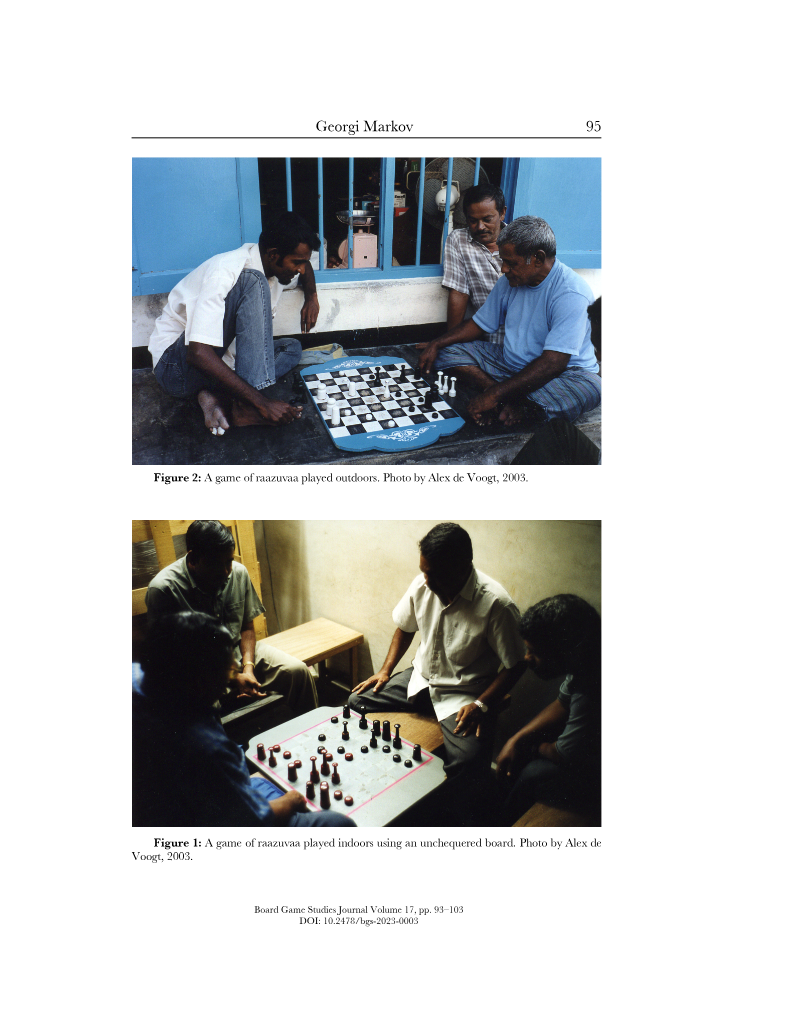
Maldivian chess, known locally as raazuvaa, has been largely overlooked in chess history and earlier literature. This paper documents its rules.
This paper by Georgi Markov, published in the Board Game Studies Journal, documents the rules of Maldivian chess, known locally as raazuvaa, a game that has been largely overlooked in chess history and earlier literature. It corrects prior accounts that treated raazuvaa as a variant of Indian chess, and it argues instead that the game is closely related to pre-19th-century Ottoman Turkish chess, possibly a surviving relict of that tradition. The author's aim is to establish an accurate rule description and to situate the game within a broader account of how a European-invented chess form may have spread across the Muslim world and beyond.
The rules are reconstructed from older literature, a short article by a native author, and personal communications with specialists and a Maldivian sports organisation, supplemented by analysis of videos from a 2020 tournament. Raazuvaa uses the standard orthochess setup and piece movement, but omits the initial double pawn move and castling, promotes pawns only to queens (with an unrestricted number), and treats bare kings as a win unless the bare king can capture the opponent's last piece. Stalemate is a loss for the stalemated player, and the kings are placed crosswise, with the queen to the king's right. The author notes that these features closely match a 1745 description of Ottoman chess and a 1671 account of crosswise kings.
The paper's broader argument is that the Ottomans may have been an important conduit for the new European-style chess, with its long bishop and queen, carrying the crosswise king arrangement to regions such as Siberia, the Aleutians, and East Africa. Comparative evidence from Mongolian and Aleut chess, along with reports from Zanzibar and German Witu, supports this hypothesis, though the author treats it as plausible rather than proven. The paper closes by warning that traditional variants such as raazuvaa are endangered by the spread of standardised orthochess, and by calling for their preservation.
Board Game Studies Journal · 2025
Board Game Studies Journal · 2025
Board Game Studies Journal · 2025
Board Game Studies Journal · 2025
Board Game Studies Journal · 2025
Board Game Studies Journal · 2025
Board Game Studies Journal · 2024
Board Game Studies Journal · 2024
Board Game Studies Journal · 2024
Board Game Studies Journal · 2024
Board Game Studies Journal · 2024
Board Game Studies Journal · 2023
European Conference on Games Based Learning (ECGBL) · 2026