1 free read left. Create a free account for unlimited reading + AI research.
Create free account
Keynote: How to "Break-in" to the Games Industry: Why it’s Both Hard to Hire & get Hired PGCD#2
Key insights
6 takeaways- 01The games industry suffers from a high-turnover labor market where fewer than 17 percent of professionals possess more than seven years of experience.
- 02Organizations must move away from pedigree-based hiring metrics and instead adopt holistic evaluation processes that prioritize adaptability and individual potential.
- 03To combat high burnout rates, studios need to shift their focus from short-term acquisition to long-term internal mobility and improved work-life balance.
- 04Hiring managers frequently rely on inefficient, costly poaching of passive candidates from established firms rather than developing internal talent.
- 05Firms recruiting for senior leadership roles like CTOs should utilize a 'jackpot mentality' that emphasizes mission-driven incentives and equity to attract talent from secure, external positions.
- 06Prospective candidates should bypass traditional application methods by using tailored outreach and portfolios that frame non-industry experience as transferable, problem-solving competencies.
Ask AI about this video
Transcript
hello everyone thank you for taking a break from your regularly scheduled work from home programming bring your kids bring your spouse bring your pets because they won't leave you alone anyway let's see let's this what do you do what do you do is probably one of the first questions we get asked when we meet new people it's what's your name what do you do and if you think about it it's a kind of a big question but we know in society that it means what do you get paid for what is your job and really it's just a product of us engaging in mental shortcuts so that we can sort of categorize people right
there's nothing manipulative necessarily about it but we're very busy in day to day life we kind of need to know in a couple seconds how can we define it and what your job is is an easy way to do it it's obviously not super accurate but it's something that we do and it's how we at first is how we evaluate people on how we're going to hire so a part of this talk is going to be how those mental shortcuts can help us but also they can hinder us so what do I do I kind of skipped ahead I'm a recruiter I'm a recruiter I'm a recruiter so are you there was a comment just made are you sharing your screen are you planning to share screen oh my okay interrupted thought I'd yeah if you want to share up your screen if you want yeah hopefully you're able to do that
here we go okay is that better yep that's better although we're seeing the powerful or the slides rather than the presentation though so we were taking the present present mode there we go there we go okay so the joke was I remember I'm a recruiter I'm a recruiter I'm a recruiter so I'm the studio recruiter at Roby oh that's what I do before it was three four three industries which was making Halo Infinite before that I was an agency recruiter at the companies you see there before that what did I do
I traveled full-time and I was a theme park performer I was the guy putting on the costumes going around and entertaining people I was also the voice-over double for donkey from Shrek in the Southeast Asia theme park region so there those aren't really directly applicable skills to what I do now but I was able to figure out some of those mental shortcuts about how people are evaluated and and was able to make a career change for myself you know in my late 20s and I think that anyone can do that and I think we should embrace those towards sorts of people that have a variety of backgrounds history lesson from World War two to 1970s companies filled about 90% of their vacancies through internal candidates people that already worked there today it's about a third I would say in the games industry it's even less why that's important is
you look at the market share that the recruiting industry has compared to the games industry it's absolutely massive last year we had one point are 152 billion in the games industry recruiting industry and I'm not just talking about like your recruiting team in in your company I'm talking about firms that their whole business model is to recruit 400 billion dollars so this is absolutely massive and this is because those mental shortcuts were talking I was talking about earlier this is because we're seeing the solutions to our problems externally and internally we could get really zen about that but don't have time for that agenda this is we're going to get into why is it hard to get hired why is it hard to hire and what to do about it when I was making this talk I thought you know is this gonna be tailored to people on their own career paths is it tailored towards people who are making those decisions about your career paths and I figured you know we're actually kind of gonna be both in our careers so
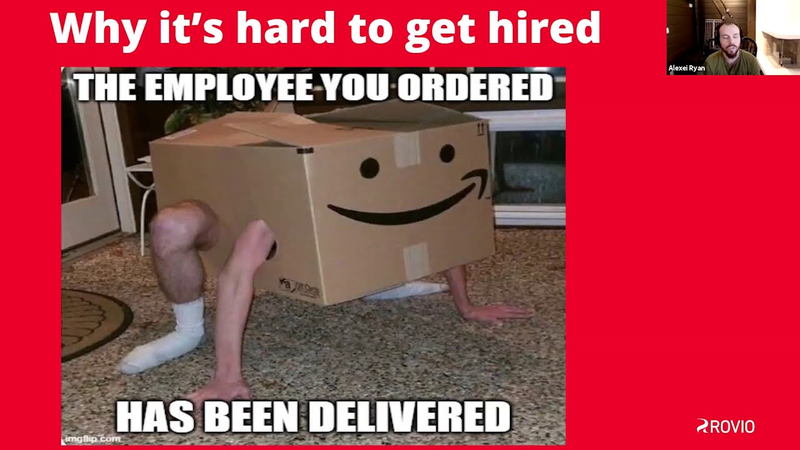
we're gonna go over both why it's hard to get hired I think this image kind of wraps up the main reason why companies and teams look at candidates often as a complete package something that is signed sealed delivered it's it's finished we can order them off of a menu a job description looks very much like like a specific order but no one is a finished product no one is done learning and no one is done growing so we can't expect people to come in and just be the solution to our problems because what they've already done we also have to consider what they're going to do now how we really decide on a hire decision this is not how we necessarily should decide but these are the things that we decide on
first thing is the pedigree when I was talking about the mental shortcuts the heuristics from before when we're looking at a resume the human attention span is about seven seconds nowadays so we're spending about seven seconds looking at a resume so we're not going through each thing and we're not trying to make a bunch of mental leaps about what this person could do we're trying to find things that we recognize and one of the things that we recognize our company names and what we do unfortunately is that we outsource our evaluation on to other companies so we go well I recognize that company they're really good so this person must be good they've evaluated them so we can assume that they're good and usually those people who have worked at companies that we recognize we usually push them through the process that also plays into they've already done the thing often times when we have some tasks that need to be done we have a vision that needs to be completed
hence we're making a roll or opening a roll we're looking for someone who's already done the thing we want them to do now and so what then we do is then we outsource experience Elster's experience to our competitors we're saying well we want our competitors to have trained these people and we want our competitors to have grown these people into doing these things and then we're just going to reap the benefits and we don't expect them to make any leaps of skill set or experience that plays into them specialization in one field number of years if you look at any job description most of them will say needs three years experience five years experience seven years experience but if you look at if you ask a hiring manager to really look at the qualifications you go what makes this need five years versus four years they won't be able to tell you oftentimes it falls into internal equity someone feels like they've been working at it longer and you know it's not fair
if we hire someone who has less years of experience but we're not taking a consideration what they actually do and the last thing is culture fit I could do a whole talk on culture fit but what I will say about it is we often disqualify people for culture fit because we don't we're not vibing with their personality there's there's a trope of you know what I have a beer with the person and this is not this is not what we want to be evaluating on culture fit should be something how does their personality in their way of working how does that you push the envelope does that is that a here to a certain amount of our values but also challenge on others and of course are they not rude are they respectful why it's hard to hire a lot of this comes down to we're ignoring active candidates and we're pursuing passive candidates too much there's a couple a couple stats here from Wharton School and LinkedIn we're going to get
into in the neck slide we're going to get into motivators that candidates have but I'll touch on this very very briefly when we go after a passive candidate I define as someone who already employed not really looking for a job not really necessarily interested in what you were doing but they're being reached out to and you're trying to you know twist their arm trying to woo them trying to get them to join an active candidate is someone that has shown interest in your company and an active candidate can also be someone whose internal at your company right someone who is interested in getting a promotion we're making a lateral move or changing projects or changing crafts within your company when we pursue passive candidates and we're asking them to do the thing that they've already done so there's no promotion being given to them maybe the quality of life isn't that much different maybe there's not much different that we're offering them
so then it has to be more money and if we look at the industry-wide and raise rates it's about three percent so about every year people get on average in industry about 3% raise but when you leave to a new company you get about on average a 10 to 20 percent salary raise so if you do the math there with the industry attrition average people stay in their companies about two to three years so passive candidates know to make more money they just keep jumping they just keep jumping and some big companies know this and they try to keep them with long term incentives but that doesn't work because then the next company will just pay out those long term incentives right so what happens in these these couple candidates they keep getting recycled every time they jump they get more and more and more and more expensive and they very well may be very good at what they do but their price range is this exponentially higher than
the active candidates that you could have been pursuing and why is this relevant is the next stack is it takes according to the same Wharton School study it takes outside hires three years to perform as well as internal hire in the same job all internal hires take seven years to earn as much as them so you can see you could see where the discrepancy is here we're paying tons of money for people based on pedigree they've worked at a bunch of good companies we assume that they're better than the people who are actively interested or the people that are already in the company and know how things go and statistically they're not going to perform as well as if we just promoted it from within and then I'm ashamed of talent acquisition leaders like myself only 20 percent say that internal candidates are an important source to fill vacancies which is shameful shameful alright I've done a video on this before this could be a whole talk on its own but when I practice this yesterday I ran a little long so I'm gonna be super brief on this
what motivates candidates really comes down to these four things in general its career growth which is are they are they getting a promotion and title or they're getting additional responsibilities can you offer them a career roadmap when they join your company or while they're in your company and if your company has at least three out of the four of these you're golden if you're failing on any of these that's okay you overcompensate in the others all right compensation it's not just salary yeah those passive candidates in general like to hop and get raises every time you could throw money at people but it doesn't keep them but it is it is a factor but I say especially for leaders work on the LTI as you know stock equity RS use whatever profit share that you can guarantee them it'll give them sort of a you know a more of an emotional tide of it because they know they're getting compensated for the good work they do they know that that success means something physical to them and
compensation is not just lifestyle it's also showing how much you value the candidate right it's even if you can't compete with like the big dogs in the industry when you're offering somebody you could say you could explain to them why this is really good within the market why this is really good within your own company and why you wanted to give them you know maybe higher than average offer for the context and they're showing them that how much you value them it's more of an emotional thing personal life work-life balance need I say I need to say anymore one of the reasons why I moved from California to Finland is because there is no crunch we work 37.5 hours a week we can't be asked to do more so that's huge and then passion a lot of us get into games because of passion a lot of us staying games because of passion and big tech is competing with us for talent and they're gonna be offering sometimes three four times the amount of salary
for some people like engineers and designers and producers and whatnot but people staying for passionate so when you're talking to candidates when you're talking to people in your company make sure when the first things you talk about is the passion piece and and when you are selling a candidate on a position or or a company feedback to them what they said about what they're passionate about and present what you have to offer as that passion if you truly can't do a lie and then when you're close to them all you do is when you're giving them the offer you go hey remember you said you're passionate about this you're gonna be doing this a lot and it's an easy sell it's an easy close so what should we do about these things if your candidate have done a video on this if you haven't gotten that big break know that I talked about you haven't worked for that big company yet so then you kind of you kind of pass through that that mental shortcut of being recognized that's okay
but what you need to do is you need to realize that like these hiring managers and recruiters were all busy but they need to know that if they take a chance on you that you're not going to be a risk right they want to know that their life is gonna be easier if they give you a shot so keep it super simple reach out to people stalk them on LinkedIn you can always stalk me find people in your craft find managers in your discipline and reach out with two things why you're specifically interested in the company or in the project say something about that other person that you've noticed about their work say something that what draws you to it and then why you specifically be an asset you know go out on a limb you know maybe assume assume some things that they're doing they're doing oh I noticed based on an article that you were going to be making personalized gains by 2022 I'm actually working on a machine learning project myself you know
I think that that might be a valuable asset to that goal BAM you've done some research that looks super good don't expect all your dreams have come true off of a single cold reach out so stay in touch connect with humans talk with them constantly talk about the industry then if you're not being given a chance by somebody else give yourself a chance work on stuff make mods in your favorite game a volunteer time on indeed passion projects when I was a theme park actor and I came back to California and tried to get in the games industry I applied and applied and apply it and no one would take me obviously who's gonna take a guy who just put on costumes for a living to work in the game company No so what I did was is I volunteered my time to work on a video game in some dudes garage for free it made no money it was a little space shooter released on Android but I did it I didn't let wait
for anyone else to give me a chance I worked on that and that led to my very first games job because at least I kind of knew something about development and that is great success what to do as a hiring manager so we should be being proactive it's crazy to me that you know companies will say you know what's your most valuable asset and we'll say oh people but then we don't really invest in talent acquisition we don't really invest a lot in HR so this is what we should be doing we should be hiring people for potential we should be hiring people before we need the role to be filled and look for unique stories you do not know how someone's background is going to pay off in the long run and this is one of my favorite quotes hire employees who introduce healthy conflict and divergent views that can spur real growth look for high-risk people in today's unpredictable business environment companies need people who can roll with the changes that occur
frequently so these are the types of people you should be hiring yes the person who's done the same thing for 12 years will be reliable will be dependable they'll do the thing that they've always done but you do need the wildcard people you knew need to innovate or die if you're a hiring manager and you're gonna open a role this is what you should do in order first check your internal talent as as I told you internal talent performs better it's also a huge morale boost company-wide when people are getting promoted when they see that there's actual career development within the company then if that fails then you check active external Talent and that includes referrals I could do another talk on referrals don't rely exclusive on referrals it can homogenize your culture but do that if then the people that are already interested you cannot find what you need then you need to rethink your requirements it's not yet time to engage passive talent you need
is rethink does this person really exist do these do these qualifications are these realistic right what do we in fact need them to do and I recommend remove all mention of years of experience on all your job descriptions I will say that blanket as a rule unless there's some legal reason that you need them to be there then if for some reason none of that works then you can start engaging past the talent for that role you can start reaching out to them directly having your recruiters reach out to them directly hire internal recruiters don't don't rely exclusively on agencies they're very expensive they're good at what they do but you want to have an internal talent acquisition team who can create a database for you and Korean employer brand for you and lastly everyone just network istick networking was a dirty word it really just means meeting humans and talking to them stay talking to them we're all humans at the end of the day and we just like to work with people we like and that's it I hope
I didn't go over time and thanks for bearing with me the tech stuff in the beginning if you want to reach me LinkedIn on most active on and I threw my Instagram on there just so you can see what finish life is like from a foreigners perspective I chose the hashtag in to finish life somewhere along there is I thought I came a half adopted in at times anyway and thank you for that thanks and so we've got a few questions I'll go straight to them because we've got plenty of them so Louise Dylan is asking any advice on breaking into the industry in a marketing / events position she's got a lot of experience with in tech space but she had she showed hiring managers that she has a passion and transferable skills oh yeah I mean events events are amazingly transferable I would say that not a lot of companies see the value in them when I I won't mention the company but I worked at other companies and we were
really really meticulous about the ROI of the events we would throw we'd say this is how much it cost to throw this is how many candidates we we got so if you're approaching a big company I would say have some metrics people love numbers if on any resume I tell people don't list your tasks list your accomplishments and numbers speak to everyone not just big companies so if you through through events you could say I did it for this reason these were my measurables this is what I accomplished this is how I grew the business or whatever and those are going to translate as far as how you could pitch that to a games company I would say employer branding is huge from my perspective as a TA person like also user acquisition is really hot like I said before with with the reaching out to people try to identify like what company you're going after is see what
their goal is and see how you can tailor the work you've done to that and if you network like I said and you get to know people they'll give you more than that 7 seconds of their time and yeah hopefully that's helpful any sense how has the visa situation for internationals applying for roles I only have that work our company's gravitating towards hiring national people instead or are they still looking for international people imagine in Helsinki and such a demand on the local talent pool I I'm assuming it's still the case you're desperately come try and get everybody to see the values of living in lovely Helsinki or Expo yeah you-you-you mean that's why I'm here I am not I'm not a local local Finn I came very far away in California my job
is to convince foreigners that this is a great place to be so yes absolutely I wouldn't say yes the whole corona thing has slowed things down logistically but at least for for my work no we're still very much going after international talent I would say yeah it's going to depend on on the company you right now the bigger companies are winning because they they have the bandwidth to you know stay afloat when things things are tanking so the big companies across many industries are absorbing all the best talent right now whereas I feel like in the past couple years it's been kind of opposite big companies have been losing talent to the exciting startup so I think people are kind of craving that stability I I'm not an immigration lawyer so I can't advise on specific visa situations but what I will say is we are as an industry
I think we are evaluating how important it is for people to be in the office but something that people don't realize is there's a lot of like tax reasons and legal reasons why a company needs you to at least be in the country so for Rovio we're basically if there is a really compelling case to start you remotely we will but the expectation is that you then do have to move to Finland or Sweden where we have our office yeah it's a difficult one particularly sitting here in the UK we have obviously the gonna fall out from Pro brexit to really hit us but actually even then just sponsoring an international visa is very prohibitive for a small company it's impossible but it is as near to impossible as most small teams could do so I think it's part of the reason why from an international point of view it's large you're going to be the bigger companies but that being said we work kind of internationally so we we were remotely
anyway so we happen to have people but you have to hum as consultants you can't find them as staff and that can have other implications so it's a it's a tricky Beast but I think it's obviously something that needs to be paid attention to so next question and again well rattle through these so Eden Reeve is a freelance concept art is having a tough time entering the industry they've sent messages to people trying to connect and quotes has been ghosted what hundreds of people apply yeah how do you get into such a good positive role okay so you have you have an advantage because you're an artist you can have a portfolio this is a huge huge advantage especially for junior talent because you just go I do this this is what I've done the proof is right there is a lot harder for other other crafts to do that you
have to kind of convince somebody so make sure that your portfolio is up to date make sure it really shows what you're proud of I think especially when you're junior it's less important to show your variety and it's more important to show like what's your specialty is so you do how you want make your art station your website whatever feature what your specialty speciality is and then you can have other links to other stuff that you can do personally I've seen even even at Roby Oh our art directors are very open to they don't care about the years of experience necessarily in some of our studios they're just like our amazingly good cool you're also fighting against everyone's fighting against the whole my application gets lost in the abyss it's true you know even at Rovio
were a big company but like I'm it I'm the recruiter and I can't even tell you how many applications we get every day so even I have to like take 7 seconds to read them all I just can't do it it's just impossible and I refuse to use things like box to auto do it so I think when you apply and forget it it's a very very rare chance for anybody to get the job from that so I say apply and then reach out to somebody in in the company respectfully hey I applied I'm interested you know could you give me any advice or I noticed this use the script that I that I told you about I don't mind pings at all and in fact I think that shows productivity so just just you know be the squeaky wheel that gets the grease have a good portfolio and follow up follow up respectfully and stay in contact and then when an opportunity pops up he'll be first in mind I'm gonna switch switch questions I
think this is kind of connected there's somebody here saying would you advice to somebody who wants to get into the games business but has no direct experience and his in this case I say he's an anonymous so it could be either gender I need you and you know that not talking about young people but more experienced folks how do you get someone who's got backgrounds it's not games being able to bring that into the games industry particularly they don't have the artist portfolio yeah so that's what I did I was unemployed when I left the theme-park world living in Asia I left the theme-park world I travelled full time for a year and then I went back home to California and I was unemployed for seven months so I was unemployed for a year in seven months and I worked at theme parks I had no directly transferable skills whatsoever but when push comes to shove you figure it out
so like I said you get experience doing something the reason why I'm in recruiting is I figured out that somehow somehow actually my skills and experience being a performer and understanding human psychology into getting to a role to act you have to understand human psychology so I realized oh that's transferable that's something that I can do and I had to believe that myself so when I'm when I'm working on that game I told you about that I volunteered in a garage that gave me the game's cred that showed that I was proactive and I was going out and getting whatever experience I could so then when I finally started reaching out to people at this at this little agency recruitment agency that worked with games companies they saw that had worked on a game and I was able to come up with a compelling elevator pitch about why my theme park experience but translated the recruiting experience it's ridiculous
but if you can make that if you can believe that yourself people will believe it so I don't know what it is you do anonymous but there is something that you do everyone has value because everyone has potential and if I looked at my past and made that an indicator of what my future would be then I would not be wearing em and you don't have to either yeah and I think I so I might kind of when I joined the industry 22 years ago the way I did it is by making a game but it was a tabletop role-playing game I made not I'm not a computer game but I used my marketing expertise because I was a trained marketing guy to come in and I've ended up being a game design or a consultant kind of running big platforms it's about your drive I think to a certain extent and so I'm gonna kind of try and we've got time for one question we've got about seven in this list so many I'd love to answer you know someone's asking about game engines hacking is it worth just make games if
you learn a game engine great and doesn't necessary have to be one or the other it's about understanding how you gonna apply it is that I'm sure there's one yeah exactly even realize of the two but I've seen people game maker showing the capacity to learn as well I get you to answer this last this question and apologies all the others Isis from Miss Dec Nelson so any tips of finding and hiring people at the senior team level so you're trying to find the new company but you need an MD or a CTO to come join you any thoughts on that side Oh for a CTO level yeah yeah so you have to play on the on the jackpot the jackpot mentality right these people are already making they have great stable secure jobs they have great salary they probably have great stock options you need to play on that sort of like Silicon Valley Hollywood thing it's the
difference between a BMW and a Ferrari right that's one way to be like look you're gonna get in on the ground level you're gonna have massive equity on this thing you got to pitch them like you would pitch an angel investor right you have to you have to make them see the huge value of this thing you can also play on the passion of it right figure out what their passion is why do they get into what what they do you know no need to be manipulative but you can kind of you know figure out like is the corporate life draining them in any way one little stat I will drop is it was your year ago or two years ago the 30,000 a GDC participants less than seven seventeen percent of the attendance had been in the industry for seven years or longer so what that tells me is that a lot of these people are burning out and they're going to they're leaving they're leaving the games industry right for these big tech companies but there may be something that goes ah man you know I missed those good old days right play on the passion
and play on that jackpot mentality I don't know I'm gonna say thank you very much there are so many open questions I will try to answer something conserve you can descend into me on LinkedIn I always respond only dude that sounds good so thank you very much Lex thanks everyone basically she ated so that was how to get into the game industry from variety of perspectives you
Summary
The games industry faces a systemic recruitment paradox characterized by an over-reliance on pedigree and rigid hiring criteria, which frequently overlooks high-potential talent. Hiring managers often default to poaching passive candidates from established firms, a strategy that proves both costly and inefficient compared to the performance outcomes of internal hires. This cycle of recruitment is further complicated by high industry burnout rates, as evidenced by the fact that fewer than 17 percent of professionals possess more than seven years of experience. Consequently, the industry struggles to retain seasoned expertise, creating a volatile labor market that prioritizes short-term acquisition over long-term development.
To bridge this gap, prospective employees must shift away from traditional application methods in favor of proactive engagement. Success requires deep research into specific organizational needs, the cultivation of professional networks, and the development of portfolios that showcase tangible skills. Candidates are encouraged to frame non-industry experience through the lens of transferable competencies, such as marketing or design, to demonstrate how their unique backgrounds can solve specific studio challenges. By focusing on passion projects and persistent, tailored outreach, individuals can distinguish themselves as "wildcard" candidates who offer fresh perspectives.
For organizations, the path forward involves abandoning mental shortcuts in favor of assessing true potential. Companies should prioritize internal mobility and foster environments that emphasize work-life balance and career growth to mitigate burnout. When recruiting senior leadership, such as CTOs, firms must adopt a "jackpot mentality" that leverages equity and mission-driven incentives to attract talent currently entrenched in more secure roles. Ultimately, the industry must move toward a more holistic evaluation process that values adaptability and initiative over the narrow, pedigree-based metrics that currently dominate hiring practices.





















Comments