1 free read left. Create a free account for unlimited reading + AI research.
Create free accountWhitepaper European Conference on Games Based Learning (ECGBL)
1 free read left. Create a free account for unlimited reading + AI research.
Create free accountWhitepaperEuropean Conference on Games Based Learning (ECGBL)
It proposes making cognitive dissonance a computable, playable mechanic.
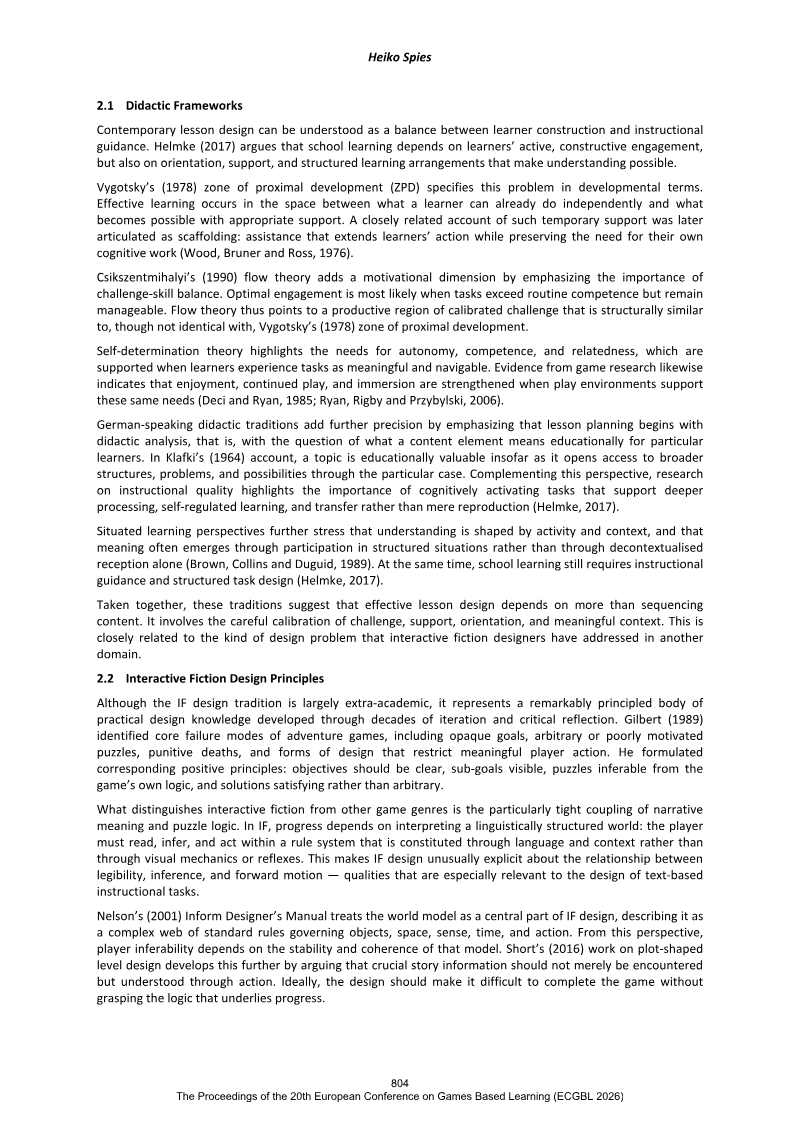
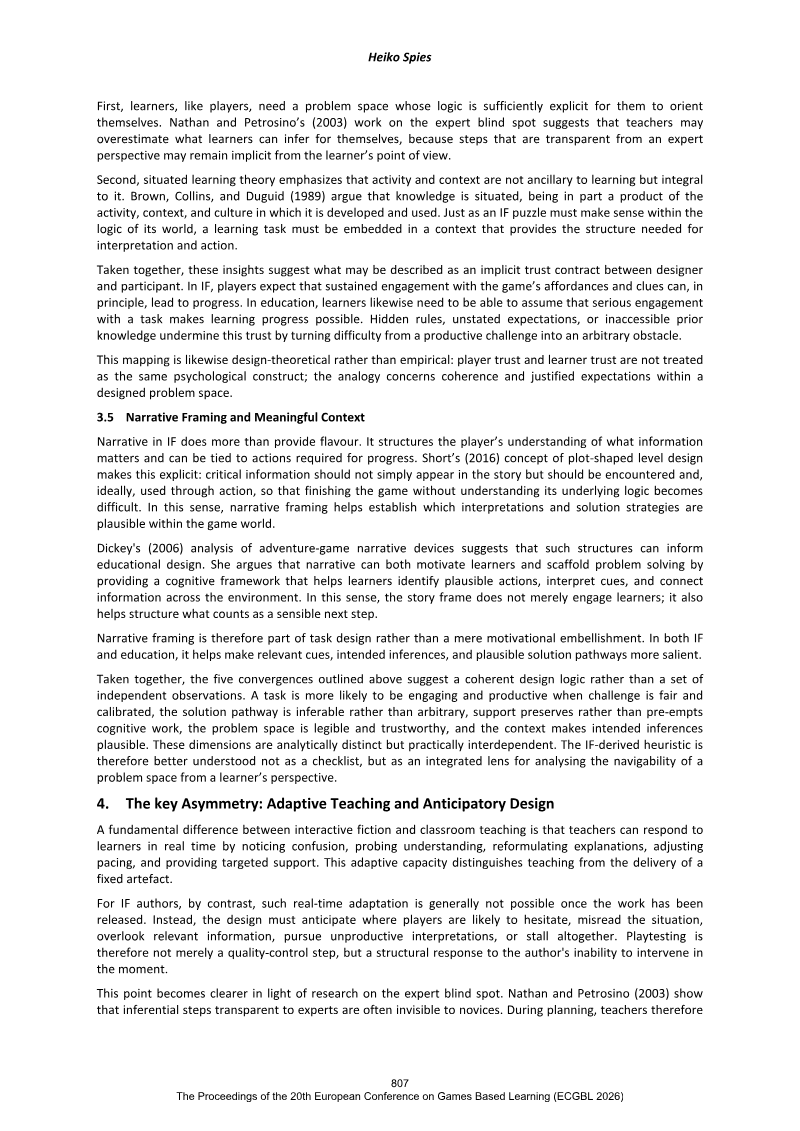
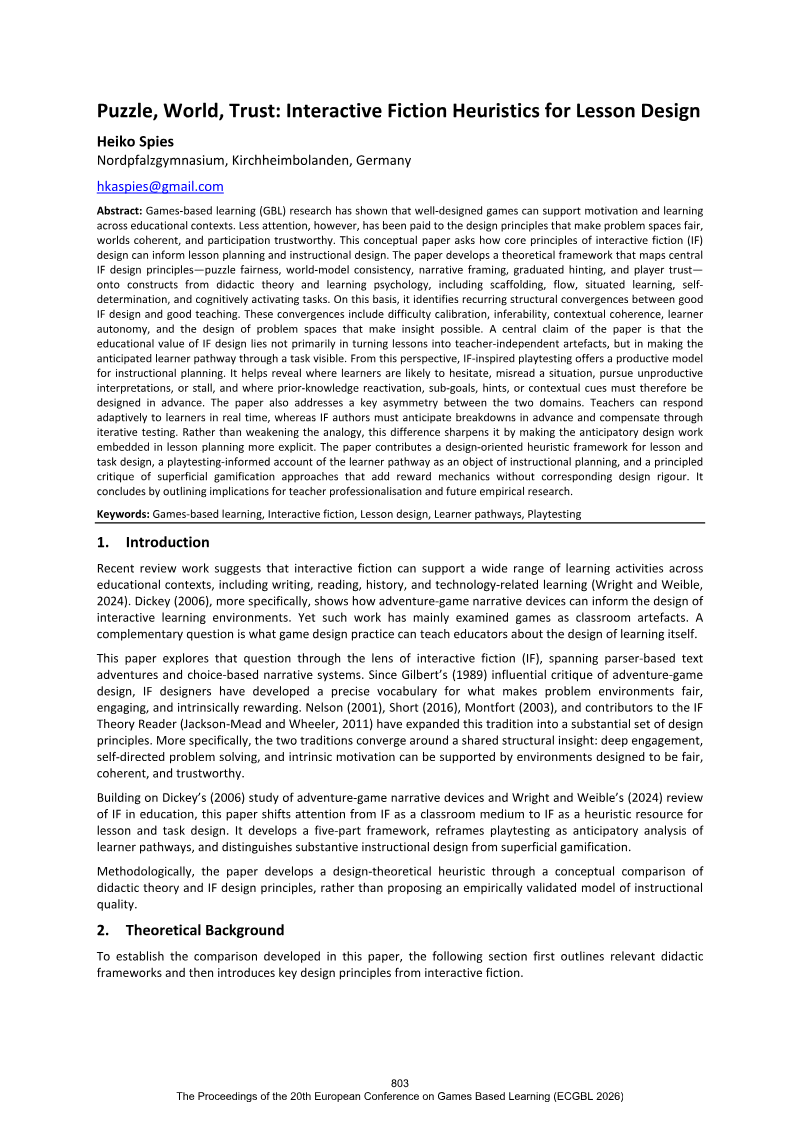
This paper presents a design-stage prototype that operationalises Festinger's theory of cognitive dissonance as playable mechanics within a mobile interactive narrative for educational games. Its central argument is that serious games typically treat psychological concepts as atmospheric backdrop rather than as dynamics players can probe, and that making dissonance computable, through tracked variables and choosable reduction strategies, could support conceptual understanding and reflection on personal rationalisation. The system models Belief Strength, which weights how firmly a player holds a declared value; Cognitive Strain, which accumulates from conflicts between beliefs and actions and compounds over time; and a Persona Dominance Ratio, which reshapes the inner voices a player encounters as a coping pattern stabilises. Three labelled reduction pathways (behaviour change, belief revision, and justification) are presented as explicit options, and the paper notes that justification most erodes belief strength while providing the greatest immediate strain relief.
The prototype comprises ten scenarios organised around five belief domains, with the final five forming a linked arc on coercive control in intimate relationships. Players select three beliefs at onboarding, face two-option decisions, and proceed through strain feedback, coping choices gated by a conflict threshold, and LLM-generated reflection on each episode. The paper grounds its design in constructivist and experiential learning theory, particularly Kolb's cycle and Mezirow's transformative learning, and positions its contribution against knowledge tracing and affective computing approaches that do not represent belief dynamics within the game's own logic.
No empirical results are reported. The authors explicitly frame their learning claims as design hypotheses, to be tested through a planned pre/post study with approximately 20 to 25 adult learners using a conceptual quiz, think-aloud protocols, and post-game interviews. Acknowledged limitations include the binary decision structure, uncertain validity of pre-defined belief elicitation, and the absence of individual differences in dissonance tolerance. The paper proposes the underlying approach as a transferable design pattern for other psychological constructs, such as moral disengagement.



European Conference on Games Based Learning (ECGBL) · 2026



European Conference on Games Based Learning (ECGBL) · 2026



European Conference on Games Based Learning (ECGBL) · 2026



European Conference on Games Based Learning (ECGBL) · 2026



European Conference on Games Based Learning (ECGBL) · 2026



European Conference on Games Based Learning (ECGBL) · 2026



European Conference on Games Based Learning (ECGBL) · 2026



European Conference on Games Based Learning (ECGBL) · 2026



European Conference on Games Based Learning (ECGBL) · 2026



European Conference on Games Based Learning (ECGBL) · 2026



European Conference on Games Based Learning (ECGBL) · 2026



European Conference on Games Based Learning (ECGBL) · 2026
European Conference on Games Based Learning (ECGBL) · 2022