1 free read left. Create a free account for unlimited reading + AI research.
Create free accountArticle Breda University of Applied Sciences
1 free read left. Create a free account for unlimited reading + AI research.
Create free accountArticleBreda University of Applied Sciences
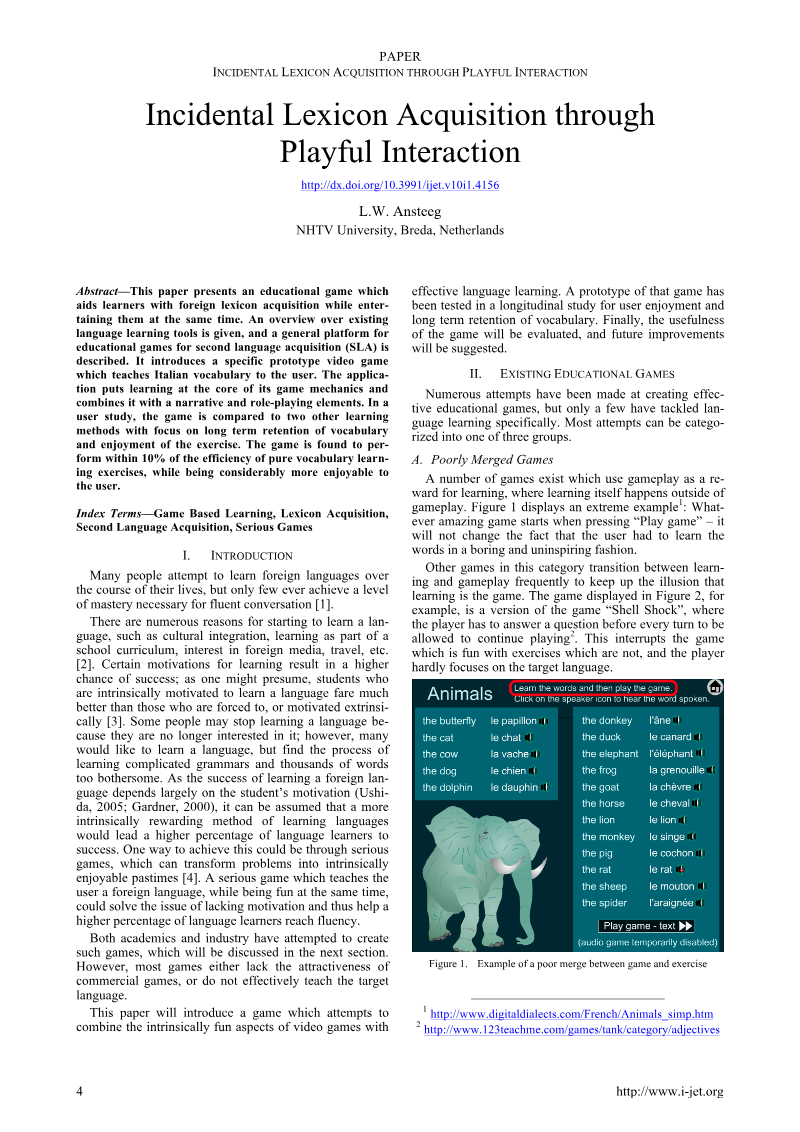
The author reviews three existing approaches: poorly merged games, games that interrupt play with exercises, and gamified products that add points and badges.
This paper presents a prototype video game designed to teach Italian vocabulary while keeping players entertained, grounding its design in the premise that intrinsically enjoyable learning can help more language learners reach fluency. The author reviews three existing approaches to educational games: poorly merged games that separate learning from play, games that interrupt gameplay with exercises, and gamified products that add points and badges to tedious processes. The paper then argues for playful interaction, in which learning is the core gameplay itself, and outlines design principles covering lexical entries (morphology, orthography, prosody, semantics, pragmatics), grammar acquisition through integrated rather than explicit instruction, multisensory output, and a spaced repetition system combining the Pimsleur method with the Leitner system.
The prototype teaches only vocabulary and orthography, with the player learning spells in a wizard-apprentice narrative using four abilities that correspond to different learning methods. In a user study of 12 Dutch students aged 18 to 27 with no prior Italian, participants used the game, flash cards, and the Memrise website over three weeks, with tests administered after each session. Long-term retention after two weeks averaged 6.08 words for the game, 6.25 for flash cards, and 6.58 for Memrise, placing the game within roughly 10% of the other methods. On enjoyment, the game scored 6.92 on a 0 to 8 Likert scale, compared with 4.42 for flash cards and 4.55 for Memrise, and it was the most frequently preferred method in both weeks.
The author acknowledges limitations, including the small sample, the short two-session span that is insufficient for firm conclusions about enjoyment trends, and the narrow focus on written recall rather than phonetics or conversational ability. Future work is identified as needing to demonstrate effective teaching of grammar and the remaining lexical aspects to produce a complete language-learning solution.
Breda University of Applied Sciences · 2026
Breda University of Applied Sciences · 2026
Breda University of Applied Sciences · 2026



Breda University of Applied Sciences · 2026
Breda University of Applied Sciences · 2026
Breda University of Applied Sciences · 2026
Breda University of Applied Sciences · 2026
Breda University of Applied Sciences · 2026
Breda University of Applied Sciences · 2026
Breda University of Applied Sciences · 2026
Breda University of Applied Sciences · 2026
Breda University of Applied Sciences · 2026
European Conference on Games Based Learning (ECGBL) · 2026



Comments