1 free read left. Create a free account for unlimited reading + AI research.
Create free accountWhitepaper Journal of Games, Game Art, and Gamification
1 free read left. Create a free account for unlimited reading + AI research.
Create free accountWhitepaperJournal of Games, Game Art, and Gamification
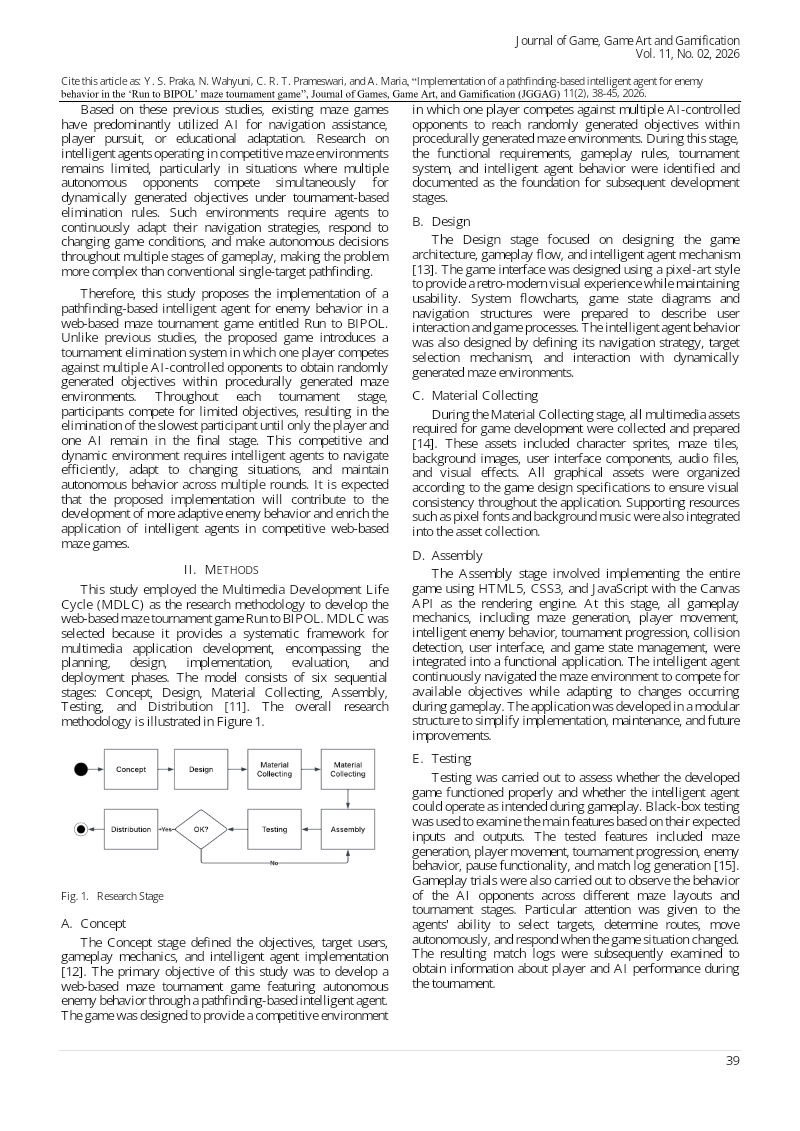
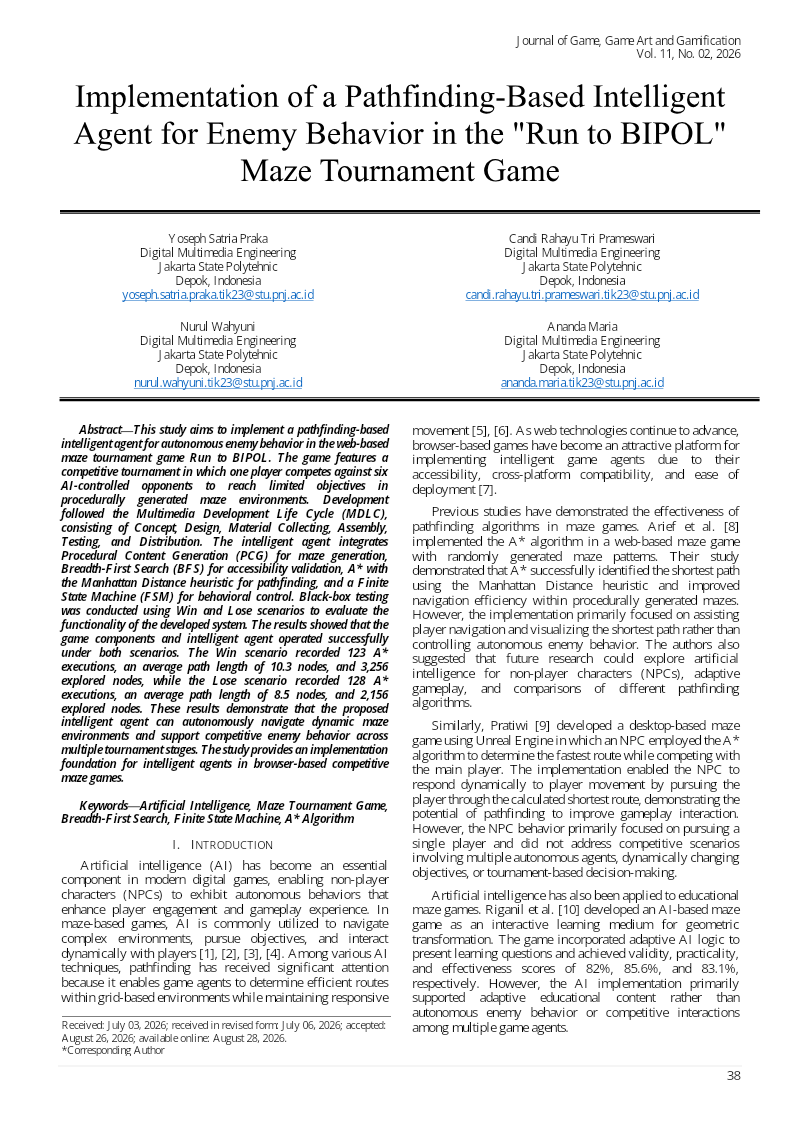
This browser-based tournament game integrates autonomous agent intelligence within a web environment. It establishes a scalable framework for competitive maze navigation.
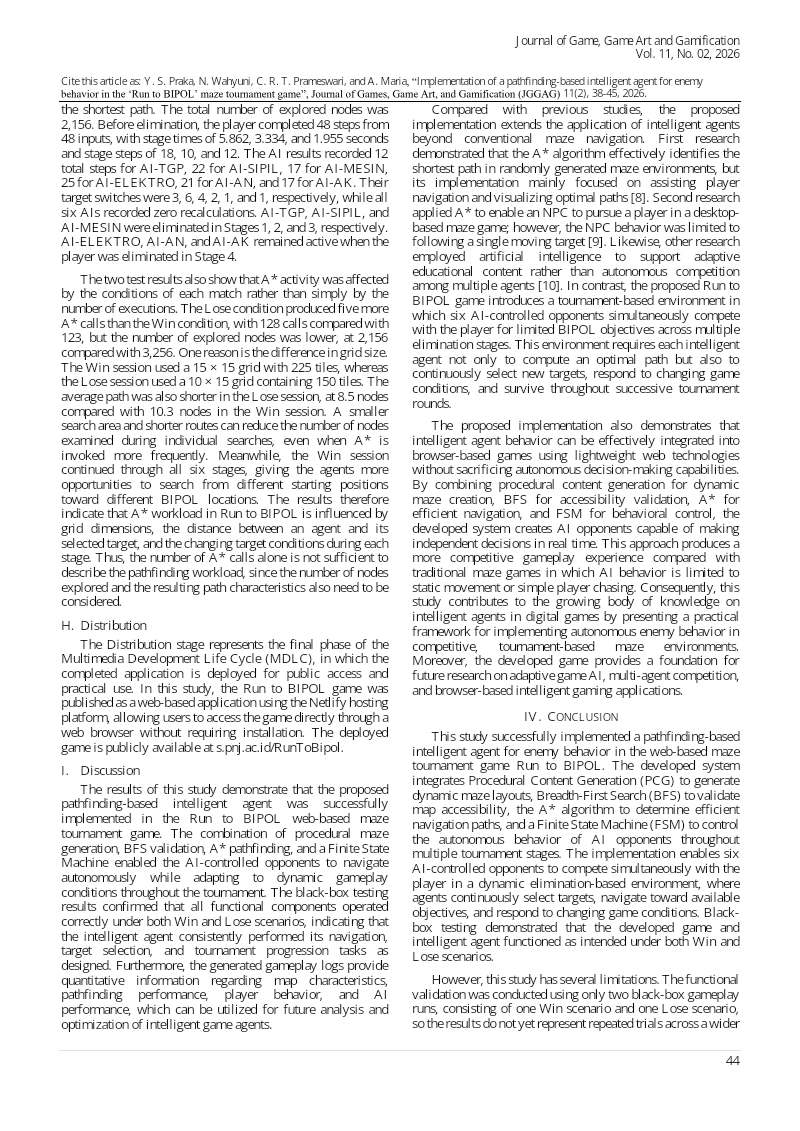
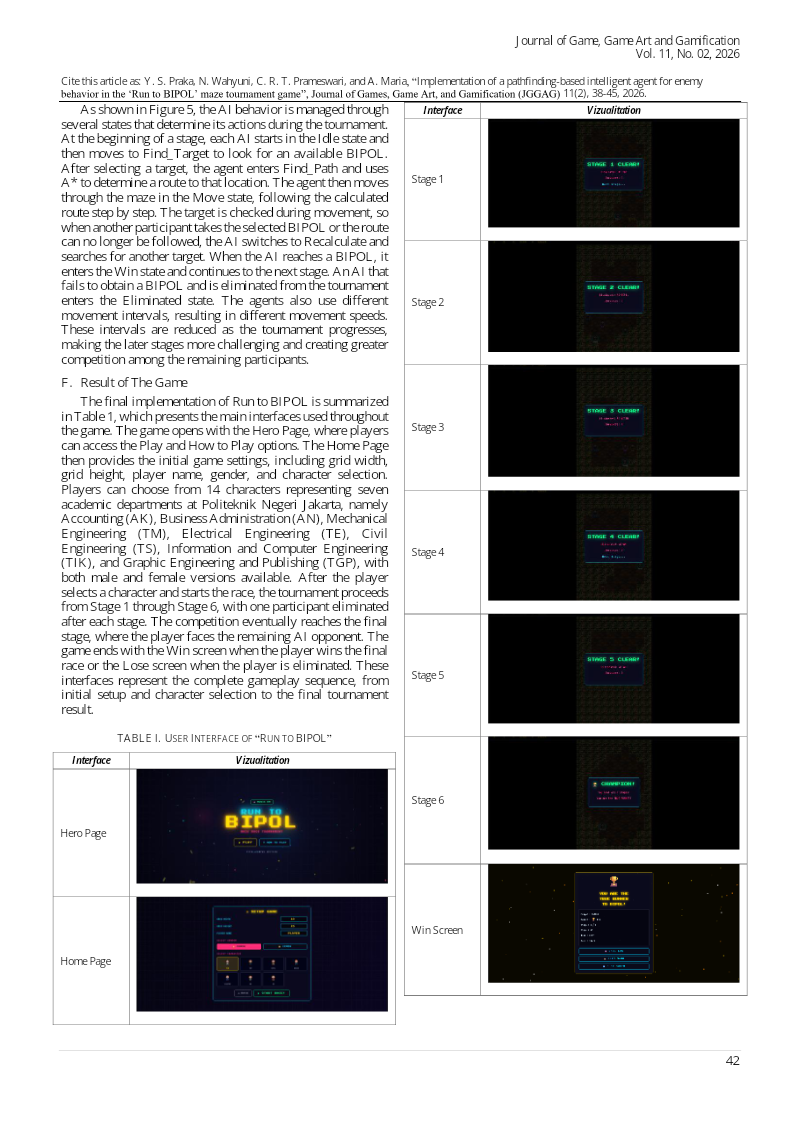
The development of the web-based tournament game Run to BIPOL demonstrates the effective integration of procedural content generation and autonomous agent intelligence within a browser-based environment. By utilizing the Multimedia Development Life Cycle, the project establishes a scalable framework for competitive maze navigation. The core architecture relies on Breadth-First Search to ensure map viability, while the A algorithm, enhanced by Manhattan Distance heuristics, enables agents to navigate complex, dynamic layouts with precision.
Enemy behavior is governed by a Finite State Machine, which allows for sophisticated decision-making and target selection throughout various tournament elimination stages. Black-box testing confirms that these systems maintain consistent performance and competitive integrity, successfully facilitating multi-agent interactions within a procedurally generated setting. This implementation highlights the viability of combining classic pathfinding algorithms with state-based logic to create challenging, autonomous opponents in real-time gaming applications.
Despite these technical successes, the current implementation remains focused on functional deployment rather than comparative optimization. Future iterations would benefit from rigorous performance benchmarking against alternative pathfinding algorithms and the inclusion of comprehensive user-experience evaluations. Expanding the scope of research to include more advanced decision-making models will further improve agent adaptability and depth, providing a more robust foundation for future developments in intelligent, browser-based competitive gaming.
Journal of Games, Game Art, and Gamification · 2026
Journal of Games, Game Art, and Gamification · 2025
Journal of Games, Game Art, and Gamification · 2025
Journal of Games, Game Art, and Gamification · 2025
Journal of Games, Game Art, and Gamification · 2025
Journal of Games, Game Art, and Gamification · 2025
Journal of Games, Game Art, and Gamification · 2025
Journal of Games, Game Art, and Gamification · 2025
Journal of Games, Game Art, and Gamification · 2025
Journal of Games, Game Art, and Gamification · 2024
Journal of Games, Game Art, and Gamification · 2024
Journal of Games, Game Art, and Gamification · 2024

Thomas Brush · 2026