1 free read left. Create a free account for unlimited reading + AI research.
Create free account
Hyper-casual math
Key insights
6 takeaways- 01Between 2014 and 2019, the sector transitioned from a market of accidental viral hits to a sophisticated, publisher-led ecosystem driven by data and aggressive marketing.
- 02Hyper-casual profitability relies on a strict mathematical threshold where user acquisition costs must remain lower than the lifetime value generated by rewarded video ads.
- 03Developers utilize iterative product refinements, such as optimized onboarding and push notifications, to incrementally boost retention rates for viable prototypes.
- 04The industry operates on a volume-first strategy, where publishers like Voodoo crowdsource hundreds of prototypes to rapidly identify and scale titles with mass-market appeal.
- 05Future industry development is expected to rely on artificial intelligence to automate concept generation and predict market trends, potentially favoring higher-quality, durable titles.
- 06Market saturation and declining organic discovery are forcing a shift away from minimalist mechanics toward more complex, feature-rich gaming experiences.
Ask AI about this video
Transcript
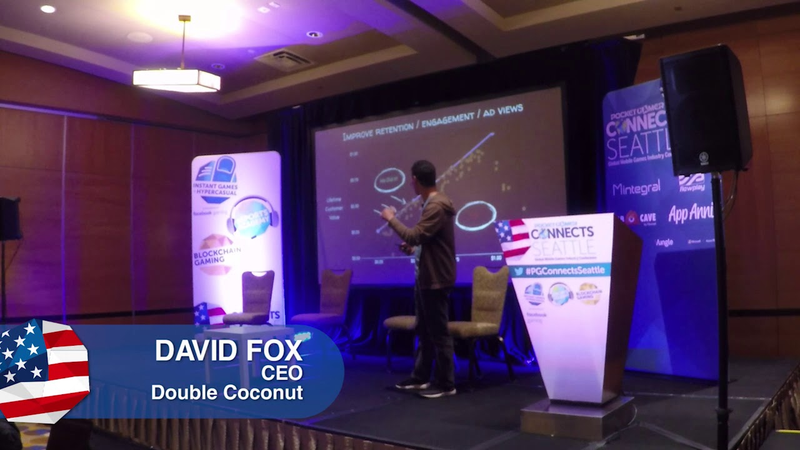
I'm going to show you how hyper Kajal gave us got started let's invent one so I can only use the back of my hands and let how many I get ready to start counting please help me 1 L 1 C that sucks let's start you thank you I was there and it works cool alright we'll play more that later so my name is David I had put my called double coconut and we do all sorts of games mostly work-for-hire and really we've been doing what are now called hyper casual games for years and years and years as I'm sure many of you have liked any mini game with a little simple mechanic where you repeat the same thing often times is a hyper casual game so we've done many and now we're doing them more explicitly so let's start in terms of math like how did we
get here as an industry where hyper casual games are a thing like like how did that happen and really you have to give credit to a guy named dong dong win from Vietnam and he was inspired by actually another stupid ping pong paddles with the strings on them so he was inspired by that to make a game called flappy bird so how many of you guys have played flappy bird alright everyone's seen it and it's basically what I'm just did like you do this stupid thing you suck and you want to do it again and you want to do it again and you want to do it again in this case in his case it's a flappy bird in my case it's a snot rag but you get the idea so dong created flappy bird huge success really can call it the most mindless of games and I and I say that as with deep respect it's a game where you basically do nothing and just keep trying to progress and this became such a big hit 50 million downloads that he actually got overwhelmed took it down from the
App Store and spawned a whole industry of people trying to replicate his accidental success so throughout 2014 to 2017 you have what I call a super casual so it wasn't really hyper casual yet it was still the typical kind of arcade game that maybe we're actually used to in arcades right and back in the 80s with with the idea of very simple friendly goo graphics in the case of flappy birds it was actually very familiar graph he stole from Mario very quick to jump in there's no tutorials no intro you just get in there you figure out within seconds what you got to do sessions are quick and the challenge keeps ramping and ramping and ramping and you just want to get better and better and better so especially among tweens this became a huge thing to do in the during recess and and under the desk do you know during boarding classes and these games took over and became a way to get millions of downloads if you hit the right if you hit the right genre
right and again very very similar to the type of games we used to play for a quarter where you want to come in play a score and tried to get do you get better to get your score better and better and better with a very simple mechanic and then a company called ketchup game and 2015 ketchup they started off with one game and you could see if some of the numbers here like absolutely ridiculous they ended up getting to hundreds of thousands of dollars millions of downloads all with many many games and they they really took things from super casual into the hyper casual realm in 2016 there was also an individual and this guy is very interesting David who created a game called color switch and what's interesting about him and his game became kind of the next flappy bird hit as he wasn't even a programmer he used a tool called Bill box was just
created some tough levels that he thought were fun and boom created the next big hit so what happens right in 2017 we get to this very interesting stage now where there's so many of these games basically all by ketchapp that people are sick of them they're their dominate at the top 10 there it's saturated and then people figure out that with the right ads that are showcasing your games gameplay and just in a very simple quick way you can you can really juice these downloads and you can play a sort of arbitrage where you're spending less on your ads then you're making by showing more of these ads within your game and the company that really dominated this in 2017 was Vudu they started with a accidental hit called paper i/o and they turned this into a juggernaut with they ended up getting the dozens of games hundreds of
millions of downloads and one thing that voodoo really really did well was published so they had developers from outside send them their games and they just published the ones they liked and they really also started getting into testing and this is where we get into the math so I want to walk you through how Vudu and other companies now are using math to turn this whole crazy little tiny game mechanic and AD mechanic into something that's predictable in a real business all right so yeah let's let's skip ahead a little bit we won't go into the theory all right so you know in short you can see the monetization for each game is going down down down down down from games where you're maybe buying the game for the three four bucks to a game where you're making maybe you know maybe making 10 cents per user retention is also going down these games get pretty boring after a while no matter how cool
they are you really can't play them for too often but the downloads are getting crazy and that's where much like a pop music industry you're making up from in volume and what you lacked with retention and monetization so let's let's break down the math a little bit and just you know this this was actually kind of insightful to me once I understood how it really all works so obviously the free-to-play business comes down to a very simple formula you want to make more money than you spend right that's kind of a lot of businesses are like that so casino games you're actually spending a lot of money to acquire a real money casino spending maybe 100 bucks to acquire someone and you're gonna be making way more than that if you're a successful game hyper casual you may be spending somewhere in this range right so somewhere maybe in the in the 30 to 75 cent range to acquire someone and you then are trying to make that much money back so how does it work so let's see if
we go back here all right cool so the you know the real driver of money in a hyper casual game is retention and the reason for that is if you look at the the math beneath here and the income line right so you have your let's say let's say you someone plays your game for five days on average alright so they're driven by this retention of five days they're playing an average of three sessions a day they're seeing three video ads for retention or sorry per session and maybe you're making about a penny per ad right which is actually pretty typical for a rewarded video ad so if you multiply five by three by three and sent get 45 cents so now if you're able to acquire for under 45 cents you have a successful game and now you can start especially acquiring at volume and getting millions of users it's five cents per user doesn't sound like a lot but when it's times multiple million it becomes a very interesting business right so the hyper casual cost per
install usually goes into this sort of realm you're putting ads out there and you and honestly when you put an ad out into the hyper casual world until you start seeing how the audience reacts you have no idea how much it's going to cost sometimes you'll put some art out and maybe it's too similar to another game you get nobody clicking on it other times you try something really weird and people loving it and and you know you're getting it out for 10 cents and a user so this is the way companies like Voodoo work they basically are our hyper or our crowdsourcing success in the game they're taking maybe a hundred games and they'll stick them out there and acquire some users right and and start seeing how these things are retaining and it's gonna be all over the map some games people are gonna love and actually like play a couple times a day and come back to for many days because they just for whatever reason it they love it they hits them other ones that maybe are even better quality maybe you spent eight ten months making the game and great graphics people aren't interested they
they play maybe ten percent of people like it and the rest just aren't even coming back so if you plot a hundred games out you're going to get this sort of the random almost random plot of retention now then what they do is they create a bunch of ads for these games and so they'll throw these ads out for the games and really comes down to the core gameplay like most of these ads all show one you know 15-second 1015 seconds of the game happening and people either glom onto it or they don't and if they do you get these really really cheap cost per installs if they don't you can see those outliers there people might you know just just not be clicking on at all you have to pay many dollars to get an install so now if you put it all together if you're now plotting your retention which remember retention is leading to your actual monetization you're plotting your retention and you're left them customer
value out against how much you're spending on the ads you'll see that most of its poles about this line most of them are actually netting negative at first when you throw things out there you're maybe have a bunch that are just on the line maybe one or two games here is breaking above the line and profitable where you're you're earning more for just showing ads in that game than you are spending ads to acquire people to that game but if you could take those top games that are on the line or close to the line and do a couple of tricks push notifications awards badges slightly better graphics maybe reduce the the on-ramp so you're jumping faster all these things start edging the game's retention up a little bit a little bit and boom now you have more games that are starting to become profitable then add to that a very sophisticated ad team that's really looking at at the data and trying to mine the data to get the lowest cost per install and boom now you're finding these pocket these delicious pockets
where your cost is much lower than what you're earning and boom you have a couple of hits all this process that I'm showing you here this happens within a couple weeks with maybe just a few hundred users fairly cheap to do you wait till you get to this point and then you then you open up the gas and start throwing as much money as you can into ads and start making a business to make sense okay so you know it's interesting like I think um if you were coming up here looking for like a design talk on this is how you can make a hit hyper casual game I'm the last person to tell you how and I think anyone who does is full of it nobody knows anything really about what's going to work you got to do what you love you got to do what you think people love some people clone outright some people are innovating entirely and you just don't know to you put it out there and in fact a game you put out today might have different results than again you put out six months from now it's crazy but if you crowdsource this
stuff and put it out there we are getting to the point where where it actually becomes is becoming a predictable business because of the math that I showed you sort of sort of make sense so where are we going with this stuff as an industry this is this is all just the more in the prediction side and where I think this is all heading but basically I think the mobile gaming market is becoming like pop music you know a lot of sense a lot of senses you know when you're if you if you're a new developer and indie or even a company trying to come up with a new unit and trying to decide what to do you have a choice when you make a game you can you can put a lot of money into production and be this mighty giant maybe get big IP really polished everything do tons and tons of user testing have relationships with Apple and Google and get featured and that of course still works and we see we see hits like that too but that's quite difficult to do and very expensive or make games as quests
as fast as you can test them out quickly and just retain them long enough to profit it may not feel as satisfying is making a big magnum opus but it's a very viable path right so I do want to caution you if you're if you're looking at this saying oh I could go ahead and do this this is not easy money alright this is not a rainbow shooting out of a whale you know really I think this slide typifies what it's really like to be an independent developer or small developer trying to succeed in hyper casual really you're you don't see like World War Z or those type of movies right as you're basically you're you're part of a horde of many many hungry zombies and most of you will die before you reach the wall but a few will make it through and publishers of course helped make that through they have the expertise in terms of the marketing in terms of getting those ad costs low and knowing how to cross-promote with their existing
players to get people in and they've also just seen a lot they know what'll work on but not work and provide some expertise so I'm not saying you have to go with the publisher but it certainly does help if you're looking for a publisher there's many out there this is the the current split actually as of December of last year in terms of number of downloads in the App Store so Vudu still dominating they actually unbelievably are in charge of the publisher of about 30% of all of the downloads in the App Store which is crazy Lion is an up-and-coming studio that is figuring it out and making some headway and you could see ketchup did very well during the viral years has not quite figured it out and they're golden sacks years to to become the dominant force so this is another list of just a few of the publishers out there there's you know they're all pretty open they all have if you go to their websites they're all pretty easy to reach they all are very very hungry for for zombies
to come on board and you know you know again I think for better or worse we are becoming like the pop music industry you have tons of hungry hopefuls tons of talented hopefuls right but just tons and tons of them ultimately you're looking for a product with mass appeal you're going to make something that that really is just being able to put out quickly rather than being maybe artistic or fancy trendy not innovative you want things that are repetitive and ultimately it's about a provable marketing machine that that ends up making things into hits or not right if you look at this was actually from an NPR Planet Money piece how hit songs work these days it's kind of the same thing that you're spending you know twenty twenty-five k developing the song trying things really kind of chump change it could at least according to these big labels and only once you
get to the point where you've tested it among multiple markets you know your song works one out of a thousand might make it that's the past this point you attach a star perhaps you roll it out with a that's where you really spend the bulk of your money and the roll out and that's how these things become what you hear on the radio every day so I'll just leave you with another luminary in the field she's not in the game field but Esther Dean I think her type of crafts and crafts person there's gonna tip if I the way games and hyper casual games work as well she's someone you may not have heard of but she's written songs you've definitely heard of she's written suffer Nicki Minaj and Katy Perry and and her a process is really fascinating she just goes in the booth does this kind of weird chanting but the stuff eventually comes out when she feels kind of a chill go up her spine she knows she has something she shops it around to the stars they all love it and then she gets a hit so
she's just got that thing just like Don knew and had the thing just like the guy who made color switch has has that thing so I'm sure some people this room have that thing I hope I hope you do and if you do you can be very successful here all right so I think I'm supposed to do some questions or we could jump into big weighty thoughts if there's no questions okay well are there all right I'll let the audience decide but any questions or did I provide so many answers that there's time you guys want to go to big lady thoughts thing hmm or you could watch me play that rag game [Music] so here's my prediction number one and I'm I think this is already proven out if there's some interesting cases but I think AI machine learning is going to invent the next hit mobile game so you're gonna have algorithms that are creating essentially video ads for games
before the games exist creating hundreds of thousands of different types of games to put out there seeing what the audience responds to and then the will will basically tell you the exact aesthetic and mechanic that appeals and some will build that in a month and you'll have a hit game again maybe depressing maybe cool depending on your outlook but it's the world we're in now and of course the big prediction to is everything old is new again all these hyper casual publishers I think they are it is becoming saturated they are starting to glide down even voodoo is is really having trouble holding on to their dominance I think audience are becoming a little sick of these simple games so you can see as games are out these publishers start declining they do be inevitable right they add real mechanics on to their games quest Maps levels you know even multiplayer and they're starting to turn these little mechanics into big mobile games and we'll come back around to you know the market as the games
market as always is where quality games will win then triumph so that's pretty much it thank you so much for your time it's a pleasure thank you baby
Summary
The hyper-casual mobile gaming sector has evolved into a high-volume, data-driven industry that functions similarly to the pop music business. The primary objective for developers and publishers is to achieve profitability by balancing low-cost user acquisition with high-frequency ad monetization. Because individual game retention is often short-lived, success relies on a "volume-first" strategy where developers test numerous simple, repetitive mechanics to identify titles with mass appeal.
The industry’s financial model centers on a clear mathematical threshold: if the cost to acquire a user remains lower than the lifetime value generated through rewarded video ads, the game is scaled. Publishers, such as Voodoo, have become dominant by crowdsourcing hundreds of prototypes, using rapid testing to identify "pockets" of profitability, and then aggressively investing in marketing for the winners. This process often involves iterative improvements—such as adding push notifications, badges, or refined onboarding—to nudge retention rates upward until the game becomes a viable commercial product.
The scope of this market is global, with a significant shift occurring between 2014 and 2019 as the industry moved from accidental viral hits like Flappy Bird to a sophisticated, publisher-led ecosystem. While the barrier to entry for prototyping is low, the market is increasingly saturated, leading to a decline in organic discovery. Consequently, the industry is trending toward more complex, feature-rich titles as players grow weary of minimalist mechanics. Looking forward, the integration of artificial intelligence in predicting market trends and generating game concepts is expected to further automate the development cycle, potentially shifting the industry back toward a focus on higher-quality, more durable gaming experiences.

















Comments