VideoTwo & a Half Gamers
🎯 How to scale influencer marketing to 8 figures systems across 15 Studios by Marion Balinoff
3 Jun 202622 min video
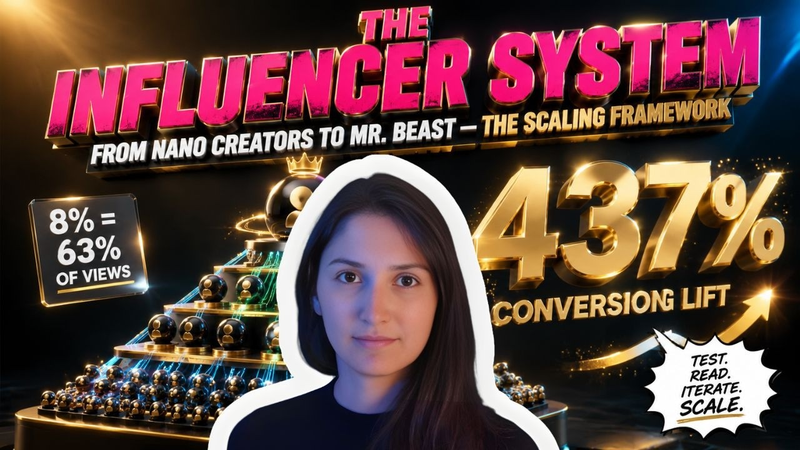
And then another example from another simulation game that with an influencer that everybody must have heard of by now, Mr. Beast. We've created a character that was clearly featuring all his color and the lightning in pink. And because we were expecting so many views from his videos like as you saw back in the day it was like 130 million views, I think and now it is probably double. Um we decided to create a full funnel around the
[music] [music] [music] [music] [music]
[music] [music] [music]
Okay, real talk before we start. This episode is brought to you by Potensic. And if you're a mobile game publisher tired of leaving money on the table, then listen up. Potensic is a premium ad network built by people who have actually been on both sides of this industry, game publishers, agencies, successful exits. So, they get it. Here's the thing. Potensic has direct deals with Amazon, Apple, Coca-Cola, Vodafone. It's not programmatic. It's direct. Those budgets land in your game at premium CPMs, no middleman tax. And they're handle everything with their in-house team in terms of the creatives.
Plus, they've partnered with Playable Maker, Vungle. So, they will take brands' YouTube videos or static images and actually turn them into playable ads or rewarded video. Proper interactive format built for gaming inventory. Brands getting a gaming native creative, publishers are getting a higher CPMs. Everyone wins. Head to potentials.com to get started or check their creative portfolio in the link in the show notes. Thank you very much Potentials for sponsoring this episode.
Welcome back to another episode of Two and a Half Gamers. If you've watched the first episode that I recorded, you know we've basically covered the foundations. So, how to set up your first influencer marketing campaign from scratch. And so, today we're going to be going one level deeper. We're going to be talking about how you turn those first campaigns into a repeatable, scalable system. So, quick word about where I'm coming from before we dive in. Um I've spent 12 years building and scaling influencer programs in mobile gaming. Um from the very first
campaign all the way to eight-figure budgets across more than 15 studios. Uh what that means is that everything that I'm going to share today comes from execution and not theory. Um and if you haven't seen episode one yet, um I would really recommend going back to it um to watch it first because today really builds uh directly on that foundation. In episode one, we have covered uh some foundational questions about budget, about platforms, about finding and pricing creators, about brief, and about measuring performance. And so, once you've run your first campaigns, a new set of questions basically arises. Which influencers you should actually be working with, what size you should start with, and when do you move up? Can you optimize what's not working, and how do you scale what is actually working? So, today we're going to answer all of this with a framework that you can start applying from your next campaign. So,
over the years, I built a testing framework to be able to follow clear path between learning to scaling, okay? Something really important to mention is that we actually launch campaigns on a monthly basis, and when you do, you make sure that all your influencers go live together. The idea is for you to generate a spike in your organics so you can measure the campaign performance. This is basically the simplest way to measure the performance, and like I've explained in the first episode, YouTube is basically for me the best platform to start with for measurement purposes. So, to begin with, the first 3 months are going to be a knowledge gathering phase, okay? Where you should test multiple verticals in order to see what performs best. As a reminder, verticals are content verticals, so true crime, lifestyle, family. Then, once you've gathered some learnings, you can start optimizing your campaigns and work solely with the verticals that going to deliver the right performance. And then after that, you move on to the scaling
up phase, where you know what performs and you can increase your budgets while testing new verticals with a smaller share of your budget. And once you've mastered YouTube, you can start exploring other social media and this cycle basically starts again. So, one big thing that I see team get wrong on trading influencer size is that they think it's a quality signal. So, either they assume that bigger means better, or they go all in with micro influencers because it's cheaper. But, the reality is really more interesting than that. So, if you look into the numbers, 2% of YouTube channels fall into the micro category. So, influencers that deliver less than 50,000 views per video. But, those channels only account for 37% of the total views, right? So, the remaining 63% of the views comes from only 8% of the channels, and so the mid-size to mega tier. This basically shows that you'll need to work with all sizes of creators in order to scale and to keep testing. Now that we've
established that that you've understood why the size diversity matters, let me show you how to actually read that data. So, this is the vertical assessment table that I walked through in episode one. I'm bringing it back here because everything in today's framework is really built on it. So, each row is a content vertical, so you can see the numbers of videos, the views generated, and the last column, which is the most important one, the percentage of videos that have reached profitability within that vertical. So, here we've got cooking is our top performer at 42% of the videos reaching profitability, family at 11% for me is a clear cut, and true crime at 22% is really the interesting one. So, we don't have enough data to call it a winner, and we don't have enough data to also kill it basically. So, that's exactly the kind of decision that the framework helps you make. So, as a reminder, there are three different
thresholds that I use before I draw conclusions about any vertical. So, the first one is the 30% profitability ratio is the quality bar. Then we need at least 10 videos per vertical and at least 500,000 views as a confident threshold. So, that's basically telling you whether you have enough data to act on. If a vertical doesn't meet those volume requirements yet, the answer is really not to cut it, and the answer is to keep testing to gather more data before you can decide. Once you know which vertical are underperforming, the next question is obviously why, right? So, that's where this table comes in, so you're looking at the CPM, the conversion rate, and the LTV side by side to tell you which lever basically is the problem. So, if you take the example of family here, CPM is high, conversion rate is low, and the LTV is the weakest in the in the entire table. So, that's not one problem, that's basically three. Whereas true crime that we were looking at before has a solid LTV but a low conversion rate. So,
that's definitely more of a fixable situation. So, let's break it down. So, what you see So, you see what each of those KPI actually means and what you can do about them. First is the CPMs, cost per thousand views. This is mostly set by the market, the vertical, the creative tier, sort of size, um and you have basically unlimited control over it. But, you can negotiate, obviously, and you can choose verticals where CPM tends to be maybe more competitive. Then you have your conversion rate from views to installs. Um this is the lever that you're going to have the most control over. So, brief quality, gameplay shown in the integrations, GIF length, in-game integrations, all of these are going to be helping you moving the conversion rate, and I'm going to show you examples afterwards. And then the last one is going to be LTV. So, this is obviously the quality of the players that you're acquiring, the monetization, the retention. And so, if your LTV is off, that's often a targeting problem, either wrong audience, wrong vertical, wrong market. And so, now that we have that,
let me show you exactly how and when to pull each of them. Um because the answer isn't the same at every stage of the program. It depends on where you are in the testing framework. About the testing framework, as we are starting a new tube, we'll be categorizing the influencers by numbers of views. Something you might have heard me already say, but subscriber is not a metric that I pay attention to because in the end, high number of subscribers doesn't always equate high numbers of views. It might have been an old channel on YouTube that I acquired millions of subscribers, and they might do very little views at this point in time. So, to begin with, we should list all the verticals that you believe can be a good fit for your audience. So, for example, family, true crime, gaming, cooking, wellness, whatever that is, because you're I don't know have a game that is female 35 plus audience, right? So, we have relevant verticals based on that. And so, we launch our first few campaigns. And then, that's when you start building the tables that I was just showing before in the previous
slide. So, most likely you won't reach profitability, and that's normal because the first phase is the knowledge gathering, right? So, you willing to iterate. You might iterate on your audience targeting, targeting slightly older audiences compared to what the influencers had, on your sub verticals, because some verticals are very very broad like gaming between someone that plays The Sims and someone that plays Warcraft, it's obviously very different types of content. You can iterate on the gameplay, the motivators that the influencers are showing in their integration, and you can start leveraging gift links and gift codes. Um, so let me show you a concrete example here. Obviously, gift links or gift codes are an added incentive for the audience to download your game, so that's going to increase your conversion rate from views to installs. And I'm showing you an example from a simulation game. So, first campaign, no gift. As you can see, the ROI 39%. Our target was 100% and our campaigns were very far off. We launched the second campaign
with two different types of gifts, which were a character and a starter pack composed of in-game currencies. As you can see, the ROI went way above our target, which was great, but then I started looking into the performance on an individual level, and I realized actually that yes, the conversion rate was much higher, but the LTV was also dropped by half. So, looking into the campaign performance, I actually realized that all the influencers that had shared the starter pack had a much lower LTV. That was simple because we were cannibalizing the early all early on monetization because the starter pack was too generous. So, what we did in the third campaign is that we only had a character as a gift. And as we can see, the LTV went back up again. The conversion rate was also much higher than the first one. And so, overall, the ROI was double than what we were expecting. Something really important here to mention is that whatever the gift that you offer your audience, make
sure that you tell the influencers what it is worth in a currency that they know, USD, euros, whatever that is, because they don't know the the monetization in your game and they will understand that this is worth $15, this is worth $50, whatever that is. Going back to the testing framework, you've launched three first campaign in that learning phase and you have iterated and you'll realize that some of the verticals don't perform for your game. From the basically the analysis tables that I showed you before. So, you start excluding them when you move on to your next phase. And so, that's when you move to mid-size and macro influencers and you keep testing and iterating on your campaigns. Unfortunately, maybe not all the campaigns still at this stage are not going to reach profitability. So, you keep iterating on certain events that happen in the game. So, you can also iterate on, you know, sub-verticals that we were saying before, your gift things and code that you keep testing. And you start introducing, sorry, contest and
giveaways. Those contest and giveaways work on basically two levels. They increase the conversion rate because that's an immediate incentive to download. People want to be eligible for the contest, but they also can improve monetization because players might be incentivized to reach a certain level within a certain time frame to be eligible to win. So, it all basically depends on your strategy. But the rewards matters a lot. Generic prizes I get generic participation. So the best performing giveaways I've seen tie the reward um directly to the influencer. They match something they've made, something the audience actually wants. And so you have selections of content of of prizes that the influencer can make based on their audience. Tech prizes like phones that definitely work because who doesn't want an iPhone? Uh but they track a broader audience. That isn't necessarily what um your players want. So keep that in mind when you design the mechanics in the game. Going back to the testing framework, you're now
confidently spending with mid-size to micro influencers. So now you get to move to mega influencers. So those that are making a million of views per video on average. And considering those influencers are going to be much more expensive, it's really really important that you make the most out of those collaborations, right? And so you include gift links, giveaways, and contests. Contests. You can start looking into custom in-game integrations. And so I'm going to show you a few examples, but I want to tell you, okay, now is where things definitely get more ambitious because you will need support from your broader team, but the results get significantly better. And so custom in-game integrations mean collaborating with an influencer directly to bring them into your game. So it can be anything. It could be a character, it could be a skin, a decoration, badge, whatever really. And you don't really need to start big. One of the easiest entry points is taking an existing item
um and simply reskinning it or renaming it after the influencer basically. Um so low production effort, but still creates that personal connection between the creator and your game. Um and as you scale, basically you go further. But it does require obviously buying from product, from art, from live ops because this is not something that the influencer marketing team or person can pull off alone. So, let me show you some examples. Here we've got Daily Caresy. She's a true crime influencer, very feminine audience. And as you can see on that picture, she's with her dog Daisy. As in her videos, she helps solve true crimes. She was integrated as a decoration item where she helps a policeman in an investigation and she's pointing to her dog Daisy who had found a clue. In this setup, we had one item, the dog decoration that was given out for free when people were clicking the link. And then the other one was obtainable either through playing the game or directly in the shop. Another example from Dream, a gaming influencer, very male audience.
He's very recognizable for his green hoodie and the smiley mask on his face. And so we've turned him into a character that had exactly the same features. And as an example from a word game, we worked with the family influencer. And so we renamed the tiles to play the word game after them. And we gave them some sort of styling that was in their branding. And then another example from another simulation game that with an influencer that everybody must have heard of by now, Mr. Beast. We've created a character that was clearly featuring all his color and the lightning in pink. And because we were expecting so many views from his videos, like as you saw back in the day, it was like 130 million views, I think. And now it is probably double. Um we decided to create a full funnel around the influencer. So, basically, people would watch the video, go to the app store, see the app icon that was
directly around the influencer. And then once they finished their first time user experience, they would see a pop-up that would show them everything related to their favorite influencer, how to collect them, their characters, what to do with them, and how to enter the giveaways. And so, based on all those different games of different genres with different types of influences, on average, the conversion rate increased by 437% from views to installs, and the ROI by 279%. So, this is really massive. So, this is basically the full picture, everything we've covered today mapped out across a 12-month timeline. In Q1, you're in knowledge-gathering mode. So, nano and micro influencers testing as many verticals as possible, starting to layer in um gift links and codes. By Q2, you've cut what doesn't work, and you're optimizing with a broader size range, adding giveaways and contests to your
toolkit. And from Q3 onwards, you're scaling all sizes, your proven verticals plus new ones that you're continuously testing. And for the right creators with the right size, custom in-game integrations. So, the mechanics basically evolve at each uh each stage, um but the logic stays the same. You test, you read the data, you iterate, and you scale what works. This is one continuous system from your very first nano influencer all the way to a MrBeast collaboration. And with that, let's wrap up. First key takeaway is that volume isn't the goal, the data density is. What I mean by that is that the more influencer, the more signals you're going to have. So, more verticals tested, more data points to read, and less noise from individual performance fluctuations. You're not buying reach, you're really buying learnings at this point. Second key takeaway is that you need to gain perspective. You want to analyze the influencer per vertical and
sub-vertical. So, you don't evaluate creators individually, you evaluate them in the pools that they belong to. That's what is going to tell you where you want to double down, and where you want to stop spending. Third key takeaway is that you need to break silos. Um, you want to make influencer marketing a cross-team sport. Influencer marketing shouldn't sit in its corner. Um, this is one thing that I feel really strongly about because influencer marketing, you know, the person or the team can only go so far on its own. Um, when product and live ops are in the loop, when they understand what you're trying to achieve and actively support it, the results are in a completely different thing. I spent months pushing for this alignment at one studio that I was working at, um, and it was a slow process. But, the moment that the product team saw the impact of the first integrated campaign, they really came back to me, uh, knocking at my door asking who was going to be the next, uh,
big influencer. And so, that shift, uh, from influencer marketing being a solar effort to it becoming something that the whole company is invested in, that's what make the channel really starts to scale. Fourth key takeaway, be creative when testing. The obvious verticals are rarely the best performers. So, your audience has a life outside of the content that you think they watch. Test widely before you really narrow it down. And then, finally, remember, it's a process. Most team give up between campaign two and three, and that's exactly when the data starts becoming useful. So, patience isn't passive. This is really part of the strategy. And that's a wrap on the testing framework. So, if there's one thing I want you to take away from today, is that influencer marketing isn't a campaign. It's a system, right? Um, and like any system, it rewards the people who are patient enough to get it run and rigorous enough to read what it's telling them over time. So, we've covered a lot of ground
across the both episode now, from setting your first budget and picking the right creators, all the way to analyzing per vertical and knowing when to scale. So, this relief this framework is is for you to use. Um and next time, I could show you something that I think changes how most people think about this channel entirely. We've been talking about influencer marketing as an acquisition level, uh but the data suggests that it's small doing a lot more than that. I'm calling it the growth multiplier, so let's see when I can follow up on that. And in the meantime, if you have any questions, you know where to find me.
Auto-generated captions from YouTube — names and numbers may be misheard.
Influencer marketing functions most effectively as a continuous, data-driven system rather than a series of isolated campaigns. By treating influencer programs as a long-term testing framework, publishers can transition from initial knowledge-gathering to high-scale, eight-figure operations. The primary objective is not to purchase reach, but to generate data density, which allows for informed decision-making regarding content verticals, audience targeting, and creative strategy.
The framework follows a 12-month trajectory. In the first quarter, teams focus on knowledge-gathering by testing diverse content verticals with nano and micro-influencers. Success is measured using a vertical assessment table that tracks video volume, total views, and profitability ratios. A vertical is considered viable only after meeting specific thresholds, such as a 30% profitability rate and a minimum of 500,000 views. Once data is gathered, teams move to an optimization phase in the second quarter, incorporating giveaways and contests to boost conversion. From the third quarter onward, the focus shifts to scaling proven verticals while maintaining a smaller budget for continuous testing of new, experimental segments.
Strategic levers for improvement include managing gift codes and custom in-game integrations. While gift codes increase conversion, they must be balanced against lifetime value (LTV) to avoid cannibalizing monetization. Custom integrations—such as reskinning in-game items or creating full-funnel experiences around a creator—are the most effective scaling tools, having demonstrated an average 437% increase in conversion rates and a 279% increase in ROI. Success in these areas requires breaking down organizational silos, as these initiatives necessitate collaboration between marketing, product, art, and live-ops teams. Ultimately, the system rewards patience and rigor, as the most valuable insights emerge only after multiple iterations and consistent, data-backed adjustments.

Two & a Half Gamers · 2026

Two & a Half Gamers · 2026

Two & a Half Gamers · 2026

Two & a Half Gamers · 2026

Two & a Half Gamers · 2026

Two & a Half Gamers · 2026

Two & a Half Gamers · 2026

Two & a Half Gamers · 2026

Two & a Half Gamers · 2026

Two & a Half Gamers · 2026

Two & a Half Gamers · 2026

Two & a Half Gamers · 2026
Two & a Half Gamers · 2026

Two & a Half Gamers · 2026
Two & a Half Gamers · 2026

Naavik · 2026

Two & a Half Gamers · 2026

Two & a Half Gamers · 2026
Two & a Half Gamers · 2026
Two & a Half Gamers · 2026
Two & a Half Gamers · 2026

Two & a Half Gamers · 2026
Two & a Half Gamers · 2026
Two & a Half Gamers · 2026
Comments