1 free read left. Create a free account for unlimited reading + AI research.
Create free account
How to Build a Player-centric Business Model (That's Resilient Enough for the Next Decade)
Key insights
5 takeaways- 01In-play monetization, which dynamically integrates branded content into the game environment, serves as a resilient alternative to traditional, intrusive ad formats like interstitial videos.
- 02Approximately 98% of mobile gamers are non-paying users, a figure expected to rise as the global gaming audience grows toward three billion monthly users.
- 03Traditional interstitial ads negatively impact player retention once a specific threshold of impressions is reached, necessitating a shift toward non-disruptive advertising models.
- 04Programmatic platforms are essential for scaling in-game advertising, allowing publishers to align revenue goals with the expectations of a mainstream audience across diverse genres like sports and puzzle games.
- 05The in-play advertising model leverages contextual data rather than personal user information, ensuring compliance with evolving privacy regulations while maintaining a seamless user experience.
Ask AI about this video
Transcript
we're going to now kick off uh to kick this off properly we have uh sam hoover from admix who's going to talk to us about how to build a player-centric business model that's resilient enough for the next decade so sam over to you well thanks for having me thanks everyone for being here um excited about the talk that we have today to discuss how to build a player-centric business model so this talk really has two objectives um the first objective is to talk a little bit around the the current changes in the industry there's a lot of stuff happening and and hopefully this can help you steer the direction if you're building a game if you're building a project uh trying to kind of bring a framework on how to stay focused on the things that really matter for your players which is always the right thing to do and the second part the second objective of the talk is really telling the story of admix and
how we came up with the in-play monetization concept which also was basically following a player-centric goal player-centric uh concept to always keep in mind what are the players interested in now if you don't know what in-play is uh in-play is kind of the hot topic in game monetization at the moment the idea is that we are able to uh push branded content whether they are ads static ads or video ads within the game play itself as you can see in the image here so instead of having interstitial and rewarded videos which interrupt the game instead of that we have an sdk where you can dynamically insert brands within your experience which creates additional revenue without affecting your core retention metrics we've been going on for about three years uh raised about 12 million dollars so far we have a pretty big news coming in the next couple of weeks to announce
um more of that we have about 65 people and we work with around 300 games hundreds of advertisers um we're able to plug into different networks we have access to our own brands as well and they're really trying to create a new market a new way for publishers to monetize their games without affecting the user experience and for advertisers mainly brands to finally be able to target gamers so let's get started there is a lot of changes happening currently in the industry i've just listed a couple of things here uh by no means this is limited to that there's a lot more to it and this is across various topics regulations privacies new ways new infrastructure new ways to monetize games new type of interests from brands to finally be targeting these gamers so lots of things happening and the future could really go in in different many ways and that's really tricky it's it's
exciting but it's also a bit overwhelming because there's so many directions so many things happening that sometimes you just wonder which which which one is it gonna be which future are we going to see how can i prepare for the future in such hectic time and so the framework that i want to bring today which is how we build admix but can be applied to different projects as well is a slightly different way to look at all of this to kind of cut up the noise and really focus on what matters looking at the fundamentals from the perspective of the players in other words what do the player want what do they want today and what will they want tomorrow there's a really famous talk from jeff bezos where he explains that it's not about trying to predict the future or trying to predict what's going to change because that's very difficult no one can really predict the future however you can look at what is not going to change because of course things are changing
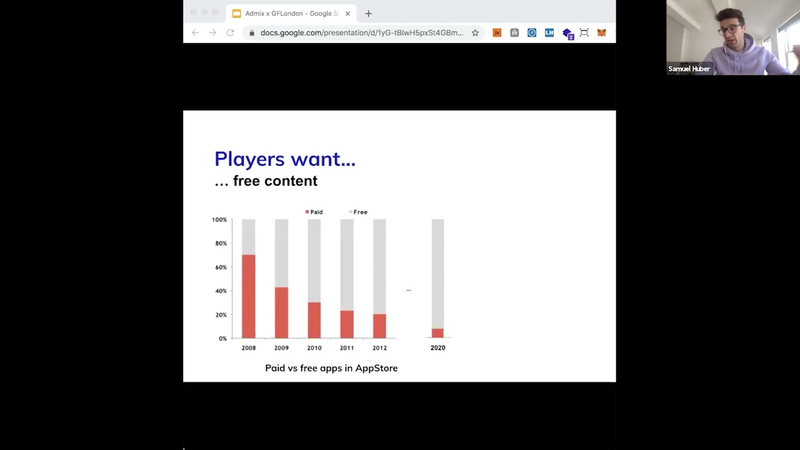
every day but there are fundamental things or behaviors that are true today and also will be true tomorrow and that gives you a great certainty about the future so if you're building or publishing a game today or you're in the space it's really about looking at what the players have wanted one today and will want tomorrow regardless of the noise regardless of everything that is happening you can focus on that and actually be able to deliver a great project now this is not rocket science concept of course what i'm saying here um but actually what i found is it's often overlooked when uh people are making business dishes decisions so if we summarize what players will always want and again nothing rocket science here so don't expect something groundbreaking um players want free content that's something that you know has been happening and it's happening today and will always be happening i'm generalizing of course i know there's a massive play to earn uh you know markets
and um in a purchase and hundreds of billion dollars of course some people are paying absolutely but i can't imagine a world where a player would want to pay for a game that they can have for free or pay more if they can have it for less right so the idea that we can minimize the cost of the content is something that obviously is something that players will always want now another thing is about great experience focusing on the experience no matter the noise no matter what's around is always going to be a positive and lastly privacy which is something that more and more users are getting tuned to their rights a lot of people are more and more passionate about the type of information that they're sharing so if you give them the ability to control their privacy if you do not compromise on their privacy this is something that is always going to be a positive now this is super basic of course
but i want to go into a little bit of detail into each of this um big kind of topics here because there's a lot of discussion around free to play for example and a lot of people saying oh you know we have nfts now it's a way to own the game and to actually create a different business models and you have subscription as well is advertising dying is still a big thing and if you actually look at the numbers you can see that yes there is tremendous growth in all of these paid markets hundreds of billions of dollars being spent but at the same time this is generally spent by a small fraction of users if you look the average mobile game about two percent of users actually convert so the vast majority is free to play and if you couple that with the growth in gaming where we now have about 1.6 billion monthly gamers depending on what you count as games but if we cast a very wide net and this is going to grow to 3
billion in the next couple of years and that growth is not coming from early adopters or people who are willing to spend a lot of money on games obviously those guys are already playing so if you look at an average um market adoption curve of the gardner cycle um gaming is well advanced here right most people are playing games one way or another and so the new audience that is contributing to the growth of gaming are the conservatives the the skeptics even people who said oh you know 10 years ago they would never have imagined that they were playing games and now they might be playing hyper casual or other type of games and if you look at how much people spend generally um across this adoption curve the enthusiast people adopting the technology first generally spend more than the one who come later because they are the fans they understand it they're happy to spend money in the latest console and paying for games and
contributing and they're basically the whales right they caught the game first and now they're spending more money so as gaming is becoming bigger and bigger um for every paid user you have 50 plus non-paying users that are joining the conservatives the skeptics the late adopters so more and more the proportion of user spending is going to decrease that in itself in absolute term is going to grow more more more and more people are playing games and they're paying for it but an even bigger proportion is not and so that's a very long way of saying that free content advertising is a hundred percent here to stay there a lot of people thinking that other business models are going to replace them that's not the case right the the proportion of free-to-play users is there and it's going to keep growing because the market is becoming more and more mainstream and this is evidenced by many data points one of them being this the number
of paid apps in the app store has always kept decreasing yes paid apps in absolute dollar value make more money than ever but there's still a smaller fraction compared to the much faster growing free-to-play market and how do you monetize free to play how do you monetize free users users who are not willing to spend money while advertising is going to remain a key monetization driver so now i'm sure this is not a surprise for ev for anyone but there's a lot of discussion around other type of business models is it going to overtake in-app purchases and the way that we're seeing it advertising actually is going to be more and more important especially for casual and hyper casual games as it already is because that audience is not going to convert so this is just again a long way to say that if you look at the fundamentals there are things that are not changing the fact that more and more people are going to be free players is something that will be here to stay no matter the noise no matter what's
happening in the industry so let's talk about the second topic seamless experience now when you're crafting a gaming experience of course every publisher every developer is trying to create a great great experience generally what gets in the way and again this is speaking from the data is intrusive advertising being a part of that experience and cutting that experience creating these breaking points within the experience this data coming from iron source here showing um the basically the the ltv or the average revenue per user um as a function of the number of interruptions in the game in other words the number of impressions per user per day for um i believe that this is interstitial videos and you can see that we basically have a peak at eight impressions per user per day after that you start losing users you affect your
retention faster than the extra revenue so very quickly in the process after showing eight impressions per users per day that's your peak this is how many ads you should serve as a maximum to maximize your revenue beyond that you are not maximizing your revenue so again this is um this is pretty clear that here the advertising experience is actually playing against the what players actually want which is the fact that they want a seamless experience so if you're able to remove that if you're able to stop those interruptions you can't go wrong with that this is another thing that won't change and the goal here is to remove this peak here and try to have a line where no matter how many uh impressions per user per day you're serving um you can still increase your tv for quite a while or at least you you will probably have a peak but it will be a lot further so it gives you more growth opportunities before you are
reaching your local maximum and this is again all of this is part of how we were thinking about okay we're bringing this new monetization solution to the table how what do we need to change what are the key drivers that are going to make that experience seamless again now the third point was around privacy of course everyone if they have the choice if they're given a direct choice like the att pop-up people want their privacy to be respected if you are the choice do you want this app to know everything about me or not people are going to say no and on average this is about the the data shows about 25 opt-in of that pop-up across various apps as of as of july which is not surprising now if you ask the question in a slightly different way like we do in our gdpr content pop-up which we are providing as an add-on for for developers now we have 75 opt-in and
that's because the question is worded in a different way so again if you ask in the right way for the right reasons people are sometimes willing to compromise but overall people more and more are getting privacy aware no player would ask for more of their data to be shared or compromised that's another thing that won't change that's another thing that is not going to change and that you can make sure to implement in your next project so that brings us to kind of the the thought process of what players actually want very basic very foundational topics that you can then build on top of and this is precisely what we have done so you've seen this video now before before my talk started so i won't start it again but the idea of in play is that we are the ultimate business player-centric business model and that's something that takes the all the boxes
that we've talked about before um it's made to monetize free to play games free to play games are going to be more and more important it doesn't interrupt the user experience it's infinitely scalable because it doesn't create those interruptions inside the game it doesn't affect the retention and your curve of ltv keeps increasing and lastly it doesn't compromise personal data most of the data that we use is contextual to the game it's not about who you are in the real world it's not about the purchases that you make it's not about that it's about understanding the type of environment and how you are interacting with it now the best part of that is that it is a tool and uh i often say that this is one of the first tool for monetization it's not just a plug-and-play solution that you slap on top of your existing game you can actually decide how it's going to look craft your own experience as part of it i'm just showing you a quick extract here that shows in a fast-forwarded way
the sdk you have your ad units you can place it within the game you can create this digital estate inside your environment and then monetize all these different spots without affecting the user experience so it's a hundred percent player-centric because the the setup of it is done by the publisher and the publisher by default or the the developer at least they're trying to create the best experience and that's why by aligning the two interests you can make sure that this model is absolutely player-centric and this is the proof i wanted to take you through a couple of examples that this is actually working um and also why does it matter so much now to focus on these things that are always going to be true focusing on the fundamentals focusing on on what won't change well if you're thinking that the amount of free to play users is growing then of course you are monetizing their time
inside the game so the longer they stay in the game the more valuable they are the longer you can remain a seamless experience the more you're going to be able to monetize them um and this is precisely what in-play is all about by not creating those interruptions so an example here with a studio neon play is to they've run different scenarios with a control scenario five placement in the game 10 placement in the game and you can see that the retention is not changing so we here have a solution that is so player centric that users do not leave and therefore that curve ltv curve keeps going up instead of coming down after a maximum which means it's monetization without compromising on the user experience a couple of other examples here showing an increase in lifetime value because these are 3d walls or different type of games you can stack various placements inside the game every time someone sees the placement
they don't need to click on it it's all passive at the moment that creates extra revenue incremental revenue without affecting the existing um interstitial or rewarded strategy that can still be part of the game this is purely incremental so therefore no risk for the developer other examples as well regarding privacy we've been able to fast track quite a lot of of integration at the beginning of the year because of the upcoming ios 14 change this was back in q1 q2 a lot of publishers were not quite sure how their main business models were going to be affected is the cpm going to go down is performance spend going down to zero what's gonna happen let's mitigate that with a new revenue stream that doesn't rely on the idf as much because it's mainly driven by contextual advertising and brand spend to to mitigate that and those two studios have therefore mitigated or diversify their revenue stream by
using an in-place solution like like admix and the last one that i wanted to show this is a really exciting one is really to show that because we're a tool and not just a plug-and-play solution um it works everywhere initially we targeted general like sports and you know 3d environments and city-driven storylines and stuff like that but very quickly we had other publishers uh trying us in in different type of games like puzzle games which at first thought is not the maybe the more logical way to place those type of placement but because the publishers are extremely creative they can actually come with really really cool activations in january that we didn't even expect would work and that's the beauty of being a tool and being publisher driven as long as it maintains player centric experience you can use it anywhere you want so to close off i think i'm almost done
with my time allocation here um this was to show that there's a lot of things changing in the market you can always try to keep focusing on the fundamentals cut off the noise what do the player actually want and there are three main things that we've identified here and the same thought process was what we applied when we came up with the concept of in place so you can apply it at a different level game design distribution monetization and we believe that in play takes all the different boxes that we talked about and it's a new business player-centric business model that could help you generate significant increased revenue and that's the idea you focus on player behavior that won't change and you can ensure that you have a business model that is going to be resilient for the next decade or at least for more years as you are trying to navigate a very fast-changing market thank you so much everyone if you want to know more about in-play please
reach me out any way you want thank you so much we've got loads of questions for you so uh let's kick off straight away do you think that uh ai that's used to understand information is not personal enough does um uh does it sometimes detach the developers from the players too much is that something you kind of have a view on um ai in terms of serving the ad to the right player or i'm just quoting the question so i think what they they probably mean that it's hard i can't interpret for you my friend yeah i mean you know we use different signals inside the game of course it's very important for advertisers um that their advert is seen by the right person you know it needs to work not only for the for the developers but for the advertisers as well it's a full ecosystem so we use various data points and we are starting to use um different layers of machine learning and ai to to
make that matching um even better but you can still do that using information that you capture inside the game more about the gameplay itself rather than the personal data of the actual player exactly i think the the use of personal data is the question mark here and obviously with the idfa and also with the now coming to force the aadc so that's the um uh the oh i can forget what the aadc stands for but it's the children's code the appropriate age-appropriate design that's it um so i think that's going to be an important part of things moving forward so smarter use of um of data is it's perfectly good provided will you do it with insight um so i know traditionally you looked at vr experiences with admix so the question here is are you still doing that or um are you broader than that now yeah we did start with by focusing on vr trying to build a new business model for immersive experiences where traditional advertising just doesn't have a space
but very quickly we had adoption from mobile because you know we work with unity we work with other game engines that are cross-platform and the market being so much bigger we um you know vr now is a fraction of our revenue very small fraction of our revenue but it's a market that we're very passionate about you know we're looking a lot at the metaverse everything happening in virtual world and that's really where we want to play we want to be the monetization layer of the the immersive internet um that includes gaming from front and center but also virtual worlds vr and ar as this market develop the next question is from uh joe pong and um they're saying it's in play or admix in general um really a new business model or just a new way to leverage ads for monetization framed differently um how does in play change the fundamentals of doing business for developers and publishers um well you know at the core we are getting money from brands um advertisers
and passing a a commission a pretty big commission back to the publishers so in a sense it is a business model that existed before but i believe that because it doesn't affect your core retention metrics and it is truly player-centric that is the biggest innovation here this is the first time where you can monetize without compromise by adding more spaces inside your virtual environment and make money from this the inside of your games without affecting the user experience as long as you are obviously doing you know not not covering the whole thing with ads of course um but it gives you a lot more flexibility it is a true monetization tool a developer tool that you can really become part of the creative process it's not a layer that you put at the end it is truly part of the creative process i think because of that it is it is truly transformational and uh and we can start to you know we start to see that in the data as well
and i think it's interesting because um it's it's a it is a very old model uh i think the first uh in world ad was chubby chups the lollipops uh i can't remember what year that was but i'm gonna guess that 1992 something yeah advertising in games has been almost as old as gaming itself we've seen exactly product placement with nintendo um i guess what we bring to the table is the technology so it's it's all scalable you install one sdk drag and drop and then that connects you directly with various sources of advertisers whether they're direct you have the ability to approve which advertiser comes into your game to down to the creative level to give maximum creativity and maximum control to the publisher so we're building tools around all of that to make it as seamless as it is to monetize a website do they where you just put a tag and it works and you get paid monthly that's really where we want to get down to
um and it's not just exercising as well and the use of pre-existing kind of brand um inventory well i shouldn't call it inventory because the language of inventory means different things to the advertiser versus the publisher but anyway so the advert material pre-exists placing that inside the game in a smart way makes that process a lot smoother which hopefully makes it a lot easier for the branding uh well the advertisers themselves to to be able to unlock one of the things that's traditionally held back this model in my opinion has been a a difficulty in converting the the ad buyers to use this process has that significantly changed it has it has for two reasons so the first reason is about technology is about making it simple for the advertisers to buy if they have to come into a new platform if they have to create specific in-game assets this is just friction that they're just not willing to do right they're very busy people you know the agencies they
work with dozens of channels tv facebook and google and so for them to add all this overhead all this complexity to target a new channel is difficult so first thing we did was let's make it as standard as possible plug into the platform that they're already using to do media buying in other platforms and make gaming as part of that that's our first step that's our way in so we support existing formats the brands do not need to create anything new they can buy programmatically or directly from platforms that they already use so no need to sign up with admix we just make admix available to them through platforms like the trade desk or google for example that's the first step but the biggest step is around gaming becoming part of the culture gaming you know you and i know that gaming has been big for decades but only in the in the perception of advertisers and brands this is really only exploding now and kovid has been a
massive catalyst to that uh where you know roblox and fortnite are always in the press it's like the new tv it's part of the culture everyone plays and because of that brian's finally woke up to the fact that there's a huge audience there two billion people almost every day that they can reach in different ways so that change in mindset means that now there is demand for them to actually invest into in-game advertising which wasn't the case even three years ago so the combination of the two things is really the rocket ship that we're talking about oh i agree uh of course i was talking uh campaign the uh advertising magazine uh from home market had an event last week on mobile gaming i was talking on that panel i was like dave from game wars as well and it's kind of ironic that now the point where bran and advertising and starting to understand that value of games when privacy is coming in it's going to make it more difficult than it would have been had they done it a few years ago but actually i think it's a good thing it means that we're moving forward into a space where we have to be a bit more sensitive to people's privacy
sam i'm afraid i'm out of time thank you very much for that and we're going to move on to the next speaker so thank you sam thank you oscar thank you everyone great stuff so uh obviously i think in in world in-game ads is something i've been quite passionate about for a while there are a number of teams out there who are looking at this it's something that hasn't quite worked yet in the mass scale that it could but i think will happen and as part of the many mixes of the way you think about monetization for games i think it's an important thing to play with you
Summary
The primary objective of this analysis is to provide a framework for building resilient, player-centric business models in the gaming industry. By focusing on fundamental player behaviors that remain constant despite technological shifts—such as the demand for free content, seamless experiences, and data privacy—publishers can navigate market volatility. The central thesis posits that monetization strategies should align with these core player interests to ensure long-term sustainability and growth.
The industry is currently characterized by significant uncertainty, driven by evolving privacy regulations, shifting monetization trends, and the rise of new platforms like the metaverse. Data indicates that while paid gaming markets are growing, they represent a small fraction of the total player base, with approximately 98% of mobile users remaining non-paying. As the gaming audience expands toward three billion monthly users, the proportion of non-paying players is expected to increase, reinforcing the necessity of free-to-play models supported by advertising. However, traditional intrusive ad formats, such as interstitial videos, often negatively impact retention once a certain threshold of impressions is reached.
To address these challenges, the concept of "in-play" monetization is introduced as a resilient alternative. This approach involves dynamically inserting branded content directly into the game environment, functioning as a creative tool rather than an intrusive interruption. By leveraging contextual data rather than personal user information, this model respects privacy while maintaining a seamless user experience. Case studies demonstrate that this method can generate incremental revenue without compromising retention metrics, even in diverse genres ranging from sports simulations to puzzle games. Ultimately, the success of this model relies on making in-game advertising scalable and accessible to brands through programmatic platforms, aligning publisher revenue goals with the evolving expectations of a mainstream gaming audience.


















Comments