1 free read left. Create a free account for unlimited reading + AI research.
Create free account
How To Become A Great Manager!
Key insights
7 takeaways- 01Effective management requires balancing business objectives with individual professional development by fostering trust and authenticity rather than relying on micromanagement.
- 02Operational excellence is best achieved by replacing infrequent, high-stakes performance reviews with a continuous feedback loop and regular, real-time coaching check-ins.
- 03Managers should utilize structured frameworks like skills matrices to define clear career progression expectations and help employees transition from technical tasks to broader organizational responsibilities.
- 04Leaders should model vulnerability and transparency by actively soliciting feedback from their subordinates to strengthen team culture and mutual growth.
- 05Managers must create safe environments that allow for risk-taking and failure to ensure the long-term innovation and health of the organization.
- 06High-performing teams are built by using personality frameworks to improve communication and identifying skill gaps rather than applying rigid hiring criteria.
- 07Addressing underperformance requires objective-based development conversations, which may lead to role transitions if that path better serves an individual's long-term success.
Ask AI about this video
Transcript
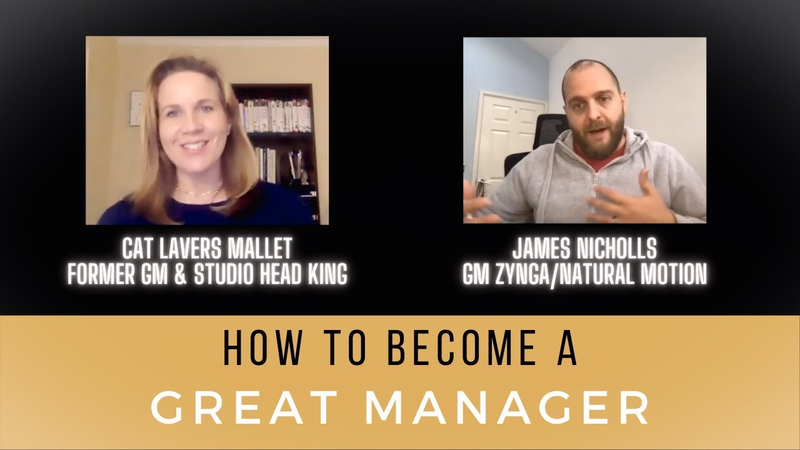
hello everyone and welcome today we're going to be talking about what does it take to become a great manager and in my own experience i've had the opportunity to work with some folks who i thought were great managers and some who are not so great and so in this discussion today we have kat lavers malay former gm and studio head at king and i'll actually give you an opportunity to talk a little bit more about your background as well as james nichols current gm at zynga of natural motion and both of you actually were identified to me as really great managers so i am dying to ask you both a lot of questions about what does it take to be a great manager and how why do people consider the two of you great managers but just to kind of set the stage and to let people know a little bit more about you maybe we could have you start by giving a quick introduction in terms of your experience and background starting with youcat uh sure so i've spent my career building
call it product centric businesses so spent a long time in the games trenches as a product manager at playfish and then coming up through ea as a producer executive producer and then went over to king where i built out the uk studios as their first head of studios there um since then when it bows ai start up a couple other things and then i have now set up my own consulting business helping uh growing companies with their operating strategy uh figuring out how to get from here to there and spoiler alert it's all about people right like it's all about figuring out how to manage people through complex messy stuff green and james hi yeah so i'm james i'm the general manager of a new studio for natural motion in the midlands in birmingham i've been with the studio for a year uh gradually building it up from from nothing um which is super fun before that i was at king for four years
in fact cat interviewed me just before i joined which was super awesome so we haven't met once or twice before i was there for four years doing kind of design direction and then production direction the last year i was there and running teams before that i was at codemasters for seven years and various other companies before that so i've worked in games industry all my career for about 19 years or so mostly console and pc and triple a and then more more recently free to play type games um so yeah i've been kind of managing people from a reasonably early age i think i was in my kind of early 20s when i got the team's thrust upon me and had to make it work from there so i kind of learnt on the job and kind of made it work from there really okay and so maybe just to dive right in and get getting straight to the point maybe we should just open with the first question in terms of what does it actually mean to be a great manager so in other words if you were to like break down
the responsibilities or like the objectives of a manager how would you break that down in terms of like the different responsibilities and maybe you could also speak to what are the hardest parts or the the hardest things to do as a great manager and since you're first in my window maybe starting with you james uh sure i mean obviously there's there's loads to it and it's very contextual as well i think as a general thing a manager is somebody that enables people to become better at what they do levels them up within the the framework that they're in at the moment so you're looking for someone really who's at least fairly humble or get some motivation from that that side of work um if there's somebody that needs to you know impress upon everyone else that they're the leader and the person in charge it normally doesn't last very well so if you're that kind of person that loves seeing people kind of come through and develop and you know nurture underneath you then it's normally a good sign that you've
got the right kind of basic qualities and then you can go into lots and lots of details about how they organize and run things but i think you need somebody who's kind of firm but fair in their approach it's no good being everybody's bestest buddy all the time because that can sometimes be tough to keep going when you hit hard times so you need someone with that kind of mentality that's going to you know keep keep things in bounds but also um you know sort of step in when when need be um you need someone who's an awesome communicator i think and when i say you know great communication that's not standing up in front of a group of people and you know giving a great oratory performance it's more about somebody who can adapt their communication to lots of different people so in a group setting in one-to-ones you know getting through tough conversations with people so recalibrating your calibration based off the individual so i think all of those things are kind of in the mixture for pretty much any manager i think you've got to be fairly
authentic in the way you come across if you're you know people are not going to really buy into how you're leading them if you are coming across as somebody that's you know fake or you know saying things they don't believe in i think that's going to undermine you pretty quickly so i think that's kind of a really broad kind of starting point i'm sure you'd like to come in cat though as well there's probably loads of things i haven't thought of there yeah james i think that's a really good list i think i i think you know there's a lot of conversation around what is leadership and and what is management and you can get super academic on kind of parsing those things out right but at the end of the day you've got two parts right you've got to lead the business and you've got to develop the people and you do you know one without the other well that's going to collapse right and so if you think about the business part i would say it's about ensuring that important decisions get made but but more importantly james i think as you pointed out being able to tell a story right talk about like where are you going why does it matter
right like what's the journey and why is the work worth it uh and on the people side i think obviously there's all the mechanics around goal setting and making sure that people are doing the right work and that they know what good looks like and that they have um they understand kind of the path that they're on but where uh what i think separates the good managers from the great managers and by the way i'm super flattered to be um at least someone lumps me among the great managers um because i think it's by far the the most important part of of what i do is being able to link those things together and understand doesn't matter how big your team is right understand each person on an individual level and make it clear to them how what they're doing in their day-to-day how that ties back to the bigger story
like why does it matter right because not every day is going to be a fun day um so if i'm getting up in the midst of a pandemic and it's kind of a slog what what's it all for and and i think to me the the hardest part about being a manager is when those two sides of the coin collide right the lead the business and develop the people particularly in games right like people work in games because it's a passion right it's a creative business you've got people putting really their sort of heart and soul into making a thing and sometimes through no fault of their own it just doesn't work right like they've done all the right things we asked them to do a thing they did the thing players didn't like it right or someone else's product was better or it wasn't too expensive to buy an ad right and so now you've you've got to make those hard business decisions while also being empathetic and
understanding people on an individual level um and to me that's really hard and it's also what separates the good leaders and managers uh from from the great ones right if you can't make those hard decisions if you just kind of delay or postpone because it's hard you're not actually doing anybody any favors like it's just it's just gonna be worse for everybody in the end so um put on your big boy pants you know and make those hard decisions but do it in an empathetic way right so it sounds like if i'm hearing you both correctly there seems to be a lot of focus in terms of what you guys are talking about as far as development mentoring training of employees and then cat tier point the great managers will also tie back the work that a direct report is doing to maybe the overall business objectives and why their work matters and in in terms of like the you know one of the things that we hear about a lot in the games industry and varying by different game studios is
the actual in terms of the work itself in in terms of like the observation of the work or evaluating the performance of the work what would you say in terms of that part you know for studios that crunch a lot is a great manager someone who can like force their employees to get a lot of performance or maybe that's the wrong way of of stating that or like what should the role of a manager be in terms of the actual evaluation observation or output of the work that direct reports do um shall i jump in so um yeah i i think that you kind of touched on this already you've got that rock two roles to play right you're there as you're there for the company that you work for to make sure that the people there are doing their best work and hopefully leveling up as well so you you do have to kind of keep both of those things in mind a common mistake i think for new new managers is they want to purely
focus on the people and that's always coming from you know a great place and they want to you know do everything right by those people but sometimes that's not actually setting them up for success if they're kind of allowing them not to do the role they're really there to do or they're not setting them up to do their best work in that role so yeah i think you as a manager i think you need to start from a position of trust you trust that the people that you're working with and that you've hired are going to do the things that they had to do you're not kind of checking on them every five seconds to see if they're doing the thing they said they were going to do earlier and try and make any kind of targets or goals depending on what it is they're doing measurable there's something tangible they're going to do that you can agree that that was a good result at the end of you know a period of time and then you should get the you know that individual the flexibility hopefully to get there in the way that makes sense for them um you know i think commonly you'll get new managers kind of come in and they kind of stamp down okay this is how you do the work and you know i want you to do it the way that
i've always done it and that sometimes stifles people from achieving it in a different way but you do need to i guess be objective enough to then kind of sort of be honest with yourself and with that person if that work was actually good enough or if you did hit what you set out to do over the course of the year even if there's you know lots of lots of reasons why it didn't come together or the quality wasn't quite there for reasons beyond control it's good to be talking about that all the time and be really clear what's expected i think people in the long term prefer that if you're getting if you're getting a kind of consistent and honest assessment of what you're doing rather than someone saying oh yeah everything's great everything's brilliant and then suddenly out of nowhere there's this course correction of now actually wasn't very good people get really knocked back by that and it actually isn't helping them in the long term to kind of mask how things are going so i think that firm but fair kind of approach again that i mentioned earlier on just you know consistent be honest if you're giving feedback from a place of wanting to develop the individual
it's not going to be like punitive and horrible to them you're you're trying to help them be successful in their role but you do have that role to play i think to give them that feedback so if i'm hearing you correctly james it's basically like just working with a direct report to make sure that whatever the objective is in terms of the performance or output that whatever that goal is is agreed upon and is very clear and then in terms of how they actually do the work you don't want to micro exactly what they do or how they do it but what you're looking for is just whatever that agreed upon output looks like is that yeah yeah i would agree with that and you may need to help them get there so if you've set them a goal and they're struggling to hit that then as a manager you might need to then start to step in and give them some structure or some advice or some coaching or something to enable them to hit that goal but if you start from a point of view okay here's your job and i want you to do this this and this like a checklist that person's never going to really kind of grow they're going to just wait for the next instruction so i think it's you know it's that kind
of thing i'm talking obviously completely general here i mean you can get very specific for different crafts and there's different types of work in different parts of the games industry but as a general rule i think you've got to you've got to start from that position of trust give them the space to do their work and get to a goal maybe in a way that surprises you and then if they're struggling you know start to close that brief in simplify it down and help them to get there and then step back again once they start to hit it cat any thoughts yeah i mean i think james you you hit the nail on the head that it has to come from a position of trust first right and when you're developing someone in a way that feels like hey i'm helping you get to where you want to go right then then you're much more open to receiving that feedback so focus on you know what's the outcome rather than just like the work being done uh and building that feeling that that you're on their side right and and that even when you're giving critical feedback or you're
saying you know what you're not in the right job how can you do that in a way that feels like i'm on your side in this conversation because this is just a mismatch and i think having now worked a lot in the uk and a lot in the us there's a real kind of cultural um layer to this like in the us in particular our professional identity is so tied up with our personal identity and our sense of who we are right like you go to a cocktail party like when cocktail parties are a thing right and one of the first things that that people ask you right is what do you do in the uk change you can back me up on this or not like it's kind of rude right like it's my job it's definitely the two are separate from one another you're not defined by your work i think is is fair for most people um you know it varies not all industries but um but like you know well while we're talking in broad general terms right and and when you're in a culture where your job
and your sense of self are so closely tied together um feedback that says hey you're not good at your job very rapidly and very frequently becomes translated into you're a bad person right like there is something wrong with your character you know your sort of sense of character because you don't know how to do this thing yet and so i think you know as you think about leading with empathy how do you separate those things out um there's a concept of s-curves in in skill development i don't know if you guys have come across that one right but you'll see it in like training courses i think it's a mckinsey thing and i find it really helpful to when i'm uh working with a team member say for this particular skill that we're working on where is this person on that s curve right are they just learning how to do it um where everything is kind of hard and slow are they on that rapid acceleration up
where they're like really on fire figuring it out or are they at the mastery part but they're actually not learning that much anymore they're just really good at what they do and quite frankly they're probably going to get bored and you need to find another curve to move them up and thinking through having different frameworks of how you develop somebody based on where they are on that curve for that specific thing that they're learning to do to me i find to be a very helpful um framework right like that's your original question right the how much hand holding you do how much micromanaging you do really depends on how much you not only how much you trust that person to be able to do the thing but how confident they are in their ability to do the thing let alone do they actually have the skill to be able to do the thing um and and getting the match of all those things right i think that's the secret sauce right
and maybe to just even dive a little bit deeper into the specific qualities or skills of the manager and you guys have alluded to a few different things james you talked about authenticity you talked about trust you know cat i think one of the things that you touched upon is actually having some situational context right understanding for this specific individual maybe because we're in the uk you might treat that individual in a different way from somebody in the u.s or things of that nature but could we dive a little bit more into like if you were to think about or to break down what are some of the key skills or qualities that a great manager should be really cognizant of and start to try to develop to become that great manager what would you say some of those things are listen well okay 100 100 percent degree yeah i i think cat earlier mentioned like leading with empathy right that is that empathetic skill
like being able to to hear different people hear what they're saying understand where they're coming from so i think coupled with that it's like a a kind of an emotional maturity so it's nothing to do with age but but yeah a degree of either experience or ability to kind of understand where someone's coming from where's this feedback like we were talking about the context in which someone's operating in what their background is what their preferred communication style is really starting to think okay where's this coming from what's this person thinking when they're saying this and sometimes even just taking the time to just hear people out sometimes you know people that work in your team they need to decompress there isn't actually a point they just need to sit down with you for half an hour and just go oh my god this is just too much or this is really bugging me or i need to get this off my chest and once that process has happened then you can actually help me at the side so yeah listening skills if you're not a good listener um it's i've come with some managers who aren't good listeners they hear the bits
that they're they're interested in and often you have to help them go you know well have you actually sat down and asked this person or is that actually what they're saying or you know what do they really think about that and then they start to kind of connect a bit more with their their team member right 100 so for managers who want to build some of those skills whether it's listening well or leading with empathy what would you recommend that they do so maybe it's in terms of like during one-on-one meetings that they spend some time at the beginning just trying to talk to their direct report about issues and try to listen to them or what what are specific things i would that you could think of to try to to get people to start to practice some of these skills um i think in a one-to-one context you obviously you've got to give enough space there's some basic techniques you can learn in terms of asking open questions okay not bombarding people with information or statements but starting with very open you know how are you today and what's going on how do you
feel about this and seeing where that goes i think a very i mean a very basic one for a brand new manager is just spending some time with people so you know when i first started at king i i interviewed every single one of the team got to know their back story spent an hour with them you know no agenda no his here's the objectives we're gonna go through just learn about who they are as people and what what are they motivated by and where are they going i think then you know in a one-to-one capacity yes there's some some basics you can do in terms of learning you know how to leave space an interview be be present in that interview as well don't turn up when you're kind of checking on your phone and after listening to the conversation because you're not taking in their body language you're not really absorbing what they're telling you so in that moment you've got to be you know devices down focused on that one person and make sure that you're hearing what they're saying and then i think another one um that i commonly advise for managers is it kind of a little and often approach in terms of one-to-ones so you know it scales depending on the
size of your team but maybe like a weekly catch up for half an hour is probably better than one big catch up every month because things can go quite awry in in the course of a month say and and then you're kind of reacting to okay now i've got your time here's all these problems that have bubbled up as opposed to us that as they start to happen you can kind of just course correct more gently if you're catching up more regularly with people um that's very general advice again and obviously it's contextual depending on the work and the people but those those are the kind of areas i think that gives you a kind of base level connection i think with the people you're working with right cat yeah oh good yeah i would certainly agree with that and i think james you touched on this earlier as well that one of the things that new managers uh often do is sort of blur that line between being friendly and being friends um where you're kind of now you become
like your therapist right um let's just sit and chat through all the stuff you're feeling which is all well and good and important but you actually need to run the business and being clear on what the decisions are that need to be made and making those decisions um i've seen many new managers and experience managers stumble and um i certainly have made that mistake in the past and probably will make it again right of delaying making a hard decision because of the impact that it will have on the team and it's it's really one of your main responsibilities right be able to make hard decisions and and um being able to articulate what is the decision that needs to be made another just sort of super tactical thing that i like to do is uh absolutely have frequent one-to-ones but often i find that the weekly one-to-ones they get taken up with kind
of operational stuff right what's going on with this piece of work what's going on with that goal right what's the stuff that's happening day to day and so breaking out um right about once a quarter and having a separate personal development one-to-one that's really around where are you going what are you working on kind of from a personal skills perspective uh and let's not talk about what's going on day to day in the business at all because i find if you try to annual performance reviews like they're good they provide value but a year is a really long time right how do you um create opportunities for someone to develop in in much shorter time frames regardless of what kind of the official structures are of of your business i think is important so how the regular operational one-to-ones on a on a very short cadence uh and then many times a year have one ones that are really focused on career and personal development
yeah it's a really great shout out and also kind of maybe breaking out the office or something if that's possible you know obviously at the moment it's a virtual office or a different background and zoom or something but um you know if you can take people out for a coffee or something like that it changes the nature of that conversation a little bit as well changes the atmosphere around you can maybe open up a little bit about how that personal development piece is going yeah it's really good advice to make sure there's some time for that individual's development as well as just catching up on a project or something like that and you know given that one of the things that you you both have identified is a key kind of responsibility for managers in terms of skill development and cat you're you're mentioning like you know some initiatives around skill development could you guys talk a little bit more about so what should or how does that look for both of you in terms of how you evaluate the skill of one of your direct reports and what
are potential whether it's frameworks or methodologies that you would use to try and identify how somebody should be building skill over time and then how do you kind of give that feedback are there you know whether it's like uh you know um just general feedback as far as like a deloitte consulting start stop continuing type of framework or maybe it's like do you have like a skills matrix or kind of specific definition of how people should be developing or maybe you guys could just you know speak to me in terms of how do you guys generally think about that or are there frameworks tools that you guys use to to think about skills development uh maybe starting with you james okay um yeah it's a very very broad topic of course it depends firstly i'd say it depends if i'm coaching somebody who's um a direct report who's doing a job and a job alone or whether it's somebody who's like a team leader or a manager themselves
obviously that's a very different set of skills i love cats um analogy of the s curves thing that's such a good analogy for managers who kind of they they start off thinking they're ready to do a managerial job and then realize they have to learn all these other skills that they've never used before these totally different set of kind of communication and uh you know interpersonal skills they need to develop i think yeah skills matrix type thing for somebody who's doing a you know individual contributed type role and needs to do very well the more specific you can be on that the better in my opinion um there's nothing worse than somebody who is feeling they're doing a good job and their manager is giving them sort of vague ideas about what they need to do to continue and there's there doesn't seem to be anything specific that individual can do i remember being told once at a pre a job a long time ago that i couldn't be promoted because there was somebody older than me that they weren't ready to promote me so things like that just drive people nuts like when they just don't know what it is they need to do and if you can be it's really hard
sometimes with soft skills particularly in the games industry you think of people like games designers maybe artists to some degree where it's a kind of it's good when i see it kind of feeling in the work it can be very difficult to quantify that but it's something i've done a lot say with managing designers in the past is really drill into what those skills are that you need to exhibit and even then it's not like a checklist it's not like do this this this and this and get a promotion at the end of the year it's more like this is the framework of skills i'm expecting to see you exhibit here's how you move from like a mid-level person to a senior to a principal or something this is the influence area i'm expecting you to have so you know to start off with it's very local then i'm expecting to see you have an impact on your team then outside your team in the wider area and help them trying to picture what that looks like if if you've identified find something together then really dive in on that and help them give them the training or find a mentor that can give them that it doesn't necessarily all need to come from you um
you know be genuinely on their side to try and help them get to that point um it's going back to the little and often thing again it's you set up a framework like cats are you know checking in regularly on their development through the year giving them steer and advice and course correction and see how they're doing along that way so you're not kind of getting to the end of the year and then going yeah no i'm not really feeling it i don't think you quite integrate i can't really explain why but it's not you know i'm not really that happy with it you've got to kind of really you know give some specific examples that you've noted down during the year you know this went really well i loved how you gave that maybe next time you could try this or you know next time you do that presentation let's try this approach and you know see if that works for you and you know giving them feedback all the way through the year and also things that didn't work you know if there's an example of where something didn't go right hopefully you're sitting down going through that discussion but you've taken note of that when you're looking back over the course of the year you know you remember this incident okay we worked through it but you know we
needed to make a you know a correction there so so specific examples all the time to back up that that kind of skills matrix approach i think of its managers it's a whole different whole different thing again well maybe we can go into that as well in a second but uh i thought maybe cat do you want to kind of come in on where i've started there yeah i think um the examples you pointed out are really good right talking specifically around the individual contributors right examples um a framework if you've got one i also think that peer feedback is invaluable right and focusing on building a culture where giving feedback is appreciated uh and and also expected um and and quite frankly teaching people how to receive feedback right how to receive uh unpleasant feedback uh because if you are bad at receiving unpleasant feedback you're not gonna get any and then you're gonna be stuck where you are um one thing i might also add uh is that it's very common for you know you have a new employee or
a new manager uh and they come in and they say hey uh i want to be promoted right and you get a lot of focus on i basically just started this job what do i have to do to get promoted and that's one of the things that i find helpful is to try to like raise the sort of extend the horizon a little bit and shift the conversation from what are the things i need to do to get promoted to what are the things that i want to develop for the long run where am i going my goal is not to get promoted right my goal is to you know i want to be just expert at my craft right i want to run a fortune 500 company like where where are you going and how are you starting to think about your portfolio skills and promotions are nice obviously right they're important sort of signifiers of of progress whatever that means but quite frankly like the more experienced you get the longer it's
going to take in between promotions and you need to have a i would say a healthier framing of why you are building this skill set right why you are trying to achieve this is it about the money is it about the status is it about the recognition is it about like my sense of personal worth and if you can understand that as a manager then i think you could have a much more constructive conversation with that employee of not so much focusing on what do i have to do to get to the promotion and engines also yes managing management there's totally different kind of fish you also kind of reminded me of an area that's quite common as people get more senior in whatever craft they do the the skills matrix type thing starts to kind of rapidly run out of room and there's not really that kind of the more senior you get or the higher up in an organization you go the less defined those roles are going
to be so sometimes it's helping people maybe they've moved from a senior position into like a principal role or something like that helping them define what that even is you know where do they add new value what's changed about their role sometimes you're having to help them almost discover that for themselves and helping them manage their way through a bit of ambiguity about where they now find themselves and then you know we'll get on to manage managing managers i'm sure but it's often that thing of kind of almost rediscovering themselves it's not just do what you used to do but a little bit more or you get paid more for doing the same job you've now you're now expected to do extra you've got to have an impact right across your organization or you're expected to go outside and network with other people or you're meant to be developing those around you where you weren't before it varies depending on the role but helping people through that i think can be you know quite tough sometimes it really takes um that people kind of sometimes at the top of the game in a particular role they're super self-confident they're really flying and then they jump up into the next run and they suddenly kind of
feel completely out of their depth they don't know if they're doing a good job anymore and the manager has to help them kind of steady themselves and refine themselves almost so as much as a skills matrix helps you get to a certain point there's also that that very nebulous area when someone starts to get to a senior position where you have to just help them almost discover themselves again as a as a new manager or as a leader or someone who's seen as a thought expert on a certain area you know you need to help them find that identity for themselves almost right and maybe before jumping into a discussion about managing managers cat i wanted to dig a little bit deeper into one thing that you mentioned which was around this topic which in my experience has been one of the biggest issues which is like giving and receiving direct feedback because if i'm being honest most i would say 90 of the places i've been it actually doesn't happen right and especially the larger the organization and the more political the organization
like actually giving direct feedback is a death sentence if i'm being honest and so could you talk a little bit more about that cat in terms of how you know what is it in your opinion what what is your approach around giving and receiving direct feedback and to your point about training people to receive direct feedback what are some examples of things that people could do so you're totally right i am i have been through countless performance reviews cycles where you see the peer feedback come in and it's all glowing like i know that you have think that this person you know has this challenge like you've complained to me about it all the time and yet you didn't write it down right uh because people want to be supportive and they also don't want to um like be punished essentially right for uh for giving that feedback um so i find
that there's something about the very formal performance review process that says you know this this is feedback that will be on your permanent record uh which makes it big and scary and and kind of sets the bar high right for what you're going to put in there it's going to be there forever um and if you can build a culture of feedback just in like small interactions it's much healthier and tends to happen more right so and you can do it by putting it in the context of what they're already doing like not a sandwich right but saying like presentation was really good it would be even more effective if right or and and all those sort of in the moment um thanks for sending that through uh it
would be a little clearer if you could tell me x um or pushing on uh oh and can you can you add that right like teaching people uh very sort of specific things that they can do to be more effective um in the moment right i mean we've all had the instance of feedback shows up six months later for a thing that you did before right that's not particularly useful um and and the tone comes from the top right so if you can demonstrate that you're giving that feedback to ideally to peers but to team members in a way that is um semi-public like in safe spaces but giving feedback that is reinforcing and also constructive
um i think that can be that can be quite effective like generally obviously you want to praise in public and and criticizing in private but when you're giving i think there's also ways to do constructive feedback in public that does not feel like shaming does not feel like you're in any way embarrassing the person but more giving them more opportunity to grow into and then in terms of how you would encourage other people to also be giving direct feedback is there something specific that you do or basically leading by example i think leading by example is is the big one um and it can get a little bit hokey but you ask for it right you ask for it and then you act on it and you can incorporate that as part of of retros um right there's ways um to formalize but keep it informal right this is gonna be a session where we're gonna be talking about this sort of thing it's not gonna be written down
right this is not gonna decide whether you are a four or a five right it's just so you know how people are receiving the work that you're doing okay and then for let's say a specific direct report who's being very defensive as you give some feedback it's like well but this and that makes you know is there are people who are like that how would you deal with that situation or to your point about training someone to receive the feedback what would be your thinking or approach i usually let it sit for a while okay right because i think that often their first response is to go oh no let me explain why and that like let me tell you why your feedback is wrong um and then they go home and they think about it and they're a little bit sheepish and then they come back the next day and then you say hey you know should we talk about that feedback again right usually it's a different conversation once they've had time to get their sort of fight-or-flight response out of the way okay
uh james what have you found we've um when i was first at king and i was managing a team of designers we had we had this kind of issue where within the team everybody's feedback to each other was very positive it was always the good stuff it was always well done you're doing a great job and we had to try and frame that from the point of view of like if we're going to get better as a team we need to provide a way to give each other constructive feedback and we worked with the the training team there to provide um some training in radical canada which is this idea of is exactly what cat's been saying it's it's uh direct feedback it's honest feedback but it's constructive and it's friendly it's not designed to tear someone down or belittle them you're giving them honest appraisal of what they just did in order to help them get better and that that definitely helped the team sort of frame it in that way so you moved out of only giving people nice feedback where they're not really learning if they missed a trick and you actually help them maybe practice
giving each other feedback on certain things or just doing it regularly exactly as cat says in retrospectives or provide sessions to give each other feedback and practice it and what i find generally with teams is i think it's a very human natural reaction to be defensive to someone criticizing you i don't think that's a unusual thing for someone to feel but once you get over that hum like as a like in your craft you'll actually crave that feedback once you've had it and you've enjoyed it and you've seen yourself getting better from it you'll just always be looking for that feedback after that so it's um it's quite a you know it's a thing you have to lead people onto i think in a bit of practice bit of training setting up the right environment just as cat says and you know sometimes individuals need a little bit of a nudge but mostly it's about kind of getting used to it and if you can lead by example yeah doing things like um like a 360 survey or something that your direct reports get to contribute in that then signals to them that you are also looking to receive feedback and
you're actually doing something about it so if you say if you can kind of summarize okay i just had this survey and i did these things this is what i'm working on this year that that really does then set an example to everyone else of like okay yeah even even my boss thinks that's a good idea so i'll give it a whirl as well and see if it works for me this year i think that's such a good idea james the it shows so much um vulnerability right to be able to say to your team hey this is what i this is what i got from the feedback uh here's what i'm doing about it and and keep me accountable right if you see me not doing it give me the secret handshake right and remind me that i said i was going to be doing this yeah i absolutely agree and sometimes it can be frustrating that you get feedback from members of your team and you're like that's not me that isn't true but it kind of doesn't matter if the feedback's there that's their perception right right or wrong whatever's contributing to it so showing them that you've heard that message and you're trying to do
something about it um speaks volumes i think it shows that you you're trying your best you're trying to learn you're also a human being he's not perfect he messes things up sometimes but um you know it sort of sets a precedent for them to try and do the same thing on their local level right okay great and maybe now talking to james you've been alluding to this notion about managing managers and kind of like skills development for managers could you speak to some of your thinking along those lines yeah it's something i've i've done a fair amount over the last kind of i don't know five or five or six years and it's very different trying to lead people into that space um as we've kind of been touching on like right the way through it's quite an individual thing your style or your brand as a manager there's no kind of single way to be a manager you've got all of these different soft skills in play and you know you're trying to be your authentic self and also try and lead and be responsible and all of these things so how you do that as an individual is very unique i think so you do need to kind of
understand that person and help them i think we kind of touched on it a little bit earlier on but you've got to give them some space to develop as a you know as a leader and manager but do that in a safe way so they've got it they've got to be able to fail but in a in a safe environment so if you're giving them some new responsibilities for people it's no good to kind of leave them alone for six months and come back in this like hr lawsuits and like a disaster on the team or something like it's too late by then you've got to you've got to kind of you know help them along the road without doing it for them and that's very difficult when you're managing managers i think that there's a whole bunch of stuff that they that commonly kind of um miss or kind of new people new to management often stumbled into so the the number one thing i i think i always see is say someone who's been really good at doing an individual job and now they're going to be a manager as well they still think they should be doing
that entirety of that individual job and also doing managerial stuff and what they end up doing is in their first few months they completely burn themselves out because what they do is they they do all the things they used to do and then they're trying to find all the time for one to ones and looking after their team and organizing their team and they just completely get overwhelmed so often you have to help them firstly understand that they can't do all the things they used to do which is an uneasy feeling for people who've been very good at what they do and often you'll it's it's not like helping them to be even better at their craft or something it's like really basic things like how to organize your note-taking system or how to manage your calendar or you know how to give yourself enough energy and recovery time during a day because often they haven't needed those skills up until that point and then they step into this role and they're like oh this is way too much and they're they're struggling for reasons that are nothing to do with their individual skill it's just they haven't got themselves
set up probably so you have to do a lot of that kind of thing um i think we've touched on a few of the common pitfalls like trying to be everyone's friend be a buddy i'm going to help you get to where you want to go you know i'm going to make it happen for you those kind of traps come along quite often sometimes you get someone who's been in a group of peers and then that one person steps up and suddenly it gets really weird for them the dynamic has changed and they're they're sort of still friends but also they're kind of their boss now and they've got to kind of relearn that so just being there and supporting them through that i think the um one of the best things you can do is mentally prepare them for this stuff as well i think that um the more upfront advice you can give them on you know what's coming as a manager is setting them up for some of the types of conversation that are going to come their way that they might not have anticipated is you know you're really helping them so a common thing is that um new managers might be what what might be motivating them to be a manager is that
they love the idea of helping people out helping them develop you know being involved in the craft that they work on but maybe what they haven't mentally considered is that person's also going to come to you when they're having you know a crisis at home or when they are underperforming and you need to help them get out that hole so you kind of need to prepare them mentally that they'll also have to have hard discussions as well as the nice stuff and you know you do it well you do it right it's a super super rewarding role but it's not an easy job there's a reason why only so many people are good at it there's a reason it's paid more there's a reason why it's not for everybody it's quite tough to do to be a manager so if you can kind of set them up with that in mind they normally get there eventually um yeah giving them giving them plenty of space identifying what their skill gaps are with them um early on so you know we touched on these skills like communication skills and listening and empathy and those kind of things some people just they just take to it
it's the most natural thing in the world to them they're already kind of doing it they don't even realize they've got a superpower some people it's a massive you know goal for them to overcome and it takes them a year or something of practicing being a human and relating to people and listening and developing those skills and then then it clicks and this and following cat's s curve analogy suddenly they just take off as a manager and all the rest kind of comes with them so um you know i think those those are a bunch of basics kind of catch all for everybody and then we can probably get into some more specifics but cat which ones have i missed there's probably heaps that i've i've not touched on yet i mean you i think you you touched on a lot of the really good ones um one thing i might add is when you are managing managers your relationship with their direct reports changes a bit as well right especially if you're in a growing company where you knew you knew the sort of individual contributors quite well they know you now there's a manager in the midst they keep trying to come to you you know
making sure that you're really uh say boundaries right of no this is we can still um you know be friendly and i'll have a relationship with you but you need to actually channel these things back through them through the manager right of making sure that you're setting the manager up to to be successful and not not um undermining them accidentally the the other thing i think going back maybe more on the leadership side than the management side is giving the manager the clear guidelines on what success could look on what success looks like right what are the outcomes they are responsible for what are the constraints that they have and what are the resources that they have available and then let them know the shape of their box um and then let them figure it out right you don't if you're figuring it
out for them then you're not actually helping right then you've just added kind of a middle management layer that doesn't do anything other than maybe do the one-to-ones right like you need to actually give them a scope of a meaningful scope of work scope of business that they're responsible for and where they can make important significant decisions that impact uh you know their piece of the pie that's a really good one yeah something i used to try to do to get people used to hiring for example being a hiring manager was delegate the role of like graduate hiring for a year to to new managers right so they they get to go through all the steps you you ultimately are responsible for the person that comes in but you you've stepped them through every step of that process from start to end so then when they see people come in they they know that that person was someone they hired they went through all of the processes to get there and they've got a kind of i don't know a
structure i suppose a technique of how to do this in the future they had they absolutely had responsibility for it but it in terms of the grand scheme of things for the company if that was a mishire or if they didn't find a good fit it's not going to destroy the business overnight so they've had the the ability to kind of feel their way into that they've had a lot of trust and responsibility put into them you're there in the background but what you're not doing is kind of going oh no no you don't want to do that let me do this one for you and then you've kind of taken that agency away from them and those kind of things are really great for new managers if you can find them a thing to own that's safe enough that it's not going to you know be a catastrophe if it does if it goes wrong but there's enough responsibility where they get that kind of the the all kind of the white heat down the back of the spine of like oh my god like this is me like i'm in charge of this thing now that's yeah if you can find that spot for them it really helps them develop so yeah like creating that box as you define cans or letting them step into that and
feel their way into it a bit be patient it'll probably kind of go a bit wrong for a few weeks they'll be a bit panicky and then they'll sort of ease their way into it after a while that's uh that's a good place to be with them okay uh i thought we can next talk about so google conducted the study in 2008 called project oxygen and basically what they did is they studied the behaviors of google's best managers based upon an employee survey and they did an update in 2018 so a couple years back and they came up with these kind of 10 oxygen behaviors and i wanted to get your reactions to what you guys thought about some of the stuff that that were the findings from project oxygen so these 10 behaviors according to oxygen where one is a good coach second empowers team and does not micromanage third creates an inclusive team environment showing concern for success and well-being four is productive and results oriented five is a good communicator listens and
shares information six supports career development and discusses performance seven has a clear vision strategy for the team eight has key technical skills to help advise the team nine collaborates across google 10 is a strong decision maker now certainly some of these things it you know you guys have also touched upon but in terms of the context of those 10 behaviors just wanted to get your general feedback or thoughts in terms of is it do you generally agree are there things that you would disagree with or you know and and how kind of actionable do you think this is and maybe starting with you kat i think i think it's a great list there's nothing in there that i would i would disagree with i think maybe one that's worth um just poking out a little bit is the technical skills to advise the team i think is actually just great phrasing um because it's particularly for new managers and james you talked about this a little bit right you're you need to step out of the doing the
work um and help others to do the work uh and that's a really hard transition right and and often uh make you feel like well what am i what am i actually doing here what value am i adding um but it's an important step so i'm i'm which is just to say i think it's good that that's in there uh and i like the way that it's phrased and i think the rest of the list i take no issue with any of them i think they're all important yeah i i i picked out that one in the list as well like there's a temptation i think for some new managers where they feel like they need to demonstrate that they're the best at a certain craft like to be the manager they need to know more than all of their line reports otherwise how would that person like believe them or trust them and it stops being true actually particularly in things like the engineering craft but you can apply it to anyone the best managers are often not say the best engineers they're the best people for managing engineers if you see what i mean so they enable people who are subject
matter experts to be awesome and what they do um so yeah helping them on that is quite good so that is really well phrased um i picked out as well as like has a clear vision or strategy for the team i think often uh cat pointed this one out right at the start it's kind of helping people find their place in the organization or what their role means for the future and helping them through that ambiguity so sometimes you can find a team is like they're not that excited about the current mission or the thing that they thought they were going to do they're not getting to do now so now what you know what do we do as a team what's exciting for us how do we find something that we do want to do you can add huge value there both for the company and also for the individuals it helps them settle and maybe find a way to develop their careers in a way that they hadn't anticipated and we've touched on some of the others already i think the one on empowers team and uh sorry the um creator inclusive team environment that one's subtly more difficult than it sounds
actually i think that if you've got a large team and you think of things like team meeting dynamics or presentations or something like that you've got to be mindful i think of a manager of not just kind of reacting to the the big personalities or the ones that dominate the conversation whatever you've got to find a way for those people who are perhaps slightly less confident or quieter in their demeanor or communicate in a slower way they've also got to find a way to contribute you need to make sure they can develop too so creating an inclusive environment means all sorts of things but it means making sure that everybody in your team feels like they can come in and do their best work that they you know have their opportunity to develop and contribute and so on and often as a manager you have to step in and help there a little bit it's not you can't just sort of sit back and wait for it to happen you often have to either create the space for an individual or challenge perhaps behaviors where one individual is dominating or one individual is saying something that's perhaps not the most inclusive
for the group you need to maybe just gently push in on that without making a massive deal out of it just to make sure that the others can flourish within the group and maybe just recognizing the overall makeup of skills within your team so if you know that certain people on your team will contribute in different ways make sure they're having an opportunity to show what they can do in that area rotate around the responsibility for show and tells or who's taking point on organizing the social this month or know whatever it is but give everyone a go you know don't end up with your you know your stars that you invest 80 percent of your effort and then everyone else is kind of left on the periphery you've got to kind of be be fair to everyone in the group so yeah creating an inclusive environment i find in games sometimes that's harder than it sounds i think particularly if i if i look back earlier in my career when we've got teams of white guys all of a similar age and background all in an office with you know particular type of banter and communication style that's
not going to be super inclusive for somebody new coming into the team right and you've got to think really carefully about that make sure that your team is welcoming to everybody that people who communicate differently you've got a chance to contribute and all of that stuff so yeah i think that one sounds like a yeah well of course you should do that as a manager and then when you start digging on that's like well there's a lot of work in there actually that's something you have to really think about one um tactical thing on on that point when i've got new teams that are putting together i'm a big fan of using some of these sort of psychometric exercises right whether it's disc or predictive index or i mean you can use the like adobe my creative type like it doesn't really matter so much which one you use i think i mean they have different strengths and weaknesses but just having the team do it to realize oh we look at problems a different way right we look at the world a different way we like to communicate in a different way and the value is i mean it's nice to
kind of get a picture of this is what you're like but it's more valuable when you start saying well what does that mean for the team right and and if it turns out that we're all i don't know red or owls or captains or like whatever the the framework is and you've got one person over here who's a whatever the other things are uh a that person's gonna be really lonely and uh feel like an outsider and also you're missing so much in how you're making decisions right and so you have to work a little bit harder to think about okay well what would be the you know if both trying to fill out your team so you have those other traits and characteristics on your team but if you don't uh how do you simulate it right how do you just become aware that that's a gap in your team's makeup and you're going to have problems in making decisions if
everybody's looking at a thing the same way and so i find across the board once people get past the oh that's hokey i don't believe in personality tests stuff uh it ends up being a really fun and interesting conversation whether or not uh everybody feels perfectly represented by whatever their result is that's kind of less the point than the sort of recognition that people look at the world in different ways like to communicate in different ways uh and as a leader and as a team member you have to uh you know think about that right back to our empathy okay going back to the feedback giving that we touched on earlier on um i had a had a team once and we had two two people working together and their skills were brilliant compliments for one another but communication wise they drove each other crazy to work alongside they were driving each other up the wall i was having one-to-ones with both of them and they were both like oh this is you know really really you know doing my
head in and we we did um the disc based training with them to and help them understand how each other communicated a bit and once they started down that road it worked okay so this is someone who prefers if i communicate in this way i will take that approach when i needed it it just kind of it was just enough it just got them over the hump of like this is frustrating for us and they started to collaborate and then you know the complimentary skills thing really started to come through so yeah that's a really good thought there and i know some teams kind of really go for it with things like those personality tests they really kind of they profile like everybody on the way in and see everyone maps i think i think it's a little bit more nuanced in that i think you need to use it as a tool to crack a problem rather than a systematic approach but yes i think those can be great for helping people understand maybe why something isn't clicking so far yeah don't use it as hiring criteria okay uh in terms of like a next topic to to talk about
i wanted to go back in terms of an issue that you brought up james as far as trust and then the other issue around performance and so if we're if we're talking about managing a direct report and you know let's say you set a goal and so let's say we have a scenario where the direct report isn't quite hitting their goals over a period of time then how should the manager react or what should the manager do in terms of trying to correct the the issue and maybe the person just doesn't have the skill yet or is way too far away in terms of like the s-curve or like what what do you do then when the goals that you are agreeing upon just aren't getting there or that person is not able to fulfill the specific task to achieve business objectives for example yeah it's the the toughest bit of managing i think it's one that i needed a lot of help
with actually i had some mentoring from a from a chat called mike rider who used to work for blizzard and was working at activision and helped me particularly sort of reframe my thinking of this i think my starting point as a manager was i i see potential in everybody right so it's it was always the case this person will get there eventually like it's just a matter of time it's just a matter of hard work and he helped me kind of rethink it from the perspective of both for you and for the individual like there's a kind of a you kind of got to be fair to them and to to all the others in your team if you're if that person isn't gelling with the role they haven't quite got the skills to succeed in that role keeping them in that place of kind of perpetually not succeeding is actually quite unfair to them and what you might find is that somebody who leaves and then you know joins in a new company or a similar position but with a slightly different context suddenly they flourish like it's just
they needed that kind of that reset point so i think that's really important for managers to think through like in terms of the performance thing it's not being punitive or cool or at least i hope it isn't like hopefully they're coming from a place of wanting that person to succeed obviously you need to also be um fair to the to the business and to the rest of the team that are being supported right so propping somebody up if they're not going to make it in the long term or they're not quite able to do the role it's not fair on everyone else in the long term um making exceptions or you know trying to cover for somebody if they're really struggling in that role it may not be the fairest thing so i think it comes back to the regular development conversations that kat mentioned earlier like it shouldn't be a shock you shouldn't get to the end of the year and go actually you're miles short the thing and we're going to think about letting you go it's something you build up to gradually so you've tried it from several angles you've provided all the training and coaching you reasonably could if they're not stepping
into the role or they're not doing key parts of the role that you think they should be doing then you kind of you can start to formalize it a bit more it shouldn't be hopefully a conversation that suddenly escalates to firing somebody but you could be maybe moving them into a more sort of serious period where you're actually evaluating their performance um you know against a particular set of criteria you're formalizing over a period of time you're going to be evaluating them and if not then you start to maybe talk about them moving on or are you going to fire that individual or something like that it depends massively i think what the problem is if it's an individual technical skill it would be disappointing if that's the reason that they they ended up exiting the business obviously if it's somebody's like personality or they are you know really upsetting people around them or they're having a material impact on a live business or something it might be more serious if it might escalate more quickly and so context is really important there i think but um i think that's the general approach i
would take um and trying to you know trying to keep bringing it back to measurable objective based things where you possibly can these things can be incredibly tough like i've been through it a few times particularly with designers and under performance and you know sometimes it's a it's a horrible experience as a manager you don't want to mess people around you don't like changing people's lives and resetting their career expectations and stuff but sometimes it can be the best thing for them in the long term i've had some individuals who've left and then they've reached out to me later and you know they've actually said that they in hindsight they realized what they needed to do but at the time it wasn't clear to them so you know but also some people will leave when they may never speak to you again you know that's possible too you've got to be prepared to do that i think in the in the long term and just and you know hope that you've made the right decision hope that you've been fair in that consideration and judgment on their behalf and you know if they've not performed
hopefully what will happen is if they leave and end up moving on they will find their place somewhere else they'll find a niche that is right for them and they'll flourish and the rest of the team has got an ability now to kind of recalibrate and you know maybe see an opportunity themselves within the team now that person's moved on yeah yes i agree with all of that yeah i think that sort of will and skill framework is a really good one um uh figuring out do this does the person not understand uh what we need them to do do they not know how to do the thing we need them to do uh or do they not want to do the thing you need them to do and and the path is going to be different based on which of those things you're going down and you know going back to this sense of uh professional identity and personal identity almost never in my career have i come across somebody
who we hired and then it turns out that they just didn't care right they didn't want to be there they didn't care almost always it's a mismatch because we hired them into the wrong job we gave them expectations that were unreasonable we gave them expectations that were unclear right so if somebody's underperforming it's not just about them right it's about what is your responsibility as it relates to the position that person's in and and sometimes as james said like the better outcome is for them to be somewhere else and it doesn't mean that they're a bad person it doesn't mean that they're a failure it just means they're in the wrong place right and um and that can be the better the better outcome in the long run even though it obviously sucks in the moment it sucks mostly for them but also sucks you know for for you um but as a leader as a manager that's where uh you need to take those hard choices
the other thing i'd think about though is that people aren't machines they they're kind of they're they're fallible they have ups and downs they have unexpected things going on at home so someone who's been a stellar performer for years can suddenly have a dip someone's motivation drops away after having a great start as we mentioned earlier sometimes people struggle when they make a step up they were superstar up into a point and then they find a level where they struggle at so i think you have to bear that in mind as well when it comes to performance can you understand the reason why you know what's going on what is it you can reasonably do and i think then i think what i would previously have done would be i would just tirelessly try and fix that problem but maybe to my detriment or maybe to the detriment of other members of my team where i'm biasing so much time towards someone who isn't gonna quite make it you know they're good but not excellent or they're they're okay but they can't quite do a key aspect of the job how much of your time are you gonna
dedicate on them versus somebody who actually is doing quite a good job and could be amazing at their job but you're not giving them the personal development time because you're focusing on trying to fix a situation that maybe isn't fixable or an individual who's just you know they're not in the right context at the moment so that's something that kind of needs so you need to be kind of bringing yourself out of it all the time and kind of thinking about okay what's what's the big picture here is this a big problem is this a temporary thing is this ever going to get better than it is right now that's a tough judgment to make as well as a manager i think maybe in terms of the next question just kind of looking back over your careers or as as you've observed new managers what are some of the biggest mistakes or things that managers should be looking to avoid we've talked about a lot of them okay i don't know that i necessarily have any anything to add on that one actually no
i think yeah i think we've we've covered a lot of them i mean the main one as i say that i see time and time again is that that problem when somebody steps up into a more managerial role and they try to do their old job plus being a manager so they end up going to do 150 of the job and they start brilliantly they love the work and then you start to see the fatigue set in they start burning out they get stressed okay they're helping them through that um this kind of that fixed mindset thing that we touched on earlier on like kind of also particular this is how you do your job you know that that's quite difficult sometimes with people when they've been very good at what they do to then lead someone else to do that and accept that they might have a different approach or a different style you know that still gets to the same result that isn't saying or maybe they're really really awesome at what they do and they're managing someone who isn't quite as good and helping them kind of make peace with that and understand how to coach that individual to be better that can be tough
yeah i think we've we've touched on them almost i think that really for managers it's just it's helping them understand that they need to develop new skills they're not going to be able to just do what you they have to learn all these new skills we've been talking about and practice and develop those and often those skills are not kind of documented very well or they're not very clear to people until they're in the role and so helping them through that's a big mission yeah and by the way so you know thank you so much for you know for this great discussion i know we're running a little bit long so maybe the last question i can ask is actually a point that you raised cat at the beginning of our conversation was around this concept of the difference between a manager and a leader and kat maybe could you start in terms of when you think about what makes a great manager and what are some of the things that a manager or that a leader should be doing that a manager shouldn't be doing do you have any thoughts on that i mean i i think the best do both okay
um the the way that i think about it is that the leadership is more the big picture stuff right where are you going it's the storytelling it's setting a vision and a strategy and making sure that there's alignment across the organization that everybody understands here's where we're going and that this is more important than that right like we're focusing on this okay don't focus so much on that um management to me is more the kind of the day-to-day right like what are people doing what's the path that they're on do they know what good looks like uh all of the kind of smaller scale stuff okay um and they're both they're both super critical right like you can't have one without the other you don't have to have every individual be good at both of them uh but you have to have them both james yeah i i don't think i can add much more really i think that um
it's possible for someone to be an inspirational kind of figurehead who's actually quite rubbish at the people's skills and it's possible for a manager to maybe be a kind of mid-level manager who's not a big personality who stands out and still adds a lot of value but i think by and large you can't really escape one side you know the two can't be completely pulled apart from each other or there'll be limits to the impact that that person can have if they don't have a bit of both i think in a managerial role you have to represent the business you have to front up and maybe you know represent something which is a tough message or something that you in your heart of hearts maybe wouldn't have wanted to do but it's the right thing to do for the wider organization or you have to buy into a message so there's those kind of things that you have to do and that that's leadership skills rather than people management skills but you need them as a manager i think so yeah i agree with canada you can't really divorce one from the other okay well thank you so much for your time
guys if you have one last message or if there's a way for people to get in touch with you how would they be able to do that maybe starting with you kat one last message the art of being a good manager like it is worth it right it's i think a lot of people worry when they transition from the ic role to being a manager role and i think the impact that you have uh on the people you manage and the people in your environment is just is tremendous so it's worth trying and uh reach me at uh i'm katerina melea twitter is probably the best okay yeah i think my closing thought would be very similar um i found being a manager super rewarding earlier on in my career i wanted to be like a lead designer and that sort of thing but i've kind of gone through that phase and i actually find it much more rewarding now to see people go on and do something awesome there's lots of people i've trained that have become leads and directors and they've had
great careers around the world and that for me is actually more rewarding than the kind of being interviewed about a game launch or something like that now i i much prefer that side of things so if if it's your calling um you know if you like working with people i would encourage people to to try get yourself a mentor if you haven't got you know a direct report a direct manager who can help you with that stuff and try it out on a limited capacity um but go into it understanding it there's a tough side to being a manager as well um but but when it comes together and you see people flourishing in their careers and stuff there's there's for me there's no more rewarding thing you can do like especially like within games i've seen some like people have just gone off and done amazing things and you're like awesome i'm glad that i was kind of there when they were just starting out where i i gave them their first gig as a manager or help them through that thing that could have been quite quite a problem later on or something
and it's it's lovely when you meet up with people later on and they you know they they're flourishing and you can see them going through stuff that you used to go through and so it's super rewarding so yeah if it's your calling stick with it get yourself a good mentor and uh you know hopefully you'll you'll get those kind of payoffs later on of seeing people doing awesome things in the industry all right great well thank you again very much there you have it how to be a great manager from two great managers all right thanks so much and yeah we'll catch you next time thank you very much [Applause] [Music] [Music]
Summary
Effective management in the games industry requires a dual commitment to achieving clear business objectives and fostering the professional development of individual team members. Success hinges on the ability to balance empathy with the necessity of making difficult organizational decisions. Rather than relying on micromanagement, leaders must cultivate trust and authenticity, ensuring that every employee understands how their specific contributions align with the broader company mission. By prioritizing active listening and consistent, honest communication, managers can create an environment where team members feel empowered to take risks and grow.
Operational excellence is best achieved through a shift away from infrequent, high-stakes performance reviews toward a continuous feedback loop. Utilizing structured frameworks, such as skills matrices, helps define clear expectations for career progression, while "little and often" check-ins allow for real-time coaching. As employees advance, managers must help them navigate ambiguity and redefine their professional value, moving beyond technical tasks to embrace broader organizational responsibilities. Modeling vulnerability by soliciting feedback from subordinates further strengthens this culture of transparency and mutual growth.
Building high-performing teams also necessitates a strategic approach to composition and inclusivity. Managers should identify skill gaps and use personality frameworks as tools for improved communication rather than rigid hiring criteria. When addressing underperformance, objective-based development conversations are essential, sometimes leading to the realization that a role transition is the most beneficial path for an individual’s long-term success. Ultimately, the transition from an individual contributor to a manager is a rewarding evolution that requires a blend of strategic vision and day-to-day mentorship. By fostering safe environments for failure and prioritizing the growth of others, leaders ensure the long-term health and innovation of their organizations.