ArticleAppMagic
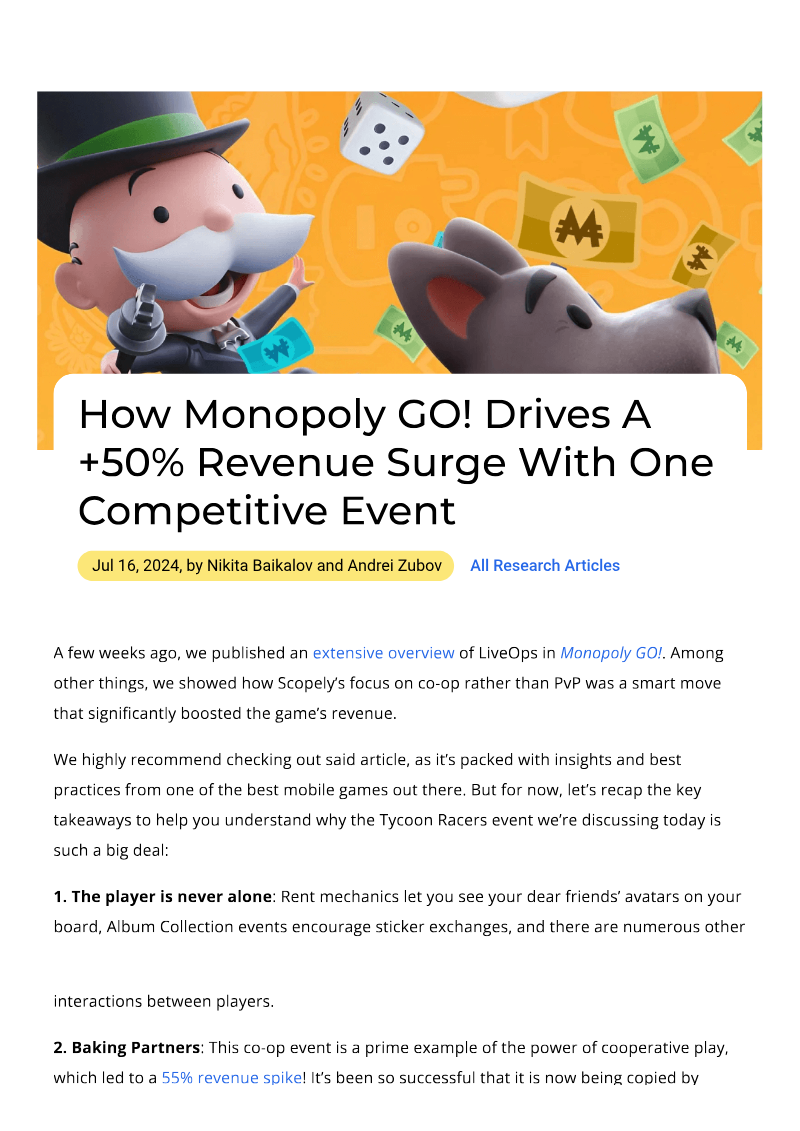
How Monopoly GO! Drives a 50% Revenue Surge With One Competitive Event
16 Jul 202421 pages~10 min full read
Key insights
5 slides
The big win
The 'Tycoon Racers' event drove a 50% revenue surge for Monopoly GO!.
Scopely integrated player-versus-player (PvP) mechanics into a cooperative framework.
Team dynamics
The event required players to form teams of four, increasing session frequency and investment.
This structure leveraged social accountability and group collaboration. It encouraged consistent, multi-day engagement from players.
Like a relay race, players relied on each other to succeed, pushing them to participate more often.
Page 19 of the reportFour
Number of players required per team in the event.
Visual cues
Visual design elements fostered urgency and a fear of missing out (FOMO).
Progress-tracking racetracks and the absence of a fixed finish line were key elements.
Reward structure
Choice-based rewards added strategic depth and increased the perceived value of participation.
Players had to select between different resources.
Proven strategy
Layering social dynamics onto proven mechanics is an effective strategy for mobile game monetization.
Data analyzed between April and July 2024 confirms this approach.
1 / 5
Ask AI about this report