
ReportAppMagic
Casual Games Report 2025: Finding Growth in a Flat Market
19 Feb 202631 pages~47 min full read
Key insights
6 slides
Market Paradox
Casual games revenue remained flat at $21 billion in 2025.
Despite an 8% increase in download volume, global revenue for casual games did not grow.
Puzzle Dominance
The Puzzle genre was the only top-grossing category to grow in 2025.
Puzzle genre revenue reached $8.2 billion, a 7.6% year-over-year increase. Downloads for the genre also increased by 9.9%.
Merge's Rise
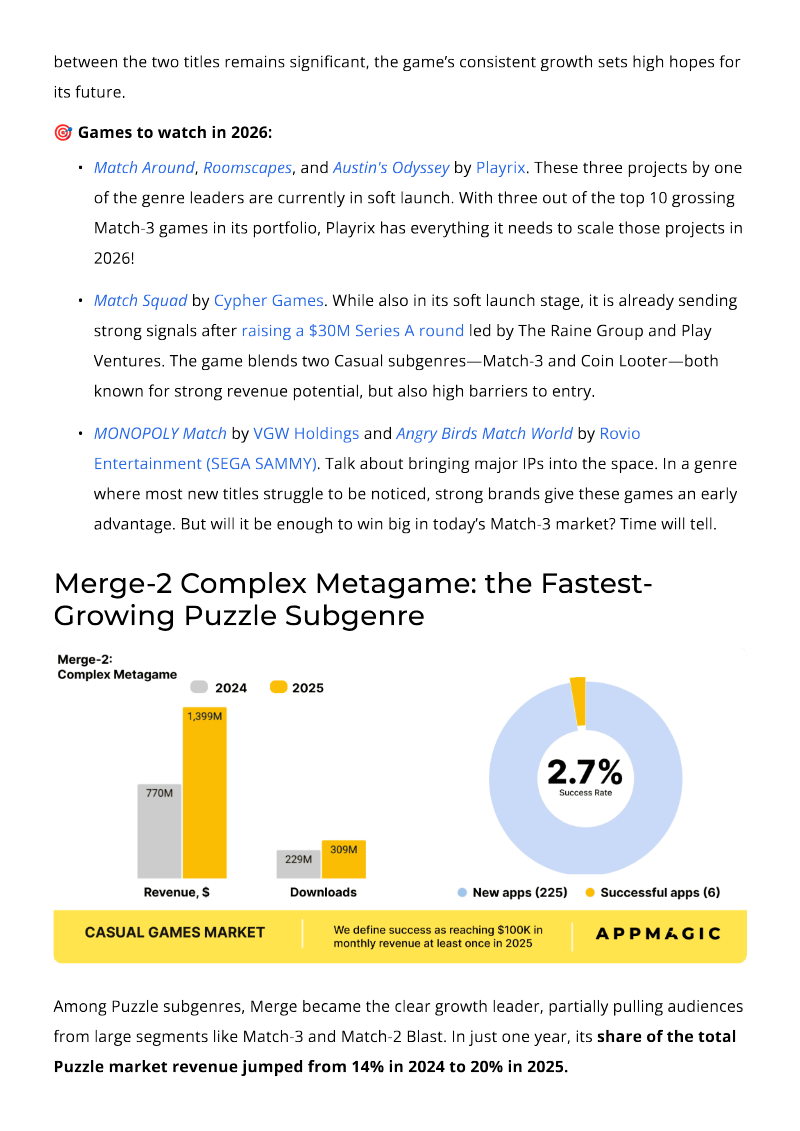
Merge games were the fastest-growing puzzle subgenre in 2025.
Revenue for Merge games jumped 80% year-over-year. Their share of the total puzzle market increased from 14% in 2024 to 20% in 2025.
Match-3 Stability
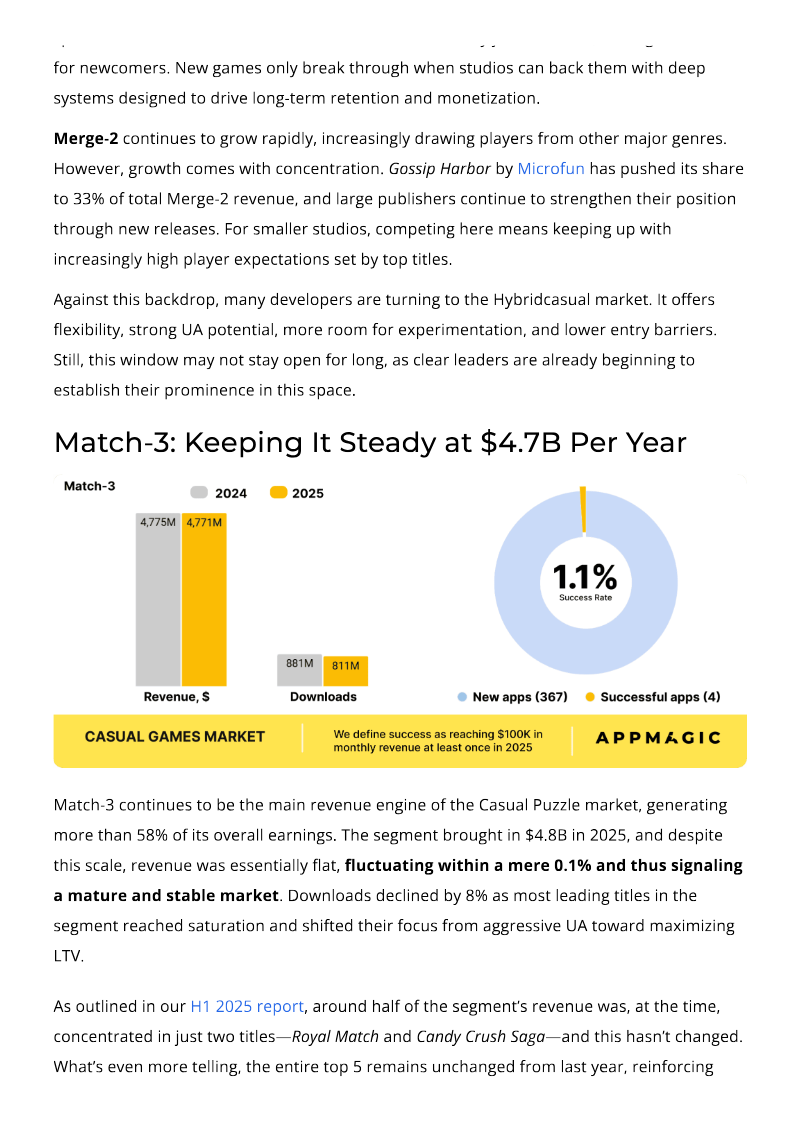
Match-3 remains the largest puzzle segment despite a slight revenue decline.
The Match-3 segment generated $4.8 billion in revenue. However, it saw a 0.1% decline in revenue and an 8% drop in downloads during 2025.
Concentrated Market
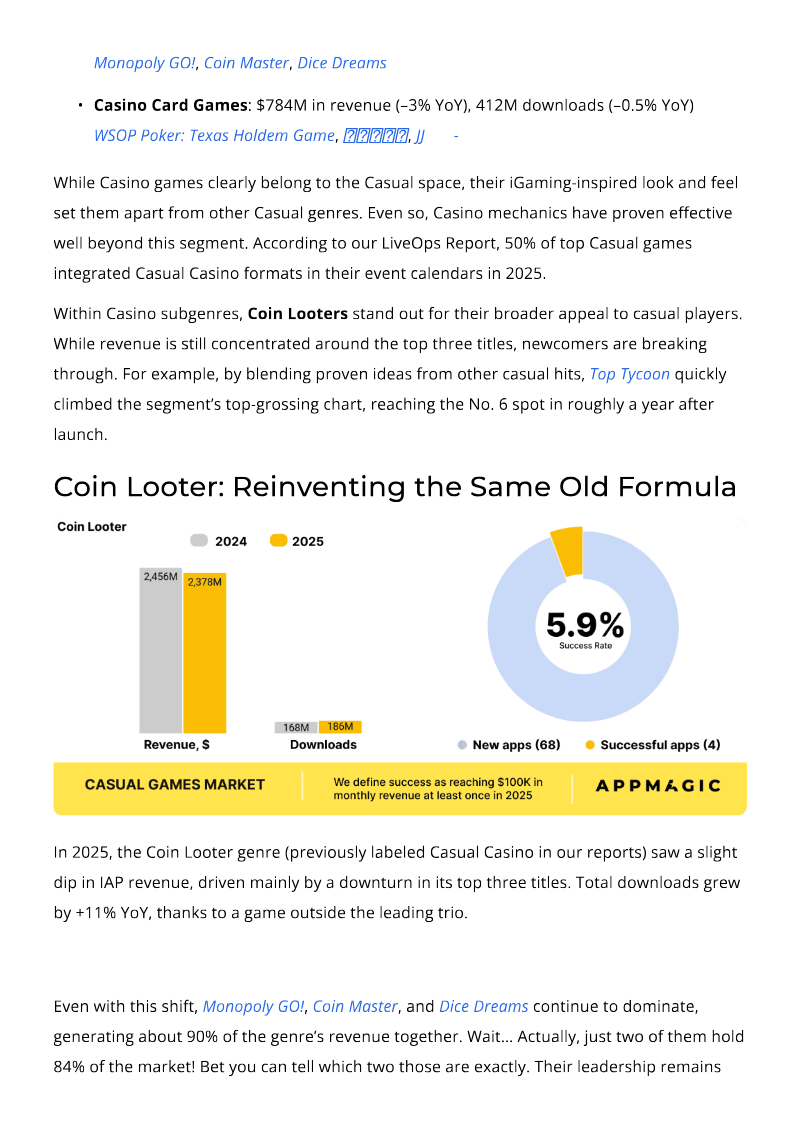
The Coin Looter genre is highly concentrated among two titles.
Monopoly GO! and Coin Master together control 84% of the Coin Looter market's revenue.
It's like two big fish in a small pond, leaving little room for others.
New Entrant Success
New titles can achieve significant revenue in saturated genres with refined gameplay.
Pixel Flow reached $35 million in revenue within six months of its late 2025 launch. This success required refined core gameplay and aggressive LiveOps.
1 / 6
Ask AI about this report