VideoThe Game Business
GoldenEye and TimeSplitters creators return: “Maybe this isn’t what we should be doing”
4 Dec 202565 min video
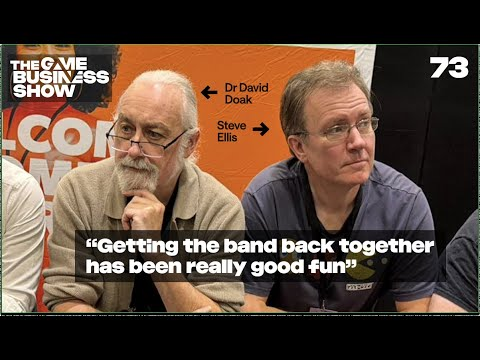
This week, are old games killing new game sales? What is going on in the Asia and MEA games markets? Plus, we chat to the legendary game makers behind Golden Eye Perfect Dark and Time Splitters about their new roglike Scrabble game. Hello and welcome to the game business show. To help me navigate these topics, plus a few more, I am joined by a longtime friend of the show. He's popped up here and there over the last nine months, but this is his first full extended appearance is the editor, founder, and owner of Video Games Chronicle, Andy Robinson.
Hello.
You're all right, Andy. Welcome to the show.
I'd say I'm more here to guide you, like for you to guide me through the topic. Sorry.
Yeah. Well, you you're here to help me.
I'm the soundboard. I'll just I'll drop the uh the oneliners. You took the bold step yesterday of angering Nintendo fans by giving Metroid, the new Metroid game, three stars. By by daring to critique their their game. Yes.
How did that go? Was it a good reaction? Positive.
It's a space I'm used to sadly used to
occupying in this day and age. Um what happens is uh you'll have reviews uh that your outlet has published over the last several years plucked out uh written by other critics to prove you wrong.
Yeah.
Your wrong opinion. And uh then then they'll play the game and it'll go really quiet.
Yeah,
I'm enjoying that.
Is it the Concord review people bring up?
We we gave um Silkong three out of five.
Oh, it's Silk Song this week. Is it?
Yeah, it's a free freelancer. But this is a whole episode in itself, right? Is that
you're you're criticized of uh of of you know, bagging the publisher money if you give a bad game a good score. But if you give a good game a uh a good game, a like much anticipated game, a uh a critical review, then you get even more um abuse. And I think I've seen other other press say this on both sides of the pond that I think I've been doing it long enough to to say it with authority as well is that you worry more when you're giving a big game a bad score
than the other way around. Right. The easiest thing in the world if we're talking about um pressure, outside pressure, and not being impartial, would be me to give Metroid Prime 4 a good comfortable score, you know, then go and retire to my smoking suite
and um you know, but light my cigar with the 50 notes. Um, so no, we're, you know, when we're doing our jobs and actually being critical and and honest. Um, unfortunately it also comes with a a lot of uh kind of backlash. Uh, but yeah, I I'm used to it, mate. Famous Nintendo hater. Um,
I know they call me
I I get that a lot. Um, mostly Xbox. People think I hate Xbox, which is absolutely mad if you knew anything about me. But um anyway, we've got quite a few big topics to get through. But actually, because we missed a show last week, it was Thanksgiving. There's a few new stories that are sort of knocking about. It's actually quite There's a couple of ones I want to talk about, but cuz the stories are still developing
like that. Have you seen the horses story?
Yeah, it's it's been it's been been tough to follow. I don't think we've actually covered it. Yeah. They've just been in the last what 12 hours been
banned on the Epic Game Store as well. Yeah. um which kind of brings into question all kinds of monopoly issues and censorship etc. However, I'm not in a I don't actually know the exact content that is is the issue. So, I'd be hesitant to Well, that's the thing and they're not really sharing it Valve and and and and that's the thing. What is the bit they can tweak? you know, if it was um in age ratings, if you get an age rating and your game goes, you know, you've get you can the the ratings board will say it's because of this component that you've got this age rating and they can like, you know, cut out that swear word or or, you know, or trim that sort of thing. That's what they used to do with like manhunt and everything. If you could do this and your game will get unbanned in the UK, but obviously with these sort of private businesses, it's a lot harder. But, um, it's a developing story, right? the go of backing it and
in a way it's got more attention than I think it ever would have done.
Oh, is this good business? Yeah. Right.
So, um we'll we'll see how it play plans out, but it's because the story is developing. I don't I'm not going to talk about horses, but I want to and we probably will talk about it in a future episode, but one of the stories I did want to talk about and we talked about it in I talked about in my micro on Monday. It's about Splash Damage. So, if you missed this story, Splash Damage has put all of its staff at risk of redundancy. They're a UK studio. They're famous for working on a bunch of games, but probably best known for supporting Gears of War. They made Gears of War Tactics. Um, uh, they'd only bought themselves out from 10 cent back in September. Earlier this year, if someone lose my voice, earlier this year, it canceled the Transformers game it was working on. It's also been developing the long development project, Astrid. Um, what I understand is this is the result of a deal not materializing. at the uh the 11th hour basically they had this um there was a big contract they were going to sign and then it didn't get signed involving a big third party publisher. So that's what's triggered this moment. Um but um one of my
problems Andy is that um there's a lot of these stories going around in games.
Yeah. And there are Splash Damage used to release a game almost every year.
Yeah. They were a real real historic um UK success story Splash Damage. But ever since they got that 10-centent money, they've not really made anything. And this is like 2020. Um, and I have to question the management a little bit here because I know [clears throat] it's really difficult, right? You you when you're independent, you have to put games out all the time and you're answerable to a publisher partnership. You've got there is that press got to you've got to get the game out. You got to do this. There is an element of it. Suddenly, you're given a war chest of money. I'm not saying this is what happened at Splash Damage, but I do worry this is the impression we're giving to outside investors. We're given a bit bunch of money and we don't seem to know what to do with it. We have these long inestation projects that get cancelled over time. You and I know of another studio that's made a load of 10centent money that hasn't released any game since they received it. I'm not saying it's just 10 money. It's other money that's out there. It is certainly a challenge, isn't it? Um, I
interviewed a Sucker Punch uh recently and he was talking about how a lot of those studios that that PlayStation acquired, I mean, say for example, Insomniac are, you know, very prolific um studio developer of games that they treat it like it's their own money still, you know, from when they were independent.
And that's kind of the challenge, isn't it? That when you transition from having to, you know, you've got to put a game out, right? the the shipping a game, a lot of shipping a game is just knowing when you have to stop, right? Not no one I think very few projects go until they're 100% satisfied um with with what they're producing. You know, the old um you know, kind of phrase is that they're abandoned, right? No game is is finished, it's abandoned.
But when you've got all of the money of uh 10 cent, suddenly you don't have to uh abandon your project so soon, right? But it's it's a skill. That's why you're seeing um Rod Ferguson, you know, kind
of parachuted in everywhere that needs to ship a game. Um he's it's a real real skill. And I I learned that when I when I went um devside, you know, how much of a skill that is having a producer who knows when to like, look, stop doing that. Stop doing that. That doesn't matter. This matters. Let's get it out. And the the risk of that is that yeah, you you kind of you're seeing um you know how difficult it is for companies like uh Xbox to to make new studios or bring new some of the new studios in and suddenly they're not as prolific as they used to be or they can't game out.
But there was a balance, right? So I always think about Obsidian is an interesting example because they've actually just carried on releasing games almost as quickly and as frequently as they did before. But a part of me thinks Obsidian should take a bit longer. Should they've got they've got more money. You can take a bit longer. You can be a bit more ambitious. You can try things you've not done before. You don't have to worry too much about we have to get this game out within this within this window or we go. You don't have to wor be that worried about it. But you're right. It's a balance between oh, we've now got a bit more time and a bit more
space to explore. Find the fun is the word they use. But then they and but then you get the opposite. But then the problem is they can't use right. It comes a point we have to we do have to ship something. So it's about that discipline. I think it's really difficult. And I think there's a I do worry a little bit about leadership in the video game industry. I do worry that we're not skilled at doing at dealing with that. And I think there's too many stories of big studios. You know, it's terrible the studios been closed or the company X has pulled out of support. Netis has pulled out of this or whatever. But part of me wonders, you know, they spent a lot of money. Have they got anything to show for it? You know, and that's way not saying that's happened as much damage. I'm sort of reading between the lines
and I and I have absolutely no experience of it. So, I might be talking complete waffle, but I wonder how much of it is the wave of um of studio heads of big big studios now who've been successful coming through the indie ecosystem. You know, I certainly I look at my own career and when you make decisions sometimes it's based on mistakes that you've seen or you've made in the past.
So, you know, I've worked at a big
company and I can use that experience to influence how I, you know, kind of now direct my own, you know, based on, you know, what I've what I've seen there. So I wonder how much of an impact that has right that maybe you know some of them in the past would have taken the big AAA experience working in the factory you know and imply applied those learnings good or bad to their own companies. Well hopefully things will work out damage but um yes it's certainly been a um that was one of the biggest stories that's broken particularly for the UK scene and it's it's always a bad look and also you know people's jobs at risk obviously that's the big one. We'll move on quickly to another news story. This is again this is a little bit old but I just thought it was an interesting one. Epic Games CEO Tim Sweeney has criticized Steam once again and this time around how it labels games that are made with AI. The Fortnite boss says that AI will be part of how all games will be made and the tag will only lead to game reviews. Games with gamers review bombing titles. The AI tag is relevant to art exhibits for authorship disclosure, he says, and to digital content licensing marketplaces where buyers need to understand the right
situation. It makes no sense for game stores where I where AI will be involved in nearly all future productions. Um, here's the thing with this. Tim often takes the business point of view. Like Epic's a B2B organization. I know it makes the biggest game in the world, right? But they're core, they they're a B2B company. And when Tim Sweeney talking, he's always thinking about how this impacts developers.
And they're not just a B2B company, they're a technology company. Tim Sweeney is a is a programmer. Yeah. you know, video games are not just technology. You know, the reason that uh it's such an interesting medium and I've always loved working around the games industry is that it's a convergence of art and technology. Right. So, it's very fun from a technology standpoint to say this is not useful to have this AI label on here. But yes, from an art standpoint, when I go to the tape, I'd quite like to know whether AI was involved in making this painting. And a lot of people, you know, agree with that. I think somebody in the comments said um you know you wouldn't you take
uh you know there's no issue people don't have an issue with label on your yogurt saying whether it's uh you know organically sourced the ingredients right it's just useful information for people who want to use that
yeah yeah I I guess I kind one hand I sort of agree the small bit that I agree with him on
is that um I do think an AI label is going to become irrelevant I think that's like you're just sticking it on everything right But descriptors maybe not like this is what the AI is in this game. Uh I think that might be a little bit more relevant. But but a label that just says AI and to be fair Steam's labels don't just say that. They do go into details. But at the same time we are still at this early stage in the AI journey. We don't know how this is going to net out. We've got folk who will tell you that AI is going to lead to a deluge of slop and take all our jobs and it's going to be awful. And we've got folks who believe AI will transform the industry. We had Owen Mahoney on this week who thinks that AI is going to triple the size of the video game industry and make everything bigger and more successful. And I think and I think
as we muddle through and start to learn what we think is and isn't right and and you know what, which is what we're doing at the moment, has a lot of hyperbole around. Um I do think actually labels like this are just probably going to be quite useful for people. Yeah, I mean they're they're you know perhaps they're irrelevant in you know for massive you know mega games like Fortnite where it's going to become a given that they're you know halfade with AI slot. Um but certainly games that are AI free will have their place right in the same way that at the moment you're seeing a big drive for physical for physical releases.
You're seeing a lot of backlash around game key cards because there is an audience that you know does not want to uh you know have that to be spending their money on that. But I think we also don't really know like what is one of the things I often talk about is what is actually like I don't use AI in production of um in anything that I write but we do use AI to get the audio level right on these shows. I use AI to
transcripts that come out from this sort of stuff.
Yeah, I use AI for transcription. It's about it's about to answer your question again. It's about the data set, right? The issue is not that you're using a tool to make something. I mean no one's got an issue with speed tree, right? in speed tree an artist has made bits of trees and then they put cobble them together. The issue is I mean there was a it's ironic that this has uh come out so quickly but and and again it's only an allegation at this point. We we put a story on VGC yesterday that um people think that there's a in the new chapter of Fortnite like there's a the telltale is always if they've got multiple like too many fingers, right? So it's not that's just what fans think and they're trolling on Reddit and trying to pull together evidence, right? And the issue with that is that it would have trolled through people's art to make that, right? It's plagarism. It's it's we see I mean it's early days, but somebody put up a review uh yesterday, a Metroid Prime 4 review that was clearly cobbled
together by AI, like bits and pieces taken from elsewhere and halluc mentioning like uh um like items and stuff that aren't in the game. Um, that's the issue. I mean, no one no one no one's bothered about the tool. It's about the data set.
So, the reason and to be fair, I don't know any answers to this. That's obviously right? But then you get something like what Arc Raiders did. I'm not talking about the voice AI. It's in our latest episode talks about it. Um, they scanned an actual landscape. They used satellite imagery to create a world um to create the landscape and then the artist [clears throat] went in and, you know, did the art thing on top of that landscape. Now that those that level wasn't built by artists that was taken from the real world thing, but then artists modified it and changed it and edit. Now that wasn't even AI, right? They've not they've not they've not taken other levels levels and stuck them together.
Use them satellite lasers, wasn't it?
Yeah. Yeah. And I'm and it's interesting. I'm like, well, what what's and I'm saying
[clears throat] what's the difference? Because I don't actually know. There probably is quite an obvious difference here between taking somebody's level of created and doing it, but and but then you got rogue likes. You know what? I don't know what I'm talking about. I'm shut up. Um the um the uh um the more I go down this, the more I get confused.
I mean, lots of lots of people are doing interesting stuff, right? You know, if they're using their own data sets and you know, they're doing things that um genuinely pushes the medium forward in a way that can't be done, right?
That's a thing. Yeah.
We went to Ubisoft recently.
Yeah. Teammates. Yeah. to see their demo, their AI kind of voice where you could ask the teammates like, "Hey, where should I, you know, where should I find the next item? Is are there any weapons nearby?" Like you could ask game specific stuff. If you ask them, you know, what's going on in the election in Venezuela right now? They'll say, "We don't want to talk about that." They're not chat bots. They're they're very designed to stick with the game. But that's in an interesting use, right? They've they've worked with presumably um worked with I think Arc Riders might have done this as well. You work with
voice artists, you know, with their permission. You go, look, we're going to spit out loads of different lines. That is a use of AI that you could see being incredibly compelling, right? Going forward that you can have um NPCs that, you know, can go beyond the the abilities of the developer and the lines that they can create, right? you saw I think you saw Nvidia, you know, kind of create demos for that in years past.
Um, so absolutely. It's just at the moment it's it doesn't look like it's quite there, does it?
Yeah. No. No. But that's kind of like there's very little in my life that Genesis AI or chat bots really impresses me. But I'm a creative I'd like to think I'm a creative person. You know, I work in an industry that will be affected. So perhaps I would say that, but it doesn't really impress me right now. I go on Google and I'm looking for a piece of information, which I have to do all the time, right? Because I'm writing an article. Oh, hang on. When did the release date of this game come out? How many copies of this game has actually been sold? And I'll put it into Google, and they give me an answer on their
bloody Google thing. And I know there's a very good chance that's wrong.
Yeah, absolutely. 18 months ago, Google stopped being a search engine, and it became an answer engine. And um if you you look at the press engine data, they think on average the big game publication, so anyone any publication with over a million readers basically. So that could also go a lot there big difference between an IGN and a smaller site. They reckon on average they've lost half their audience
mostly because of that.
Um and is I think we all know the answer. Yeah, I was going to say I think we all know the answer when I say has your experience got better? I mean, Google's borderline unusable now, isn't it? It's you can't trust it at all.
And that's that's something that if I'm going to get my crystal ball out, I think we might see a push back. I really do. Um, the digital world in general, right? Is that I mean, we've we're the first generation, I guess, right? I mean,
Facebook came out when I was 18, 19. Um, you know, being an iPhone came out when I was 20, 21, first iPhone, um, having the internet in your pocket. Um, I'm already feeling it. I'm sure everyone, it's so be so nice to like just have a 3310 again and be
and you see the vinyl sales and the push back to, you know, game key cards and I and I don't I honestly think there could be a push back, which it comes back around to uh, what you're saying about Tim Sweeney. I think that really that that isn't necessarily a given that he's right, that people won't care.
It's interesting actually because this is something that Owen only said, you know, he thinks that we're worried about a load of AI slop, but he thinks people won't put up with it.
Yeah. And I I to spoke to um somebody somebody at Microsoft a couple of years ago um uh at the game and they um they were talking this was pre chat GBC 3 or four, whatever the breakout one was. Um,
and he was saying to me like, "Oh, you know, you really it's it's massive like what's coming?" Basically, you know, because they they see that behind the scenes obviously. Um, but also it was noted in a conversation that well, you know, um, uh, AI has been able to make passable music for quite a while, but people don't buy music because it's objectively good. They buy music because they've bought into the artist and the idea behind that, right? You're not going to go and see chat GPT at Wembley. It's I think there's other there's other elements of play in entertainment on on what you
That's the thing. Nobody nobody makes money out of actual music anyway. So, it's like we've got something that makes it for us. Well, who cares? Like there's no business reason for that. Um and you're right, the money's in the live stuff. Anyway, AI is a massive topic and I'm aware of we've we've not even gone through the news yet. Um, I ask one I'll do one more story.
Oh, that was the news.
Uh, we have one more story. Nintendo
buys a Singapore studio. Uh, it's again a little old now, but Nintendo has announced plans to buy Bandai Namico Singapore Studio. The Mario firm says it will acquire 80% of the developers shares on at the end of their financial year basically rather the start of their next financial year, April 1st, 2026 with the remaining shares to be acquired at a later point. New division will be called Nintendo Studio Singapore. It's rare for Nintendo to buy the studio.
How did they come up with that name now?
Oh, I know. You know, they they they workshopped it for weeks. What do you think? [laughter]
Well, I mean, they don't like to buy stuff. You're going to have to do a lot more than talking, Andy. I'm definitely losing this.
So, they they they they basically Nintendo are this is studio they've worked with for a while. Um, I believe they um worked on um Splatter Splatoon series
and I think they were also um I'm told the original developer for Metroid Prime 4, funnily enough, before they switched it switched it over to Retro.
Um so this is a studio they've been
working with for a while. Although historically we don't see Nintendo acquire a lot of studios,
they need people now, right? They need like they
they've been uh much of the last 15 years transitioning to the world of of of HD development, of needing more content. In a way, they've kind of been protected a lot of the last decade because they were able to move so many of those Wii U games that that performed badly over to Switch and then see their sales, you know, in some cases 10x. Um, and but they're not obviously not going to be able to do that for much longer. Well, they're going to try their best with Switch 2 editions, see if they can re-release us the Switch games. Um, but they they need they need studios. They need development. They're like doubling their footfall in Kyoto. Um, possibly even more.
Building a new building. Yeah,
I looked this up. There was originally going to be a 12 13 stories building and they've now the reason why it's been delayed that building is because they want to add even more stories. They
haven't actually specified how many. So, it's going to be Yeah, they're hiring up at new studios. And you're right. And it's interesting for them because they don't Japanese companies especially Nintendo conservative Japanese companies don't like to go and get stuff like they like to I mean this makes sense because they've worked with them for a number of years. You're they know they're a good fit. Okay, you understand our culture.
They Nintendo are not going to go out and hire 10,000 staff. They're going to grow slowly.
Oh yeah. And and this is interesting. So years ago we're both fans of the developer Rare and I was very confused as to why they didn't buy Rare. And I've obviously looked into it loads. And the reality is Nintendo don't like buying studios because really you're buying people because that's what you're buying. Yes, there's IP and tech and stuff, but really you're buying people and people can leave. And typically when a new studio is bought out, the management, the people that perhaps, you know, in the case of Rare the Stampers who will be going like we they're ones that pushed through and built that studio for good or for bad. They're going to leave at some point. They've just received millions of
pounds, right? They're going to walk away at some point. And that and Nintendo's like, well, why would we invest in that? So many of Nintendo's what we consider first party studios, like intelligent systems, I actually owned by Nintendo at all. They they don't they they like to leave it [clears throat] unless they're in a situation where they need more stuff, which is what
there's a there's a chap who um so the original Super Mario Brothers was made by a team a core team of four people, right? And one of them uh doesn't work for Nintendo. He has his own company like Mark Cernyesque and he's been was doing programming on all of the a lot of the femicon you know kind of releases and he's still still working with Nintendo. It's I mean that's a very that's a very very I don't want to say Japanese but very Kyoto
Kyoto uh culture
there. Um, that's what I imagine probably the sticking point might have been with with Rare is that
maybe the conversation is, hey Stampers, you know, if we buy you, are you going to stay there for the next 20 years? And they're obviously going to say no. And you go, well, why would we do that then?
Because Mr. Miiamoto has been there as long as we possibly could, Ray. I mean, they're all at retirement age and still going.
Yeah. Yeah. Well, let's move into our big topics and um if my voice
before your voice absolutely implodes.
Yeah, take the show.
You're probably going to have to um this one is about old video games and whether or not it's a problem. Now, this is comes from this. This topic was inspired by Sega's recent financials. They revealed um that new releases accounted for 17% of his game sales during his last financial quarter. They were challenged on it and they gave a load of different reasons as to why they think that might be the case. Um they think competition's strong, pricing is too high for new releases, players holding off for definitive editions was an interesting one. But Sega isn't alone. Actually, most major companies are seeing back catalog and legacy live service games drive their revenues. While newer titles aren't always delivering the numbers, one of the big ones, and another Andy, you can talk to this is Capcom. Their latest financials celebrated the success of Resident Evil
Village, which came out four years ago, and Resident Evil 4 remake, which came out over two years ago. Monster Hunter Wilds, their actual big release of the year, has dropped off quite a bit. Um, I think it's is it behind Monster Hunter Rise now in terms of just like the previous game selling?
I'm only only for the the quarter. I think it's sold less in the quarter, but but you know, there's there's all obviously there's lots of different caveats and context there. I think a lot of those games are like heavily discounted as well, right?
Yeah. Well, that's that's part of the problem. It's not they're heavily discounted and it's as good if not better in some ways than the latest thing that's come out. There's a news data. Now, this news data isn't entirely I'll explain why it's not doesn't tell us too much. It is stuff that you've just heard before. In 2024, 57% of all games played across PC, PlayStation, Xbox were 6 years or older. So, that's Fortnite, Minecraft, Roblox, those sort of things. And there are games in that list that are over 10 years old. Meanwhile, 32% of play time was spent on games from the last 5 years. Only 12% of
play time was spent on new games. And that includes annualized sports franchises and titles like Call of Duty. Now, [snorts] that doesn't surprise me too much. We've reported on that stuff before. And also, it's worth noting that games like Fortnite and GTA Online are massive. They soak up hundreds and hundreds of hours. Of course, they're going to they're going to skew the numbers. I'd also argue those games, although they're old games technically in terms of when they were released, I'd actually argue they're current games. And um but um so there's that one. But I got some Sakana sent me some data. So Matt Biscatella, thank you Matt for sending this over. Sakana do these weekly player engagement trackers, right? So every week they say this is what players are engaging with and playing. And last week, 1,456 games on the on PlayStation in the US had at least one player on their panel. So they they have a panel of people and 1,456 games showed up on that panel. Of those nearly one and a half thousand games, only five reached only five of them reached 10% or more of the PS5
player base, only 48% reached more than 1%. So, out of those 48 games that reached 1% of PlayStation's player base, only 12 of them were released in 2025. If you remove sports games, that drops to just eight. So, Call of Duty, Battlefield, Where Winds Meet, Arc Raiders, Skate, Ghost of Yoai, Borderlands 4, Dispatch last week, the only games released in 2025 if we exclude the sports games that PlayStation players played last week. Now, there'll be other games, but that's just on it's on Saka's panel. That's a week before, it's a week during a Christmas week. The newer games tend to do well. Um, uh, just eight non-sports games reached. Um, 1% of PlayStation players. Um, now that for me is a little bit more insightful because that actually tells you what people are, you know, it's not based on hours played. Does that I mean, I don't know if that surprises you, Andy. Um,
it doesn't it doesn't surprise me at all. Um, Matt actually uh left our Patreon last week, so maybe it was
something we said like, "Come back, Matt. Come back." Um, we um it doesn't surprise me at all. I mean, this has been the direction of travel for a long time, right? I mean, didn't the Newsy Report estimate that over 90% of uh play time on PC in particular is old old games, right?
PC is even more. Yeah. And that that to me is is perhaps quite telling that there's just you've people players have never had more uh content right available to them for very cheap or perhaps included in something they already pay for like a subscription right especially on PC Steam sales like I mean even anecdotally I always try and because you can become a little bit out of touch doing what we do right you you hang out with other journalists who get their games for and play for work and you know so I I always you know stay in touch with friends who I have that are genu you know legitimate players and um they're all sat on massive backlogs you know
massive backlogs I've got a friend who's the like the biggest Final Fantasy fan right like he would cry on the spot you know about Final Fantasy that's how much he loves Final Fantasy he didn't play um Rebirth for a full year after it came out
because he's like I've got I've got too many games here, right? So, sorry. Go on.
That's me because I I don't have to play games for a living. I don't have to review them. I have I've got so many games on my backlog, but they're not just games I've done to play. They're bonafide classics. Like, I've got Cyberpunk 2077 on my backlog, right? It's as it's it's 5 years old, that game, but it's still cutting edge. So, when another game comes along that goes, "Here's a here's The Outer Worlds 2." I'm like, "I hear it's good,
but I haven't played this genuine bonafide mega game yet. So, I'm not I'm sorry, it's not it's not now's not the right time." And and it's like and you know, I look at the weekly GSD charts. We've been running them since September. And the these games have all appeared in the top 10 in the last six weeks. Top 10
bestselling games in Europe, right? So, Hogwarts Legacy, GTA V, Red Dead Redemption are in there. I don't think people are surprised by that. But it takes 2, Titanfall 2, Spider-Man 2, Far Cry Primal,
Dame Eternal, South Park: The Fractured Butthole, and this is revenue.
This is revenue. This is units. So basically, they've been heavily discounted.
Probably been heavily discounted.
Yeah. Yeah. But that's what's driven it. But those games are still brilliant, right? That's the point, right? They are still excellent games. They hold out well. Fallout 4 was number one in the week in the month of April 2024 when the Amazon TV series launched. Yes. And it was discounted as well. But the point is Fallout 4, even though it's 10 years old, is still brilliant. And it's like you, we think back to our youth, we weren't playing games. The games that came out in 1990 were NEZ games. Games that came out in 2000 were PlayStation 2 titles. We weren't those games weren't appearing in these charts. This is the I think that's that's one of the issues, right? I mean, the the consumers been conditioned to this, right? not just
with the amount of free games they get, subscription services, discounts, but also I think one of the most transformative things especially in the console space and this is a very mundane observation uh but obviously the PS4 and the Xbox One uh launching um and having that backwards compatibility which just wasn't really there in a meaningful way before you know a digital library right um and you know we all remember what it was like turning on those those new consoles, you know, PS5, Xbox Series X, and your games were just there. And it was an odd feeling like, oh, you know, because before that, I actually find myself now like younger people who I work with, like actually it seems like they don't really understand what I'm saying when I talk about generations, you know, you know how PlayStation, Sony were big on we believe in generations. And I don't think younger people really understand what that means because they've never really seen it anymore. Like it used to be a I mean, it's mad in business, right? absolutely mad insanity and they're right to get away from it.
Nintendo's been talking about this challenge for for a long time. Resetting your user base and resetting your library and but actually for for third party publishers is quite good, right? I mean I I had I saw a lot of people um I had a lot of chatter around um Switch 2 um you know a couple of years ago when they they're deciding whether they're going to make that backwards compatible or not. And a lot of what I heard was there was push back from some of the Japanese publishers saying, "Please don't do this because PS5, you know, it launches." And you say, "What are you going to play?" Fortnite,
you know.
Well, SP if you
And you're seeing it now with Switch 2, right? You're saying, "I know they they include the the Switch 2 editions is included um Switch One uh software on their reporting, but they're not selling games that you'd expect for the units of those ships.
Run through. This is I was talking to Reggie about this when he came on the show. When I bought a Switch 2, well, I bought Mario Kart World obviously came with it basically. Um, but I was a
Nintendo Switch online customer which I imagine a lot of people who bought the Switch 2 at the beginning were that means you got upgrades to those two Zelda games which you almost definitely already owned, right? So, you got a new version of Zelda games. You got new updated versions of Scarlet and Violet that actually run reasonably well.
And then you went and play GameCube games on Switch on
and you've got all these GameCube games on there. I had a library of I've got I've got my old games have been updated and I play better than ever. I've got I've got retro g more retro games into my collection and I've got Mario Kart World and then you've got CD Project and Kami whatever saying play survival kids play Cyber Punk and I'm like I've got plenty like you know and it's and it's whereas before you're right I get a new console and I I'm buying six seven eight games for well when I was younger um to to play off the bat it's compounded by the fact that they they can't get these games out as prolifically as they they used to right
um you know uh some of these consoles in the past launched with a ridiculous number of uh original games. Um so so that's that's also an issue, right? But I wonder um I wonder with the Sega
coming back to Sega. Um I I know it's only their last quarter, you know, I think usually they've got a Sonic movie massively propping, you know, up um not just back catalog sales, but they'll they'll tie a new release to that as well, right? But I I was thinking about this. Capcom uh you know been boasting about their decade of um kind of profit growth, right? Um and it's been propped up massively by their management of their catalog sales.
They're so good at it.
They're so good. Their games come out and they sell and they sell and they sell. Like I've got it this I've got it in front of me. Right. Resident Evil has sold Resident Evil 7. Uh so I believe that came out 2017 2018 something like that. Um, it sold three and a half million units in its first year and then it sold basically a million million and a half every year since. Like it just doesn't stop. Monster Hunter World's even more impressive. It does like, you know, between four and three million
units every year since it came out in the seven years. Same for Resident Evil 2. Same for Resident Evil 3. They just keep going and going and going and going. Um, so I thought I thought about this with the they don't Capcom don't really do the definitive editions, right? But also Sega's games are these big time syncs, massive time syncs. What what are Sega's big games, right? Metaphor and Football Manager and Total War. And I those are the sorts of games which you probably would add expansions. You probably would do definitive editions, but they're also the sorts of friends that my friend, the Final Fantasy fan, looks at them and goes, "Yeah, I'll put that on the backlog. I'll get to that. Have I got 40 hours this month to sink into metaphor? Maybe I'll come back to it." Whereas Capcom release more linear action games, you know, type of games where you might pick it up and I'll play that this week. I'll play
I think Sonic Racing was probably in that quarter. I don't know. I didn't actually see which quarter it was, but obviously from my Sonic Racing is a
really good game, but I do wonder if it wasn't different enough because you talk about my thing is like Monster, you know, we go back
when when did it come out Sonic Racing? I guess would be to September. Yeah.
Yeah, September.
But I I think I think that game
it's really good car racing.
Very good game by the But I don't I don't know when I I only played it at Summer Game Fest, but my feeling on it is it wasn't it didn't do anything other Kart games haven't done. It might have done them better, but it's not like it wasn't like Mario Kart World, whether you love or know there's a bit of push back on it. They put stuff in that game we've not seen in a cart game before. And it's all about like, oh, we've got to give that a go. And I think you think when people have these back catalog of games back, you know, this backlog of games, including brilliant games that are from 5 years ago that as good today as they were 5 years ago, I think I think justification becomes harder. I think what's interesting as well with Monster Hunter as well, if you're my Monster Hunter, Monster Hunter Rise beat Monster Hunter Wilds in the last quarter and you say it's cuz it was discounted. Yes. But also it still stands up to Monster Hunter Wilds, right? Which is whereas, you know, perhaps in a different era that wouldn't have been the case.
But again, again, a Monster Rises like
Monster World Light. It's more accessible.
But but also there's another phenomenon that we we've talked about before that is probably different to what it was even 10 years ago. So, talking about Monster Hunter Wilds versus Monster Hunter Worlds, you know, I think Worlds came out in 2018. Monster Hunter Wild, the newest one, Wilds had a bigger launch, initial launch, but then slowed down faster. However, for the first like kind of couple of quarters, they've basically sold the same. So, it's that tears of the kingdom thing where everyone bought it, rushed to buy it initially, and then that was kind of like it's just more people were buying it at launch than that it was that happened in the past.
More people bought Breath of the Wild in the last quarter for Nintendo than they last financial quarter than they did Tears of the Kingdom. And don't get me wrong, Tears of the Kingdom has been hugely successful, but I think Breath of the Wild, it's another example. Nintendo is obviously its own ecosystem entirely, but they're well aware, well well aware,
right, that their games cannibalize each other on the same system.
Yeah. Yeah. Well, it's interesting. But one of the things I'll say, and I want to conclude with this, is I don't know if this is really a problem. I know that's, you know, it is a problem in the long term, but if if you're if you're a Capcom and you're making tons of money from your back catalog, that's all right, isn't it?
It's not it's not a problem. It's just like we're only we're only selling 17 that but on the flip side you're selling 83% of yourselves are old games. Good. Well, that's 17% will join them next year.
Yeah, eventually and you can develop it and then when the new games are breaking through because you're playing AAA developers tend to be a little bit more risk averse. They tend to be a little bit more franchiseoriented. It actually creates opportunity for new developers to break through. If you look at some of the big games this year or this year or the last two years, Argraders, Clare Obscure, Expedition 33, Hell Divers 2, Repo, Dispatch, schedule one, Peak, all new concepts, original ideas, relatively new teams. And meanwhile, the big established publishers have this back catalog they can lean on. I think it was fascinating that Borderlands 4 was
disappointing for Take 2 in their last financial quarter, yet take two still beat their expectations, right? That's that's that's
I mean it's it's all a big we're in a weird weird weird um washing machine of a industry right now right where everyone's trying to figure out what things look like and certainly the you know one thing that we the only trend that we are seeing is that people consumers want new experiences right
I mean arc raiders arc raiders kind of shows that
um you know you got to own your niche and do something a bit Well, Bordlands is that is that the future? You know, another installment of
it's not it's not exciting people in the same way. But here's the thing. You big companies, you know, there is so much you can do for back cataloges. You mentioned a few of them. You can put your games in subscription service for a bit. You can you can last year, is it last year? I think EA updated Command and Conquer, like the really old ones a little bit, and then sold like a million of them. Um, you can tie into a movie
and TV ad adaptation if you've got the benefit of having one of those. One of one of one of um one of uh one of um Capcom's biggest sellers in the last quarter. Sorry, the biggest seller was um Devil May Cry 5
off the back of the um off off the and that came out in what uh 2020 2021 something like that. It's is Oh, no. It came out on the last gen, didn't it?
Cuz they they did a I'm sure they did a PS5 version. So, it's it's an old game, but that's on the back of the the Netflix series. Popularity of the Netflix series. It's their biggest their biggest seller. And look at everyone porting to Switch 2 right now. And I'm not just talking about Nintendo Switch two editions of Nintendo games. I'm talking, you know, Assassin's Creed and Fallout. You're seeing a lot of that. Obviously, all this means everything's a lot more competitive. We know that it's tough to break through. The bar is certainly higher for a lot of developers to hit, but um I don't know. I think it's nice that we got these big that that when you release a game, there's a long story to that game. It's not there's no
Didn't Didn't it used to Didn't it used to be the case 20 years ago that you know the vast majority of your sales are
in the first month done?
Yeah. Yeah. But that was Yeah. That's going back even further.
That's nice to move away from that, right? That's a good thing.
I'm very conscious of the time and we've got two sections to go.
Let's carry on talking about old games. Dingo.
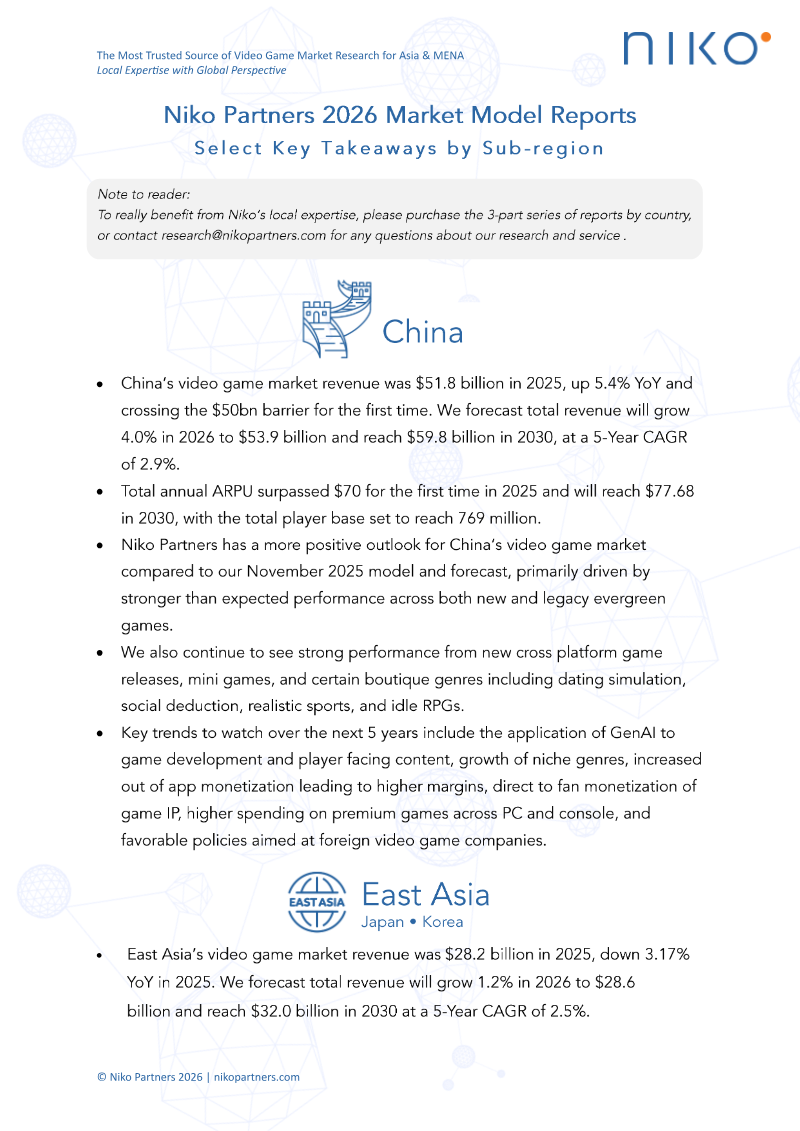
Yes. Um this one's I'm going to do this one quite quickly because I know that you you know these markets relatively well as a Andy, but this is Nikico Partners. They are the data company that if you want to get information about Asia and Middle East and those sort of markets, you go to Nikico Partners. They've just sent over excl early early look for readers of the game business. Their latest video game forecasts for Asia and MEA markets. Um the report tracks China, India, East Asia. East Asia is Japan and Korea. Southeast Asia, which is Indonesia, Malaysia, Philippines, Singapore, Thailand, and Vietnam. And MENA, which is Egypt, Saudi Arabia and UAE. Nikico Partners says that these markets all al together will hit 88.97 billion this year. So just shortened $89 billion which is a slight 2 well it's a decent 2.7% rise over the
same period last year. The number of players is going to hit 1.7 billion in that market. Um look PC and mobile are the big drivers um obviously but there are new growth areas that that Nike partners are pointing out. Um female gamers are growing in this market. There's positive momentum around consoles too. I'll come back to that. India, MENA and Southeast Asia will be the fastest growing regions in terms of revenue and gamers through to 2029. And India, MENA and China will also the biggest growth in the average revenue per users by 2029 as well. India in particular is the fastest growing market. It's expected to exceed 1.5 billion in player spending uh by 2028. It's also this is the map. This the growth in players is remarkable. Well, 9K Partners believes there will be 500 million gamers in India by the end of the year, which is huge. Anyway, in 2029, that will grow to 700 million. Um, I mean, all that sounds good, but let's be clear, the big markets for in those territories are China, Japan, and Korea will continue to be. And by 2029, Niko believes that those three markets will
work will be worth $89 billion, which represents about 89% of the total revenue across all the markets they track. Um despite only accounting for 6.3% revenue in 2025 across Asia and MEA in um that's this year console is set to be the fastest growing segment through 2029 as Nintendo expands its presence with a Switch 2 launch and spending on freeto-play titles and multi game fiction services increase. Um look this is these are big numbers even the numbers are so big that even though consoles is such a small section of the market that small section is still worth a lot. Um um you went to Gamescom Asia this year, didn't you Andy? Um and saw a different We always think of Asia, we go Japan and China, but you went where was Gamescom Thailand this year. Yeah, it's very
But it's interesting to I mean I've made a listen to those numbers and you know why I make an effort now to kind of explore the Southeast Asia games market um because it's it's super exciting, right? And in a just from a selfish
point of view, it does grind you down reporting about how everything's on fire in the West every day, right? It's nice to go somewhere where things are are growing and and doing really well. Um but but one of the things that I have um kind of learned just through briefly kind of like going to because it was in um Singapore last year um is how different they are from market to market like how radically different they can be. like say Thailand their gaming is very social you know it's very social um those are the sorts of games that do well and obviously PC gaming as well is like well on top you know consoles are console market is not mature um outside of uh Japan really um but but no like it's it's a it's a fascinating
Thailand's had a bit of a tough year according to Nikico um social economic issues in Thailand and in Indonesia means that there's been there's not grow slow growth in those markets um but that's That's the thing that's you mean like right it's different you know Thailand and Indonesia this is Southeast Asia um Indonesia and Thailand slowed
down their growth but Malaysia and Vietnam have seen real fast growth and it is and it's same with Europe actually I know that people love Europe together but I used to do the European charts all the time and like Dragon Ball would be like the second bestselling game in France and in the UK it doesn't even get the top 20 um and and it and you know and there's an NBA game it's Poland or something like that NBA's huge it's just
the one the one that we always talk about Invisles, right?
Oh, yeah. Spain. Yeah. Um, it's just and you've got these different markets, different territories. So, it's not a simple case of just saying, oh, it's all mobile and PC and they all at the same games. It is more complicated than that. Um, I'm not going to spend too long. I say that you can those numbers whenever I read out numbers on the podcast. People can't keep up. That is on the newsletter. They all be on there as well. And if you go on the website, the gamebus.com, you can just get all the data there. Um, uh, so you don't have to remember a few I just wrote down. Um, I'm going to conclude with our final topic, which is actually a mini interview. It's so indulgent because basically I shouted to two of the creators of one of my favorite games or
some of my favorite games, Golden Eye, Perfect Dark and Times Splitters, Steve Ellis and David Do. Um, now these two, we last saw them trying to reboot Time Splitters at Embracer, a new version of Free Radical Design, but obviously Embracer went through its issues. They closed that down. They went through their restructure. But now Steve and Dave are back. the new roglike scrabble game called um Beyond Words. I keep calling it Words Beyond because I think there's a Doctor Who thing called Worlds Beyond. It's Beyond Words. Um it is mostly just the two of them making it. They do have a few contractors, but it's just the two of them. PC Cube is the publisher. Um Dave said to me they like the idea of working with a smaller publisher where they're big enough where they're seen as a bit of a big deal, whereas the smaller company, bigger company might not be. The game is out early next year. There's a demo out now on Steam. Anyway, I thought I'd chat to them about it. Um I know them quite well. They were I did a Time Splits 25th anniversary panel with them at EGX just a couple of weeks ago. So, here it is. Steve Ellis and David Dun. Hello, David. Hello, Steve. Welcome to the show. Uh,
it's nice to have you on. You were last working together on the the reboot of Titan Splitters. That's before Embracer pulled the plug. How do we get from there to Beyond Words?
See?
Okay.
Yeah. I mean, after all of the fun and games of Free Radical, uh, I mean, the first thing we wanted to do was to just do nothing for a while. So, so that's what we did. We we we had a few months off. Uh, but we we still felt like we wanted to do something. Um, and, you know, having been through all of that, building a team and being forced to shut it down again. Um, we wanted to do something smaller. Um, and and for me personally, when I'm running a company with loads of people, I don't get to do any programming. I like programming. It's kind of why I got into the industry. So, yeah, we wanted to do something smaller and something where we could be hands-on.
Um, so we set about making a bunch of
prototypes just to find something fun to do. And um I mean I guess yeah the this particular one came about just from um a little weekend project just to throw something together and see what it would be like to add add roadlike game play into um a Scrabblel like game. you you were trying to not so scrabble and [laughter]
um and you know we we we did that over the weekend. Um and I I think it was it was immediately obvious that there was an interesting game to be made. So we put the other stuff on hold and that's this is what we've been doing since. Was that so obviously a lot of it was so was it Scrabble that Scrabble like products other other word games are available. Was that the inspiration then or was there people compare you the press
release compares it to Batro and stuff like that. Was there influence from that side of things at all? Yeah, I mean I I mean I always I mean for me I'm only interested games that I haven't seen the mechanics before. Oh, that's where that's where I've got to. It's kind of Yeah. So, so I play a lot of indie stuff and and watch indie stuff coming out. Um, yeah. So, yeah, Blatter came out. I'd see things a little bit like it before, but not really gone deep into it. And it was kind of like, oh, oh, look, someone's done a really obvious thing. You know, they've taken taken the rogike mechanics and married it to something really familiar. So, obviously the barrier to entry is much lower for someone coming to it. So in black obviously you know how to play poker. So with Beyond Words you know how to play word tile games. So you've immediately got a kind of comfort zone that you're in. And then you know even for people who aren't people who would have even
know what a rogike is. You've got a you got a base that you can kind of migrate from. And and and as Steve says you know we were just talking Steve is a man of action. So rather than me getting a message saying, "Oh, why don't we try this?" I think on Monday morning it was, "What do you think? What do you think of this?" They go, "Well, yeah, obviously that's obviously going somewhere." You know, it's it's immediately interesting even in a kind of game jam state.
You've had well-known publisher rugps, not just releasing the but throughout your entire career. Um but by be able to do something like this small yourself where publishers perhaps more of a um a service company in this case rather than than somebody that's you know that's you need in order to get the game done. Was that part of the thinking of this what you said earlier suggests it is that you know the ability to just not have to to
just be you know you can get something out together. It's it's it's the the the lightweight nature of it is important and and it and that also it feeds back into I mean yeah thing that's I've always really enjoyed working in small teams was is rapid development you know experimenting with something rapidly making a decision about it I I I watched a video the other day which it was Rick Bato interviewing a guy Ken Scott who was a producer on a bunch of old kind of like 60s record and 70 and and he was saying we used to have to make decisions all the time. You'd be in a recording studio, you had four tracks, you had to decide to keep the take or go ahead with it. And those were critical decisions you were constantly making. And I do it was really interesting because yeah, that's that's what I like doing in games. You know, try something and then, you know, also you've got a small trusted audience of people. So it's me and Steve and you could be honest with each other. No, that's crap. Don't do that. Oh, no,
that's interesting. you know that kind of thing and you know and you're actively working and then you don't have some gatekeeper later on going oh why have you done it like that
you called it a first person speller David I enjoyed that um the uh it's um I guess there is a certain expectation that you'll you would always make a you're the shooter folks but I guess this makes perhaps a little bit more sense if you want to keep that hands-on approach because obviously to compete hate in the shooter genre today. Well, you know, even a game like Arc Raiders, they call themselves a small team of 120 people, right? It's it's like it's it's um it's a monstrous thing to do, but I mean, there's a couple of friends about the the shooter thing. Um I mean, we're we're we're not as young as we used to be. And it's hard to make a game that isn't uh something that you would play yourselves. Uh and you know, I'm I'm not really any good at playing shooters
anymore. I I don't have the reactions for it, which makes it really hard to judge whether uh you know whether it's right or not.
This is more the kind of game that I would play now.
Yeah. I mean that I mean that's that I think that's quite a deep thing with it is that it's been enjoyable to make because we enjoy playing it and you know I've I spent a long time playing it. I mean, we both I mean, I probably do more Steve's doing more kind of like, you know, things which aren't constantly playing the game, whereas I'm constantly playing the game. And it's yeah I'm I'm not bored with it yet which I think is a really good story you know
and yeah and the nature I mean the nature of it you know the kind of rogike thing you've got a lot of fairly nonlinear systemic interactions between stuff. So surprising things happen surprising things genuinely happen um and then you react to them and maybe
that takes you down another road of design. Although I mean at the moment I mean we're a lot of what we're doing is just balancing and looking for issues and stuff and you know that kind of thing. Um, but yeah, it feels like making it feels like making a toy in a way that when we did the tires reboot that didn't feel like making a toy cuz a lot of it was it lost, you know, I mean, it was it was it was there was a lot of great experiences there. We and a lot of nice people to work with. But you're kind of thinking, well, you know, are we actually going to innovate? Um, and and that's you that's an exciting thing to do when you're when you're making games and software. It's really interesting going back to your music example. Hey, David, there's one of my favorite bands was in an was being interviewed recently and asked, "Hey, are you going to make any albums like your first few albums?" And they were like, "We're in our 40s. I don't think I should be writing about meeting girls and at the prom, right?" You know, it is like it doesn't it doesn't that's not relatable anymore.
That's not what it's not what I write. It's not what it's not space in the world I would write. And it wouldn't be authentic and it wouldn't be true. Thanks, Steve. Your answer there about I don't play shooters anymore. I know I I this is the sort of game that I plays. That's interesting. I've not heard it phrased like that in the game space before, but I guess that's true, right? You would make something that you feel like you can relate to, you can understand, you can appreciate rather than force yourself into making a genre that actually maybe, you know, in the past for you as on a on a personal level. Well, well, I mean, you know, to to give the kind of trit example of it, you know, 30, well, well, not quite 30 years ago, but, you know, in in in the late '9s, we were both in the top 10 world console firsterson shooter players because because we were the only people playing cuz we were making it. And then we let other people play it and they rapidly handle the thorasma plate.
Well, I won't take up too much of your time because I I appreciate that it's uh you're heading towards deadline. Steve said he's hoping to get a uh get it finished pretty soon. I I now that you've sort of done this indie project between the two of you, is this are we going to be seeing regular Steve and Dave productions moving forward? Is that the goal?
Who knows? Let's see if we make some money from this one. Yeah, I mean it, you know, it's it's kind of it, you know, the getting the band back together part of it to pursue the music thing even further. This has been really good fun. I mean, it's been really enjoyable to work on. The back end of it is less so just because you get to a stage where you can't you have to be much more conservative about things that you touch because you don't want to break it, etc., etc. Um, you know, it it would be it would be nice to get I mean, you know, it it would be be nice to have some some success with it
because that would be, you know, it's it's almost like a a validation that you're still able to do something, you know? I mean, I, you know, I, you know, I go, I go to, we we did the Eject thing recently. go you go to these places and you know it's great to meet people and have them telling you the things that you've made touched them but then always in the back of your head you're thinking yeah but that was like 20 years ago maybe maybe I'm not any good at that anymore um so it's really nice to revisit it as I say I think I like the game I think we've made something that's good it would be brilliant if it you know for us Santa DQ if it could go out there and have some success if it does Yeah, I mean I think we definitely have the appallet for doing more stuff. If it doesn't, we might then just be going, well, you know, maybe this isn't the isn't isn't something we should be doing. It's been nice to be doing something which feels like toy Mickey again.
Good. Good. Well, I hope it does very
well. Thanks for your time.
Thank you. Thank you.
You're obviously a rare fan. Uh Andy, have you downloaded the demo to uh
I've not downloaded the demo, so I want them to send me the game.
I want the full game as well. Yeah. I don't I don't want to play a demo. I think it's um but I I do I am really looking forward to it. That's that's um I I'm becoming an older man as well. Uh so uh Rogike Scrabble sounds like a a 13-hour flight sorted to me. Um Bacho is just the is the the mind killer. Um I was playing um I did play one demo recently. The play sec game coming up is called Rakcoin I think
and it's [clears throat] like um you know um like British arcade seaside coin machines. Yeah.
Yeah. It's that but it's like rogike coin machine.
Wow. Just literally put a rog like on any on any familiar setting. Yeah.
They know they know where where their niche is.
They know what they're doing. They're just targeting me directly. Um. Yeah. So, no, I am looking forward to it, but I think it's I think it's not that far
off.
No, Steve actually said I press record. That's why I said record. It's like he he want to put the final building in before Christmas. So it's like um so um
so that's that's the impression that I got that I kind of there's no point playing a demo cuz I might have it in a few weeks.
Yeah.
But yeah, I'm looking forward to it. I'm glad that they're making something that
nice, isn't it? Nice. They're still together.
Nice to get their hands dirty again and and put something out that you know has a a lower barrier success, right? Rather than making this AAA monster that requires years of I felt like
no one's losing their jobs if this doesn't work, right? And enough I don't few hit me few of those those closures hit me like free radical the second time right they for a lot of people that was the the dream getting them back together they already closed by this basically same scenario 20 years ago where they had a game pulled off of them um the Star Wars Battlefront game and to close this really tunnage studio and now the
circumstances have finally come together they can do that again years of work and then they just close it for that must be utterly soul destroying for for those two.
The the the excitement, the effort, the energy that's gone into building that game and that studio again and then having to close it again. I'm just glad to see they're back making games to be honest.
Yeah. And I love the fact, you know, they they met for the first time, you know, it was their basically their first game, Golden Eye in 1997.
They're a bunch bunch of students.
Yeah. Um I do think
and they are kind of going back to that as well is that they make those games were that we love from the N64 era were made by like 10 people.
Yeah.
You know and that's why you see that come through in a lot of their personality and their ident because these guys were able to make as I say in your interview decisions about everything
whereas as they games get bigger and bigger and bigger they kind of get a little bit diluted from that identity. Yeah, I do. I do. One of the things that um I liked what Steve said and I never really thought of it in a game sense before was this idea of like he doesn't play shooters anymore. So why should he
be making shooters? I thought that was I thought that was I thought you know you get it with musician. I said it on the on in the interview but I kind of like the idea um that actually maybe they should be making games that they can relate to that you know and and as older person as well I don't play shooters anymore. But that's why I will say this if they're listening I want them to make a shooter. Make a shooter for me, make a shooter for Andy. Like, we can't
Well, I I I disagree with Steve there is that it doesn't matter whether you play shooters. It It matters that whether you're good at making them. Um I can't attest I can't attest to sitting on NeoAF reading video game news or weekend either. Um but I do that for a job.
Um he's very very good at making shooters and I hope that he'll make one for me.
Yeah. But I guess what I mean is he sits there and he goes I can't always tell what's a good shooter because I'm not in tune with that audience anymore. That's the point he's trying to make. And my thing is like don't make a shooter for that audience. Make a shooter for me.
No. That's I mean I think I think right now is that that's the success the few
success stories we're seeing is making a game for a niche. Right.
Yeah.
Why do you make a spy shooter like Hitman with objectives and like emergent little sandbox gameplay? That would resonate, wouldn't it? You don't have to make you don't make the problem is is really probably that he was trying to make that they were for the conditions they're making Fortnite right
don't make Fortnite make something for your you know your audience for your niche we had we had them on stage at the 25th anniversary of time splits and this is a remarkable I never knew this about free radical design the first game they were supposed to make was the second site game they released many years later but they had when they found out the PS2 release date they wanted to get a PS2 launch title so they made the first time in like I don't know record time to have a game for the PS2 to launch.
I don't think the first one had a campaign, did it?
No, it didn't. But that's what I mean today.
I remember that being really radical at the time, like free radical even, some would say.
Well, it had it had a sort they sort of just stuck a load of multiplayer levels together and said that was the campaign. But my thing with it today is like I'd be happy with that if you gave me a few
levels where I can just jump around and blast and have a little bit of a laugh in it that isn't supposed to be I'd be okay with it. Anyway, sorry. I'm telling them what to make. they uh they should make what they want, but uh I uh I would love them to do that. Um anyway, Andy, I am well out of time. We've gone over time, but um I knew we probably would have too many topics and we always chat for ages. So, um but thank you for joining us. Uh where can people find
where can people read about I heard you you're doing a Patreon drive at the moment. Is it finished?
Video videoamechronicle.com. Uh we're also on Patreon. Uh very very difficult time for the games media. So, if you if you enjoy what we do, um you know, please consider supporting us for lots of benefits. Turn the ads off and podcasts and videos and behind the scenes vlogs. Um but yeah, it's all on videoamechronicle.com.
And um we're going to be in LA next week uh for the game awards.
Yes, indeed.
Um um we've got the game business has got a few TGA related special episodes happening next week, including
a chat with Jeff Keley, uh who you know Yes. The uh the uh uh I it's one of those things I'm like I he is my he's he's my business partner. He's he's you know co coowner he's the owner of the game business. So it's an element of like yeah I'm I'm interviewing the boss.
You kind of relaxedly have to talk to him.
No I want to I want to but I'm always aware that you know people go are you going to ask this question? And that's we sort of talk about everything. We talk about announcements and all sorts. Um but um yeah but do join us for that one. I think it's a good chat. I first time he's appeared on the show since we launched. Um but uh so do you but until then there's loads of other stuff going up on the game business over the next couple of days as well. But until next time, thank you for tuning.
Auto-generated captions from YouTube — names and numbers may be misheard.
The modern gaming industry is currently defined by a fundamental tension between the instability of large-scale production and the enduring dominance of legacy content. While well-funded studios frequently face redundancies due to a lack of production discipline and an over-reliance on long-term, unreleased projects, the broader market is increasingly driven by back-catalog titles. Data reveals that over half of all gaming activity involves titles at least six years old, with new releases—excluding annualized sports franchises—struggling to capture even 1% of the active player base. Consequently, major publishers are pivoting toward remakes and established live-service ecosystems to maintain revenue, as consumers prioritize massive backlogs over new, full-priced offerings.
This shift is further complicated by the industry’s evolving global footprint. While traditional markets grapple with the saturation of legacy titles, emerging regions in Southeast Asia, India, and the Middle East are projected to see significant growth through 2029. These markets are not monolithic; they remain highly fragmented, with consumer preferences and platform adoption varying significantly based on local socio-economic factors. This diversity challenges the notion of a singular global gaming trend, suggesting that future growth will require localized strategies rather than broad, universal approaches.
Amidst this landscape, veteran developers like Steve Ellis and David Do are rejecting the resource-heavy demands of modern AAA production. By transitioning to independent development, these creators are prioritizing creative identity and agility over the high-risk, massive-scale models that have led to widespread studio instability. This return to smaller, niche projects reflects a growing sentiment that the industry’s obsession with massive live-service titles may be unsustainable. Instead, focusing on personal, hands-on development offers a viable path forward for creators looking to escape the volatility of the current corporate environment.

The Game Business · 2026

The Game Business · 2026

The Game Business · 2026

The Game Business · 2026

The Game Business · 2026

The Game Business · 2026

The Game Business · 2026

The Game Business · 2026

The Game Business · 2026

The Game Business · 2026

The Game Business · 2026

The Game Business · 2026

Deconstructor of Fun · 2026

Deconstructor of Fun · 2026

The Game Business · 2026
Deconstructor of Fun · 2026
Niko Partners · 2026
Deconstructor of Fun · 2026
Deconstructor of Fun · 2026

Stillfront Group · 2026
Deconstructor of Fun · 2026
Deconstructor of Fun · 2025

Deconstructor of Fun · 2025
Deconstructor of Fun · 2025
Comments