1 free read left. Create a free account for unlimited reading + AI research.
Create free account
Getting inside the heads of F2P players who pay $50 per month
Key insights
6 takeaways- 01High-spending players, defined as those spending $10 to $50 monthly, are highly social and competitive, contradicting the stereotype of the isolated whale.
- 02Heavy spenders are significantly more likely than non-payers to discover games through online word-of-mouth, social media, blogs, and video content.
- 03Retention for high-value players relies on features that provide human-driven challenges, specifically leaderboards, clan systems, and in-game chat.
- 04Developers should prioritize creating 'demoable' games that include built-in tools for sharing gameplay footage and live broadcasting to cater to this demographic.
- 05YouTube is a critical discovery and engagement hub for heavy spenders, rivaling Facebook in importance for this demographic.
- 06Whales are highly motivated by the ability to showcase achievements, express creativity, and be recognized as authorities within their gaming communities.
Ask AI about this video
Transcript
Hey, good to be here today. So, we got a lot of data for you and uh we're gonna not have a lot of time as and I speak fairly fast. Maybe as fast as V did, but we'll see. I got more graphs. I I have less text, but I have a lot of bar graphs. And if you like graph, if you like statistics, man, we got a treat for you. So, just shortly about myself. I started a company called Amplifier about six years ago with three friends of mine. We were recently about three months ago acquired by a company called Unity Technologies which makes the Unity game engine. And now I'm happily there as an exit vice president running the show for every play and advertising. So I got lots of lots of data 30 minutes of time which means that you won't have time to write it down. However, the presentation is already up. So you can go to slideshare.net/my old demo nickname and download the whole full presentation. It actually got even more slide than this version has. So we surveyed about 3,000 people in February 2014. We wanted to understand
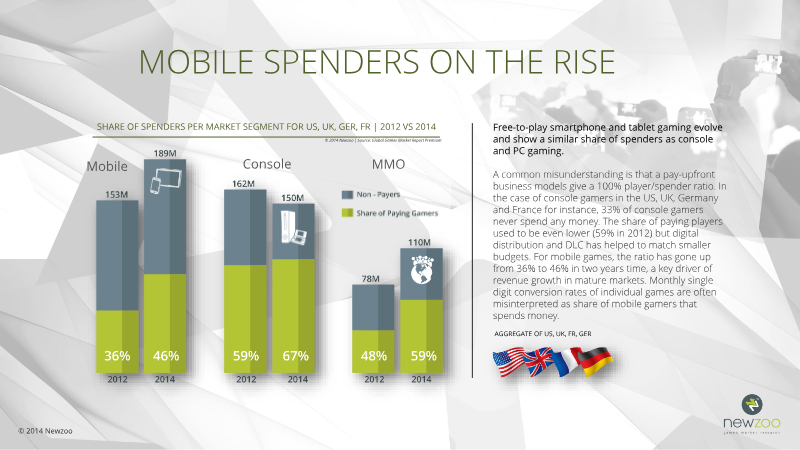
what makes whales stick compared to other people. So basically when you think about the money curve on the on how you make revenue on free-to-play games, you got non-payers, you got moderate payers, you got heavy payers, and you got even what we call super whales, people who spend up to 50 uh dollars per month. And these in our survey presented 1% and then you got 59% of people who don't spend anything. The interesting question about this is not really that other people spend more money and others spend no money. It is what makes these people tick and how do you attract them the people who spend money. So we looked at three different uh sections. Discovery, how do whales find your game? What is engagement to these people? What makes them th tick? And how do they share? So primarily trying to complete the loop. How do those people find? How do they get stuck? And how do they bring more people into your game? So, let's start with discovery. Wales, how do you find games? Is the really the question we're going to answer. And this is a pretty thick
slide, but uh the question we asked, how do you find your favorite games? And the darker line is who say they use this source frequently and the yellow line is the people who say uses sometimes. So when you look at this, the most interesting takeaway from this is that we talk a lot about app stores and the only way being being successful is being on app stores. But when you start looking at other sources, social actually plays a huge part of this. That is a friend pulls out an iPhone and tells you, "Hey dude, you got to play retro and sort of retry. It's a fantastic new game from our folks at ROIO at level 11." And then you show him what the game is. That is still driving a huge amount of discovery. We don't talk about this a lot because that type of discovery cannot be measured. It's organic. It's vermouth. When you boil this down for everybody, not just the whales, offline vermouth is just as important as the app stories. But let's start digging into the different uh segmentation of these people. So in these slides, blue will
always represent the heavy payers, people who spending $10 or more. The green line represents moderate payers and the red line represents the non-payers. So across the board when people start spending money they use all discovery sources more frequently. So this is not really that interesting. If you play a lot of games you use more discovery sources. So that's fine. But what's interesting is that when you start really digging into online word of mouth that is people on Facebook, Twitter, YouTube and other sources. What happens there is that people who spend a lot of money actually use these sources much more frequently. So there was no moderate no ma ma major differentiation in the previous slide. But when we start digging into online sources, heavy payers and the especially the super whales are much more likely to use sources such as Facebook invites and Twitter posts. What's really interesting is this slide is that whales really really like and by the way this is the reason I should have been running this presentation for my
own on my own Mac instead of these guys because these lines would be actually be aligned. So sorry about the bad graphics. These are actually ignore the gaps because these are coming from uh the UV tech presentation. So when we look at this video is super interesting. So for non-payers, they don't really go and check out video. But when start looking at things like um heavy payers, we get to about 35% of the super whales using video often for game discovery. How many of you games have provided either a video sharing opportunity or have gotten a video streamer like a YouTuber to do a let's play of your video? If you have not, this is a really interesting area to explore because video is clearly something that drives heavy spenders behavior. So very quickly looking back at this, I'm sorry actually we're going to dig into one of these things. What what people also say is that uh websites and uh press doesn't matter. I think it's
actually re reassuring that blogs actually matter for heavy spenders. So when you think about spending money an interesting place potentially explore will be specialist press for gamers on mobile even though it doesn't drive volumes which seems to be very interesting for the heaviest the spenders because they go out of their way to find something new. So to summarize why whales sing is that they like discovering games through online ver this is clearly much more important channel than it is for uh for uh non-payers they go online they will they will find invites on Facebook they will share to Facebook they will go on YouTube they will go even on Twitter to find these things and this is there's a very big differential between online word of mouth and the non and the non-paying behavior so I would really encourage you to think about how you create online virality because seems to be reaching the whales. They're also actively seeking
out games. So things like blogs and press and let's plays and other things that which are about discovery through other people which is either reviewers or people who are of authority like let's players are clearly influencing this sort of people. And again gameplay video is really interestingly standing about apart from the other sources for heavy payers. So whether you would be doing wines of your game on Twitter, whether it be YouTube video or Facebook video, I keep on coming back to this video word, but it's really important. So it seems to be that seeing is believing for the heavier payers and they are influenced by video. and two online sources really stand out and we all know about Facebook but we really don't think about YouTube so I'd really encourage you start thinking about YouTube as an advertising medium or an information medium so get in touch with let's players and other people who
have large channels uh and obviously we all know about PewDiePie but there's a lot of people beyond uh below that uh level of popularity that are probably very interested to review the game if it's funny interesting or So let's say think YouTube when you think about marketing for your games if you're trying to reach your channels. And by the way, YouTube is also has announced um um true view true view uh video ads on mobile. So you can actually with install buttons. So you can actually start promoting on YouTube or mobile your games for paid advertising. It's probably an interesting source right now. Okay. Engagement. So when we think about uh whales very interesting question to ask is why do you play the games you play and when we look at this and we try triangulate how does how does social play into this when because we're in our survey we're primarily interested on how does social affect whales and there's not a huge amount of
difference when we think about this social features are important for everybody So things like competitive play or ability to see others play or text chatting overall are features that you would say I would typically play a game longer if it features this. So this is what we asked like how does this retention get affected by that and we didn't see a huge differential when we added into the heavy payers and the super whales. But fundamentally what's interesting is we think about whales being somehow psychology sick people who just play alone and they don't have any life. They're clearly more interested into getting involved in in the social features. They social features help in retention. There is not a huge gap here but it reinforces that when you go into the game and start spending money you want to engage with other people. The next question is what we asked is like
well how do you feel about this type of features and then we had a basically a scale of three one was I hate it and the other end was love it. So trying to get like emotional response out of the people. So leaderboards are surprisingly important and and this strikes me as odd because we all had leaderboards in games for ages and they feel like an outdated feature which is we just throw into the game. But everybody seems to like leaderboards and especially when we add in whales there are or super are very important. But this is really interesting. Making new in-game friends, in-game chatting and responding challenges and these things are are really standing standing out. So if if in the last slide everybody was roughly equal on the social spectrum slightly more for the super whales then when we start really looking into specific features the whales are really starting the super whales are really starting start starting to stand apart and making
new in-game friends is is a super involved feature. I need to meet this new messy person and I need to get in start uh sharing resources with him or coordinate with him. But what this means basically is that these people are really looking for experiences that go beyond just just tapping on the screen. They're looking to get challenges. They're looking to get involved. And other people are super interesting because they are exciting. They are messy. They are unpredictable. So playing with other people adds a new dimension that makes the game more rich and more complex, more unpredictable. And that to me was definition makes the game more fun. And clearly games right now mobile that do these things whether it be things like Clash of Clans providing clan system where you can body up with other people or with your existing friends or it may be a new mobile type of games that are coming along. They're all tapping into this feature which are about playing together or playing
against somebody. And and to me that's something if you're if you're working towards a free-to-play game that really drive uh you have to think about whales I think you need really necessar think about social as a key driver for these people. Now game communities are not really what you do in the game but what you do around the game. That is a place where you can go to to meet with other people that also like the same game. And in a community setup we're trying to find out and by the way there's a lot of small text here. We're trying to find out what type of community features matter. And again, this is not a super interesting slide because everything is similar. So heavy pairs are slightly more interested on on communities than the non-payers are. So but everybody seems to be somewhat interested and again the heavy pairs the heaviest of pairs don't really stand out. But what this basically means that the in-game communities are more something that that gets added on top of the game around the
game and doesn't deduct from the experience and people like well you know I would use it I would go there but they don't really make your game either which we all know if you had a forum to a game it doesn't make a great game it doesn't make a bad game into a great game which is provides an outlet where people can meet up so in terms of like when when I think about game communities they're more in additional They're really just a kind of spice on the mix that let some people come together. They let them interact and explore the game outside of the game and maybe create their own rules. But clearly game communities are not really just driving it. A very interesting question is often is like should people use their real identity or should they use a uh fake identity? And what we did in this graph is that we we looked at different uh segments of payers and we looked at uh what what they want to who they want to play pay play with play with. So if
you're playing with real friends, you obviously want to use your real name. That's the only category actually where your real name is at all interesting. And then when we start going to anything else, you get into some kind of nickname thing. Clearly, if you want to go with one choice, the nickname with an avatar image seems to be the one everybody everybody's pretty much comfortable with, except if you log in pretty much with Facebook. But the problem with Facebook login is the heavier you go into a makeup identity, the heavier you go into a game that has a fantasy like I'll just use Clash of Clans again, like I don't want to be known of myself in the cl in in the clan because I might be playing with a 13-year-old boy who is a clan leader. I have no no willingness to learn that he's a 13-year-old snotty nose boy. So I I really think that Facebook is a little bit challenged uh set up on the on the mobile or any any game scenario. And apart from games that are really like meant to be played together with your real world friends, it doesn't
seem like a good match. So lot of data and again I I urge you to go and download the presentation and take some time to dig into that. But what's really standing out is competitive play. There's also clear drivers to show off and surprisingly many really want to make new in-game friends. They want to meet with people and they want to challenge them. The game communities are really just an amplifier. They are not a driver. But put put this together. Whales seem to be relatively social people. Okay, let's talk about one more factor which is like if you get a whale in so they discovered your game maybe on YouTube. They come in they get engaged with the communities they start playing for a long time. They make friends. How do they bring in more people? Again a pretty thick graph and interestingly when you and which matches what we talked about earlier on discovery and how do you discover games for for everybody vermouth is an
probably the most important way of discovery and sim similarly the most important way of sharing is telling other people in person hey you got to play this game. So this is something that games that are immediate that are rich in in their graphics and you can get very rapidly benefit from. So if you can pull out a phone and immediately show what the game is about, say Angry Birds original was new and novel, you could immediately connect with somebody else and demo the game. So I would really think about how does how does my game become demoable? So when I pull out the phone or a tablet, how can I rapidly show what the game what the fun what the X factor in my game is? because clearly that seems to be the these two seem to be the number one ways of sharing. Other than that when you start looking at you have the app store ratings uh and then you start getting into Facebook and whatnot and interestingly even something like about 5% of people now and then do live broadcasting
of mobile gameplay. So when we talk about video something like sharing is happening but this is really interesting in terms of like already today went super super hard to do live broadcasting for mobile games. Of 3,000 people about 5% in the United States are already getting involved with that. So it's not a surprise that people who are super engaged in games are also more likely to tell about them because they clearly enga like them more. I don't think there are people who just go into games and pull out their wallet and start paying. You actually have to hook them. You have to provide something of interest. So these people are interested. So when they're spend more money, they're much more into gaming and they're much more likely to talk about the games. Again, I'm sorry for the broken graph because it's it's not on my own own machine, but what's really
interesting that the heavier suspended across the board are super super likely to share. These are people who are like if you go to something like a let's say if they were playing golf these are the guys who would have never shut up about golf and their new golf club that they just bought. So they are just playing whatever the game is. They won't shut up about talking about the game because they're so invested in that. So sharing actually comes very naturally to these people. And what's interesting is when we go into a little bit less um popular methods of sharing uh such as uh tips and tricks or uh watching footage or of video of somebody else's game and discussing the games on forum again the whales really stand out and this is interesting when tips and tricks discuss the games on forums. These are really standing out. But look at this. Uh this this is actually again this is
not correct but for for the $15 or more guys there are over 10% of these people say they often live broadcast their model gameplay. These are really really interesting statistics because it's actually pretty hard to do a live broadcast. You have to, for example, on tablet, you have to AirPlay to a PC or a Mac or actually in a Mac and then maybe pull out a uh video recording application and then connect that to Twitch or YouTube live or Ustream or wherever you want to put it to. And if 10 plus percentage of the heavy spenders are doing this, maybe you should be advertising your game on Twitch. Maybe you should you should be doing this for your game when you're developing your game because clearly some people are super interested in that. or maybe you go on to Twitch and see who's live broadcasting mobile gameplay and start marketing those people directly and that uh obviously we are in the business of video sharing and what's interesting is also about 20% of the heavier payer heaviest of payers are also into video sharing so sharing
replace and this also matches with the fact if you remember that the heavy spenders are super likely to discover games on YouTube so video sharing and video watching goes hand in hand and they're really getting very involved with Earlier we talked about how forums they already iname communities were not super important but then again these people are super interested in going to forums and talking about their experience. So almost for the heavy spenders you can say there's no limit to how much trouble they will go through in order to connect with other people about the same game. They clearly don't care about the obstacles in their way. they will go and do it. Again, I think the takeaways are here is forums and video live or or replace are really matter really matters. So, let's let's talk about where do they share to if they're online and across the board obviously Facebook rules YouTube coming second and then you
got all kinds of things like WhatsApps and Twitters and Skype is interestingly super popular that that kind of really stood out for me. Again, if we put in the heavy spenders here, Facebook rules, but YouTube is second. And we don't really talk about YouTube, and I keep on coming back to this. We really don't talk about YouTube as a game marketing tool on mobile. We don't talk about as a sharing destination on mobile, but you cannot spell video games without video. So, YouTube matters. And I really urge you to take, if you take one take away from here, it's video and YouTube. There's something here that's really happening uh which we are not paying all of attention to. Then we wanted to understand why do people want to share? What's the motivation? And interestingly across the board, creativity really matters and there's obviously the need to bring other people in and the need to tell other people about it. But interestingly, creativity across the board is something that people are interested by. That is I'm doing something interesting in this game. I want to show other people see what I'm
doing. So I think games and games whether they be like Minecraft or even things like Clash where you can build a city that or town that looks like just like your dreams would look like sharing that bit of creativity is something that people are proud of or they have a creative solution to a problem. There are there's other reasons also to share and one is to become part of a community and one of the one of the things we are wanted to understand in our survey is that how important is the social aspect of sharing of becoming part of a larger thing. So, how much do you agree if you enjoy uh how much do you agree with these with enjoying game sharing? And again, you know, whales are social. And I think we need to take away this notion of this um lonely dude in a basement who spending money or a or a
somebody who's kind of a psychologically ill that he cannot connect with other people because he spends money. I think we've really stigmatized Wales a lot and the word is even derived from the casino world well where these people are clearly somehow special and that maybe a little special and the the interesting thing is the communities do matter. The more you spend money, the more you share, the more you discover to social, the more you want to connect with other people. So it clearly seems that sharing matters. The tips and tricks really stood out being part of a uh or talking on a community and and if you share tips and tricks, you want to be an author or or authority. You want to be somebody who people recognize as being somebody who has knowledge. So, you probably want to help people, but you also want to be recognized for helping people. They're clearly showoffs. Share like live broadcasting gameplay on mobile. like you have to be a super ex exhibist to do
that right now because it's so hard, so cumbersome and they're still doing it. So tools that let you show off are clearly something you want to bake into your game and they are really interested in going and seeing what others do. This is because if they're so invested on building something about winning or mastering the techniques, they want to see what others do. So facilitating in-game visiting or ability to see other people in your game motivates them because it lets them compare themselves to others. Creativity across the board was a very big driver for sharing but also I would say helping others and being part of the game community also matters. So you want to create tools that let people be recognized for their uh contributions their u their activity on the community. So if you're building something you want to be also feeding there need to be recognized but also create an outlet for creativity. So how do you make your whales happy? I think and I I removed some
slides for this because we have less time than I had at GDC when I did this last time. On those slides we talked about some of the genres that whales really like and competitive gameplay really came came out from there and actually pretty male themed competitive gameplay. The in-game community is a way for retaining players, a way for connecting them, and I think providing tools for easy sharing really matters. You want to provide tools that let them compare themselves and show off. And obviously, we all hear enough from Facebook that we all know that Facebook matters and Facebook matters and Facebook logging matters and you should be sharing to Facebook and anybody to Facebook. At least I've heard this speech many times. But I've actually never seen a YouTube representative any gaming convention talking about how YouTube matters but YouTube matters it matters almost as much as Facebook does so that's one major takeaway from this okay the oblart sales pitch what do we do we do all kinds of things actually
in-game community and mobile replay sharing so yes my presentation seems to match what we do so we're going to play just a quick video on what you can do with every play uh this is a game called dead Trigger 2 it's uh made in Unity and it's um currently available on iOS and Android with every play. And let's see if we get this rolling. Oh no, I missed him. Hope he didn't want that arm. Oh no, another big mama. Yeah, that's a go away big mama. So overall when we think about gameplay sharing if you are into really creating something and showing off I think video is a pretty good way of showing it's pretty graphical even for big mas. So fundamentally this presentation is available uh here on my slides share is actually has a lot more data on that and the graphs are actually nicely aligned
on on the slides share instead of here. So I apologize for that. If you want to learn more about every plate you can go to developers.everplay.com everyplay.com and you can find me on Twitter and you can find me on my on my email and I went so fast we actually have some time for questions even question only. Come on, you're being stingy. Oh, one question for question. There's a question there. Have we got a mic? My lovely assistant will sprint across to you. He's very lovely. He is very lovely. Look at him. I remember I used to move like that. What happened? Add less of this thing. And it's not on. On. No, this one on. Hello. Okay, great. So, uh, like a side channel question sort of does your data sort of. So, what's the number one mistake you can make to drive your whales away? Number one mistake you to
drive your whales away. We didn't actually ask them this question. try to stop playing. But and so I I'm going to only speculate. Um my feeling about this is is running out of something interesting. And running out of something interesting basically means once you start paying you really made a commitment you and and some of the other research says that whales are actually very logical about their spending batter. There's really good research from Ubisoft uh from Nikki and and another person around why why is spending happening and a lot of this was like rational investment decisions on on creating more powerful things for you to enjoy in the game. And I think once you run out of interesting things to compete against to challenge you in the game then you will stop playing. And I think the interesting thing about people is is that you never run out of people and people are messy and interesting. So things that facilitate PvP and and clan
systems are almost infinite in their content because other people are infinite. They make things that the game can never make. So I would say the running out of interesting choices runs people away. And if you have other people in the game to compete against, you're probably never going to run out of interesting things, especially if you facilate the inter interacting well. Okay. Can a big round of applause please for you.
Summary
This analysis examines the behavioral patterns and motivations of high-spending players, commonly referred to as whales, within the free-to-play (F2P) mobile gaming market. Based on a February 2014 survey of 3,000 individuals, the research aims to identify how these heavy spenders—defined as those spending $10 or more monthly, with "super whales" reaching $50—discover, engage with, and share their gaming experiences. The findings challenge the stereotype of the isolated, anti-social whale, revealing instead that these players are highly social, competitive, and deeply invested in community-driven interactions.
Key findings indicate that while app stores remain a primary discovery channel, heavy spenders are significantly more likely than non-payers to discover games through online word-of-mouth, including social media, blogs, and, most notably, video content. Video emerges as a critical, underutilized medium for both discovery and engagement; heavy spenders frequently watch Let’s Plays, share gameplay footage, and even engage in live broadcasting despite the technical complexity of doing so on mobile devices. Consequently, the research suggests that developers should prioritize YouTube as a marketing and information hub, as it rivals Facebook in importance for this demographic.
Regarding engagement, the data shows that whales are driven by competitive play, the ability to showcase their achievements, and the desire to build in-game social connections. Features such as leaderboards, clan systems, and in-game chat are essential for retention, as they provide unpredictable, human-driven challenges that static content cannot replicate. Furthermore, these players are highly motivated by creative expression and the desire to be recognized as authorities within their gaming communities. The study concludes that developers should focus on creating "demoable" games with built-in tools for sharing, social interaction, and creative display to effectively attract and retain high-value players.