1 free read left. Create a free account for unlimited reading + AI research.
Create free account
Games mergers and acquisitions market 2017 – Recap and predictions
Key insights
6 takeaways- 01The scarcity of large-scale targets is forcing acquirers to shift their focus downstream toward mid-sized studios to secure market share.
- 02The 2016 games M&A market reached a record $24.1 billion in announced transactions, with large-scale deals consistently accounting for over 80% of the total annual volume.
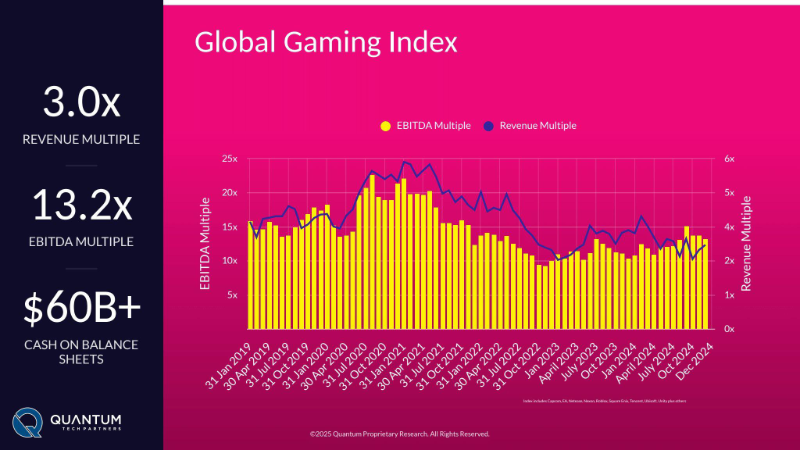
- 03Large public-market acquisitions currently command average valuation multiples of 3.2x revenue and 10.3x EBITDA.
- 04Smaller private studios typically receive lower upfront valuations of 1.6x revenue, though performance-based earn-outs can increase these multiples to 3.7x.
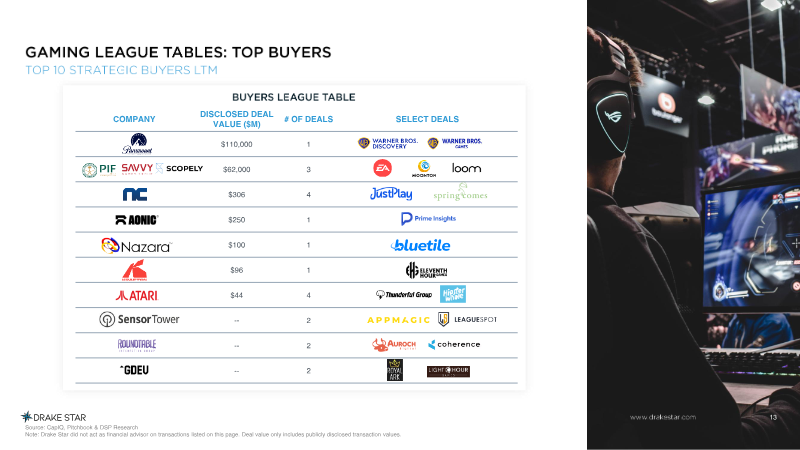
- 05Asian firms are the most aggressive market participants, leveraging significant cash reserves to acquire Western studios for geographic expansion.
- 06Future M&A growth depends on the emergence of new, disruptive platforms or genres, as current sectors like virtual reality have not yet reached the scale required for significant institutional investment.
Ask AI about this video
Transcript
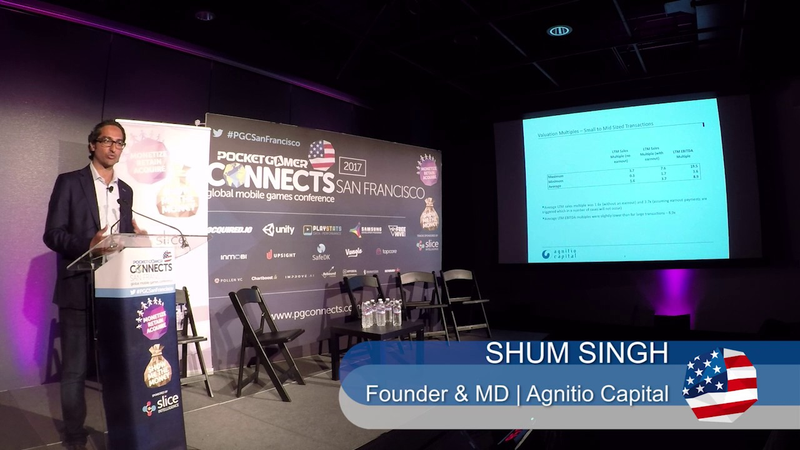
[Music] so I think this is what the third conference I follow teeth on so I'm seeing a trend but I think it's always great to have teeth start because I think he sets the tone get expand coverage here I guess he sets a tone for slightly smaller emerging studios and what it's like to raise capital from as he said you know publishers or equity investors this presentation is going to focus more on slightly more mature studios since this is really an M&A discussion and what's been going on in game sector really from a buyout perspective so this is big publishers acquiring smaller publishers yeah and so first a little bit about Agni show maybe some of you guys have seen presentations before or not but we were founded in 2003 in London were fully authorised regulated
investment bank again based in London but also have an office in Seattle which is run by my partner David bloom which many of you might have met over the years we're focused exclusively on the game sector predominantly mobile but also online we are principally an adviser so we basically assist Studios on selling themselves to larger publishers but also in some cases we will assist them on sort of growth equity rounds and when I say growth equity rounds I'm talking about raising equity investment to the tune of sort of five to ten million dollars and beyond some of our recent deals feel free to go to the website you can you know see some case studies as well but you know very recently we literally last month sold ehre public labs which is both an online mobile game publisher based in Ireland and Romania
to still front group just at the end of last year we sold babble games which is the leading middle-east mobile game publisher to still front as well here in the US we sold dragon soul which was a very successful RPG title developed by pear blue in Madison Wisconsin to greet and then literally around this time last year we sold tickets which was a profitable long-standing business but fairly small to any mocha brands we've also made a couple of principal investments over the years the one you guys are probably most familiar with is hutch games based in London which does a lot of pretty successful racing games including smash cops and hot wheels and also game influencer which is an influencer business which was founded by the former co-founder of flare games so these were some of the trends I want to set the scene a little bit about because
I'm going to go into kind of the size of the market after this slide and how phenomenal 2016 a year was a record-breaking year for M&A but a lot of these trends are still valid I pretty much haven't touched this from from the beginning of this year so the dominant players I think I think we all know this are continuing to crowd out the top grossing markets I wouldn't I wouldn't even say 250 probably almost the top 300 and a lot of this is due to them just having these massive marketing budgets to continue to outspend everybody I'd say probably the player that we're all familiar with that has done this is MZ here in the US so again if you're a smaller mid-sized studio it's really hard to profitably acquire users as well as and then in terms of the games themselves you're starting to see a lot of triple-a quality games and that polish continue to get better as well
what's also interesting is the mobile games market has now become the largest part of the overall games industry and will continue to grow and and actually get bigger visa vie the growth rates compared to PC online and console and of course when it comes to M&A the Asian players again continue to dominate in terms of making the largest acquisitions of companies globally they continue to have cash awards and continue to be acquisitive so this was the slide I was alluding to so if you'll see 2016 it was really just an absolutely phenomenal year 24 point 1 billion dollars of announced transactions and if you looked at through the first half of this year what's interesting is that actually come visa vie compared to a lot of the historical results we're on pace to have
an above average performance this year so assuming we assuming the industry you know experiences a similar result you'll end up at about six point four which compared to previous years is actually not a bad result but but what is actually particularly important is large deals actually still comprise the vast majority of that announced deal volume so if you look even through the first half of this year there's been basically three deals United luck holding which was a Chinese consortium which acquired outfit seven four billion double use acquisition of DoubleDown and net marbles acquisition of Kabam Vancouver studio those three deals which total about 2.6 billion comprised 80 percent of the announced deal volume first half of this year and in 2016 which I call year the mega
deal really the billion dollar-plus deals you had four and those four deals comprised 84 percent of the 24 point 1 billion another interesting point over the past 18 months all requires all of these large transactions have been Asian with the exception of Activision which acquired King so are we really going to have a repeat of 2016 a lot of people talk about the game industry maturing is best specifically mobile no it's not happening anytime soon until there's another massively disruptive platform or another sort of interesting genre of games that just come out that that nobody has has figured out today so 2016 was this perfect storm of really Chinese buyers asserting themselves as we've
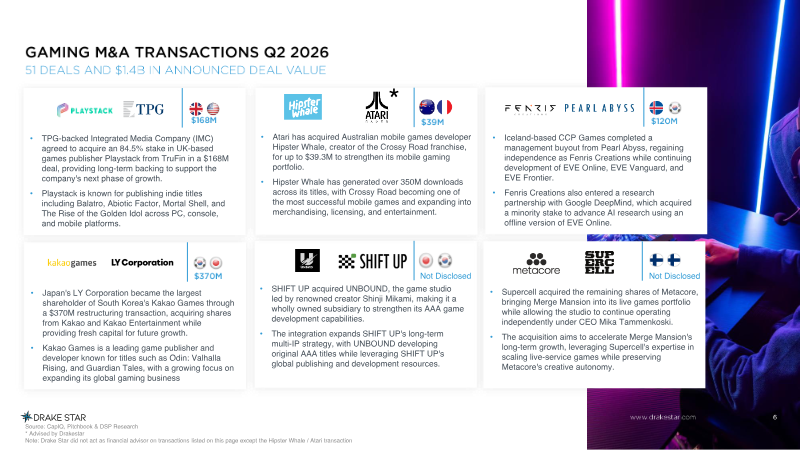
seen and even into 2017 and also you had console giants that weren't necessarily or didn't really understand mobile that finally had an opportunity to to get into the end isn't it to get into that space but really there's nothing left large to acquire anymore supercell is gone King is gone there's really not that many more billion dollar-plus mobile game companies for either Asian companies to buy or console players to buy so what is that going to mean that's going to mean that a lot of these larger players because they want to grab market share will continue to look further and further downstream so even if you look at this year in the first half of this year you've had a couple of deals they weren't quite billion dollar deals it was only outfit seven these other two were less than a billion clothes but again they're going to continue to be smaller and smaller deals so given that scarcity value you might actually see valuation multiples go up for acquiring these companies and so I wanted to
segment out what's being paid for these larger deals versus what's being paid for the smaller deals so if you look at all of these deals here these eight companies that are roughly a billion dollars or close to it you're looking at a data that's been largely fairly publicly available since most of the company's acquiring these larger players were publicly listed basically you're looking at average you know sort of LPM sales mullets latest twelve months of sales for those target companies the averages you're basically getting about three point two times and then the EBIT doll multiples for the latest 12 months you're basically averaging out at about 10.30 our players what they're getting paid they're getting paid that entire amount upfront in cash and without our notes so I didn't list out obviously all
the small to mid-size transaction because frankly they would have several pages of it so I've left the summary here what's important to note is the distinction between the upfront payment or the no earn out versus with the earn out so the smaller to mid-size players as you can see the the over the last 18 months the latest 12 months sales multiple was about 1.6 without an or now that's essentially the upfront cash or share consideration that they're receiving from these larger buyers now if they were to hit those or announce and achieve the performance metrics or financials that they've signed up for in those earn outs then they could actually get up to 3.7 and and near to what some of those larger players are in fact larger like more than what some of the larger players are getting the EBIT all multiples were slightly less came at about 8.9 but do bear in mind in fact
I'll mention it here it's hard to track down a lot of the data for for smaller to mid-size players since a lot of them are private companies sometimes the publishers are buyers buying them are also private companies and they don't necessarily publish up to date of financial information so sometimes it's difficult to garner that obviously the larger players are getting you know significantly higher multiples and again that's what you pay when you're when you're buying size and scale in the industry I think you know what Keith mentioned and you know a lot of that probably holds true here for for ma is you know some of the qualities are going to be fairly similar everybody's looking for you know especially you know really an exceptional team especially when you're buying companies and the larger company you're buying then then the more world-class of a team you're looking for
and and guys who have done it before sold companies before who scaled large organizations the track record really becomes essential in weight in some ways to really distinguish yourselves or show that you're intervening maybe you've you've you know managed to focus on a specific category or genre of games really to diversify away from all the noise or me to or clones obviously now particularly for the Asian players profitability becomes really significant and almost a must-have not essential but but quite important for a lot of the Asian players geographic expansion acquiring a beachhead operation in western territories whether Europe or North America again becomes becomes more more interesting as they want to expand out of their domestic or regional markets and then acquiring specific skill sets some is also fairly attractive and then ultimately everybody's really buying market share
we're in a very mature industry so what does that consolidation wave mean for smaller to mid-size well as I mentioned the good news is that all the large players have pretty much been acquired so the bigger publishers or buyers are going to continue to look downstream continue to acquire smaller studios so hopefully that'll actually push up valuation multiples if you are a business that's profitable growing have certain of those skill sets or criteria or qualities I mentioned previously then you know you should be able to be bought rather than sold if you're not or you know have certain may be functional or attributes that are lacking then you know it might be an interesting time to merge with other players that could potentially round out those those functions that are missing I do think this is again I reiterate this every time maintaining the status quo is is probably unwise and a very mature and
rapidly challenging market which brings us to the predictions again I've virtually not changed these from six months ago you know the Asian players will continue to consolidate they are flush with cash and have very profitable businesses domestically and regionally so they want to deploy that capital and in fact you have non-gaming Asian players I'm sure we've we've we've all read about this whether it's a you know Chinese poultry farm acquiring digital bridges and Splash Damage whether it's a mining company acquiring jagex whether it's a chemicals company buying you know other other players in the market this will continue those players you know again despite the kind of regulatory constraints they have in China we'll find ways to get capital out and continue to buy gaming assets because of the arbitrage because of the significantly higher multiples they're going to receive if if they acquire these assets from abroad from let's say
the US or Europe where gaming assets aren't really valued as high for various reasons I think it's important to note u.s. players will continue to be absent you know for again variety of reasons they're just not taking the they don't have the same risk appetite as Asian players and again they don't also have benefit from the same public market appreciation of gaming businesses small to mid-size players will continue to get bought out in fact they're you know we speak to a lot of buyers globally and a lot of them are you know should you know what would traditionally have been much much more in their sweet spot there they're continuing to acquire smaller and smaller companies again because of the market share you know land grab that I mentioned another interesting area kind of on the periphery to two games is the
sort of hole you a marketing sector which is highly fragmented which I think most certainly needs to be consolidated so we definitely think that there's going to be interesting transactions there again 2017 will be an above-average year but certainly nowhere near 2016 and then finally will consolidation actually end this year will there not be any mid-size players left and you know 2018 is your VR so that's it we have time for okay great tip they don't really I mean it's pretty obvious I think as I mentioned right it's a very very challenging market I
don't try I'm not trying in any way shape or form to be condescending to be to be in any way try to try to not let in in deeper because because I mean I've supported many indie Studios I've been doing this for 13 years and seeing them grown some of the mountains their third business I just like to be brutally honest and say it's it's an incredibly difficult marketing environment you know I personally and I've even spoken to my partner about this at length you know we might be advising different industry come next year this time because there's just not going to be any more M&A and we're consolidation in the industry so I mean that's genuinely how I feel you know I you know again if I did I wouldn't be
standing here I'd be you know on a yacht and figuring out exactly which PR companies to invest it you know but look I mean jury's out on VR I think I think it has a lot of promise I think there's a lot of Studios doing a lot of interesting things but until you have a demonstrable audience significant install bases and VR companies that are making significant revenue it's not a viable market I mean the only transaction we've seen is Google acquiring what was it alchemy labs in Austin Texas right and those guys did were what like four million dollars of revenue a year I mean how large is the VR market in terms of revenue for it for studios out there total a couple hundred million dollars I don't know you know until you have an industry that's in billions is it going to be significant for people to make and place decent bets
acquire and say okay you know what this is real we're going to you know spend twenty million dollars internally figuring out VR and find the best talent find a studio head and really try to make something of it or we're going to go and acquire these four or five studios across the world but we're not there yet I'm not saying we won't get there maybe maybe we get there in two years or three years you know your your guess is better than mine Oh [Music]
Summary
The games industry mergers and acquisitions (M&A) market experienced a record-breaking year in 2016, with $24.1 billion in announced transactions. While 2017 is projected to remain above historical averages, the landscape is shifting due to the scarcity of large-scale targets. The primary thesis is that as the industry matures and major "mega-deals" for billion-dollar companies become rare, acquirers—particularly Asian firms—are increasingly moving downstream to purchase smaller, mid-sized studios to secure market share.
Key findings indicate that large transactions continue to dominate the total deal volume, with a few major acquisitions often accounting for over 80% of the annual total. Valuation multiples for these large, public-market deals average approximately 3.2 times revenue and 10.3 times EBITDA. In contrast, smaller private studios typically receive lower upfront valuations, averaging 1.6 times revenue, though these figures can rise to 3.7 times if performance-based earn-outs are met. Asian buyers remain the most aggressive participants, driven by significant cash reserves and a desire for geographic expansion into Western markets, whereas U.S. players exhibit lower risk appetites and less public market appreciation for gaming assets.
The scope of this analysis covers the global games industry, with a specific focus on mobile and online sectors during the 2016–2017 period. The methodology relies on industry deal data, transaction tracking, and professional advisory experience within the investment banking sector. The outlook suggests that while consolidation will continue, the market is becoming increasingly challenging for independent studios. Future growth in M&A activity remains contingent on the emergence of new, disruptive platforms or genres, as current sectors like virtual reality have yet to reach the scale or revenue thresholds necessary to drive significant institutional investment.


















Comments