1 free read left. Create a free account for unlimited reading + AI research.
Create free account
Fueling Growth Through User-centric UA Creative Design PG Connects Digital #2
Key insights
6 takeaways- 01Creative assets are the primary drivers of return on ad spend (ROAS), superseding automated media buying tools in importance for modern user acquisition.
- 02Successful UA requires integrating psychological insights with behavioral data to ensure that creative output functions as an authentic extension of the game’s value proposition.
- 03To ensure high-impact creative design, advertisements must utilize visual contrast for saliency and feature strong character expressions within the opening seconds to establish a narrative hook.
- 04Effective UA strategies must shift from surface-level demographic analytics to a framework based on neuroscience and behavioral psychology to trigger intuitive System 1 processing.
- 05Developers should categorize players into psychological archetypes—such as achievers, strategists, and escapists—to align ad narratives with core user motivations.
- 06A holistic methodology that balances data-driven performance analysis with intentional, character-led storytelling is essential for maintaining engagement in an automated digital ecosystem.
Ask AI about this video
Transcript
well hi everyone hope everybody is having a great starting of week and I hope that this presentation that's coming up is going to contribute to that so today were here to talk about review and how we're approaching grow through their centric user acquisition creative design so let me start maybe by a quick interaction of myself in the context of review so started back in September 2019 as a director of growth since then I've been very involved in the in the topic of optimizing creative approaches and that's why I'm picking up that topic today and rather than trying to explain all the details about rodeo and its organization I'd rather focus on the
organization through the prism of creates testing specifically so as I just said that's a very big topic for us a review that involves the collaboration of a lot of different teams which are all the Virginia variety of skill sets from the most qualitative insight with user research and market research to the kind of analytics that you do to get you to see once you have campaigns life so as director of growth I'm leading a team of perc marketers user researchers and since recently a creative director for ads so that's the team that you can see on the left when it comes to creative specifically my teams are involved from the very early stages even before we have actual games to make sure that the games that were studying on are the most marketable as possible so we leverage insight from all sources to test approaches through user acquisition with a big focus on exploration and position itself to the right you can see that we
we also have a user acquisition team that works very closely with the growth team and that takes over once the games are live in a logic of return on investments so they disarm the insight that was collected by the growth team and keep on testing goal until the end of time to find new guys perform credits just a quick word on on this period of the presentation itself because just as any other publishers or advertiser out there we're just learning as we go so as a company we decided to invest a lot in learning how to produce that's well there are creatives there are approaches there's one of the possible avenues in America to tap you can see we're still learning but we feel that there is value in the overall strategy that we've been focusing on and that we're implementing and in the principles that will be discussed during this presentation we don't have the truth all may be well just one truth but we do have encouraging signals that what we're
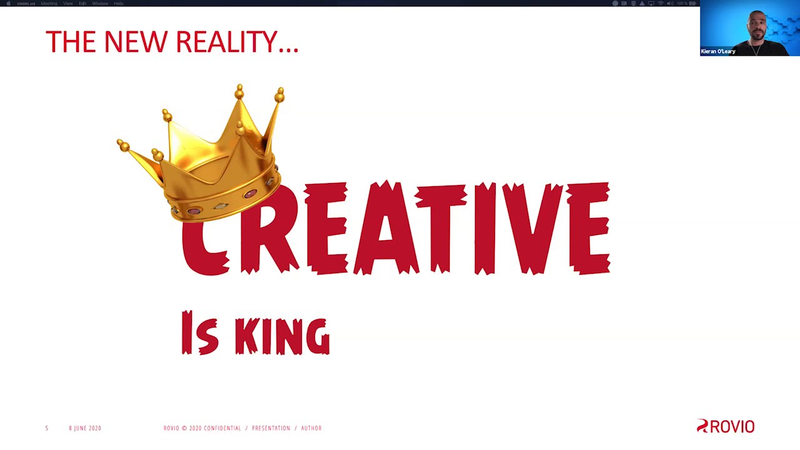
doing is is is right so let's maybe start first looking at the challenge itself I think everybody here has heard that in the in the result recent month but creative is king in a world that's rapidly moving towards automated media buying and and we strongly believe that optimizing creative is now hands-down the most effective way to you to try return on adspend some could even argue that creative is the new targeting so that brings some pretty significant changes first of all that the creative factor is always at full speed literally thousands of creatives are being priced each year with only a handful of them taking less majority of the spends that also involves a lot of constants a be testing so whether you do that in-house or he worked with a network of feathers just like we do that that requires a huge amount of time spent on briefing parsing
analyzing the performance of these creatives when there are a be tested some shortcuts do exist here is an example of a video of a couple of videos to the right that we created fall on one side and we were streamed us on the other side sugar blasts that do draw inspiration from one of the top Kabir's and they both worked very well that being said expecting the strategy to always work is Israel well wishful thinking we're noting that this approach is the entirely wrong it's just not sustainable and and first and foremost doesn't always work all let alone of a long-term career strategy and finally maybe and that's the most important point here yet it's early limits the innovation and creativity and your 52 leads more than don't follow that brings us to the million dollar question which is how to improve the odds of finding new hair cribs and be able to scale up so whether you decide
you to get inspired from from others or coming up with new concepts how can you guarantee that your dallas painting creatives will well yelps are the best possible results how do you actually rationalize your approach to creative ideation and come up with data insights all inside base hypothesis to you to test the the question is very simple though it's nuts as yourself wait but why why does it create work whether it's an adaptation from competition or an entirely new concepts one of the the obvious benefits of the industry that we work in is that it's possible to experiment and test a lot of different things quickly and easily but while it's it's eally it just provides the avians hurt you what what works but you don't get you know why it's working so if you don't get to understand the underlying mental principles that do drive design effectiveness then maybe testing is just trial and error process the the missing
puzzle piece is to understand the the hidden mental processes in the mind that are driving people to click and this is what we're trying very much to decipher so let's look quickly at human brains I'm standing here with the neuro design as its principles applied to all human kind and then he approached you for leverage its insights so what can psychology and neuroscience tell us about what is read writing where we live within the news feeds all just journey when looking at visuals nor design rules another fields such as psychology and another Capps I insist you to help understand why people reacting the way they do to to designs so as neuroscience and psychology research of a commune a lot of information over recent decades they probably have a lot of things to say about the common factors that influence whether people will like or not a design so this research has rien
crease in the recent years including the founding of a very specialized field which is no aesthetics which specifically specifically star studies the factors that you finish whether our brains respond positively to two images that's you've probably also heard about the system one and system two these are two systems that do not refer so much to parts of the brains as much as processes that the brain use and these terms were coined by the Nobel Prize and Daniel Kahneman so a system one that's the the one that were going to be interested in it's the oldest system approximately six hundred million years it works on the on the basics of intuition emotions habits prejudices and what we call heuristics it does function inside consciousness and in a completely automatic and manner processing huge amounts of information
while knitting singing no efforts all without the feeling of voluntary control then system to is is relatively new it's a conscious rational systematic and logical system which is not necessary with Hartman's you look at today so in a nutshell were intuitive impatient and image focused while we evolved you to decode information from our eyes and the volume and variety of artificial images and designs is always increasing there is much less to us than than ever before if we're slightly bull or bored or just dissatisfied with something we can just click away and research has demonstrated several times that people don't read things really online vigeous transcend it so just a quick anecdotes some some research demonstrated that was research from microsoft's with two tons
of thousand people in canada it showed that our ability to sustain focus attention in the face of distraction let's go up to eight seconds in 2015 as compared to twelve in 2000 which is reported as not being much better than the the focusing abilities of a call fish so let's look at a few principles to you to maybe maybe help human brains just figure out what they should be liking and what they students emotion leads to motion functional magnetic resonance imaging sorry for deaths shows that when evaluating brands consumers primarily use emotions personal feelings experiences rather than information such as that produced features and facts and and a lot of research has demonstrated that consumers emotional response and that as a far greater influence on their reporting intent by products than those the actual last contents by a factor of roughly
three to one so how do you bring people to to feel things about what they're seeing in to have actual emotions character is one way to make that happen they they really elicit sorry very strong subconscious response so whenever possible just use characters to advance the story or the narrative in our case approval we're looking enough to have a lot of characters and there are very often uses one of the key differentiators when placed alongside competition another lever is here so as a matter of fact we were running from here faster than we were into pleasure so it's the most powerful emotion that you can experience as human beings it's the root driver behind most of the decisions we make even when the intended outcome is is positive you need to be mindful of here for obvious reasons because it's such a powerful level that you can pull to to
create emotional moments and and fear of losing if you look at this example can be felt in this video that we saw before where in the last seconds you we showed you the reviewers that they are about to fail pay attention to and try to see how you feel but that kind of videos yourself then first and last impressions matter begging an end of a video and most impactful and in the meet you also be somewhat related so capitalize on the first three seconds three to seven seconds of the ad by appealing to emotion so that do psychology Prime the user to stay engaged throughout the entire ads then in the middle of you you can you can break it with new moves like show increasing difficulty very little to the variations and also encouraging users and and in the end conclude with something that again relates to to the interaction because our minds are up brain fall fall stories our brains are
wired for stories then contrast helps with the saliency as obvious as it might sound it's something that maybe we don't think of as often as we do because contrast between an object and its surrounding community that makes it salient so in this example that are saying we remove the the background from the actual game so that you be white and so that viewers would be able to see what actually matters here which is the puzzle mechanics so just keep in mind that color and contrast are some of the two most important factors in producing that very science II and that's even more true in the context of mobile where you can't really control some variables it's just slightly not brightness so in a nutshell like you want somebody to see something make it stand out then again that my son of use but words do get the message across when they are used carefully visual cues help take the user and return it by telling them what they
need to do so be mindful of that and culture viewers just figure out what's the key thinking from what they are watching so moving away from very general principles since it's the kind of approaches that we've been leading criteria probably we have some very specific learnings that we can sure hear the first fact that we will always need to keep in mind as advertisers is that humans on which modern members we want to knowledge humans in all their complexity rather than just to get data because I mean we've collected so mature so why does it seem harder in howler to always create like new marketing campaigns that perform it simply because the demographic and behavior that we currently use you analyze pairs is is not indicated but with the pair it's like 300 what they needs to if you
involved in students in other words were much more than or behavior and we're so much more than demographic information so yes of course user analytics are an essential component of a successful marketing campaign but we feel like it's the bare minimum so how can you look at your players using that kind of insight and looking at what actually motivates them as compared to just demographic figures pair archetypes is one way to look at it so I'll go through the layer but just let's acknowledge that several models exists from the self-determination theory to the player experience of midsection model but no matter how you look at it you can cluster people based on what they look for when they engage with game and I mean here understanding of the motivation set up your most valued letters is going to be key so if we look at these very archetypes that right in front of me they are all involved in playing casual puzzle games but they are
looking for different kind of experiences so we have the India achiever on the Left who just want you to master new skills and progress through a very clear goal what they want is to complete as many levels as I can collect all the everything that can be collected they won't use their brain in a strategic manner and they want you to get challenges then we we have the solar we get small satisfaction in the feeling that it's actually using his or her bringing in solving puzzles puzzles it's not really a competition itself that matters but more baby feel that they're both using a difference and then you've got the escapists with more interested in the world cuts the defense the characters in him was looking for inertia so if we look at our own games and that's going to be maybe even more interesting for you let's look at dreamless the dream blast is is a casual puzzle game that that's based on the Angry Birds franchise and that's focusing very much on the core gameplay
itself with a very light meta so the data that you're seeing has been collected through surveys in our game that we match against the behavior that we're tracking and in this example you can see that dream buzz players are very much into strategy in completion to look back to what we said before and if you compare them to players while playing small-timers which is also a casual puzzle game matched Rico gameplay but with a very strong multiplayer you can see that the motivation to to get are immersed in the stories is much higher so you really need to acknowledge that because it's going to be while changing a lot of things that you do in regards to the product itself and the way you advertise it so if we say that what does it mean for for the creative stem cell just a quick well a quick couple of examples so small town mirrors as you can see puzzle game but a lot of focus in the storytelling in the universe if we deal for the game and in the fantasy
which is to solve crime as compared to focusing very much on the core gameplay entirely different story sputtering blasts we're obviously that's the core gameplay that matters the most because you also want to make sure that the creative messaging itself is aligned with a game experience because if you don't go for that thing that means that your in-game kpi's are going to suffer there even within the singing you can find all sorts of pairs looping back to the archetypes that we had before you even in small summers you've got content fault yeah cheaver so focusing on collecting all the clues and solving the puzzles then you've got the soldier most likely is going to be interested in finding out who the murderer is and finally you've got a skill base where you going to focus very much on the on the characters and the story itself so even called the same game you can try different approach together through various player archetypes and you need to ensure that the game experience those deliver and
his motivations when you look up there's that retain so looking forward as I said before that's that's a topic that's still very much in motion we're learning as we go but we've got a few avenues that we've already started investigating and very good with them so audience segmentation 2.0 we recently started working with an external partner twelve traits you might have heard of them do to go deeper in the understanding of all players in their up psychology because understanding who the players are what motivates them and especially interested in Tracy and Kelly sorry what if that you helped it communicates is going to to be extremely useful to supercharge your creativity so when working with them we're marrying the old style tracking behavior with the new style which is to to look at psychology to build site-based personality personals and
understand the fullness of who they are so we just started with us it's really been quite enlightening in a few areas and we're ready to to get more out of it and then automated creative performance analysis which is another new we're exploring and and which we think is going to give us the the ability to recognize what in a video is bringing the performance so could be the character could be the very character expression could be the kind of gameplay that are showcasing all could even be the text so as you type this you should be able we should be able hopefully in the longer run to to get first all the ability to understand which approaches of historically speaking being the most efficient and on the other side provide new creative ideas so thank you for your attention I hope that was that was useful and feel free to reach out to me
if you have any question or if you want to discuss something specifically Wow that was that was amazing I just say that was possibly waste the most beautiful presentations I've seen and also who knew the advertising was so complicated my father just had a picture of a bird man of a different color but my god that was a Eve but that was I oughta see Baltimore went into it Matt but I didn't realize the psychological psychology of advertising was quite so deep um so that was yeah they're very very impressive and definitely uh hopefully it was given me when you think about hyphens give me a few of our audience a few things too to think differently as well about I've got a couple of questions but we seem to have a chunk in here as well so I'm gonna go fire me you know that's okay um first one up is what type of ad creative themes do you find most effective for high roas rows nine versus profile etc
that's very specific I guess that's a very specific question and I would be kind of contracting myself if I figured yeah you like it can insert a that's reader pens on on what your the kind of experience that your game is providing depends on with your parasol so uh I'd rather stay away of providing a pretty fighting spirit to get there and some some principles are working like I mean if you just forget a bunny you can see for fire or other like platforms you can see that a lot of schemes and approaches always working but I cannot even try once you go we know no and well obviously that's why there's so many different types of that it one thing worked with it'll be will be bombarded with that and then it wouldn't work I guess so that's the joint that's why you got to keep poking around the brains they another quick question and so feel free to buy at Leeds away for not them did you try to apply these concepts in static gif or html5 ad formats we
haven't to date fair enough good answer good quick answer he's the same question is being harassed sore twice so I'm just gonna mute so me messaging windows and they all senses harass you okay um so it's the same kind of question but I guess is how much how much of this you've got you've outlined some quite elaborate theories and ideas but obviously in the day results drive what you do I guess so how much was so balance between innit of thinking and the theory and and results what works just to be honest it's it's really impactful and I guess the work specifically like that the the principles that I've mentioned first about the like how human brain works you can like we know for a fact and this is science fact that it's working there these are principles that you should
always have in mind and then against you to block game specific approaches our experience and I can't recommend on the KPIs that we're having but it's been proving extremely impactful like were saying that since we shifted from kind of like let's try everything else that we're seeing from the computers to let's be focused on what the players are trying to get out of the play the game experience results have been much better for the for example I I said in the in the first fight that's a huge part of the spend goes to the same credits and since we started applying these principles we can see that the number of credits which we did the Spanish is much higher which is saying that we've got more than one winners and that's a very positive signal no that's great um I got question about the role of background music or sound effects you know creative and see that's something you can't always legislate it's going to be there
um you know and you guys right thing else it's so we know for a fact that's not that many people listening to song while watching ads but if you do that properly and that was - I'm gonna pick to you to be added to this presentation for 20 minutes but it's also also something that really is going to amplify the impact of your credits if that's done correctly okay as much stuff in here cause you've got you were the most popular that's what the says it happens you put it there and um like Oliver Kent says a great presentation t-test to different creatures for different channels and different markets nevertheless yes we do like if I'm saying that you need to make sure that the creatives that are using our well designed specifically for for specific audience then that also means that you need to be mindful that when running in different campaigns using different credit so we're also mindful
of the the differences when it comes to your habits so we also try to make sure that where we push in specific Jo's is also adapted to them and to the channels that are they are using okay there's a couple of questions here about about sort voices I guess this one is what's named the behavioral search partner that you work with and another is whom would you hire the crowd production and you will adjust psychologist or someone else so I guess they're talking about what advice you're taking externally so the company that I mentioned before is called twelve traits traits referring to the psychological traits and then the the critical that we're working with as a huge background in neuromarketing in the context of mobile advertising cool cool I'm gonna keep going for a while we've got a couple minutes left so don't
worry you'll get a break in a minute um as a question about your thoughts on on misleading as a topic that was being raised in different places where the ad is just nothing to do with the game and it's some it looks like it's some sort of point-and-click adventure and then you turn around and it's some RPG that featuring several questions so first of all figuring out why they work because they must work if they've been online for such a long time it means that the pair's that they are bringing in two games is well they're good enough for fall for them to justify keeping an investment that kind of creatives so we don't know yet why it's working so well but as as a publisher and when it comes the people question of the missing advertising I think that's first of all they are not all equal but I think it's fair to say that some of them are sitting in fantasy and across a lot of industries it's something that people do like think about perfume I guess that's
a woman great example where you don't actually actually show the products but the fantasy that goes with it and then I I guess I mean we were working in the in the free-to-play industry so the worst that can happen at user level is that they lose two minutes of their time doing something for free sure it's not a great experience some could argue that your brand is going to suffer from that even though we don't have yet kpi's to actually prove it so I'd say if that works there is probably a good reason and I don't see that as being unethical okay I've got a couple questions on archetypes a one is do you aiming to target all the archetypes with your games and the other is do design ad creatives and try to target players based on archetypes is it even possible any ad networks to target in that way so the the first question is yes we do and and we try to link the the performance of the pairs that we're bringing through a specific creative
approach to the archetype that we used which is the angle would be to say for example that's the escapists there are the most valuable tears that we can get it again in so that should be the approach so yes we do like the the actual track performance with the creative approach in the archetype and the second question was what sorry it was a well I think it was kind of you know how can you target that for ad networks Israel what I of targeting archetypes it's tricky you could think of that by adapting your creative strategy to the kind of games where you're advertising so I'll use a very random example let's say char advertising you know no words game then maybe some could argue that you could follow all the strategists pretty a very bad example but that's it the first that comes to my mind so we don't do it yet we're looking at it but we haven't found very still always to to do it yeah okay
I just try get to achieve more there's so many questions I just want to try and get as much now I'm anonymous on this you mentioned about running from fear of running to pleasure fear of losing do you think there would be an opportunity to create FOMO for gamers in any open-ended games and do you think that would be effective that would be effective but going back to the topic of being a pickle I am Not sure that's the the way to go I don't think we would like to bring players because they they are afraid of missing something it's a strategy that's been largely used by a lot of people sure isn't that we're starting as a ministry to to walk away from and I think that's a great thing I don't know my son plays a lot for knives a lot of fiber constantly missing out on various things in that no offense to epic of course it's like today and then storytelling versus psychological tricks which one do you think is more effective strategy well psychology me they did this sugar
in hands and in storytelling and just goes well in specific contexts because you need to have a product that supports storytelling so for example for for dreamers that I've mentioned before we don't really do this for small donors of course we'll do it because the game itself has a very strong natural layer so stuff from the product start from the audience and integral of what makes the most sense fantastic and I get one final question because I gave us who are approved for its name from its name is asks knowing what you know now would you cut with your current approach to you a work five years ago or was just more because the audience is matured I guess you won't you know hard to play something now four to five years ago but it's gee I wish I would have even Beresford back then so now it's knitted back then you would have been like a
tremendous convenient intake okay it still is but uh well more and more players are the thing that years all final one that just kept enzyme girl honestly because it seems quite sure any suggestion examples for capturing attention in the first few seconds for the last few seconds the GMAT means yeah characters well it stop depends again on the kind of game that are advertising but if you have character starting with a very strong strong expression is going to set the tone fall for everything and they were definitely going to to catch your viewers attention cool all right now it's brilliant you make you answered incredibly succinctly and very good I am there's a fascinating story you yourself Karen because you have what a piss food Irish name a French accent and you live in Helsinki yeah well I'm half Irish I've got a fresh notes and I need to do with I just said sir it's a fascinating story so but thank you so much for your generous that today and hopefully soon
in over in Helsinki see you
Summary
Modern user acquisition strategies in the mobile gaming industry have shifted away from simple trial-and-error testing toward a framework rooted in neuroscience and behavioral psychology. By prioritizing System 1 intuitive processing, developers can identify the specific mental triggers that compel users to engage with content. This approach emphasizes that while automated media buying tools are essential for distribution, the creative assets themselves serve as the primary drivers of return on ad spend. Success in this competitive landscape requires a transition from surface-level demographic analytics to a deeper understanding of the psychological archetypes that define player behavior.
Effective creative design hinges on the alignment of emotional resonance with the actual game experience. By categorizing players into distinct archetypes—such as achievers, strategists, and escapists—developers can craft targeted narratives that mirror the core motivations of their audience. This strategy ensures that advertisements are not merely generic promotional materials but are instead authentic extensions of the game’s value proposition. Integrating these psychological insights with behavioral data allows for more precise messaging that resonates on a subconscious level, ultimately leading to improved key performance indicators and sustained user engagement.
Visual execution remains a critical component of this strategy, particularly regarding the immediate capture of viewer attention. High-impact creative design utilizes visual contrast to ensure saliency and relies on strong character expressions within the opening seconds of an advertisement to establish a narrative hook. By balancing data-driven performance analysis with intentional, character-led storytelling, studios can bridge the gap between technical acquisition metrics and meaningful player connection. This holistic methodology underscores the necessity of human-centric design in an increasingly automated digital ecosystem, ensuring that creative output remains both compelling and commercially effective.













Comments