1 free read left. Create a free account for unlimited reading + AI research.
Create free accountWhitepaper European Conference on Games Based Learning (ECGBL)
1 free read left. Create a free account for unlimited reading + AI research.
Create free accountWhitepaperEuropean Conference on Games Based Learning (ECGBL)
The authors argue that DEERs foster teamwork, communication, and critical thinking, yet adoption is limited. Existing authoring tools either lack expressiveness or demand technical skill.
This work in progress paper introduces the DEER-Wizard, a low-code authoring tool designed to let non-technical educators create Digital Educational Escape Rooms (DEERs) without programming knowledge. The authors argue that while DEERs foster teamwork, communication, and critical thinking, adoption is limited because existing authoring tools either lack expressiveness or demand technical skill. The proposed approach addresses this power-usability dilemma by guiding educators through a four-step configuration covering pre-configuration, resource preparation, riddle configuration, and game structure, with each step grounded in established DEER design principles such as narrative framing, interdependent puzzles, adaptive hints, and structured debriefing.
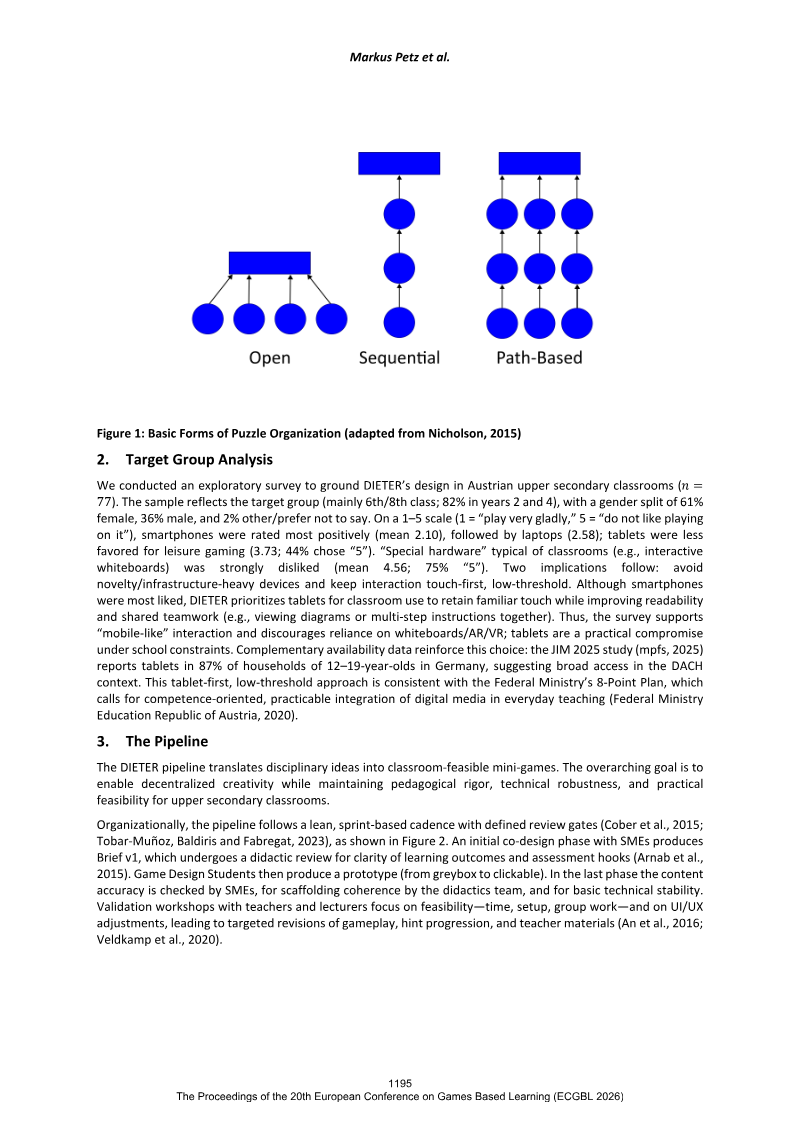
The Wizard is connected to a DEER-Generator, which converts the completed configuration into a playable 2D multiplayer dungeon crawler built on the authors' DEER-Toolkit. The toolkit supports cooperative play for two to six players and xAPI-based learning analytics. Internally, the riddle dependency graph is mapped to room progression and translated into a Petri net to drive execution and enable fine-grained state tracking. The Wizard and Toolkit are described as open-source and not restricted to a single domain, although higher education is the primary target context.
The paper is explicitly conceptual with a prototype in progress, and it reports no empirical results. The authors outline a planned formative mixed-methods study with higher education educators without programming backgrounds, combining task-based authoring, think-aloud protocols, and interviews. The central hypothesis is that participants can author a coherent DEER within a single session, assessed through a rubric covering narrative consistency, puzzle dependencies, and learning-objective alignment, alongside task-completion rate and time on task.



European Conference on Games Based Learning (ECGBL) · 2026



European Conference on Games Based Learning (ECGBL) · 2026



European Conference on Games Based Learning (ECGBL) · 2026



European Conference on Games Based Learning (ECGBL) · 2026



European Conference on Games Based Learning (ECGBL) · 2026



European Conference on Games Based Learning (ECGBL) · 2026



European Conference on Games Based Learning (ECGBL) · 2026



European Conference on Games Based Learning (ECGBL) · 2026



European Conference on Games Based Learning (ECGBL) · 2026



European Conference on Games Based Learning (ECGBL) · 2026



European Conference on Games Based Learning (ECGBL) · 2026



European Conference on Games Based Learning (ECGBL) · 2026



European Conference on Games Based Learning (ECGBL) · 2026



European Conference on Games Based Learning (ECGBL) · 2026
European Conference on Games Based Learning (ECGBL) · 2025