1 free read left. Create a free account for unlimited reading + AI research.
Create free accountWhitepaper European Conference on Games Based Learning (ECGBL)
1 free read left. Create a free account for unlimited reading + AI research.
Create free accountWhitepaperEuropean Conference on Games Based Learning (ECGBL)
Structural components include game mechanics, challenges, player profiles, and adaptation mechanisms, while dynamic behavioural components include assessment, adaptation, and event handling.
This document proposes a structured framework for designing serious games for learning, addressing a gap in existing approaches that do not clearly specify how concrete game components should be organized to balance educational effectiveness with entertainment. Its central argument is that functional requirements derived from the literature can be translated into reusable, cross-domain design components that help multidisciplinary teams align pedagogical goals with technical implementation. Assessment and adaptation are emphasized as core modules, given their central role in educational outcomes and their applicability across game genres.
The framework is developed through a literature-based derivation of functional requirements, first clustered into seven categories spanning pedagogy, rules, interaction and communication, assessment, goals, adaptation, and representation, and later refined into sixteen requirements (FR1–FR16). These are mapped to both structural components, such as game mechanics, challenges, player profiles, and adaptation mechanisms, and dynamic behavioural components, including assessment, adaptation, and event handling. The approach explicitly integrates learning, entertainment, and motivation to support the overall user experience.
Application is demonstrated through two design walkthroughs: a redesign of the "Senior PM Game" for teaching project management and the "Learning Kids App," a Vue.js web application featuring alphabet, arithmetic, and memory mini-games. These examples are descriptive rather than empirical, and the paper provides no outcome data on learning gains or engagement.
The authors acknowledge that the framework remains unvalidated. Key open questions include whether essential requirements are missing, whether the framework produces measurable practical benefits such as improved design productivity, and whether it generalizes to game genres beyond those examined. Its contribution is therefore best understood as a conceptual and design-oriented proposal awaiting empirical testing.

European Conference on Games Based Learning (ECGBL) · 2025
European Conference on Games Based Learning (ECGBL) · 2025

European Conference on Games Based Learning (ECGBL) · 2025

European Conference on Games Based Learning (ECGBL) · 2025

European Conference on Games Based Learning (ECGBL) · 2025
European Conference on Games Based Learning (ECGBL) · 2025

European Conference on Games Based Learning (ECGBL) · 2025
European Conference on Games Based Learning (ECGBL) · 2025
European Conference on Games Based Learning (ECGBL) · 2025
European Conference on Games Based Learning (ECGBL) · 2025


European Conference on Games Based Learning (ECGBL) · 2025

European Conference on Games Based Learning (ECGBL) · 2025
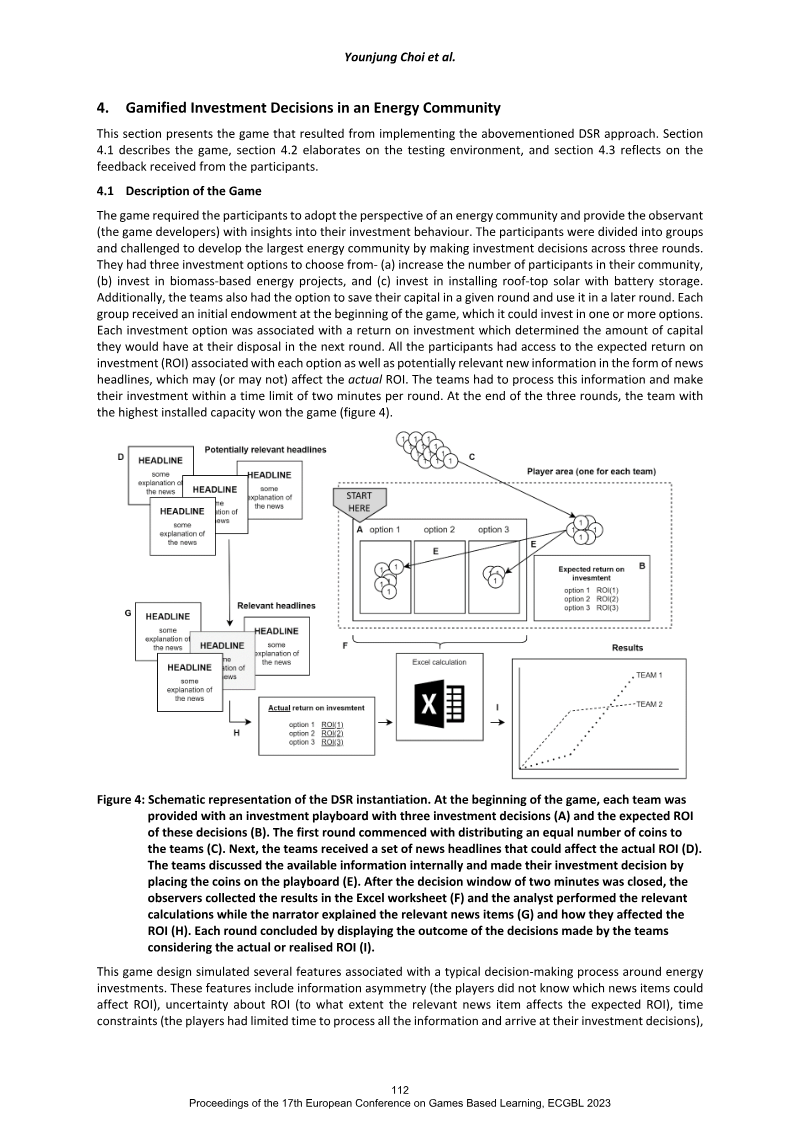
European Conference on Games Based Learning (ECGBL) · 2023



Breda University of Applied Sciences · 2026
DiGRA · 2026