1 free read left. Create a free account for unlimited reading + AI research.
Create free accountWhitepaperSerious Games Society
Distilling the key insights…
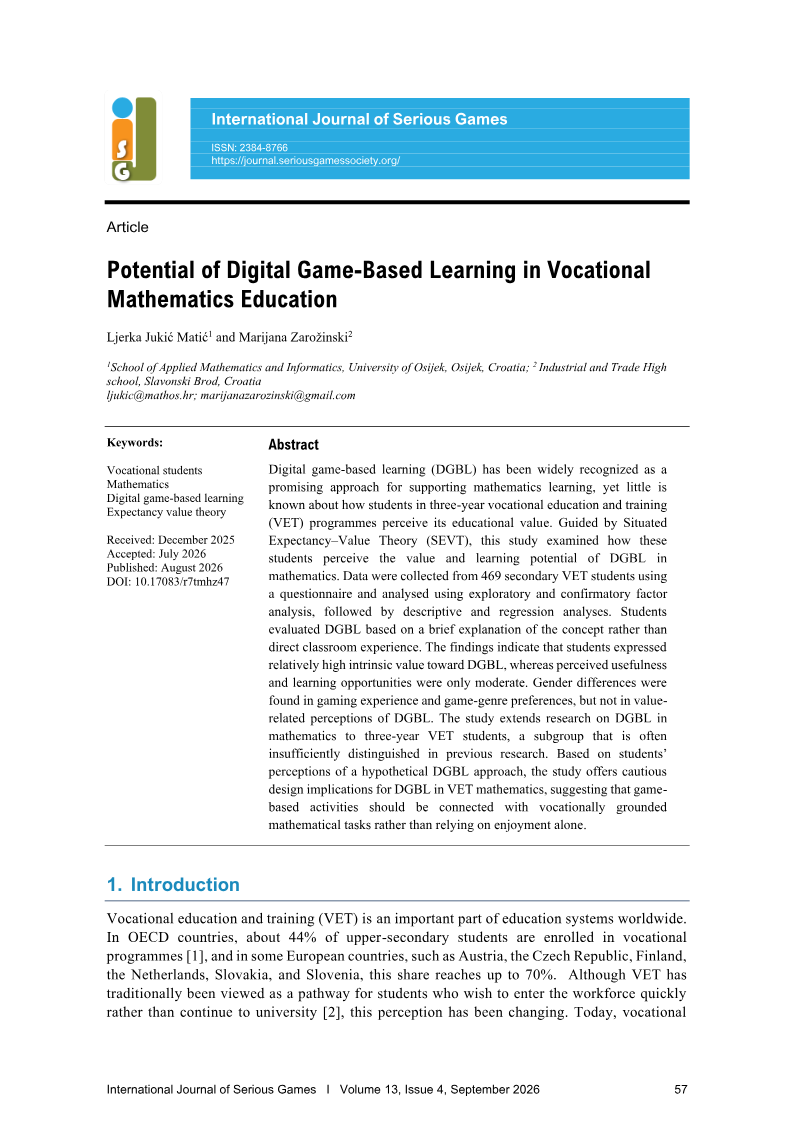
Gamification in mathematics education holds significant potential to enhance student motivation, participation, and academic focus, yet its effective implementation remains hindered by a lack of conceptual clarity among educators. Pre-service mathematics teachers frequently conflate gamification with general game-based activities, failing to distinguish between the strategic application of game design elements in non-game contexts and simple play. While these future educators recognize the capacity for gamified environments to concretize abstract mathematical concepts and foster better teacher-student interaction, they express valid concerns regarding the practicalities of classroom management, time constraints, and the risk of students prioritizing game mechanics over core instructional objectives.
The scope of this investigation centers on the professional development of eleven pre-service teachers, utilizing rigorous qualitative methodologies to assess their readiness to integrate these tools into modern curricula. The findings underscore a critical disconnect between the theoretical appeal of gamification and the practical skills required to execute it successfully. Participants emphasize that successful integration necessitates careful planning that balances competitive elements with inclusive design practices, ensuring that diverse learning needs are met without compromising academic rigor.
To bridge the gap between pedagogical theory and real-world application, teacher education programs must evolve beyond superficial introductions to gamification. There is a pressing need for formal training that emphasizes design-based projects and explicit pedagogical strategies. By providing future educators with the tools to distinguish between various game-based approaches and offering structured opportunities for practical implementation, institutions can ensure that gamification serves as a robust, long-term support for mathematical learning rather than a mere motivational novelty. Addressing these training deficiencies is essential for preparing teachers to navigate the complexities of modern, technology-enhanced classrooms effectively.
Serious Games Society · 2026
Serious Games Society · 2026
Serious Games Society · 2026
Serious Games Society · 2026
Serious Games Society · 2026



Serious Games Society · 2026
Serious Games Society · 2026
Serious Games Society · 2026
Serious Games Society · 2026
Serious Games Society · 2026
International Journal of Serious Games · 2026
Serious Games Society · 2026
European Conference on Games Based Learning (ECGBL) · 2024









Comments