1 free read left. Create a free account for unlimited reading + AI research.
Create free accountWhitepaper DiGRA
1 free read left. Create a free account for unlimited reading + AI research.
Create free accountWhitepaperDiGRA
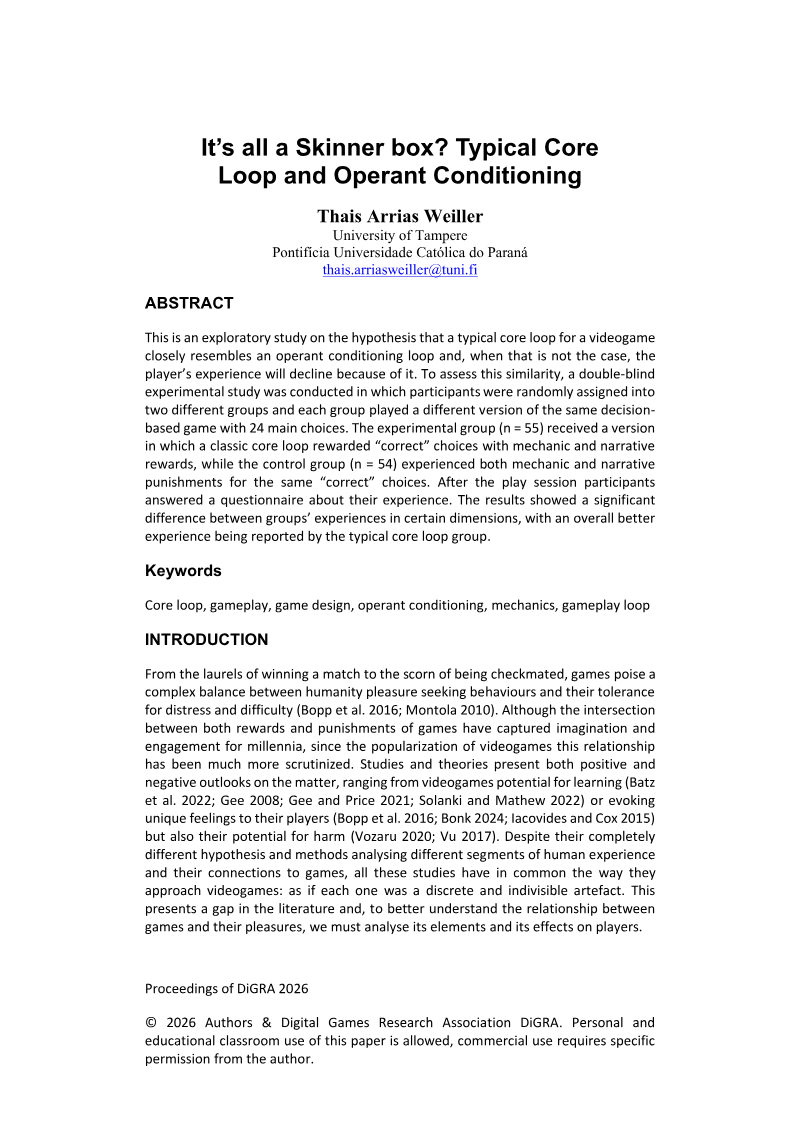
The paper argues that gamification is not inherently motivational.
This paper examines how reward-based gamification mechanisms, such as XP, streaks, leaderboards, and badges, shape intrinsic motivation, using Self-Determination Theory (SDT) as its analytical framework. Its central thesis is that gamification is not inherently motivational; its effects depend on whether specific design elements support or undermine the three basic psychological needs of competence, autonomy, and relatedness. The author positions the work as a theoretical and literature-based study situated within the DiGRA community, with a focus on educational contexts and language-learning applications such as Duolingo.
The methodology is a qualitative literature review combining empirical and theoretical sources, anchored in foundational SDT works and its sub-theories, Cognitive Evaluation Theory and Organismic Integration Theory. A central empirical anchor is a qualitative case study of Duolingo users (Mogavi et al., 2022), which analyzed more than 30,000 forum posts alongside interviews. That analysis identified patterns of "gamification misuse," in which users prioritized streak maintenance and leaderboard standing over learning, and reported loss of confidence, withdrawal, and compulsive engagement. Active and passive causes of misuse are distinguished, with passive causes including dark nudges and compulsion.
The analysis yields several preliminary findings. Feedback-oriented rewards reliably enhance perceived competence and short-term engagement, while tangible rewards perceived as controlling risk undermining intrinsic motivation. Social elements such as teams and avatars appear to support relatedness more sustainably than reward-focused mechanics. The paper also proposes design improvements, including level-appropriate leaderboard grouping, user-controlled opt-out options, and clearer explanations of how gamification differs from entertainment games. The author concludes that balancing competence feedback with autonomy-supportive and socially meaningful mechanics is essential for sustaining intrinsic motivation over time. The findings are described as preliminary, and the paper acknowledges that the empirical evidence on gamification's effects on intrinsic motivation remains inconsistent.
DiGRA · 2026
DiGRA · 2007