VideoTwo & a Half Gamers
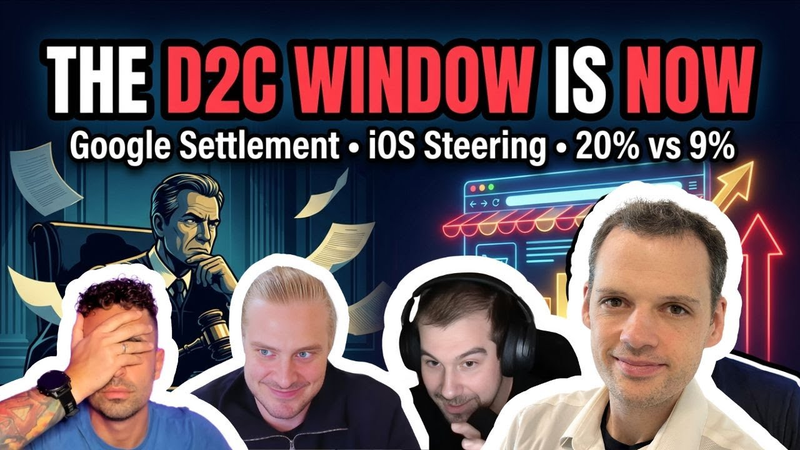
⏰ D2C is the highest ROI strategy in mobile right now & the clock is ticking! Are you ready?
8 Dec 202540 min video
He actually said like, "I'm skeptical that you are new BFFs that you're that you're coming forth holding hands and saying we agree to these terms." And so that's kind of where we are with this is that Epic and Google proposed this settlement, but the judge has said, "I want an evidentiary hearing. I want to understand how you came to this settlement and make sure that it's in the best interest of everything. [music] Golden eyes Felix with ads making those coins rise jack up designs worlds chasing the sky [music] with the two and a half gamers the midnight crew talking UA adverts and game design too mate feeling shak bringing the [music] insight we're rocking those vibes till the early day life a master eyes on the prize tracking data through the cyerspace skies feeling stacks colors like a wizard in disguise [music] jack to the highest and a half gamers talking smack slow hockey sick got your back ads are beautiful they like [music] the way click it Don't delay. Uh-huh. Uh-huh. [music]
Ah. [music] Ah. [music]
No. No. It's going to be It's going to be okay. It's going to be all right. Hello everybody. Welcome to today's episode. It's going to be interesting and very very special. or like is it super super special now or how do we rank these episodes?
Ultra special.
Ultra special. And we're going to talk about D2C again. My name is Mat Lanchic.
I'm Felix Robert.
I'm Yakubiano.
I'm Chip Thirstston.
And we are your hosts. That was very smooth. Thank you. Welcome Chip to the podcast again.
Welcome. Can you talk about like the fast spring a little bit before we start diving into different topics just?
Yeah. Yeah, of course. Well, well, first I'm I'm very honored to be a host. This is my my third time here and I'm glad I've achieved that status. So, thank you.
Exactly. [laughter] Of course.
This ultra special podcast. Yeah. Fastpring. We're a we're a merchant record payment provider in the gaming space. We've been around for 20 years now. Uh have over 3,000 customers globally. I am the head of gaming there. So, I come from game development. I left Scopi just over a year ago and I was very involved in our direct to consumer strategy there. Think about how we could migrate players from mobile to web and make the most out of that and ultimately grow that share of revenue. But also wore a number of hats across my time in gaming across live ops, user acquisition, community management, monetization, all all the fun things. So, uh, at Fastpring, I'm really focused on
just helping our customers to market and monetize direct to consumer as well as understand the latest in the rulings and regulations and championing the the cause of direct to consumer in the industry.
Nice. We're going to talk about the the epic Google settlement and also some rules like the current state. how is everything going on and and what else? If this like Google settlement can be applied to iOS and you know what are we
we as publishers doing today and fun fact I'm still in Santa recording from my house that I rented but there is an office Fast Spring in Santa Barbara I'm on the home home turf so there you go
you're much closer that's actually our headquarters that's that's the main place to be for fast
Yep. Yeah. Yeah. Exactly. Yeah,
but do you mind just starting maybe just giving a state of the affairs or state of the union just starting a bit like quickly with iOS and then just with this new settlement and what it means? What's Yeah, we'd love to get a recap.
Yeah. Yeah, absolutely. And I think it's a great place to start because the first thing I would even say about the settlement is it's not in effect yet. So, let's I've heard a lot of chatter about that and what it means and how it's changing things, but the truth is it's it's not yet in effect and we don't know when it will be. So the first thing to know is like there are different rules today than there might be in the future. So what are the rules today? Um to your point Felix on iOS we had steering unlock back in April. So April
this and specifically for the United States. So in April in the United States a federal judge made a ruling that games could steer players from the mobile game into the web store without fees and this took effect immediately. Um, and we've since seen some games experimenting with more frictionless experiences, what's called Safari View Controller, where you you pop up the browser inside the game. It's a bit more frictionless and you can link theoretically to a checkout page in that case instead of a web store. So, you have this more frictionless experience for your players. And all of this has been extremely impactful. Like that's been what six, seven months now that we've have that ruling established. And we've seen companies gradually push the envelope a little bit further to increase their DTOC share because it is such a a critical time because there can't be a fee attached to it. That's really what distinguishes this ruling from anything else going on globally right now. Now secondarily there's Android. So that
happened on iOS in April. I think what flew a little bit under the radar was on October 29th. A very similar ruling took effect on Android in the United States. That unlocks steering on Android. That's in effect today. You can steer on Android devices in the United States just as you can on iOS in the United States. And so where we've seen a lot of growth with our gaming publishers at Fastpring is publishers who were already steering on iOS and had a turnkey solution said, "Okay, great. We're going to do the same thing on Android that we were on iOS and boom, we're we're driving more revenue through our web shop that way." The ones that have been a bit more I think challenged on that respect are the ones who maybe it requires a bit more of a development effort and then they look at this epic Google settlement and the uncertainty around that which we'll we'll get to and say oh you know what like I understand the rule today because that steering is unlocked on Android but I don't know how long that will be the case. I don't know if this settlement will change that rule in the near future and so the the business case is a little more uncertain. But does it does it matter if if it's now
you mean like if actively we'll do something?
Why are people are just yeah scared?
Well, think of it. Let's say one of the most successful best practices I've seen for direct to consumer is store placement, right? So you take your store and you you showcase in there like, hey, you get 10% more value on the website, right? Or 20% more, whatever it is.
Yeah. Yeah. Well, that can require a little bit of development effort because you're actually manipulating the store, right? Moving things around. You're putting some banner in there. Maybe that's a little harder than like just launching a new offer. So, if I'm a publisher, I'm like, I got this road map. I got a lot of things I'm prioritizing on it. And I don't know if I want to invest in developing this solution if maybe in January or later like this the the terms could change. Right. So,
fair enough. But then, okay, fair enough. So I don't want I'm thinking as a as a publisher I don't want to invest resources to get more money to my pocket even for 2 months
then implement something else into the game
kind of I mean those dollars in my eyes roll quite quickly. It's like the priority should be going in this direction honestly. But I get I get the point.
No no I look I'm with you. I've been playing devil's advocate against myself in my company. Let me let me say too the other the other piece that I think gets missed today is that direct to consumer purchases are sticky, right? In terms of once I make that initial conversion as a player on a direct to consumer platform, I am much more likely to make my future purchases there because I understand that I get more value from it. I trust that it's the right place for me to make that purchase and that I will get my item inside the game if I make a purchase there. I trust them in my payment information. Like you overcome all these hurdles by just getting that initial conversion. And so if I were working at a publisher today, I'd be like, we need to drive this now because even if this this window closes in two
months, three months, whatever, like we can still harvest a lot of direct to consumer customers, create a lot of c customers over that period of time. And that will have a longer tail because they'll come back. They'll understand the web store even if we maybe can't steer them there as freely as we could. Exactly. Because then you know you kind of realize that you can go to the web shop and get more value even when the the web shop is not even like allowed anymore in the store. So I mean you create that habit already.
Yeah. Yeah. Absolutely. There's a there's a certain habituation to it that's extremely valuable that that can be done today again on both iOS and Android in the United States. Also, one big point for making this happen as soon as possible is that you can and while I'm doing it now for for one game is just getting all these web store purchases tracked, sent back to MP and actually these events even sent back to UA channels which I can optimize for web
store purchases kind of it's not real ones but at least kind of simulated ones which is not actually purchase campaign but it's targeting even higher higher value players, which means basically using a custom event optimization on the UA channel side for these p purchases, which is cheaper than a purchase campaign, but I'm targeting high value players. So, it's like in in kind of like the the UA strategy way like get on this as soon as as you can. basically even from the not overall getting more money from us but also getting more data points towards the UA channels basically
which is very important.
Yeah. I think back to the survey we ran that we we unpacked on the last podcast I recorded with you which was showing the reasons that companies have invested in direct consumer and the top reason was not profit. It was data. And so what what that actually means is like you get this wonderful unfiltered data that's
not impacted by the uh at regulations on Apple or any of that, right? So you can then leverage that data and have more sophisticated user acquisition in in addition to the fact that it's just more profitable which means more UA spend theoretically.
Yeah, exactly. Higher relative win-win.
Absolutely. Did So I think what would be helpful from here but you let me know as as an honorary host and I'm driving here today. Let me just
Exactly. take us take us into the uh Epic Google settlement.
Yes, because that's that's been talked about quite a lot.
It's a company. It's not a big settlement. It's just Epic and Google. It's not an epic settlement, but yeah, you got it. [laughter]
Pun intended.
Capital capital E. Epic
capital E. Yeah. Yeah. Yeah. Okay.
So, I think what the most interesting place to start with this is understanding how it came to be and then what's in it because Epic sued Google back in 2020, right? They started this litigation and Apple, they sued them both back in 2020. And it was with the goal of making these platforms more open
for games like Fortnite that Epic has. And over the course of those 5 years, it's been very back and forth. It culminated in April of this year, as we talked about, Steering gets unlocked on Apple and then October, it gets unlocked on Android. And then a week after it got unlocked on Android, at the very beginning of November this year, Epic and Google came forth and said, "We have settled. We agreed to these terms." and they proposed this settlement to the judge with the implication being that they would drop any litigation that this would be the end of it. The really interesting part is is that Google has said this would be our new global policy for Android. This is not just a United States policy. This is something we intend to roll out globally in response to the the the lawsuit and the litigation and everything that's happened over these last 5 years. And Epic has said we are good with this. If this gets rolled out, we will drop our litigation. This would be the end. And in response, the judge said, "Wait a minute.
I'm [laughter] a little skeptical of this." In his response, he actually said like, "I'm skeptical that you are new
BFFs that you're [laughter] that you're coming forth holding hands and saying we agree to these terms." And so that's kind of where we are with this is that Epic and Google proposed this settlement, but the judge has said, "I want an evidentiary hearing. I want to understand how you came to this settlement and make sure that it's in the best interest of everything." And that's why it hasn't actually gone into effect.
I'd watch this movie. This is the makings of a great legal drama.
This is Yeah. Oh my god. This is great.
Yeah. Yeah. It's
I'm I'm actually surprised because honestly if I mean this is not a great example, but if something like this happens in Slovakia, everybody's like, "Oh, yep. Done. Thank you very much. See you next time." Nobody would even care like
I thought that was just kind of thing you got
show thing. [laughter] It's just a shot
kind of.
I'm not lying. Like
basically performance.
Can we unpack this? Unpack this before we go into nitty-gritty. What actually is in the settlement in case like in
context of like deadlines and like was because I still
do you have a pen in hand?
No, that's like my mic from the thing
because that like it looks very serious.
No, no, no.
Can you unpack? Because the most important thing for me here is that none of these matters where sometime somewhere down the line all these changes like if judge changes his mind or whatever or something like that. Do we have any context scenarios? So what could happen and what will happen in like deadlines case like in two months this can happen three months this can happen something like that.
It's a good point. I think the timelines are uncertain right now. So the judge I think said he's looking for this hearing in December or January.
Mhm. Did he mention the year or like this year or like it's like oh
so I think there's any number of outcomes that could come from that right the judge could say okay you know what this is good enough I won't stand in the way you can roll this out and this becomes the new policy or it could require further hearings beyond that the courts move slowly
the other piece and this is me
speculating a little bit on the timeline
which we love we love speculation
just just reckless speculation here
a little bit yeah a little bit
I think the changes in this settlement, which we'll unpack, are sweeping enough that I couldn't see it rolling out overnight. Like this this ruling in April in the United States that happened earlier this year, was just we're changing the terms. Apple has to change the terms according to the court and that happens tomorrow, right? That was more of a sweeping immediate change. This one would be more Google is going to implement these changes to their policy and they need to give publishers time to react and incorporate these and maybe develop something to accommodate these changes. And that's why I think there would be a bit of a runway before we actually see anything change from the policy. So I'm cautiously optimistic that even in the like this becomes the new world order that it would still be several months before it actually changes the terms. I think it even puts like a lot of burden on Google itself because there's a lot of like
categorization and like pretty much distinction between you know when we get to the fees and stuff like between cosmetic non-cossmetic all these other things which is in my opinion like completely unfeasible going down long term but still just keeping back to the timeline context so January December the judge says something and then again
it's already of December
okay so let's say January so he says okay in January that means then what like we're looking at something like April March as for like the actual not release but like the when it goes into actual how do you say it goes into action pretty much.
Yeah. Yeah. It's possible. I mean it certainly could be sooner. It could be later. That's the part that I think we'll have to see. I think the other piece with that is that the ruling could change. Like I don't think
we we'll talk about the proposal in its current form, but it is just that it's a proposal, right? It's not the final form of the settlement. And so I think it is likely also that the rules could change. Maybe they simplify things. Maybe that's where the judge is like, "Oh, this is
too complicated." Because the reasons you mentioned like categorization and all that. Let's simplify it. And maybe a byproduct product of simplifying it is that it actually takes effect sooner and it could roll out sooner or something like that. This reminds me the the emergency episode we had about the the unions and like the the Ilkas article about how gamings are gaming is destroyed. Basically, it's like oh this is going to take for forever or could could take forever.
Yoka's letter about you destroying European gaming which could take like three years into enforcement.
Yeah. Yeah. Yeah.
It could. The other the other piece related to that is the scale of it. So like that's the timeline but also like Google has said they intend for this to be the global policy. I don't think it's that simple practice because [laughter] like each country has started calling not each country but several countries have started calling for regulations in steering right so uh even in Japan we
should talk a little bit about this but in Japan in two weeks there's the mobile software competition act which takes effect that's on December 18th and so that is positioned in a way that it will unlock steering on both iOS and Android just as it is in the United States today in addition it will unlock lock alternative app stores and it will even allow native payments meaning like inapp payments process.
We talked about it on one of our podcasts with you if you remember. So if if all that's happening December 18th and Google is saying, "Hey, we have this new policy and it's global." Well, Japan's going to be like, "That doesn't jive with our with our act here, right? Like it doesn't incorporate the full scope of that." So I think that's just like a microcosm of what I think we would see on a country bycountry basis because you've got the DMA in the EU, you've got UK calling for regulations, you've got Brazil, South Korea, like you've got all these different places that are looking at it. And so even if Google goes forward with this policy, maybe it just causes this re-evaluation where those countries may say, some might say, you know what, this is good enough. And others might say, oh, like
this still isn't and we're still going to proceed with our regulation in effect.
Ah, so now I get it. So I was looking at it. So it's uh play revenues for Google is estimated to earn them in 2025 63 billion, which is 11.4% of Google's overall revenues, right? And the profit margin in Google Play is about I think 68% according to the last reporting, right? So it's like a big chunk of profit, right? So what you're saying here is that they're getting ahead of these rulings and basically looking like the good uncle Google and that's why they're capitulating on this to look like the good guy even though they fought this for five years.
I can't speak to [laughter] their motivation.
Yeah. Yeah. No, no, but yeah, you clearly see what's going on. Exactly. because they want they want to look good like hey of course you know let's do this
hello Brazil maybe you want to use this regulation we kind of wrote with
yeah yeah and I do think there is a
certain way to respond to the momentum that's been happening globally right so it it does I think warrant that conversation then on a country bycountry basis to say like even if Google has it globally like what makes sense within each country and what we've seen is each one has a different appetite for how much they will or will not regulate Apple and Google's policies here.
But also, doesn't this kind of put pressure on Apple as well? If Google goes global, they should go global as well.
Yeah, I think
should Well, yes and no. So, in the United States at least, the courts have said they're very specifically treating Apple and Google as two different cases. So, what happens in one case will not apply to the other, but there's obviously similarities between the two, right? and and there's things they would borrow from one to apply to the other.
So, I do think there are parts of this ruling that would be appealing to Apple and that
they might consider replicating. And I think there are other parts to the ruling that might be less appealing and
and again, we could unpack those, but I think this one is like very specifically engineered to be well suited for Google and the way they uh showcased and like position their platform. it would have to be tweaked slightly to suit Apple's platform on iOS as well. And I think that the big if is if this this ruling takes effect and what it looks like in its final form when it does take effect.
So many ifs if like
Yeah.
And well, welcome to the world of gaming. likely you think Chip that we're going to see either Apple or Google at some point in the next 12 months basically go down a lot on this 30% fee on IPS to try to compete with maybe companies such as Fastpring. So that's a good segue into the ruling itself and the settlement itself because in it they are decreasing the 30% fee. So I think it's a good good place for us to to jump into that because I think the answer is yes they would look at that
but they would look at doing it in a way that they are here where they try to get a share of the direct to consumer revenue as well. So it's not like Apple 28% they decreased it by 2% or what's the how much did they decrease it by?
So it's a very complicated answer always is
as always yeah
I'm trying to think the the simplest answer would be for most games to continue transacting inside the app on Android under the current terms of this new settlement it would be 25%. So just high level stuff.
Um but we'll we'll get into how like I'm I'm getting at that number. There are big exceptions to that. Like there's a lot that goes into it. That's like at the highest level. That's kind of the ceiling again under the terms of the new settlement. That would be the ceiling for payment processing. So with that, let's talk about the settlement. And Yakub, you were alluding
to this earlier in terms of how they're structuring the the service fee, but basically what they're doing is
historically on stores, it's been 30%. That's that's the model we've all come to live by is you pay 30% of revenue to Google or to Apple for the privilege of using their platform and transacting on their platform and distributing on their platform, doing updates on their platform. Like it's just an all-in fee, 30% of revenue. Then what we've seen this year is you could drive payments off platform to someone like Fastpring and pay closer to 5%. It's wildly more profitable and you get all the data that you want. Well, under this in this settlement, Google is now breaking up that 30% fee and they're splitting it in two. So they're saying now we're going to have a payments fee for processing your payments and we're going to have a service fee for the the service of using the Android platform. The payments fee I'll start with because it's much simpler to understand which is just really the checkout experience. So very similar to what fastpring provides
right it's to to hand to process the end to payment through Google as your provider you're paying 5%. So there's just this flat 5% that you're paying to process payments there. Now the implication here is you could bring in a different partner instead. If you don't want to use Google to pay that 5%, you could bring in someone like Fastp and use them to pay the 5%. Um, would you want to if you're just handling transactions in your app, like that's another question, but that is one implication of this is that you don't necessarily need to use Google to process those payments, but if you do, 5%. Now, the service fee is the majority of the the fee here, and that's where we get into this either 20% or 9%. And the service fee is for essentially any purchase that takes place on the platform. You have to pay this fee and that's for visibility on Google Play Store. It's for updates. It's for any service of using that platform. And they've said this service fee would
apply to directly steered payments. So if I steer someone into a web store from my game, I would be accountable as a publisher to pay this service fee to Google of either 20% or 9%. And this would have a 24-hour attribution window. So steering people in and any purchase within 24 hours on that other platform would have this service fee attached to it.
How would they attribute this and how would they know?
So they've said they would release an API to track offplatform purchases for the 24 hours.
What if I don't use the API or what what if I I mean this is just ridiculous.
No, you don't want to use it in
fair questions. Yes, that's just that's that's the term here, right? Is that
Yeah. Yeah. I'm just thinking because people always try to avoid following rules and try to find loopholes. And I see one right here. Not only one, but multiple. So, come on.
Jeez.
Yeah. Yeah. I I agree. And I think the
introduction of the API is also kind of what's baked into my timeline answer earlier. is like if you're talking about developing an API on Google side, rolling that out to publishers, expecting your publishers to then put the development time to incorporate that API and actually enforce it.
It's already two years. It's already two years we're talking about. Oh, it's Google Google.
As soon as someone starts mentioning attribution windows, like I worked a lot in retargeting in the start of my career in mobile. That's usually when it starts getting murky, right? You're trying to push for a seven-day attribution window. You're like, is that really?
Yeah. Come on.
Yeah. That's not nice. Yeah.
So, so if you combine those two, right, the 20, and again, we'll get into the distinction between the 20% or 9% because I think that's the fun part of this conversation.
There you go.
But let's accept it as 20 or nine. Um, and then you apply a 5% from Google. That's how you arrive at that 25% or 14%. Right? So, if you're processing your payments there, that would be the the rate that then you're paying under
the terms of the settlement to to Google. If you're playing if you're you're transacting through your offplatform solution, well, you have a different payment provider, so you're not paying that 5%. Right? Theoretically, you might have to pay this service fee to Google, which seems pretty prohibitive, right? So, if you're paying 20% or 9% to Google plus a fee to a fastring for your your offplatform solution. So, I think that's the part that's really interesting. But the to your point it becomes okay how would I not incur this service fee? Well if I steer someone to my web store from social media that doesn't have a a service fee attached. If I steer them in from content creators from Tik Tok from Reddit like any from direct load or just from organic word of mouth in the community like all these places would still you would only pay your fastping fee in that case. You wouldn't be paying a service fee to Apple or Google. And so I think it almost would kind of take us back to early 2025, nine months ago
before these rulings in in the United States on Apple and Google where it became about how do we get players to our web store without necessarily direct steering.
Exactly.
Yeah. This is all all theoretical. If that's assuming the service fee as it currently stands takes effect and becomes enforceable and there's any number of questions you brought up about that. But even if it does it it would just kind of shift the direction that we're trying to get players to direct to consumer channels not necessarily be a a like negative headwind as much as just changing the the course of the river here.
And I already see me as a developer [clears throat] sending players to my landing page. He says, "Hey, this is not the web store, but click here. This is the web store." And you get all the all the value added there. Thank you very much. See you next time. That's it.
Acecraft is exactly what Acecraft does.
Exactly. Yeah.
Yeah.
That's like easy as that. So yeah, we did
nearly all the big games steer people to their social networks and social hubs like Discord and like everywhere else already
and then from there. Yeah.
And this is like one step away from like, you know, no API.
Yeah. and and I think that becomes more the potential path forward for direct to consumer growth. And I do think that's why these current windows are so interesting. Just circling back to where we started on this, like right now we can steer directly from mobile games into direct to consumer channels without a fee. I think that's the part that is temporary and will change in some form or fashion. Like you can't live in their house.
People don't realize that people still still don't realize like this is the the window of opportunity. I don't get it.
Can we talk a little bit about the 9% versus 20% thing?
Go for it. Do you want to Do you want to kick us off?
Why?
Because they can. Because the only reason they can come up with it because they can.
Of course, it's not because they can. There's like Let's just talk a little bit like, you know, brainstorming here. Why should gameplay affecting things should be
pretty much the fee should be higher on those? like I don't get this at all. Then you go into like, okay, so who's actually in the settlement? Oh, there's Fortnite which is run on cosmetic economy. That's that makes total sense now. Like why wouldn't you strike this kind of nice deal that is basically you because you are one of the biggest games on the platform that is running a cosmetic economy maybe except League of Legends, but League of Legends is primarily on PC and like outside of mobile. I mean like there on Wild Wild Rift client. But the other thing is that have you ever even thought about how it works in your game? Because in Epic and their whole UFM platform, you buy basically the hard currency that you do then to buy the stuff around the game. And by enabling monetization in your UFN network now with microtransactions in these other islands, which means other people can now like pretty much get the gameplay affecting items. How do you even know that they're not going to buy the play effective items through the hard currency which you cannot determine
to begin with? Oh, so what happens now? You're going to pay the 20% fee you weren't promised because honestly, how can somebody decide if like you know all the mobile games, literally nearly all the mobile games run on this like two two currency system like real world currency gets converted to hard currency and then hard currency gets converted to actually something that you actually want because we need to do that. So you lose meaning of value in the process. But then the problem is again like initial purchase for was for the hard currency not for gameplay affecting. There's numerous games that can you know you buy hard currency and with the hard currency you can buy both cosmetics and gameplay affecting items.
But the real real money comes through
wait the listener if you are lost we are lost as well.
Good.
You're not the only you are not the only one we are lost. This was five minute long question ended with an answer and now we can move on.
Yeah.
Let me let me do a reset.
Yeah.
So, so the 20% or 9%. Like how was it defined then? Like the enforcability piece is like incredibly murky and that was the the question was
impossible literally.
Yeah. So, so 20% or 90%. How will Google take this service fee and how do they intend in this settlement to apply it being 20% or 9%. What they've said is 20% will be for gameplay items that have a competitive advantage. Uh which it could include, hang on, I pulled up the legal terms here. I want to make sure I get this right. I love a lawyer. Lawyers play game designers
that impact game outcomes, gameplay progress rate, or player power, or purchases with random outcomes like loot boxes. Any of those things fall in this 20% bucket, which I think we can all agree is the vast majority of mobile revenue.
Exactly. It's like 90 95% of
like most of it.
99
even. Yeah.
So, what falls in the 9% bucket? In the 9% bucket, remove ads, APS, I guess. Yeah.
So, in the in this settlement, it says items that do not have gameplay advantages, including purchases for content, levels, events for cosmetic items. Also, inapp subscriptions for apps and inapp and linked purchases in non-game apps. I know we only care about gaming, but for non-games, it's kind of interesting. But yeah, essentially it's gameplay advantage and loot boxes all in the 20% bucket. And the 9% is just content, cosmetics, levels.
How do you define content? Yeah, literally subscription is gameplay power effecting every one of them.
That's the most arbitrary rules I've ever heard.
On paper, that's not sure, man. This is amazing.
And Fortnite's battle pass is not a subscription, by the way. It's a battle pass, which is a
subscription. It doesn't matter like define subscription. Is it recurring on
monthly basis? Yes, subscription. There you go. I don't care. It's really in that fine print and how it's going to be defined. Seriously,
I think like the judge will just cont if he has like at least like few few more people talking to him that like matter.
I mean was skeptical. So I guess
let me ask this in a different way to chip looking forward at the market with this ruling. Is there spring in your step? Is there spring or fast? [laughter]
Oh my goodness. I was on a
What happened to you? I mean, I love these jokes.
I was on a call with somebody the other day and they were positioning fast. They were like, "That's why. Fast spring is a fast spring into that region." And I was like, "Okay, that's not that's
I kind of like it. I like it. Yeah, I like it." Well,
it works. It works.
It works really well. No, I think well that's where does it how do how do I feel about the future I guess like it's just so uncertain and that's why I think it's important to
understand like the direction these are going because the the part that's more actionable to me is like Google is clearly making an effort here and to your original point Felix like they are lowering the 30% now they're not lowering it significantly they're looking at how they can do these tiered behavioral like fees based on the the behavior of the purchases in the And yeah, like we can talk about the right now. That's what it is. Yeah. Like Yeah.
But it tells you the direction they're trying to go, right? And so I think whatever the endgame is, whatever the end result is, like this is the first indicator we have of the direction that Google is trying to do where they're saying, "Okay, we'll accommodate in some areas, but we'll still preserve and defend our business in other areas."
But in the future, it's going to be whatever you make it, right? At least on your end. I mean, that's at least for short term. I mean, yeah, exactly.
That was very motivational.
Yeah, totally. Every conference I've been to, there's so many developers that basically brag now with how much D2C
percentage like earnings they have. And you didn't have that environment a year and a half ago, right? Like you're hearing people be like, "Oh yeah, we're on 40%. We're aiming to be at 50 or we're at 50. We want to go higher." So it's definitely moving in one direction. It's not towards Google or Apple, right? So yeah.
Yeah. Yeah. I think it is there's a lot of momentum and it's only increasing and so like like we mentioned earlier with Japan that's one of the biggest markets in the world and that's unlocking in a few weeks here and I think we'll see equal momentum grow in that direction and again that has native payments which is something we haven't had in the United States so far. So I think that will uh push things even even further down the road. So, I'm very optimistic about the space and continuing to drive that. But I think we also need to just be cognizant that there are these extremely heavy counterforces in Apple and Google and they're very powerful and they are they are doing what they can to push against that. And so, um, I think it'll be really interesting to see how this court case develops, how the judge responds to
this, what gets accepted, what doesn't, what the timelines look like. Those are all open questions, but it for me it starts with understanding the settlement today and like what are what are the terms of that? What are they trying to do here? And then we'll see what that actually looks like in practice down the line. This this reminds me a little bit of the the situation with COVID happened and people are like oh my god like people are home they're playing more this is going to end soon so let's not push the budgets too much because then we going to need to go back and whatever and then became like three year or whatever bubble then obviously that bursted afterwards but people who take took advantage of that bubble were in a way better place guys. Yeah. Don't wait.
Don't sleep on this.
Exactly. Like you said, like it's it can end tomorrow. Well, most probably won't, but still there's a window of opportunity. That's it.
Yeah. Yeah. Yeah. And I think the important part to know is like what would I do today as a publisher? Like I would steer on iOS and Android today in the United States. So get ready to steer
on Japan on iOS and Android in a few weeks. Uh I would go full speed ahead on those channels. And then if this ruling rolls out and does get approved at some point in 2026, um I would keep going full speed ahead on iOS. Like that wouldn't that's not going to change in the immediate future. Like that opportunity remains there.
And then I would really look at the the terms of the Google uh settlement or whatever form it takes at the end and try to understand that and adapt and um I'm sure we'll we'll talk more about it. We'll talk about on the fastpring blog. I'll be posting on LinkedIn about it. We'll we'll learn a lot more about that as it comes, but that's all uncertain. We don't know the timeline. We don't know what's going to happen there. What we do know is that to your point, mate, like this is this is the state of play as it stands today and there's a lot of opportunity in that.
Exactly.
Yeah. I mean,
thanks Chip. Yeah, it's great. That's that's amazing way how to how to put it because like that's like you you don't need to wait for for anything and just putting I I know it's resourceheavy
sometimes for some publishers but just
putting whatever in your game that can make you make more money is always a high priority. It should be.
So we're having this discussion again about the settlement basically.
Sounds like it. Yeah.
Yeah. Hopefully in in a a very very long time in the future when this is more has more finality to it.
Exactly. Because these
thanks for the rundown because as I said this yeah somebody might use the word murky but I would literally just use the word completely confusing because again settlement happens and then like h I don't like it. So what happens now? There's no deadlines, no terms, no nothing and like so what? But good to take the opportunity as Matthew said.
Yeah. I mean there's two w clear winners from this right? Developers and lawyers. So those are the two big winners on this right. So yeah
any other comments Chip uh before we wrap it up where where can people take contact you again
your email me on LinkedIn just chip thirsten there you can find us on the fastpring blog passpring.gg GG. Next big event for us will be Pocket Gamer London. So I will be traveling out there.
Oh, nice.
Going as well. Yes,
we'll see you there.
Yeah, definitely. We'll we'll have a booth. So come by, see me, talk to me about the latest in all these exciting settlements. Uh and then of course GDC after that we'll we'll be out in force in San Francisco in March.
Awesome. Thank you very much, Chip, for coming on. And the listeners, if you have any comments, questions, whatever, put it into the comment section. Join our Slack channel and see you next time. Cheers.
Byebye.
Bye.
See you.
[music]
Auto-generated captions from YouTube — names and numbers may be misheard.
Distilling the key insights…
Direct-to-consumer monetization has emerged as the most effective strategy for mobile publishers seeking to maximize return on investment in the current digital landscape. By steering players toward proprietary web stores, developers can bypass traditional platform fees and capture valuable first-party data, which is essential for optimizing user acquisition and fostering long-term player loyalty. This shift is particularly urgent as the current regulatory environment provides a temporary window of opportunity to establish independent revenue channels before platform policies become more restrictive or standardized.
The regulatory landscape remains in flux, particularly regarding Google’s proposed settlement with Epic Games. This proposal suggests a complex, tiered fee structure that would split the traditional 30% commission into a 5% payment processing fee and a variable service fee of either 9% or 20%, depending on whether the purchased items are cosmetic or gameplay-affecting. However, the implementation of these rules is hindered by judicial skepticism and potential conflicts with global regulations. Because the enforceability and precise definitions of these fees remain ambiguous, publishers are encouraged to act decisively rather than waiting for absolute legal clarity.
Ultimately, the industry is trending toward a model where publishers aggressively drive traffic from external sources, such as social media and content creators, directly to web-based storefronts. By leveraging these off-platform channels, developers can effectively circumvent platform service fees and retain a larger share of their revenue. While the long-term impact of pending settlements remains uncertain, the immediate priority for mobile developers is to build robust direct-to-consumer infrastructure now, ensuring they are positioned to maintain profitability regardless of how future platform policies evolve.

Two & a Half Gamers · 2026

Two & a Half Gamers · 2026

Two & a Half Gamers · 2026

Two & a Half Gamers · 2026

Two & a Half Gamers · 2026

Two & a Half Gamers · 2026

Two & a Half Gamers · 2026

Two & a Half Gamers · 2026

Two & a Half Gamers · 2026

Two & a Half Gamers · 2026

Two & a Half Gamers · 2026

Two & a Half Gamers · 2026

Almedia · 2026

Two & a Half Gamers · 2026
Two & a Half Gamers · 2026
Two & a Half Gamers · 2026

Two & a Half Gamers · 2026

Two & a Half Gamers · 2025
Two & a Half Gamers · 2025

Two & a Half Gamers · 2025

Deconstructor of Fun · 2025
Two & a Half Gamers · 2025
Two & a Half Gamers · 2025
Two & a Half Gamers · 2025
Comments