1 free read left. Create a free account for unlimited reading + AI research.
Create free account
Changing Business Models in the Games Industry - Plotting a Path in Interesting Times
Key insights
6 takeaways- 01Technological advancements, specifically cloud gaming and 5G, are driving a convergence of mobile and console experiences that necessitates a shift toward platform-agnostic design philosophies.
- 02The industry is polarizing into two distinct tiers: low-budget projects and high-end, multi-million dollar co-development opportunities, with market consolidation increasing the difficulty of securing high-level partnerships.
- 03Subscription services like Apple Arcade and Google Play Pass are shifting mobile monetization toward models that mirror the ARPU metrics of streaming services like Netflix rather than traditional free-to-play structures.
- 04The rise of high-fidelity, premium titles ported from PC and console is intensifying competition for independent mobile developers, forcing a re-evaluation of traditional studio team structures and design priorities.
- 05Independent developers must choose between deep specialization in free-to-play mobile expertise or a strategic pivot toward premium, cross-platform, and subscription-ready content to ensure long-term viability.
- 06Studios face significant operational friction when attempting to simultaneously manage premium console development and live-service mobile operations, often leading to diluted focus and resource allocation failures.
Ask AI about this video
Transcript
[Music] hi good morning thanks for stopping by early really appreciate it I'm gonna use to my curse there's a couple more people and the room is slightly bigger do we have do I need to start this okay I can't see the monitor so I'm just gonna pivot between you guys and the screen so I was asked to switch to this scream stream which is big screen gaming which is actually not what we used to do but it's a fit because we're doing it now and what that means and why and how that happened now we have there I'm gonna explain you in the next 15 minutes and hopefully there's something there that you find interesting magic moments paladin is a
studio of about 60 people we've been around since 14 years we're now scratching on 60 as I said we're fully self-funded never got a single dollar of investment in organically grown we're exclusively developing on unity a we have our own proprietary back end tech which we use for synchronous multiplayer games on mobile as well 360 odd pipeline we're basically doing everything in-house accept sound and music that we outsource for the last about 10 years we were doing mobile and about six years were mobile free-to-play mobile first I would say because some of our own IP is actually out there one title called Momonga is actually I think
on everything except microwaves and fridges including Wii and Xbox and all kinds of fun stuff on that we don't do ourself though we licensed it out and it's not making us rich but it's fun we're usually on the prime business model for the studio until now is development so we work with publishers on some of the really cool partners we've been lucky and honored to work with Bandai on Kongregate app store key Lu spill plugin digital and the list goes on and that's what we did and that's what we do so I want to talk very briefly because we don't have a lot of time about some of the trends that we as a mobile / console pc studio or suing are seeing in the market and I'm just going to throw those out there and we
can talk about it afterwards there's obviously a lot more beyond the list that you see there so one of the things that we're seeing that we're having a close eye on is cross-platform play X clouds from Microsoft on there's fortnight which is also on everything I think they are on microwaves by now probably 5g big words big thing I honestly don't know too much about it at this point what it means but it is something that we're watching it will increase fidelity on the streaming site cheaper devices that's one thing that might happen on the actual OMS focusing on content because they now have a platform to do that much easier crypto games I know that's that's also very big word but there's something there that's extremely interesting one of my friends is in that business now in Canada and it
is quite mind-blowing what you can do there it's not something that we do right now at the moment but we're watching it we actually got requests in a request in for something to work on in that space as a work-for-hire on a blockchain based game more big PC games coming to mobile on Diablo call of duty that's with real good quality full-blown experience transported onto mobile and now it actually looks good and it plays reasonably well um that is something that's a little bit scary for the smaller independent studios because you're going up against call of duty Wow if you want to make a shooter on mobile right now I think that's a scary thought they are games and I specifically didn't mention VR because I don't believe in it
yet personally aaaahhhhhh is a cool thing though and there's a handful of concepts and a handful of games out there in the market already that utilize that you know I'm personally a big fan of Jurassic world a life that's that a or component is super fun to play with my nieces and nephews so there's something there as technology develops that should be watched on any other thing more on the business side that we are seeing is that the deal sizes are going up on the upper end and going down on the lower end so you know typically the last two three years ago the average average deal maybe it was around half a million maybe a little bit cheaper maybe a little bit more but that was a good mark for like an independent co-development to shoot for that's changing quite a lot there's a bunch of stuff on the very low end 54 a
development in there and there's a quite a bit of space up there that goes way beyond 2 million at the moment um that's something we're seeing and that's that's new in essence it's not getting even easier even now we've been growing about 50 percent year-on-year over the last three four years were 60 people now that does not make it easier if you have to manage on a cash flow basis and you are independent on that certainly is is a challenge code development at that higher levels of projects is getting a lot more competitive that's one of the things that we've been seeing over the last year if you want to get one of these big projects it is not getting easier on the partly because there's been a ton of an M&A activity on a lot of deepika publishers and organizations grabbed some of the
studios you know anywhere between the twenty to forty fifty people sighs that has an impact on what's out there in terms of code F opportunities and one thing that we really realized also partly by running our own life ups now with our game called storm bound who here heard about storm and you all got to check it out in the App Store it's awesome it's a synchronous multiplayer game caught battler very very cool so we're running this since about the beginning of this year on our own again we co-developed it was congregate and now we're trying to figure out how to really do live ups on our own one thing we all realized is that even at our size on doing that is extremely challenging and the amount of resources it takes not just money but also people in structure and organization it's really challenging
to pull off yourself so and I do believe that is if you want to play in the big leagues and especially if your aspiration is to create a hit title in mobile free-to-play you need a partner unless you have a lot of money lying around somewhere how about this new stuff everybody talks about it since quite a while on stadia arcade on these subscription services we now have pricing which is awesome I think that's cool I'm already signed up for both of them why not on five bucks a months that's really an impulse purchase which is great but what about this like what does this mean for somebody like us as a developer any studio so what I wanted to figure out is what does a subscription business mean right because it's so it's a great word um it's nice to say but what does it
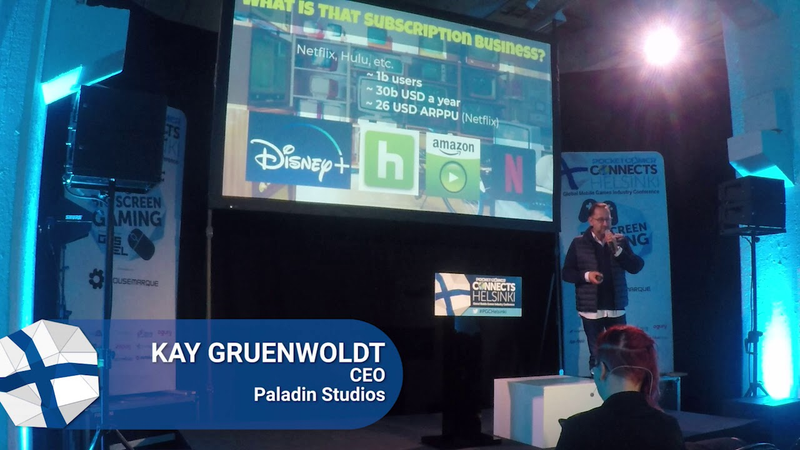
mean well let's look at some of the stuff that's already out there so we got Disney Plus just signed up for that because it was a month's free yay I'm a binge watch star watch Star Wars and everything around it and I'm might actually keep it it's priced really well hulu amazon netflix all the pundits that have been around since quite a while what are they doing well they have about a billion users which is not too bad they're making about thirty billion dollars a year that's actually less and also more than I expected before I started looking into it if you compare it to what our industry is doing which we're going to do in a second there's some interesting parallels there and that is something I was very surprised off on they have about $26 or poo on Netflix does how does this work well I guess somebody
signs up somebody cancels so that's the average that a paying user generates for them how does this compare well if you look at the games industry the the gaming networks that's actually in the definition of statistic that I pulled here that is subscriptions so that is a smaller part of the business right now I'm gonna activate the laser because I can it's not the laser that's yes so we're looking at 2019 Mobil does about a billion dollars download games which is you know the steams and the other PC stuff and console stuff on a little bit more than that we got online games about 700 and we got the subscription the network's was about 80 what I don't know and I'm trying to figure out is if that
number here for mobile actually includes these subscriptions and VIP plans and all these business models that are actually reoccurring revenue already in it which I think it does and it doesn't put it in here if that's the case on that number should really change and this one should too if we roll it into that because with on these two major services offering subscriptions I do believe that's something that will change these numbers right so that's that's that um in terms of the the users on you know there's obviously a lot more that there was games than streaming TV in this case but it's interesting to see that mobile is about right there where the streaming services are in terms of users if you're looking at the revenue of thirty billion that obviously pales compared to what you guys do or what we do I'm not saying that we're making
fifty billion was paladin but hate that'd be nice so the mobile industry is nearly twice of what what these services do at the moment and it's still growing quite nicely on I think anything that goes five years out is a very hot guest to make but um I'm sure we can be pretty confident that next year is going to be seeing and grows in this industry as well but if you look at that that um you know the download games and the online games together that's about the size of what Netflix and Co are doing so it's a nice chunk of the market looking at the ARPU is actually a little even more interesting and if you see that again we have the subscription here that layer on Xbox Live and PlayStation and Nintendo the oppo is actually fairly similar to what Netflix is doing now what I'm
wondering is is the actual proof for the game subscription services on mobile gonna top that because if you just look at mobile that's obviously a lot higher nearly twice that but it's going down so if we look at this in like two years or so I think we're gonna either have a very positive or some kind of surprise on for sure yeah how could this grow on Netflix is really happy I think was what they're doing I'm not sure what kind of profit are turning but obviously their revenue about quadrupled in since 2012 on there at about five billion right now per quarter which is massive I think that's a really good business so this whole idea of subscription doesn't seem like a bad one to me and I get why Apple and Google are looking into it
right makes sense on what does this mean though for us well on one way to answer that question is um try making premium content right instead of free-to-play subscription requires a different type of content on you not you're not so much focused on just the science of it the numbers the algorithms and the actual monetization scheme that you need to have if you do free-to-play but I think there's a different focus on these games so luckily or interestingly we had the opportunity about two years ago to start thinking about and start on developing a premium console game that's um that's
interesting because that's not who we are so we were very grateful to have that opportunity on I mean if you guys so who's a mobile developer mobile studio here that's very little but usually if you talk to people in the mobile industry there is an aspiration of making bigger stuff there's some big mobile games out there that you know make billions and have hundreds of millions of users but I think in a lot of developers games developers the aspiration is to do something that is on a big screen and we've seen that too so there was a lot of he has more and it was really interesting to see and we said okay you know there was lots of stuff going on let's give this a try when we started this on subscription mobile was not really a thing there was rumors about it but nothing concrete that we know now is
going to happen that's this experience over the last two years not a walk in the park if your mobile developer you two guys and you think about doing this it's not easy there is a big big difference between developing free-to-play and developing a premium game for a console or PC I personally do think that there's a lot more focus on level design as just picking one element out of it I know that our team right now it's about 30 people 32 people on the console game and I do believe we have stopped counting six or seven level designers that's nuts that's about seven times more than or five times more that we had on any of the previous mobile games which you know we're not huge but also not very small and some of them were focused on the
actual level design like aleca are very interesting there are more iterations in general there's the bigger team that's one of the big findings the bigger team did not scale from our previous set up we've been working in these small cells that have all functions of developments are integrated and we thought okay let's just throw a couple more people on that for level design for you know programming didn't work we basically learned a very hard lesson that we broke up the project into different teams again and now have an overhead structure above that that manages on a project level very different set up and working with publishing partners are really affected the way we plan and work and a lot of other things if you're interested on talk to me afterwards or or get in touch there's been some interesting learnings on that one but the benefits are that we're working on a
premium game I do believe there's transferable design and production skills applying to subscription-based games on which is which is very interesting we're very happy about that and that is something for you know any kind of studio at any kind of stage we know now know going through this process how we need to scale up further from here if you choose to do it right where does the path lead us in 2020 there's basically two main opportunities to explore one of them is free-to-play mobile we're going to stick with this at least for a while because we do have some interesting opportunities there as a studio it's what we do since about 10 years so we shouldn't just ditch it but we're really looking at this premium cross-platform track as well and try to figure out if that is the way for us to
go as a studio as a team as a business as well I do believe there's some really cool opportunities in both areas but we want to take some time to figure it out one more learning though and that is really really important that is something that has been building in peloton over the years as we typically run three to four projects at any given time we are at the size now where we truly believe that we have to make a choice it is already very tricky having a console team and a bunch of mobile free-to-play teams on different sides of the studio there's a magnet effect on that is drawing people to you know whatever is the coolest at the moment and that is very very hard to manage but that's not the only reason it's also the business side of things the business model trying to figure out how to run two completely different things at the
same time is a huge challenge and I strongly believe info that is required to actually get the success that we want so I think in 2020 by the end of it we're gonna have to make a decision of where we gonna go interesting times um yeah I think I'm I'm at zero so thank you very much for listening to my ramblings on please come up to me afterwards I'm gonna be around the next two days if you have any questions and want to know more of what the pitfalls are of making this type of content yeah thank you so much questions any questions no questions you sure alright okay good anyway question there
is a question yeah um good question so I have to be honest and say I don't know the reason for that is that a lot of times the free-to-play developments that we did over the last years we did miss big partners that had a lot of that stuff covered on there and so we were taking our baby steps and running this ourselves with the live game that we basically took over fully there is a ton of really really good solutions services out there I don't want to point a single one out because I I can't do that at this point in time but one of the things that we're
doing right now is putting a lot of research into this because we're actually looking at designing a high Pooh free-to-play mobile game based on some of the stuff we did it takes a bunch of time and it's a full-time job so I would say the best advice I can give get somebody to deal with it just that yeah you're welcome anything else all right back to Netflix I guess so you're here to see our honors project but I guess I can tell the town now so the time is and oh my god so basically I'll just tell you right now so what's gonna happen is what is amazing is that and of course like we can't sell any of that usually but now that you here is great I haven't been able to tell anyone dissolve like super excited I don't suppose they even tell you about their it's gonna be absolutely amazing let's get you on board
you [Music]
Summary
The games industry is currently navigating a period of significant structural change, characterized by the rise of subscription-based models, cross-platform play, and the convergence of mobile and console experiences. Independent developers face a complex landscape where traditional free-to-play mobile development increasingly competes with high-fidelity, premium titles ported from PC and console. This shift necessitates a strategic re-evaluation of studio operations, as the resources, team structures, and design philosophies required for premium, subscription-ready content differ substantially from those needed for mobile-first, free-to-play titles.
Key industry trends include the emergence of cloud gaming, the potential impact of 5G on streaming fidelity, and the growing influence of subscription services like Apple Arcade and Google Play Pass. While mobile gaming revenue remains robust, the introduction of subscription models is expected to alter average revenue per user (ARPU) metrics, potentially aligning them more closely with established streaming services like Netflix. For independent studios, this environment presents a dual challenge: deal sizes are polarizing between low-budget projects and high-end, multi-million dollar co-development opportunities, while market consolidation through mergers and acquisitions has increased competition for high-level partnerships.
Operational findings suggest that scaling a studio to manage both premium console development and live-service mobile operations is exceptionally difficult. Internal organizational structures often struggle to support these divergent business models simultaneously, leading to challenges in resource allocation and project management. For developers, success in this evolving market requires either deep specialization in one model or a strategic commitment to a single path, as attempting to balance multiple, distinct business models can dilute focus and hinder long-term growth. Ultimately, the industry is moving toward a future where content quality and platform-agnostic experiences are paramount, forcing studios to decide whether to double down on established free-to-play expertise or pivot toward the premium, cross-platform subscription market.


















Comments