1 free read left. Create a free account for unlimited reading + AI research.
Create free account
Balance Your Game’s Monetisation Mix for Greater Retention
Key insights
6 takeaways- 01Diversified monetization strategies are driving a 17% year-over-year growth in industry revenue.
- 02Incorporating opt-in rewarded video allows developers to monetize the remaining 95% of non-paying users without cannibalizing existing IAP revenue.
- 03A hybrid monetization model combining in-app purchases (IAP) and in-app advertising is necessary because only approximately 5% of a typical player base engages with direct sales.
- 04Developers should utilize rigorous A/B testing to optimize ad placements according to specific game mechanics to maximize average revenue per daily active user and lifetime value.
- 05Major publishers including Activision Blizzard and Product Madness have demonstrated that thoughtful rewarded video integration does not negatively impact player experience.
- 06Strategic use of rewarded video can increase session times and provide players with meaningful progress, supporting growth across casual, mid-core, and hardcore genres.
Ask AI about this video
Transcript
we've been talking about all of the options with monetization we've seen how you can design in-game ad placements we've talked about how you can work with communities and brands all again to get more mileage out of what you have and that's what our next discussion is also about i'm excited that we'll be hearing um how to balance your games monetization mix for greater retention because that's what it's all about it's one thing to get people in it's another to keep them there that's really the prize and that's why we have two people here speaking from facebook audience network we have antoni emanuel roberto ribeiro sorry publisher uh development manager at facebook audience network welcome antonio and and we also have with you we have youth yes so we're both here because of the background screen it's a
bit funny we're going to try it because otherwise utility is only partially visible okay but we're not going to be on screen at the same time so that's fine we're going to do this all right we're going to figure it out i'll let you and utah take it away thank you thank you very much right so um thank you everyone for first of all taking the time and and joining us today for for this session i hope everyone is well and is enjoying pgc so far and so in this session as a little bit as peggy was saying we're really going to try and give you a little bit more information about how to balance your monetization mix and include in-app ads and in-app purchases in your game so we do know that finding the right combination can be quite challenging and obviously there's not a one solution fits all and depends on various factors related to your game but hopefully after today and after this session you we will provide you with a few more insights um on how to achieve
this so but first just a quick intro my name is antonio rivero i am a strategic partner manager for the facebook audience network team in emea and also with me here today she's not visible at the moment but she's here she's going to join us is my colleague utida and she's going to lead the last section of the session today right so today we really want to explore and dive do a bit of a deep dive in these four main questions why should we consider a mix of in-app advertising and in-app purchases how to estimate the the potential advertising revenue in your game what results are publishers and some of facebook audience network partners around the world seeing in different types of games after integrating ads and lastly but also very important how can facebook audience network help you a developer or a game studio in
integrated ads and in this journey so let's maybe take a step back and start on why it's important to balance your monetization mix so there's a lot of evidence showing that gamer publishers to the game publishers today are driving higher retention and profitability when they achieve the right combination of iap and iaa in app ads in their games we know that a balance in game economy is a crucial aspect that takes time takes effort but when done successfully can have a major positive impact in your business and without detracting from the the player experience so you keep your players happy and engaged as we all believe they should be if you only target the small percentage of the population of of your players and users that that accounts for the uh a very small percentage of your total users the ones that are engaging in mobile gaming sales
so you are missing out on incremental revenue so if so far you've leaned in and done exclusively in-app purchases to reach your current phase of growth perhaps it's time to considering exploring in in app ads and on the other hand if you've been relying just on ads in the ad monetization model perhaps it's time to consider in-app purchases as well as we believe that the combination of the two is the best solution uh for for every game so um even after all the headlines and the changes of the past year what is the current state of the industry so according to the idc which is the international data corporation mobile gaming advertising revenue paid to publishers and developers is still growing at a very healthy expansion rate of over 17 growth year-over-year and even considering the ios changes in 2021 which we've all kind of obsessed over
about over the past year or two years even but even with all that the idc still predicts that worldwide mobile in-game revenue for publishers to hit almost 44 billion in 2022 versus the 32 billion achieved in 2020. and so the industry is healthy and growing we know that but in terms of ads which is what we're discussing here today we also know that and there's plenty of research that has shown that players are increasingly increasingly more receptive to in-game ads we know that in perhaps the hyper-casual casual and the social casino game players have been traditionally more exposed to ads so even in the early days it was always a more common form of monetization in those types of games but i think what's really interesting and kind of really moving uh the industry forward is that due to the the rise of
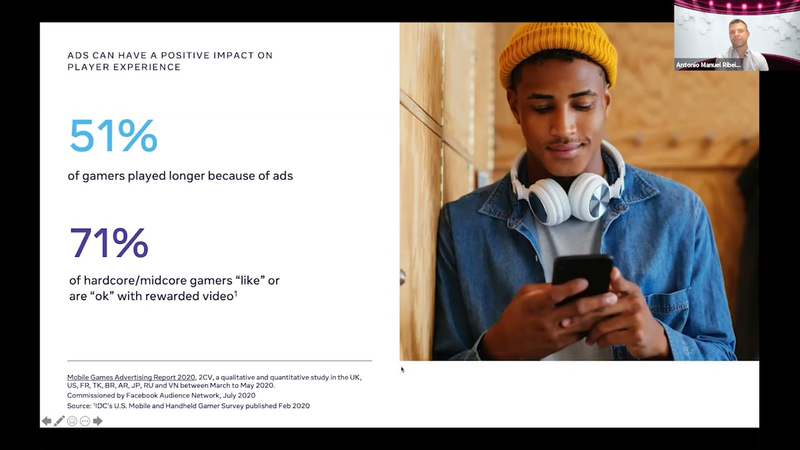
in particular opt-in formats such as rewarded video which is the the best example uh player perception towards ads is more favorable than ever and we're starting to see now uh several hardcore and mid-core mobile games actively uh adopting this ad format with great success not only in terms of revenue but also in terms of player satisfaction and data shows this so we know that according to another study from the the idc that over 70 percent of let's call them hardcore gamers i don't like that term but it is what it is but yeah they are either like or at least are receptive or don't have a negative perception to the rewarded video ad experience because it's opt-in if they enjoy it they can engage with it if they don't they can simply ignore it and play the game in without engaging with it and so all this to say that in reality when that integrations are done well and this
is a big caveat because we have all seen that integrations that unfortunately are not done well but when they're done well and well planned and players do recognize this and we know that this can lead to a very positive and in some cases even enjoyable experience uh within the game and so having said all this it all sounds very great great and easy but we do understand that the uh the process of implementing ads in a game especially for the first time uh can be quite daunting and you are likely and your the studios and everyone in the team are likely to have several concerns and one of the most frequent questions we get is will have will ads have a negative impact on player retention and of course there's no universal answer to this it may have but test data suggests that it in again when done well it does not it does not have an impact on player retention so there was a study
from apani that showed that an increase in the number of daily active users and an increasing also the session times in the three months after games installed in that sdk so in short the player time increased in games after integrating ads further we also see that these results even though there was a you know bit of a variance between um countries and regions overall the type the increase in time spent was seen across all countries across the globe after the three months and as you can see on the the chart here in the kind of the lighter blue which i think to me is even more significant the biggest increase seen in total time spent was actually seen three months after the sdk installation which to me means that the change that we saw after the first month was long-term and sustainable so it wasn't just like a short-term effect but actually the time
spent actually increased after three months and so that was about time spent but what about probably the second most popular question which is what about retention will ads impact retention again it may have but most likely no we if we look at this that same study from app annie we find that worldwide mobile games saw higher monthly active users and downloads after a nat sdk install so in this study i think one of the most interesting findings shows that mobile games that installed their first ad sdk in 2019 actually increased their numbers in in monthly active users and downloads compared to the pre-installed period and again there are some regional kind of variances but we do see this trend of increase across different countries and regions
so time spent retention and now everyone likes money so will ads actually lead to incremental revenue or is just or actually won't make much of a difference so we know that a lot of publishers and these are some of our partners working with audience network but they're seeing link like great success with hybrid monetization models because they see it as a way to diversify their revenue streams and earn incremental revenue so i think most of us know that um iep's centers are very around a very small percentage of players so there's obviously the varies from game to game but most studies reveal that on average fewer than five percent of players actually engage in in-app purchases and so what this means uh if this is if your your game is similar to this is that there's a huge pool of players
let's say if it's five percent uh engaging with ip but 90 95 percent that in a sense are not being monetized so and it's this pool of 1990 percent that really translates to the uh what we call the incremental revenue opportunity that can really complement your current um iep strategy and so to kind of as a going halfway through the session i wanted just to recap uh what are we think are the four main benefits of adopting a hybrid monetization model so we just spoke about it first of all diversify your revenue streams if you depend on about only five even ten percent of your users to generate 100 of your revenue because they are the ones that engage in iep that can be a risky proposition so with iaea it does help you diversify your risk and especially in countries where players
typically don't engage with iap time spent so we've also seen that evidence that add integrating ads into your game can also lead to an increase in time spent uh in your game and longer play sessions the revenue opportunity so if we've covered there's a if if the ads integration is well planned you can definitely avoid and plan to avoid iep kind of cannibalization meaning that in-app ads revenue is incremental to your current revenue and then enhancing the player experience i think a lot of people forget about this because oh it's ads but there's a lot of research that shows that in a particular rewarded video that it can actually in many cases it can even improve the player experience it can give you know your players access to new features or products that otherwise they would never uh be able to use or even kind of help them overcome
difficult or even more frustrating sessions uh sections of the game and be able to progress and continue playing the game so definitely there is evidence of of this as well and so we talked a little bit about the incremental ad revenue but how do you go about calculating you know you have your game is live where do you start and how much money could i potentially make from ads so obviously this is an estimate and it's but this is the model we use and um this is what and kind of some of the metrics that we think when estimating average revenue uh from ads in the game so we look at metrics such as the number of daily active users the ad frequency that you're planning to integrate and also other factors with the expected ad engagement rate and then cpm values which you can use and find and there's certainly a lot of information available of benchmarks and typical values from
cpms for different net formats and even per country and region so to to kind of help you define this a little bit what does it what would it look like in practical terms so the first metric we recommend looking at is how many unique players you have per day so how many unique players actually open the game on average each day and then starting with this number you multiply this by both the number of that the number of ads per day that a player can have access to so let's say in my case here um it's rewarded video and i choose three ads per day maximum and also the expected ad engagement rate which in the case of rewarded video translates into the uh if you think about it the percentage of players that will actually opt in to watch the rewarded video which in my case i am saying it's about 30 percent and so with this resulting value you can
then multiply the cpm benchmarks for that of ad format let's say i'm using a global average in this case uh 20 but what you can actually do is take this same analysis and do it by country or region so you have the number of unique users in that country or region and then use the the the cpms or the average cpms that historically are seen in those countries to give you more accurate but to simplify we did it globally and in this in this particular case with all the values that you can see on screen it would turn out to be a potential ad revenue daily of eighteen thousand dollars so which is not bad um but and then we can assume this is a start and then from there you grow but as an estimate we think this is a um we'll put a smile on your face when you finish some of these numbers hopefully so with that revenue estimation out of the
way and to help you estimate the value of in-app ad revenue then we need to talk a little bit and spend a little bit of time talking about how to determine the right monetization mix and strategy for your games so as with most things in life there is another one glove fits all model that we say oh do this and work for all games but instead what we really recommend is think about your monetization strategy as results of the type of your type of game and also the player experience that your game provides so you can see some examples here on the screen uh for casual hardcore and social casinos and some of the recommendations we make but yeah as you can see we would not recommend the same match strategy and integration of ads and even formats say for a hyper casual game which we know may entail shorter quick bursts of gameplay versus a hardcore game or mid core where players spend more
time typically longer play sessions so in this case we would actually recommend just the opt-in format which is rewarded video and while revenue is obviously a top of mind for everyone it's not always everything so we also want to ensure that whatever you do that you do see the results like we discussed in the beginning of increasing player retention and improve lifetime value so here are some examples of metrics and success stories from some of our partners that worked with us not only to implement this but also on different case studies and you can see here you know official numbers from a variety of publishers such as activision blizzard or product madness that there is evidence that there is an overall increase in sessions and time spent in the game and ltv when adopting a hybrid ads plus iap mix and we're going to spend a little
bit of time uh just covering some of these success stories so we're going to start with an example of casual and hyper casual highlighting a case study with a publisher called sundatas which is a japanese-based casual games developer so for those of you not familiar as i said they're a japanese gaming company and publish a variety of original and licensed games but focusing mostly on the sort of the casual experience and here you can see a quote from one of their business directors stating the great result that integrating ads did help them increase their arp tau the average revenue per day daily active user by 25 but it wasn't that easy to get there there's a story behind it so for a very long time uh sunday toss relied only on in-app purchases and i'm sure that you know this will resonate and it's familiar to some of you they faced the monetization team one into integrated ads faced
very strong internal resistance from other teams to integrating ads and so how did they go about this at the time they were operating 15 games and the main concerns from the developer team were that players would see ads and for other games and go and migrate to those games and not come back to the the the sunday toss game and also that by giving out free items via rewarded video it would have an impact and decrease the sales in-app purchases and so the process what they decided to do was to choose one game i think they chose one of their smaller games and integrated rewarded video ad units into one game to test and prove results so during the test they monitored closely very closely user retention impact on revenue and if indeed users were dropping off after seeing the ads or no they were staying in the game and what they saw surprised some of the team members some of the more kind of um
reluctant ones because they did see an increase in play sessions and they did start seeing the added revenue from from ads and so after seeing in this test example a 25 increase in arc tau and a 22 percent increase in retention they decided to integrate ads uh into all the other games in their portfolio so definitely a success story and now we're going to look at one of the publisher that most of you are likely familiar with uh activision blizzard and provide a little bit more details on their journey from ix very successful iep exclusive games to hybrid monetization um in titles such as candy crush saga call of duty mobile and the fairly recent crash bandicoot game and this one just a bit is a bit uh close to my hearts because um activision blizzard is actually my client i've been working with them uh for over four years now from the very start of this journey of
like let's integrate the ad sdk towards where we are now in the mixed monetization and this is an example of a a publisher with a set of games that historically relied only on iap and they wanted to there was a desire to monetize the pool of players that were not engaging with iap but crucially for them and this was completely out of the question any negative impacts on iap revenue or additive or any negative player impact on the player experience wouldn't simply not be acceptable and so they partnered with us and in short we tested tested tested that's how i can summarize we tested different ad formats we tested different placements and rewards different user segments different types of integrations and all along with these tests we had a set of we're tracking we're monitoring we're analyzing all the key metrics and results and if at any stage they were these results were satisfactory we would
move on to the next tale next stage and scale scale scale and so the result after uh all these years is that they now have a very robust ad monetization integration they use rewarded video that lives alongside their ip activity and crucially for activision and some of the studios like king the overall reaction and engagement of their players with reward video is shown to be quite positive they did a lot of their own research and have strong results that it does not detract from the the game experience and finally we'll look at product madness which is an example of how a social casino game also can find the right monetization mix for this kind of very specific vertical so product madness is a london-based social casino developer which again the familiar story always relied on ib purchases as their exclusive revenue stream for their
titles but again there's also that desire we want to explore ads monetization but some voices within the company were again saying will ads disrupt our already established iep player base so similar to the some of the other stories they decided to take one of their titles implement rewarded video at certain points in the game where they had data that players were were getting stuck or even frustrated and stopped playing the game so with rewarded video suddenly players have a choice to whether to engage or not engage with the ad but if they did engage with rewarded video and they chose to watch the ad they were awarded with initial coins that would keep them um playing by by giving them access to more slot spins and so as a result of the testing in one of their games 555 gold they saw very good results and they implemented they decided to implement ads across their other games and some of the key results um it was
they saw 120 increase in artow in the game of heart of vegas an increase of 7 percent in overall slot spins in their game cashman casino and overall across their portfolio where they integrated the ads a two percent lift in user retention so i hope this was all useful now i'm going you're finally going to meet my colleague uh youtube i'm going to do a kind of smooth transition who's going to take you through the the next stages of the presentation thank you thank you antonio i was just wondering because i was uh watching on social media some requests to go back a couple screens if you wouldn't mind let me go back to the uh yes i know this is i'm sorry i'm sorry this is we give people what they want it's right after you have your estimate potential daily ad revenue that this yeah that table and then you have like a little bit of a cheat sheet around what fits with each different
genre yeah that's a popular one so i'm actually i'm actually gonna capture it myself now and share it on social media um apparently a really uh popular one and uh this is based on your research and experience is that correct that's correct yes and excellent just as an fyi youtube is going to share later um a qr code that takes you to some of these studies so obviously this is a very nice summary but there will be uh access to kind of yeah all the studies and you have this information excellent much more uh later so yeah we love goodie bags at the end well thank you antonio no worries we're gonna fast forward to where we were exactly thank you another type of smooth transition so it's all this and this oh there we are this is it yes once again goodbye and perfect is it all good now okay so thanks antonio hi everyone um okay so at this
point of the presentation you should be understanding how a well-balanced monetization mix of in-app advertising and in-app purchases will benefit your business so let's dig in how facebook can help reach your goal so facebook audience network is a net network that's designed with the experience in mind first we understand that user experience is key for the success of the game and by putting the player first we are building positive ad experience with high value-add formats then it is clear that you need a partner that can match with your audience while generating great performances here at facebook we benefit from our strong pool of advertisers who are bringing diverse demands not only gaming and we have a global reach now you also want to be as efficient as possible when it comes to monetization and by being 100 a 100 percent building and network facebook helps you maximize yield with minimum resources lastly we also share a lot of values with developers as we own several apps
such as facebook and instagram so we understand the importance to invest in security and privacy and ensure compliance with all initiatives we also want to make sure that publisher has access to tool for safety such as block lists when you bring all that together you have an ecosystem where everyone gets to win your player have a seamless ad experience with quality ads which offer user users a variety of brand safety control you as an advertiser you can reach your target audience and meet your objectives then our diversified demands the increased competition on our platform which means better return for you as a publisher so we balance the needs of people advertisers and publishers we offer the two most uh important and successful format for gaming so first rewarded video which offers players to watch a short video in exchange of a certain value so most of the time extra lives are free coins
interstitial which is a non-user initiative at formats that often appear between two levels or at the end of a milestone for the users we also support banners and native facebook also delivers strong creative types such such as playable which is an interactive format that user can engage with so now beyond monetization what we are offering is a close loop between monetization and user acquisition as players engage with ads you earn more so you can spend more on ads to acquire new high value users our details inside can allow you to prioritize where to reinvest into user acquisition efforts for your games this all works together to help you achieve higher scale than reach in user acquisition on facebook family of apps through players with high lifetime values value so today we came here to discuss ways
you could be more strategic when it comes to monetization so we're almost at the end of this presentation so let's sum up the key takeaway first an effective implementation of in-app ads can lead to upside alongside iap then major developers have now adopted the strategy of balancing their iaa and iap revenue and they've seen great successes in user retention so as we've seen on all these case studies that antonio has shown and lastly there's definitely money on the table the projected 44 billion revenue payout to publishers and developers is growing 17 year-on-year and so now how to move forward okay so on that slide you'll find a qr code that will lead you to all our documentation so all the case study everything that antonio has explained just earlier don't worry i'm gonna stay few minutes on that slide so you have time to take your screenshots or scan it now if you want so you you will have gets guides for inapp and success factors per game
category we have also included more helpful tips on measuring the first time impact of ads on your game and some additional ap tasting tips so i'm just gonna pause a few seconds to make sure you have time to take that key record okay so i hope you had time to save it otherwise we can just stay on that screen after we really appreciate your time with us today thank you for listening and i hope you enjoy pgc thank you thank you as well and thank you for keeping that screen up there for a while i also uh had to grab it quickly um excellent presentation thanks for sharing your research and above all some of those great rules of thumb from you and your uh colleague antonio so we will still here but not on camera but thank you appreciate it and i should come back on screen i feel like i'm the voice of some invisible voice here
that was was that was a great talk i'm doing some live tweeting and i saw the response to that so some thanks and some kudos out there from people who really appreciated understanding making the match between the ad experience and the ad mix and the game so uh great now i know you're not taking questions but you did leave us with a great goody uh we have our qr code so it's almost as good as having q a right yes thank you so much then i'll let you go very much moving on absolutely it thanks so much
Summary
A hybrid monetization strategy that integrates in-app purchases with in-app advertising is essential for maximizing both player retention and long-term revenue. Because only approximately 5% of a typical player base engages with in-app purchases, relying solely on direct sales leaves a vast majority of users unmonetized. By incorporating opt-in ad formats, particularly rewarded video, developers can capture value from the remaining 95% of players without alienating the core audience or cannibalizing existing purchase revenue.
Strategic implementation of rewarded video serves as a powerful tool for engagement, often increasing session times and providing players with meaningful ways to progress through game content. Evidence from major publishers, including Activision Blizzard and Product Madness, confirms that these ad formats do not negatively impact the player experience when integrated thoughtfully. Instead, this balanced approach fosters a more sustainable ecosystem that supports growth across diverse genres, ranging from casual titles to mid-core and hardcore experiences.
The industry is currently experiencing a 17% year-over-year growth in revenue driven by these diversified monetization models. To achieve optimal results, developers should prioritize rigorous A/B testing to tailor ad placements to their specific game mechanics. By moving away from a singular focus on in-app purchases and embracing a hybrid framework, studios can effectively mitigate financial risk, increase average revenue per daily active user, and improve overall lifetime value across their global player bases.
















Comments