1 free read left. Create a free account for unlimited reading + AI research.
Create free account
Alternative Billing Solutions and how to Monetise SMS Traffic PG Connects Digital #2
Key insights
7 takeaways- 01Alternative billing solutions, such as direct carrier billing and premium SMS, are essential for monetizing users in emerging markets where credit and debit card penetration is low.
- 02Alternative billing methods improve conversion rates by prioritizing user privacy and convenience, as they do not require the disclosure of personal financial information.
- 03Direct carrier billing and premium SMS enable one-off transactions, subscriptions, and trial periods by charging costs directly to a user's mobile phone bill.
- 04International standard SMS allows for cross-border monetization by charging users at standard international messaging rates, providing a low-friction alternative to domestic-only payment methods.
- 05These payment solutions are accessible to developers of all sizes, including independent studios, due to flexible integration options and minimal setup requirements.
- 06High-potential regions for these billing strategies include Africa, South America, and parts of Asia, specifically Indonesia and the Philippines.
- 07India remains a high-potential market for alternative billing, though it is currently characterized by complex regulatory constraints.
Ask AI about this video
Transcript
There we go. There we go. Hi everybody. Hi. Hi. How are you? Doing all right? Yeah, I'm good. Thank you so much. This is really interesting. I've just listened into the last talk and it was really really good. Yeah. Glad to be here. No, thank you for being with this, you know, and in this digital world it's a little bit different cuz you don't have that like interaction with the audience, but we've obviously got all the audience in the chat and we've got the the question and answer section. So, yeah, but you know, very happy to have you here with us. Glad you're doing well. Thank you. Thank No worries. But yeah, I will let everyone throw their questions into the chat and the Q&A and I'll be joining you after, but I'll be right here if you need me, just hiding in the background watching your talk. Okay, fantastic. Thank you. No worries.
Okay. Um so, hi everybody. My name is Danny. Um I work for Mediatel. Mediatel is a company that's been around for almost 30 years now. Um we are essentially a telecoms company. So, our specialty is anything phone related, phone payments related. Um we are based in London. Our head offices are in London, but we also have offices in Hong Kong, in Delhi, in Spain, and in Kiev. Um we essentially focus on providing alternative phone billing solutions. Our We've been doing this for a very long time. I've been with the company for almost 10 years now. Um our phone payment solutions are very I've got this little a slide for you in a second. Our phone pay our payment solutions are all anything consumers can opt in with a phone, which are essentially anonymous, alternative, and very easy for anybody around the globe to use. Users in Africa
or Asia or any country in the world only need to have a mobile phone in order to sign up and subscribe to a service or to opt in for a voting, to use a chat, etc. Um they don't need any credit card details, they don't need any debit card details, they don't need to give away any personal information. All they need to be able to do is either send an SMS or make a phone call. I have a little slide prepared for you. Let me see if I can um do this. 1 second. Okay. So, essentially, alternative billing solutions. I think it is something that is um very commonly used in um any market, any virtual games, any virtual content essentially, especially in countries where credit card and debit cards are not as common, where users often only have a mobile phone to opt in, to
subscribe to something, to utilize a service. So, we have come up with a range of services um that we've developed over the years, and I just want to take you through it. The first thing is the first question is to why alternative billing methods. The main thing is to convert more users. I come from a country, Germany, where 10 years ago we didn't have conventional credit cards. In Germany, our debit cards are not tied to Visa or MasterCard like we know it. We have no long number on our cards, we have no CVV, we have no expiration date. So, if a German user comes to any website and wants to pay and it doesn't have a MasterCard he's usually not able to. So, we provide solutions to convert those users as well because alternatively, if you're in the German market you want to um convert traffic in the German market 10 years ago, you would have needed an
alternative solution because not a lot of people had Visa or MasterCards that are actual credit cards that they could pay with. Everybody in Germany is used to paying with direct debit, et cetera, which is very common. And if you offer that solution on your service, then great, you will convert a lot of users. If you don't have an alternative option, you convert maybe only 30 years 30%, but that was 10 years ago. Anyway, there's still a lot of countries in the world today that don't necessarily offer credit cards or people have access to them. So, the easiest way to convert more users is to give as many billing options as possible so they can choose the one that they have and pay for your service. Um we have seen the biggest growth in countries in South America, Middle America, um Asia and Africa, MENA region are our biggest markets. Um it is simply because everybody has a cell phone, everybody is able to send
and text a message. It is really quick, it is very uncomplicated. Users can opt in or make a call. They don't need to worry about high charges, they don't need to worry about disclosing the personal information on a website or on an app, um especially if it if it is to um enter their personal details, their address, their phone numbers, et cetera. None of that is necessary with our billing methods. Um let me take you through them bit by bit. Which solutions are available? Um one of the most commonly known is probably premium SMS. Premium SMS has always been around and I'm sure you've seen this um when you watch TV and there is uh something a show like The Voice etc. that says "Oh, please text the now to vote for your favorite. Who want to do you want to vote for? Text ABC to 1 2 3 4 5." That's the That's what premium SMS
is. Um it's All the user has to do, he needs to text a short code a keyword to a short code that will be tied to our client's service and tie the transaction to him. So, it's a very quick and easy way. There is premium SMS available in a lot of different countries including the UK. It's been really big in the UK. It's mainly used in mar- in offline advertising in this day and age. So, if you're advertising via TV or you're advertising in print or you're advertising via radio or having competitions, voting, etc., then usually premium SMS is the way to go. Um the second option is carrier billing which is similar to premium SMS but is more widely used for any online services. So, anybody who's on a website service website who wants to subscribe or wants to opt in for a service can
simply use carrier billing. All it does is they um click on the same pay by SMS or pay by direct carrier billing. They fill in the phone number in most cases which triggers the transaction. We send an SMS to their phone. They confirm it and that's it and we bill them. It's very uncomplicated. It goes very quickly to process. Um upon successful the customer will get charged to his phone bill and upon successful billing he'll get granted access to the content. So, this can be used for just like premium SMS it can be used for one-off transactions. We can also bill subscriptions. You can even build trials if you want a consumer to try your service for a day or two, you can set up a trial function with a rebuild that says, "Okay, for the first 24 hours, all you pay is, say, $1.99. After the first 24 hours, we'll charge
you $5.99 per week or $10.99 per week." It entirely depends. Um what I want to say here is that this is available in a range of countries globally. The tariffs that can be built are different in each country. The regulations are different in each country. SMS, when it comes to any kind of phone billing, is usually regulated by the local um local body. In the UK, this is the PSA. In uh they're different in each country. Um we have all the information, so we will, of course, support you in getting everything um signed up, everything ready, etc. Um the last SMS solution that we have, I'll then come to the others, the last SMS solution that we have is international standard SMS. And that really is even easier in the flow. It is slightly different in as it cannot bill premium rates. Well, for
premium SMS and carrier billing, you can charge quite high values, but all the clients need to come out of the country that you're promoting. So, if premium SMS in the UK, only UK consumers can use it. If you have premium SMS or carrier billing in Germany, then only German consumers can use it. So, this is unlike credit card. In credit card, you set it up and all the countries that connect to Visa and MasterCard will be able to much um will be able to you sign up your users. For premium SMS and carrier billing, it's limited to each country that you want to set the service up in and only consumers from that country can then use that payment mechanism. Um and often we can enable um an easy integration that lets you add on different countries. Um international SMS. International SMS is really interesting. It is quite
perfect for any country where you want to start monetizing your your traffic or fake or SMS traffic. Um because the consumer essentially only gets charged at the rate of an international SMS. All he does is send an SMS to our numbers. We have many different terminations, many different ranges for countries, SMS ranges for countries that the user can text into. They're essentially virtual mobile numbers, so user can text into a UK mobile number and when his SMS arrives, we'll do a post back to our client and my he processes the consumer as paid. Um he says, "Okay, this is it." There is no opt-in. It can't do subscriptions. There are no premium tariffs, but it is an amazing way to um subscribe or to to to monetize any kind of traffic from Asian countries, African countries, South America, Middle America, the MENA
region, et cetera, because all the consumer has to do is send an SMS, a normal SMS. It'll only cost him uh at the the cost of an international SMS that he's charged by his phone company. Um and this is it. It is a really great way to opt consumers in for voting, for competitions, um uh for any kind of virtual content really that is not necessarily premium content. If you have any premium content and you need to charge a certain value to the end user in order to make money out of this, then international SMS is not necessarily the best solution for it, but it's a great way if you have any kind of virtual content that requires only a quick opt-in. Um it's yeah, it's really good. Um okay, let me just go on. Um okay, now we come to the other solution. So, phone pay per minute for instance are ideal for any kind of
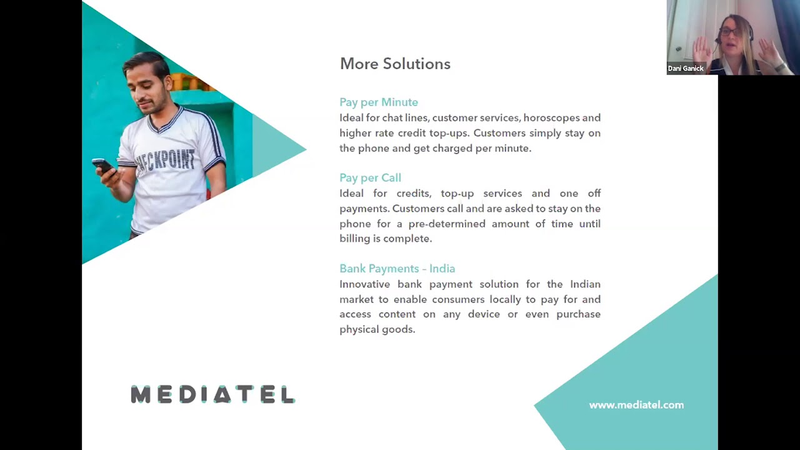
services that require the user to be charged for every minute. This could be for e-wallets for instance or top-ups of credits that then can be used to spend on a game. Uh virtual credits. Um e-wallet top-ups, yes, I've said that already. The consumer essentially will dial a premium rate phone number. In the UK, this would be an 090 number um that the user will be charged say £1.50 per minute for. We will keep the user on the line for as long as you need in order to charge the amount. Say you want to charge him £10, then we would keep him on the line to achieve the £10. And after that, the user will be told to hang up. He's now fully paid and then he'll be taken through to the content. Um pay per minute, pay per call, a pay per call I think it says it all. It is a call that is charged at a certain rate. The call has a certain duration. It doesn't carry on and on and on. It may only last for a minute or 2 minutes. And
then the consumer has topped up and can be sent on their way to consume their credits on your website, on your service. Um pay per minute and pay per call are just like premium SMS and direct carrier billing that are only available domestically. So, you can have a premium pay per minute number in the UK. And you can only have users calling from the UK. So, we usually then look at how can we help you convert your users in a certain country, which countries are key for you, where do you want to convert more users, where do you need to convert more users. We then look at all of the different options that we have in these countries and we'll give you the best best possible solution that you could be trying. Um they are essentially pay per minute for instance in the UK it's used for all kinds of psychic services etc. There are different tariffs available. We can charge a
consumer 50 p per minute, we can charge a user £1.50 per minute up to £3.60 per minute in the UK. We have pay per minute and pay per call for a lot of different countries available. Um happy to talk some more about that later or to to share anybody who contacts me I can also share a coverage list or something. Um so you can get a better idea what we can provide. And the final solution we can offer from our side is not a phone payment actually, it's bank payment for the Indian market. India has a lot of different payment solutions at the moment, none of them are phone payment solutions. Um but in India people pay for a everything um via different bank methods and we have found a partner who is able to monetize users in India essentially through different bank payment solutions that are very easy that users in India are already very familiar with that they're using to this day so they can simply choose which method is the most
convenient for them. And in then in no time you have them signed up and they can start using your service. Um that's essentially our products in a nutshell. Obviously there's a lot more information on alternative solutions, but it's as I've said in the beginning it's really a great way to monetize more users especially in countries where you're struggling to get enough paying customers which may be down to simply to the fact that they don't have credit cards or that they're not or maybe not willing to enter the personal details or credit card details. They may want an easier secure solution something easier for them to process. For phone payments as well, it's so uncomplicated. It is so quick for anybody to just use it. If you look at most of the content these days is consumed on a mobile phone. I think I've read a study somewhere that said 75% of all mobile con of all content in
this day and age is consumed on mobile phones. No longer people sit on their laptops or on their computers. It is more and more the handheld devices. So then obviously having an option where they don't on a much smaller screen than on the laptop where they don't need to enter in all their credit card details, their address details. I know a lot of it is pre-filled this day and age, but where they may only need to send an SMS or need to make a phone call from a device that they're already holding in their hands. Much simpler. Converts incredibly well. So that is something that's really interesting for for anybody who wants to get and monetize and convert more users in a range of countries. You will not find in the US and Canadian markets in Western European and German. But Germany is different, but in the UK for instance, a lot of people have Visa and Mastercards etc. A lot of people are happy to pay on a Visa and Mastercards.
They're tied to the App Store. It's quite simple in this day and age, but you have still a lot of countries out there where it's not as easy and users are relying on alternative solutions being a way available. Um Yeah, that's um that's about it. Um Yeah. Sorry, just a second. So, this is essentially yeah. That was my little presentation. Sorry, this is my first time. Just wanted to Thank you. I hope it's given everybody a little bit of information. There's obviously a lot more in this um when it comes to alternative payments, but this is just an idea for you of what Midea can do to help you convert more users. Hi, well, thank you, Danny. Thank you for that talk. Oh, you're welcome. Thank you, everybody for listening. Yes, and and I know that um for a lot of people, you know, I think you know as well as uh we do cuz I mean at least
I've been banging on about it. We've got the Discord as well. So, if people are too shy to leave questions into the Q&A, then we've got the Discord where you can continue the chat. Go in there, check everything out. So, I'm sure there'll be some people in there who will want to find out more and everything else like that. But, it's really interesting. I think for me, I always know back from years ago when I worked with uh publishing that for countries and regions such as Brazil and India, uh having alternate payment methods was obviously one of the only ways to sort of break into those sorts of regions. So, yeah, I think it is a a really interesting thing for developers to explore alternate payment options. Yeah, and I know a lot of people are scared of um big integration, complex procedures, et cetera. Obviously, this is the same, but every billing company, it doesn't matter if you set up a merchant account with a credit card company or anybody else, there is obviously always an element of of of a process to it. Um but, I can I can honestly say for instance, our international SMS, it is super quick, it
is super easy, there is no approval time, et cetera. So, we have some solutions that can be very quickly set up. Um and it's not a massive integration. It always sounds, oh, this is going to be a big job. It's a little bit scary because I need to set up individual countries. But it's not necessarily the case. It entirely depends on the country itself and what needs to be done. It's definitely a great way to monetize if needed. Yeah. Well, thank you. Yeah, thank you so much. And like I say, um You're welcome. you know, I'm sure that uh some people will have some things to ask. Oh, we've actually got some questions. So, we'll we'll fit one in quickly before before time. But uh yeah, so uh So, the first question we've got in here is when working with different locales, what is the best way to use your solution during the design phase? Is it necessary Is it necessary to design for each locale? Um it depends. Um for most of the billing methods, when it
comes to for instance carrier billing or something, it's usually just a button that is entered on the payment page that needs to be added to the payment page that says uh pay by phone, you know? And then the we we do the transaction. All of that we take care of it so that our client does not need to build anything around aside from offering it on the payment page. Um we will do everything else. So, it could be an in English-speaking countries, it could simply say pay by phone, and then we get the user. We pick up the user. We trans do the transaction. We hand them back. Um for some countries, yes, it would need to be where you phone number that's only available in that country, say in the UK, you would only market to your UK consumers. You would need to display a UK phone number with the UK terms and conditions. So, yes, then that payment button or that advertising material will need to be designed for each different country that you would be using us in.
Yeah. And um I suppose we'll fit in one of the question before we uh move on but and take the chat to the Discord is there someone who's asked um and I suppose Yeah, there's there's two questions that sort of approach the similar sort of topic. So, we'll sort of combine them into one. But someone asked uh which which market or region do you think is the most promising to for developers based on your data? And at the same time someone's asking about India in particular being considered a a sleeping giant. And you know, do you see this as a time when these sorts of giants wake up? So, yeah, I mean basically what sort of regions uh seems to be the most promising for this sort of monetization? The most my personally from experience is African countries. Looking at the northern African countries, we're looking at South Africa as well. Um a lot of the Asian um territories, Philippines, Indonesia, but also South America. Essentially often places in the world where people literally only have a mobile phone and they have no other way
to subscribe or to opt in for something. But yeah, Africa is a huge region. I think India has an an a lot of potential. I it India is very restricted when it comes to billing solutions and the gaming gambling sector, etc. I think there is a lot of potential um with India. But yeah, it's been always really difficult to find a solution that's actually workable there that gets approved, that allows consumers to actually utilize and opt in for gaming or gambling service, etc. Yeah. Let's go on. One other one that I just I want to ask cuz I think it's uh particularly interesting from Chris is is there a minimum size of company expected uh company size or expected revenue to look into these solutions? Like basically I think you know, what he's getting at in the second part of the question is is this also a viable option for independent developers and small developers? Absolutely. We have obviously some solutions come some solutions may cost a setup fee or something that we have no
influence on where, you know, however, we will always work with anybody. For instance, in the UK, we offer free setup, no monthly fees. So, no matter how small the company, we can look at this or we can recommend maybe a a different solution that we can offer that any company can just use and try out and test to see how it works for them, if they can monetize it. Uh, yes, absolutely. We don't have any requirements on how big a company needs to be or how much traffic it needs to bring us. We're happy to look and speak to anybody who's interested in this and to want some advice on how they could potentially be uh, monetizing their consumers. And all I need to know is which countries you guys are looking for. And just let us know saying, "This is my product. This is what this is, um, the country I need to convert better. What can you offer me?" So, if anybody has any kind of wants to get an idea or pick my brain, just come and talk to me. You can find me on LinkedIn, you can
find me anywhere. I'm going to be here, I'm going to be around this week at the show as much as I can as well. So, come and speak to me. And just tell me what country you want to convert and we'll see what we can do for you. Yeah. Well, thank you very much. And I think that's a great time to say that, you know, we've obviously got the Discord and the Meet to Match and everything else like that. So, everyone can follow up with you there. Thank you so much. Thank you for having me. Thank you everybody for listening. Bye. Bye.
Summary
Alternative billing solutions serve as a critical monetization strategy for game developers and digital content providers, particularly in emerging markets where traditional credit and debit card penetration remains low. By leveraging mobile-centric payment methods, developers can significantly increase conversion rates among global audiences who possess mobile devices but lack access to conventional banking instruments. These solutions prioritize user convenience and privacy, as they do not require the disclosure of personal financial information, relying instead on the ubiquity of mobile phone ownership.
The primary billing mechanisms discussed include premium SMS, direct carrier billing, and international standard SMS. Premium SMS and carrier billing allow for one-off transactions, subscriptions, and trial periods, with charges applied directly to a user’s mobile phone bill. These methods are highly effective for virtual content and services but are generally restricted to domestic markets due to regulatory frameworks. Conversely, international standard SMS provides a simplified, low-friction opt-in process for virtual content, functioning across borders by charging users at standard international messaging rates. Additionally, pay-per-minute and pay-per-call services offer viable alternatives for specific use cases like e-wallet top-ups or virtual credit purchases.
Geographically, the most promising regions for these alternative methods include Africa, South America, and parts of Asia, such as Indonesia and the Philippines. While India represents a significant market with high potential, it remains complex due to specific regulatory constraints. These solutions are accessible to developers of all sizes, including independent studios, as many providers offer flexible integration options with minimal setup requirements. Ultimately, adopting these diverse billing methods allows developers to capture revenue from previously unreachable user segments, ensuring that monetization strategies align with the payment habits and infrastructure of local populations.

















Comments