VideoGameMakers
STOP Making These 4 Ad Monetization Mistakes | A Guide to Higher CPMs
11 Oct 202569 min video
Transcript
Hey everybody. Today we're drilling down and discussing practical ad monetization execution. So the focus will be on practical implementation and we will be talking about an ad monetization operators playbook. To talk about this with us, we are joined by Kelly Kang, a leading ad monetization expert and the founder of the consultancy game plan. Before founding her own firm, Kelly led monetization and product teams at some of the industry's biggest names, including Glue Mobile, Big Fish Games, and Aristocrat. And so, without further ado, join this discussion to learn how to set up, fix, and optimize your game's mobile ad revenue. Kicking off the discussion with Kelly right now. All right, Kelly, welcome and appreciate you joining. Just to kick things off, I thought we could first focus on the biggest pain points you see in ad monetization. And you as a consultant who helps scheme studios of different
kinds, different sizes, different capabilities. What are the most common pain points you generally see?
We see a lot of different things from different sizes. But what I what we usually see or what I usually see is a studios are getting squeezed on margins. So even when traffic grows or revenue doesn't always scale. Um at the same time a lot of the them are heavily rely on this few big ad tech players which makes them very vulnerable. Um when policies or auction dynamic shift which in this DNA it happens all the time there's new policies dropping new like auction dynamic shifts. Um so and and there's also a dayto-day strain. So with the ad ad ops same you know with the advertising we don't really get the full scale or full headcount. So we're always kind of juggling on the multiple partners SDKs and the reporting
right and Kelly I'm sorry but could I
stop you there and just just for our audience because I think there are going to be a number of folks in the audience with different levels of
expertise and understanding in terms of the context of admon but when you say margins are getting squeezed could you go into more detail? What do you mean by that? How are game studios getting squeezed on margin when it comes to admon?
Yeah, so when you're actually look uh when you grow your traffic, you just you just expect your re admon revenue to grow as well because oh we're serving more ads but that doesn't happen all the time. There are few factors but m uh major point is the margin squeezing. What that means is let's say the we call it the middleman uh they used to take 40% or back in the days or 30%. But now we
in the middleman you're talking about the ad networks. So like like an apploven or unity ads or whoever.
Yep. So all those uh ad networks like all those uh guys they used to take 30 40% or is contracted to take 30 40% or
whatn not but because there's a all these fees that we are not aware of that is not part of the margin meaning there could be a tech fee another 5% 3% 10% we it's not contracted but because it's tech fee it's just added on top of that and there's all these different fees that you we don't see. Uh so because of that the margin even though we say hey it's 6040 7030 meaning we're going to get 70% of the entire cut or 60% of the entire cut that doesn't happen it's most likely we'll be looking at not even 50% if you actually do the start to end math uh so that's when I say my my margins is al we just not getting the margin that we are expecting to be or we are not getting the share uh revenue share we call old terms uh what we used to get.
Okay. And is there anything that a game studio can do to try to get more margin
or basically at this point because the
ad networks have gotten to such a huge scale, you just got to
take what you can get. Is that the situation?
I will say 90% yes. Take what you can get. But 10% is actually not focusing on too much on this rev shares, revenue share we call it. Because a lot of people are like I want to do like 7030 or you know 8020 meaning 80% I want to get the profit and 20% for that ad network.
Let's not focus on that because at the end of the day like I said earlier it doesn't matter what percentage you're contracted to get because at the end of the day what you see is very different from the percentage you're you agreed or contracted to be. So focus on what you're actually getting at the end dollar. Don't focus on the 7030. I know everyone like likes this negotiation tactic and I mean I used to do all the time so uh that makes sense but at the end of the day it only matters how much are you exactly getting at the end so look at the net how much you're getting rather than let's go deep deeper into
this negotiating terms
right and so there's so your point is there's only so much you can do focus on the things that you can control and so then let let's talk about that so let's say you have a game you're generating some ads monetization revenue and a client comes to you and says, "Kelly, we we have some ad monetization in our game, but what does your day one process look like when you take on a new client and you you look at their setup, you look at their revenue, can you walk us through what your audit typically involves? What are you looking for? And where do you potentially see areas that you can improve or not?" Yeah. So day one for us is really getting to the lay of the land. So we obviously because game team or studios will tell us, hey, this is our genre. This is how the game play goes. But we will note that down. But I like to play the game from the beginning cuz I want to be the experience. I want the full experience. It can be different
from what game teams actually describing it to be. Uh so we start by looking at the fundamentals like what mediation setup they're using how demand sources are configured like which ad network are they using and if they're actually taking care of taking advantage of this like inapp pattering or advanced waterfall like because I know for this most of the time small to medium studios like to just set up hey this is what I read on the article or this is what someone says I'm going to follow this exactly. So what we do is every game is
every games are different. Uh so you like to go take a look at the fundamentals of that game specifically. Uh then dig into the data side of it. What metrics are being currently tracked? Um and what the frequency cap is. Um so we'll kind of look at all the current setup as is as how it fits the game and then get a clear picture of what we could do. And also from a player experience, what is the player
experience? from a revenue perspective. Uh so like ad density like how deep is ad going to like what is the placement current current placement look like
uh and whether the current man monetization feels align with the retention. Uh so from there it's usually pretty clear on the picture of what the big gap is or big gaps are and whether it's a diversification of the demand or ad network or we are talking about misop optimization maybe we're not fully utilizing
um advanced baiting or you're not fully utilizing the advanced waterfall manual waterfall whatever it could be u and just the kind of operational inefficiencies which we see a lot um is this kind of minimizing in the operation because I know we like to complicate and add more layers to it but sometimes those are not needed or sometimes it's just kind of everywhere. So we like to kind of make it optimal uh for that game studio.
Okay. So Kelly you you mentioned a lot of stuff there. Maybe I could kind of go go back and try to unpack some of what you said. So, one of the things you mentioned is uh like there may be some folks in Admon that that read about a particular setup and just copy it. And so, I assume what you're talking about is maybe the setup with respect to header bidding versus waterfall. You then also talked about specific metrics that you're looking at. Then you look then you also talked about things like, you know, the frequency ads, frequency of ads and placements. And then you further then talked about certain operational efficiencies. So um could we actually dive deeper into those four areas?
Yeah. And I I know you're you're very advanced, but for someone who has a basic understanding of Admon like myself, it'd be great to kind of
really understand those areas in more depth. And so for that first one where we talked about header bidding versus waterfall, how do you generally think
about that? And what are some of the what what does this decision-m process look like or how do you structure that optimally for different kinds of games or different kinds of teams?
So I would say if you have a really lean team meaning one headcount or not even at we don't typically get one headcount we get half a headcount or quarter head count for the smaller to medium midsize company. So if you do have that structure I would say
start with the inapp header beating. So I know
sometimes you read about this you know
um blog and basically saying the manual waterfall actually works better. Yes and no. It really depends on your audience and your scale of the game. So if you have a very I will say small studio or midsize studio start with the inapp header bidding but as much as you could. Meaning don't start with oh these two are the big ad network guys so I'm going to put them on inapp header bidding. everyone else. I'm gonna try to do
manually because I think I know better than the machine or I can do this because trust me I've done it. Uh so let's I my suggestion is to start with if you have a one head count or half a head count whatever that might be if you have a lean team at the end of the day start with the inapp header bidding and then go from there. Once you have everything kind of set up then you can maybe AB test in the future uh taking one in header beating out and making that into a manual waterfall. But start with the inapp header being across all when you uh when
right and and from an operational perspective if you go header bidding that is my understanding dramatically less work than doing manual waterfalls. Is that correct?
It is dramatically less work. So think of it as setup and forget it kind of situation. So once you can set up in a better bidding you don't have to touch it. It will do its own thing. But in a manual waterfall, you have to consistently update the pricing of that waterfall or continue to add.
For example, inapp pattern bidding means
you will just set up one line and that's it.
But manual waterfall is you could have 50 lines, you could have 100 lines. So depending on what the price point might be, you will have that many lines. And if your tech stack isn't too uh I guess not there yet, let's say it's in the beginning of the phase of your text stack, then you might have a higher chance of ads failing if you do it, you know, manual waterfall because you're you're calling at this point 50 lines, 100 lines. So versus
just I mean one line, you know, millisecond it could go a lot faster. So I would say it really depends where your setup is. But to start with, inapp header bidding is the best start and it is quicker.
And when you start to think about going from pure inapp header bidding to like AB testing some some waterfall, when do you start thinking about doing that or how do you think about what what would be step one to that initial step of
integrating some kind of hybrid approach or shifting to more of a waterfall based approach for that?
Yeah. So that's uh when you first consider that it can be something like when you have a dramatic shift in your game. So when you have your DAU shift going from 100K to 200K or whatever it might be or you have a new different geo uh DAU coming in or you have you you want higher ePM um obviously everybody wants higher CPM. So eventually we will want to test that out later. But uh and I'll say the major thing is in the Q4 or whenever there's like a high advertiser that's coming in basically saying hey we have this much budget we want to allocate it to your app or you know when you hear something that there's a big advertiser then you will want to separate them out and give them their own line so that they can feel as much as they can uh versus a competing or maybe there's a tech issue or whatever it might be. So we want to make sure that that's when you test it out. But I would say it's always best idea to test it out once you go live about 6 month or
eight month later. Uh that's when you try it out one by one because even though in pattern bidding is is very attractive because there's no work. Set it and forget it. Uh and and I don't think I can do better than the algorithm or the machine. So it makes sense to stick with the inner pattern bing. But to give you a clear, I know not I know ad networks hate it when I say this. Not all ad networks are better in a better bidding.
Meaning if you change them to a manual waterfall what it used to be and give them the rate like start with the 85 80 75 and give them the rate they come in a lot higher than when you give them the freedom of to pick whichever user they can come in at. So, think of it as a not all ad networks are ready to or ready or better in inapp pattering.
Okay. And maybe the one other follow-up question along this line of of questioning could be what would be the
impact or what would be the things that you would watch for when you do start AB testing or integrating more waterfall. Would it would it impact things like or potentially impact things like fill rate and then you know require a lot more time from an admon person to set all that stuff up? What are some of the impacts of that? I will say feed rate it will stay about the same just because the more at uh manual waterfall you add you're not add I mean it's a different story if you're trying to add only two three lines but when you're adding this manual waterfall you add very granular level then they won't you won't see any fate issues but it is a lot more on a ad operation or administration person's uh work dayto day because they consistently have to kind of update the pricing or make sure it comes in at certain rate uh that it should be. So it is a lot more work. Think of it as is adding depending on how granular you do, think of it as adding two to 15 hours a week.
Okay.
Yeah.
So you probably should be at some level of scale before you you consider that.
Yeah.
And going back, we mentioned four things. The second thing you talked about was looking at the data. And so about the data, can we talk about that? what are some of the key metrics that you look at whether it's adow or CPM or like can you talk about what specifically are you looking for in the data? Yeah. So few things two things I know we all heard of and we are really focused on is ARP add arp and a CPM because that's the most known thing and
because we are so focused on those ad arcm there are a lot of things uh the key metrics that we are missing in ad monistation factor meaning ad engagement uh we want to be able to continue to so because we're so focused on just the revenue per user user and just a CPM like CPM can be $100 but what if it only
feels two impression so let's not focus on those whole CPM let's focus on more of a ad engagement re we re let's say game team started a new placement or launched the game with the new placement uh what is the engagement look like do are we looking at 70% engaged users are we looking at 20% engaged users so continue to keep uh keep on track with this ad engagement is very important and the ad session. So instead of just counting like ad views uh meaning impressions uh look at whether users are actually in uh interacting with the ads and how that changes um the spend think of it as the spend more time in your app. So be by having this ad placement is this user staying within the app longer or is this uh placement actually driving the user away. So that I mean it sounds simple but these are the little things that you know we are not really focusing on when you talk about ad
monetization. they only kind of tend to focus on we are getting such a low CPM we are getting you know our art out is this but I mean all those are good factors but because of those two main things we're missing we're missing at engagement at session length uh and and the next thing is impression depth meaning are people seeing just one ad per session or are they making it far enough to see multiple ad placement that you set it up. So that actually explains how sticky the users experience are. So you could set up multiple placements in a different time of the game or different level of the game. But we can think of all this we want uh which I see that all the time is hey I have this seven new idea you know seven new placement idea I want to put all of it. Great. But what they're not doing is actually tracking them accordingly. meaning they're looking at it as hey we launched this new ad uh placements but
it's not getting attraction so we got to get something else. Um that's the main thing they're doing but what you should be focusing at what focusing on is think of it as individual placement and individual impression like so by doing this is this impacting the other placement. Maybe this is getting a lot of traction with this one new uh new placement that you did but because of that maybe other uh other KPIs are falling behind or other placements are not getting attracted. So those are the things that you want to kind of look at. Kelly, the third thing that you talked about was ad placements, which you have kind of discussed, but for somebody new to Admon, could you kind of describe what are the primary ad placements and then maybe you could walk through how you decide what kind of ads go into the different kinds of placements?
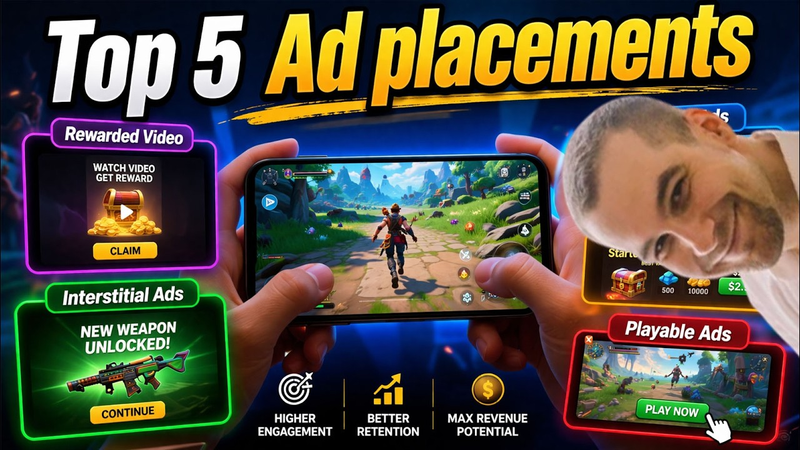
Yeah. So, I would say I love optin advertisements. Uh, so optin meaning that user isn't ads aren't
intrusive. user get a say in the ads meaning they have to click on it in order for them to get to an ad. So they're opting in. I know that's a really old older term optin as so when you say opt in ad the number one I'm sure you guys here is a real video RV we call it just kind of RV what that means is when user opt in user clicks an ad when they watch it they're getting something in return it can be five coins it can be soft currency hard currency but what it just means for users time by watching that at defaults are 30 seconds so by watching it at 30 Second, they're getting something in return. So that's why you call it R video. And second thing is offerable. I know this is a very very old uh old school term. Uh and it's coming back. I think it definitely came back. What it is is it's a wall of so it's an also an optin. User has to click on it to get to that placement. So
when they click on it, you will see a wall of I guess list of offers they can do. Meaning by finishing one offer they'll get again hard currency or in this case meaning five coins 20 coins depending on what they do. Third thing is interstitial. This is what every user most of the non administration people call it you know advertising and they're like we hate ads because it's so intrusive. That is inner innerial. What that is when you're playing game, I don't get an opt. Users don't get an optin. So what that means is when you're playing game, it just pops up in the middle of your game play. It could be your middle of the game play or when you finish your turn, you get a popup at you have to wait depending on the game five, seven, 10 seconds of you you're forced to watch an ad and sometimes the X button pops up or sometimes it doesn't. You got to wait for 30 seconds then the X button pops up. So that is the I would
say most intrusive ad placement uh and most well known just because that is embedded in most of the casual games. When you play a game match three ends then you get this forced ad uh and then go to a next. So I recommend I mean starting with the real video uh and offer what depending on your currency situation within the game. So, and obviously I one one thing banner depending on your again your game if it's static it's your game is there con you know it's not moving screen it's just that one default u static then you could put a the tiny little banner on the bottom of the screen I'll say that's one of the traditional and oldest placement that there is but we don't see that often these days because our games are consistently evolving or you keep changing scenes or screens because because of that banner cannot stay in that one one static page. So that's why you you don't see banners much and the
ECPM we're talking 10 cents 50 cents rather than $55 in R video. So when you think about these days it's all about the optin placement. So, video offer wall and depending on your game type, it can be interial.
And do you generally try to personalize the kind of ads that different kinds of players get as far as ad placements are concerned and how do you generally think about doing that if if you do?
Yeah. So, that's that that's what we want to get to eventually. So when game teams actually what launch an ad, we tend to go with 100% programmatic and just kind of set it and forget it. Here's all this demand. As long as they're getting ads, they're good. That is not the way that we should be optimizing. So what I recommend is segmenting to the to the best as we could. Meaning obviously when I say segmenting uh most of the game teams are capable of uh segmenting geo or the game level I mean free free
players versus a payers or non-payers versus a payer. So we can do all of those segment. When I say segment we're talking a little bit more granular. So think of it as a heavy ad watchers or um passive ad watchers. So those are the things that I would like to recommend is meaning when they have every time they have ads available they continue to watch an ad that means there's less likely they're going to actually click on that advertising right so we want to give them more of the impressionbased advertising rather than a you know actionbased CPI CPA based uh so I would like to segment I mean re I recommend segmenting out like depending on a user users ad type ad watching type and then few things are level or what this is one thing that we don't do is once they I don't know gate at level 10 or level five that's when they see an ad that's
great but there also needs to be a differentiation in between level five versus level 20 level 100 whatever it might be uh there should be a differentiation in between the rewards that they're getting meaning if they're level 100 their five coin means nothing versus if they're level five your five points mean so much bigger. So depending on your level you want to segment those rewards different type as well.
And is that is that what you meant by add viewer type or could could you explain what you meant by add viewer type? Yeah, add viewer type meaning is uh maybe that uh some some users everyone's different but you want to create a bucket for those user ad viewer type meaning as like a passive ad user uh or aggressive ad ad viewer what that means is every time when there's a ad available some users are I'm going to watch this and get these two coins as much many times as I can until they say you don't have any more ads. Those are what we call like aggressive ad type or
just passionate ad type versus uh yeah more uh passive means we know even though they have ads available
they are they might not watch it or they'll watch it maybe once a day.
So you might want to give them a different type of um advertiser rather than this um passionate ad watcher.
Got it. And the fourth thing that you had talked about before was operational efficiencies I believe. So could you talk about that? What what are some of the things that you generally look for or that you think teams can improve upon?
So that is uh creating that I guess the formula and a template. So what that is is I know it sounds very simple but not as simple as it sounds. So meaning on a weekly basis we like to have our admon people or ad you know product managers kind of going to or every day hey let's check this admon um
just like AP let's check our signals like what are the impression looking how are you know admon looking like and all of that we want to actually make that simplify it and make it into one template report so you just automatically just simp uh space it out rather than just kind of
I know I've seen this and it's I mean as much as it sounds easy it's it's not so I see a lot of people just kind of doing this daily manually they're spending oh hour a day is not too bad so I'll spend this hour a day but that's five hours a week where you can be it can be down to one hour a week if you have that template available if you have this a you're tapping into their APIs at all at networks has APIs tapping into APIs or simple as drag and all the excel and put it in or if you're not tapping into API type yet. Uh so it really depends what you're up to. But I will say the um first thing is simplifying the reports and simplify uh simplifying the
um with I guess the team granular meaning within the team um a lot of people are actually doing the same thing over and over again but just different people. So this admin part ad product manager is looking at the same thing versus this administration is looking at the same thing and this this other PM is or GM is looking at the same thing but because of that we are we are we we're spending one hour each test that's three hours uh one day that everyone's doing same thing so that's when we want to actually give narrow it down to hey how can we simplify this and
and I the last thing is working with the ad network uh partners we say. So think of it as a
yes they're there to help us. So please use not use them but please work with them in terms of get more data when you can from them rather than you digging into five hours of you know API and not
getting the answer you need.
Right. So I I kind of interpret what you have said essentially as like how do you optimize the reporting? How do you audit? How do you understand the health of your ad monetization? So, what are the specific things you should check? How many meetings, you know, the the kind of data sources that you're looking at? All all that kind of stuff in addition to like how you interface with your ad partner.
And so, I I I get that. I think maybe the next question I'd be really interested in is maybe if we even took a step back and you thought about a new a new game. So, let's say there's a studio and they've got a game they're really excited about. It has uh, you know, a significant proportion of ad monetization as part of the design in terms of how they would monetize the game. But I wanted to actually be very practical here and ask you about, okay, step one, you're going to launch this game. It's got ad monetization as part of the monetization strategy. What do
you actually do? What's what's the first thing you do? whether it's like picking your ad networks or your mediator or anything like that. Could could you just describe you know blank slate you're you're going to launch a game what what do you do?
Yeah. So for a brand new launch we start by looking at the game economy and the player flow. So add layer as in to support not fight retention. So think the first thing we'll do is we define ad format. Is it going to be Rudy video? Is it going to be intersticial like we talked about earlier? So Rudy video is a backbone and interstial is obviously you know natural breaks. So the first thing we'll do is define the ad formats which ad format will be using and to kind of looking into you know frequency cap and how do re how many rewards or what are we giving it to them? What are we giving users uh so they don't inflate the economy and all of that. So in parallel
why we are doing that we're looking into um mediation and then we're looking into ad network.
Okay
meaning on the mediation who do we choose uh and which mediation fits the best and once we define the ad format in the beginning meaning the first thing we're going to define ad format once we define we will know which ad network we'll be adding after that. So we cannot we cannot do vice versa. We cannot I know a lot of people like we are going to integrate this mediation and we're going to have this five ad network because they're popular and then and then after that we're like well we're going to have this interstitial or we're going to define ad format after. The problem is not all ad networks are strong in certain ad format
right? Therefore, you need to define your ad format first, then go to a second step which is mediation and the ad network. And let's say you chose offer as a ad format in the beginning.
You integrated um meta only they don't have offer wall. So you cannot go vice versa. So you really need this ad format. then mediation and picking the right ad uh ad ad network for your ad format and your game. So that is the first two steps that you'll be doing.
Okay. So and again just so I fully understand and and if I make a mistake please feel free to correct me. So like step one again what you had said is actually the the product the game integration of the ads trying to understand how are you're going to integrate ads into the game like in terms of ad placements and the user experience.
Y
the kind of second thing as part of that is also to understand what the value exchange is going to be and the impact to the economy by integrating these ads. Yeah.
And so that's kind of like the the product layer in in terms of like what you would first do.
Then the second thing you were saying is
um the mediation platform and the ad networks would be like that second part, right? And for that second part in terms of mediation uh platform and ad networks, can you walk us through how you think about that? How would you make a decision on which mediation platform to use? And in terms of the ad networks, you had mentioned some networks are good at different kinds of ad formats. Is that how you would pick that? And then how many for a new game would would you want to start with?
Yeah. So on the mediation u as we know there are only few big guys currently only two three I guess big guys. So I would like to be at least six or seven but here we are at two guys. I'll say uh maybe maybe third ones coming in these days. Uh so on the mediation side we choose the one that best fits the current stack. Uh meaning is your game big is your game small what is your game genre look like and reliable in the
inapp header bidding like I mentioned earlier is you want to start with the inapp header bidding. So even though there are a lot of media uh mediation out there some of them only supports two inapp header bidding uh at network and we have like five manual we current we do not want to start with with them uh just because it's a lot more operational cost for us uh and this does this mediation have a clean AB testing if the game studio currently doesn't have it we need to look for a mediation that could provide all the solutions that the what um the game studio currently is lacking in so So I know a lot of game studio actually have their own AB testing tool or placement level testing or anything. Uh but if they don't have that it's okay. We just got to look for the one mediation that actually has the clean AB testing place reporting and you know and stable SDKs and strong scan support and painless operation meaning what does the mediation alerts look like? What is
their API look like? And what is their QA tool look like? Again, if the game studio has all of that, we don't need to factor this in. But most small to midsize games don't uh studios don't have that. That means we want to look for a mediation that has all of this answers. Uh and we bias and at the end towards a platform with a broad demand and fast iteration uh and great debugging tool just because it's going to make our launch go way smoother. Um and for the demand partner when you say ad network I will I will say yes more the better but not when you don't have that much impressions not when you don't have that many um um users I would say right now is your focus shouldn't be less integrated 10 network uh that was a I guess that's still for big companies or back then where hey we are only looking at 70% 80% fill rate our users are requesting ad is
not feeling that is not the case these days these days it's 99% uh fee rate uh is just because there are more advertisers um and the second thing is that 1% is tech is likely the tech tech issue uh so when you look at it think I think when you're choosing demand partner ad network I'll say start with the lean core four to six ad network that covers the global field uh and the key formats like if you have the you video in a shell look for the one that covers the all those uh for example core ones uh when we say a core ones admob meta unity uh and depending on on ablovin and if you need like one or two you know re regional specialists like mint integral and pangle if apac really matters for you so really depends on your game um genre and your user base,
but start with the four to six big guys uh like I just mentioned and add on one or two more of ad network if the you know AP pack or whatever different reasons matter for you. Kelly, I I thought it was great you were very specific about some of the ad networks that you were looking at, but when it comes to the mediation platforms, could you talk about more specifically like some of the bigger players and how you would make a decision between them?
Yeah, so I would say it really depends on what you're looking for and there's currently two very big guys, uh, level play, Unity level play and
um, Max above and max. Yep. So it really depends on what you prefer. Who do you like to work with also it's a matter of do they have all the tech capability that you need meaning or do you need AB testing from them or or do you need this you know QA tools from them so you want
to take a look at both they offer even though they're same thing they offer a little bit different of those little tech wheels and vessels. So you want to take a look at those uh before you make that decision cuz it really depends on what your studio is capable of currently.
Right. But Kelly, you know, I know you know Josh Chanley Kelly, but one of the things that Josh has mentioned is that if you use Max for example, uh you there is a little bit of an advantage from a UA perspective there. Do you also agree with kind of that perspective or how would you would you factor that into your decision for for a mediation platform?
Yes. So I do agree 50% of what Josh says and Josh knows this. So I do agree 50%. Uh you do have an advantage uh of max if you and above max if you are currently spending a lot on ablovin on UA side.
Okay. uh but if you are if your scale is
small I don't think it's that much of a big difference uh meaning if you're not spending too much in UA with applovin uh I don't think it's that much of difference and also if your UA site the problem these days is back then everyone used to spend 80% of their budget 70% of their UA budget on via epit but these days I do notice that there's all this um offer wall or other uh solution that UA are currently using utilizing that means they're going to have less and less uh spend via apploven in that case I don't think it's a big factor again unless you're using big chunk of UA dollar through ablovin then I think yes it's beneficial for uh their algorithm to have your uh admon on better if you're using their app loving UA.
Okay. And just going back to like this scenario in which we have this new game being launched and I wanted to so you you've talked about some of the initial first steps and the things that you need to consider. But now I also want to I wanted to get your thoughts and feedback on what kind of team is necessary when you're going to first launch this game. You want your admon to be optimized. H how do you decide on the people that's part of this admon team? How many people or is it an existing person? Uh do you suggest having an internal team versus having like a combination of somebody internal and working with an external consultant perhaps like a firm like yours? How do you think about that in terms of the the team, the staffing and what they would do?
Yes. So my opinion towards this hasn't changed uh from the day one is uh I worked at all these bait companies previously and I am all about actually
having a lean team uh at least for the lean admon I do believe in too many cooks in the kitchen causes problem. So because of that I really believe in this lean team and for example previous my current uh previous company is I we I was running uh I'll say what 40 million uh just on admon but I have my team less than five people or six people just because I really like lean team and here's the reason why so from admon side
the reason why I'm starting a lean team and then making sure the fundamentals are in place meaning that we always want to focus on everybody should focus on one thing rather than just 10 things spread across. So you don't need a big team right away for a new game. Uh one dedicated person focusing on ad setup mediation just a basic optimation dayto-day is usually enough but key uh key early on is to make sure you're tracking properly. Uh so once you do
that I will say probably one but if you're starting game I'll say half a head count is totally fine as well. Um and as the and in that way when UA actually starts testing their campaign uh you guys could the admma person can talk to the UA team to get the right feedback and not just the installs without any context. So you want to give them you could communicate that internally and as a t as a game grows uh that's when you scale your admon site as well. Uh maybe add someone to run AB tests only on placement experiment with the ad format not just sticking with the one ad format. uh so and eventually data analyst uh and to dig deeper into the revenue by cohorts and more deeper data but at the very beginning one dedicated person half a headcount and optimizing early signal is enough um and obviously uh I do recommend external but consultant just
because I do believe in rather than having one dedicated junior person I believe in why not um consult with the expert that's been out there uh and short term uh because you just started you don't know if your game or admon is going to be uh if your admon is going to go this way or other way so you want to start with a consultant so you're not really committed to a whole thing and you want to get a whole scope of and the newest trend or latest trend uh with the consultant so I do believe in that either half a headcount or one one dedicated headcount if you could if not I think the best way is to start with the consulting so you can get all the ideas um and all the strategy in the beginning,
right? So, so maybe like a conservative approach would be to start with a half or a single person that maybe works with a external firm like yours.
Yeah.
But then how do you think about scaling? So you mentioned five people at 40 million in admon revenue for example.
How do you how do you model that or is is so you had mentioned maybe it's a scale of the the revenue is it you know do you divide 40 million by five to determine the number of people you need or how do you think about that or is it more organic like ah there's a lot of work here for the things that we we're trying to do just add another person because of the amount of work that is being added on as you as you start to scale.
Yeah. So I am very financed driven uh meaning because I was actually reporting to CFO. So all I think about is kind of how does everything back up by the number. So it could be a good or bad sign. But good news is at the end of the day we're going to make money. Uh so how I determine is I like to look at per headcount how much could that headcome bring per year.
Meaning are we talking 1 million or are we talking 200,000? Uh so I will look at that ratio and go from there. Obviously you'll depend on every game like 1
million could mean big difference and maybe this headcount only cost us 80k then yes it's a no-brainer but no not really just because you want to think about what is that we're not looking at just apple to apple at this point. You have to look at all different factors meaning by having this headcount would it take away from other persons or are they working on other days. So you want to factor in everything, but at the end of the day, I like to look at it by per headcount. What could they bring per year? What is what is my upside per year by doing this full-time? And that's why I couldn't justify back in the days. We went from 20 million, 40 million, 60 million at one point. I could not justify of adding more just because by adding more it will make our life easier, but I don't think it'll bring significant 5 million or 3 million a year more. And that's when we did have one or two um actually uh individual contractors uh back then just because I
see more of a revenue bene benefit through that route rather than having a full-time because again this advertising industry is still growing and it changes all the time. There might be a lot of work this month and next month but the following month I'm not sure if it's going to be there or not. Uh in that case I cannot justify. I cannot guarantee the return. Uh so that's when we will go just kind of um temporary route. So think of it as or I would like to suggest as as a revenue return per year.
Got it. And now that we've kind of talked about like getting things kicked off and starting, I wanted to now shift towards you're operating a game. And then I I have a number of questions in terms of like how you think about optimizing efficiency or maybe differences. And so maybe the first question I can ask you and and I know Kelly, you've got a lot of great experience. You've worked across a lot of different genres, right? So I think
you were at Glue. So you worked on lifestyle games, big fish, casual puzzle games, aristocrat, social casino. So when you look at a ad monetization strategy across different genres, is there a big difference as far as whether it's specific KPIs or placements or things like that from a strategy perspective? How do you think about different genres or is it generally uh relatively the same?
That's a good question because as strategy really does depend uh depend on genre and have to adapt to the genre and player mindset. So for example in casual games players are often very tolerated with that especially real video because play um casual puzzle games users have few different casual puzzle games on their phone and most of them commit to video. So they are very tolerant with ads. They know what ads are. Uh so it
ties directly to the progression as well. So they need they need to watch this so they can get two more moves after this turn. uh so they're watch an ad to get more extra move power up and a second chance. So in that space in that genre you can lean into higher ad frequency because it feels fair and it it's part of the game loop.
Uh but when you're talking about with the lifestyle game is also audience is very different. Players here are more creative uh and the so their ad experience should be much lighter and more integrated. So meaning that when you just add a advertising on top of their game, they will notice it because they're more creative, they're more artsy, they'll look at it goes, "No, I hate that. I hate that it's there." Um, so frequency is usually a lot lower than casual games. Um, and the placements needs to be feel optional and edited rather than just kind of part of the game. Um, so
like really video that gives you extra decor item, they will love it. But if you push too many inner social for this type of ads, like this type of game, you will break the game flow. Therefore, you'll risk a churn. Uh and lastly, social casino is a whole different genre, whole different layer. Players are often spending real money and a lot of money. Uh so their value are they want to feel like it's premium feel uh when they play this social casino game. So ad strategy tends to be more on a lighter and a very conservative side. So ads might be used more technically rather than just you know addition uh to it and re placement ex it should extend the session. Uh so you're not actually putting ready video placement into social casino games to make a lot of money. You're actually putting in to extend the session so the user can have more fun and so that they want to play
more and more. Uh so the frequency should be very undercut and monetization model should be a lot lighter. Um so to kind of sum up so for me it's always kind of comes back to understand the players motivation in that game in that genre and are they more quick sessions or are they longer sessions with within the every time they play the game or are is this more of a competition or is this more of a casually playing game? Uh, and that drives not just the frequency, but also the type of ad format that we're going to use in that game.
Got it. And also operationally, I wanted to ask you about kind of common mistakes and quick wins, but let's talk about common mistakes first. So, you again, we we've already started, you're kind of operating your game. What are some of the mistakes you commonly see that maybe folks in our audience should be looking out for? I'll say um I think I did this article not long ago too but it's one of
the biggest mistake I see is the teams treating admon as a afterthought and this is common mistake I will say eight out of 10 games or what I encounter is they make their game they launch it and they go hey I edit this placement how does it look and that's when you come in goes okay you definitely edit this after your game and they're like how do you know because we it's it looks in it looks very integrated within the game. Um it's because that usually means there's a miss revenue and the bad data early on. Meaning you could add it but I can tell by the data that the placement could be sparkly as possible but I can tell by the data hey your data signal where is early on data and they're like well we added this after the game so we don't have that. Uh, so those are the little things that we're missing. And I also see teams overloading players with a lot of ads in the beginning because
they're like, I heard admon money is a thing. I heard we could make so much money in admon. Um, which is I love it. I love to hear that, but not when you're not doing it right. meaning they're basically saying we're going to start inter level three because that's what other games and that's what they did and we're going to give them I don't know um every other other turn or whatever it might be. So they're overloading players with this interstial in the game early on in the game. Uh what that means is they can spike turn before even they learn what your LTV true LTV looks like. So now they're looking at the game team's looking at, oh, their LTV is only five days. I'm like, well, because you start overloading with ad in day four, therefore it's going to be day five. So you want to wait till your true LTV comes out before you start sending them showing them too much ad. Um, and frequency and placement needs to match the player journey. You cannot say, "Oh, I once saw five ads per when I played
other games, so I'm going to do five ads." your player journey is different from that other game's player journey. So maybe five is not enough. Maybe your game is harder. It should be more. Maybe your game's too easy. Five means it's too much for your game. Uh so it depends on your game players journey and your game economy and your uh game uh insight. Your everything's going to change. Um and finally is not having a clean measurement uh the data perspective. So you're not tracking it right your tracking isn't set up right. So you might be collecting all the data but you're not actually looking at them. Uh and that can be that is the biggest I I'll say know data perspective that I see a lot is UA team is flying blind meaning UA is spending all of this. They're say oh we made this much money by spending this but I'm like are you but they're not looking at it in terms of ARP out and LTV perspective. Uh so if
that happens then it can get costly very quick
right and Kelly I wanted to actually maybe dig a little bit deeper into the second point that you had mentioned which is overloading players with ads. So certainly if you like ramped up the frequency, added more ad placements, you could see a sudden increase in at ARPD and everyone's like, "Yay, we're making a lot more money." But to your point, then you could have additional churn or your LTV could reduce. Could you talk about what specifically you generally look at when you're trying to optimize for, you know, the the amount of ads that you're showing or things like that? Do you look for like a DXRPO? Do you look at a specific churn metric, what do you generally look at to to optimize the the amount of ads that are shown and the the sort of ad placements?
Yes. So, in terms of in casual games, I'll look at as a um session length. So,
how much are they playing? Meaning when they open the app, are they playing as let's say it's two minutes or that are they consistently playing two minutes or are they dropping off early or when they do drop off do they not come back or do they come back or so how many times do they come back a day? Uh and in terms of different journalist social casino you want you don't we don't look at that it doesn't matter what you what you look at is what is their entire LTV look like. Uh so I really depends on the genre but those are the few things I'll look at and also I cannot stress enough is the long-term um um LTV meaning when we are talking about we look at D30 I mean like like I said we raised the AR I mean we raise the impression cap we raise frequency cap everything's looking great we just made seven cents more per user great but was
that for two days only was that for 5 days only. What is a D30 look like? What is a D60 look like? So when I actually turn on any of the AV testing on what I I always have a hold out obviously and obvious and even when the result is great in the D60 D90 I we don't fully launch that until
D6 month or whatever it might be because we will always hold 10% to that group to look at the long-term impact. uh short-term wise, yes, we always see more revenue, but is that sustainable? And also, what KPI is it messing up? If it's is everything's up, great, but if every um that's way too good to be true. So if something's a something's likely to be little lower. So it's just a more of a does a is a trade-off worth it or and then the most uh I'll say the metrics getting impacted is always the LTV and a churn rate. Uh especially if you are
serving a lot of interial churn is the number one factor. Um,
and I know people when you look at it like right then they're like, "Oh, I looked at the D7 in turn rate is exactly the same as what it was before we sent it or before we actually um improved or changed our impression. Uh, it changed our frequency, but what is D30 look like? What is D60 look like?" So, I cannot stress enough to look at the longer term.
And so, those are the common mistakes. Any thoughts on quick wins like quick things you can do to just try to boost stuff?
Yeah, I mean studio feels our revenue is kind of plateau which happens a lot. We do a lot of testing and it just kind of stays still or it goes down little by little. The first thing I recommend is look at your placement and frequency. It sounds easy but often the quickest win comes from a very very fine tuning
meaning how ads are integrated into player journey. So for example it's testing ready video in a new spot. So I know you have this already video spot but testing in a new spot uh where player journey feels like it's part of the game and it feels natural uh and so right after level completion or you know maybe a bonus chest or unlock of new big stuff. So it can be something like that but testing out a new placement uh and the frequency is the first easiest quick quick win you can do and another one of best win is refreshing your mediation setup because we are inapp header beating these days what we tend to do is set it and forget it but refreshing meaning make sure you're using the beating when possible like I mentioned earlier and adding a new ad network or maybe you got to clean up your waterfall also small changes like that can definitely uh impact the direct revenue and by doing this and additional is recommendation is AB test frequency cap
it sounds easy but not that many people actually AB test they just assume oh I'm going to go from one through three cap a day so it's going to work because the more ad the better it is or whatever it might be so increasing video uh availability was slightly adjustment to the interstial pacing rather than
rather than 2 minute maybe try 2 minute 30 second pacing or maybe maybe try I don't know different different um interial pacing uh so not just showing a lot more ads of for interial but um change around with the pacing uh we see just easily 10 to 15% lift in this entire admon revenue in the da uh in the arda uh so I think these are the little quick wins that
right so kind of what I heard was sounds like one is just experiment mentation whether it's with placement, frequency, all that kind of stuff.
Second is maybe checking your mediation setup. And then third would be like
experimenting with different ad networks. Yeah.
Is that okay?
Cool. And maybe the other question I could ask is um working with partners. And so I mean back in the day it used to be that there were some folks who thought that part of their job was just yelling at their partners to um have them like tune some knobs to give them better performance. But can you talk about if you're an admon what should that relationship with different partners look like and what can you like and you mentioned this before right as in terms of your operational efficiency like how you leverage your partners. Well, could you talk about if if I'm admon in a studio working on, you know, a heavily admonet sized game, which partners should I be engaging with and how do I leverage them best? How do I engage with them best to like get our studio more performance or better deals or what whatever that may be.
So, yelling at partner doesn't move the
needle anymore. And trust me, cuz I used to do this all the time. So uh so I've been in this field for like 14 15 years. I I keep saying 14 so probably longer than that. 14 years now. But in the beginning I definitely yell all the time. It worked. It worked. Uh if I yell, they were paying attention to my game. They were paying attention to my knee. So it worked. But these days most to uh it actually comes from programmatic and not manual deals. So the better strategy here is actually to choose a strong partner uh not the individual but partner as a ad network itself and set up the fair competition through the mediation or bidding they have then
uh focus on optimization and the stuff that you could actually control
uh and that means placement frequency and player experience. So I will say ad network ad partners there uh but it's
not more it's not it's not like yelling like we used to but it's just more of a getting the insight from them within their uh ad network rather than actually trying to put in manual uh deals because these days the manual deals I would say it's only 5% out of the entire 100% deal 95% is all programmatic and all the algorithm and they're doing better than uh humans. That's why there's less of a manual deal and they let their machine take care of it. So it is it is likely just kind of working with them as a partner.
And maybe I could also ask you about the opposite problem. So let let's say let's say you you want to like make sure that your admon person is actually working in the interest of the company. Okay. And so um how do you prevent your admon not to make decisions whether it's with the mediation platform or ad networks because that ad network partner is
taking them to the keshi concert. You know what I'm saying? or uh you know at at MAU they're doing all these things and so like h how do you keep the relationship clean and uh incentivize the admon person to make the right decisions for the interest of the game or the company rather than for you know hanging out with the with the partner in in some some ways
I that's a great question because I had to deal with this the whole time is is honestly perks and concerts are really fun and you can't Let but I know you can't let them drive the business decision but they're really fun. I cannot lie. Oh, they're really fun. The way to prevent this is by grounding a partner selection in the data and the process. Meaning I had a lot of uh admon managers under me and I wonder the same thing. I'm like are they choosing our ad network certain way? Because I know they
just went to Bruno Mars concert. I thought they just had this Michelin star, you know, restaurant. Is it is it because of that? So I mean I I trusted my team but I had that you know 20% doubt in my mind. So how how I dealt with it is actually with the data and the process. So we will have a template saying hey I want to see this metrics increase by this day. even if they are giving them this Bruno Mars concert ticket and all of that they cannot manually uh change the data. So I always kind of look at it as a data and a process uh and then performance the reliability it's not really they them as a car manager might be great but they cannot fake the innovation of the company. So I want to look at it like what's their next six month or next one year kind of innovation project look like. Um and so I want my team to focus on this data and the process rather than
this who bought last week's steak dinner you know the most recent person. So so if you got if you have a clear KPIs and a fair testing framework then you have to hold them uh accountable for it. So best partner wins because of the result not the entertainment. But this is a very great topic which I actually got this question many time from other adob manager as well. They're like how do I know that my team's not using this?
So yeah.
Okay. So I I think maybe just kind of shifting and and probably in closing I've got a number of questions where maybe we just look at the the future and kind of trends that are happening in admon. So maybe the first question uh for this section would really just be around what are what do you think is happening like at the beginning of our conversation you mentioned that there's some consolidation in terms of the ad network space that has that's having pressure on margins for example what are
other trends that are that you're seeing or that you think that admon managers should be aware of that could potentially impact their business either currently or in the near near-term future. I mean there are just two main things that I'm really excited about and one is it might be stretching it but one is a rise of an AI so meaning the predictive placements and which takes a lot of manual work of the teams where we're not you know basing on this placement what we think is right but I mean I trust machine uh and the second one is the evolution of the ad format so maybe it's interactive ad format even shoppable ad format. Currently
our I feel like our ad format has been kind of plateaued. There hasn't been anything anything exciting. Uh so I'm really looking forward to even like those interactive shoppable that feels like part of the experience and in instead of this interial interruptions
or intrusive art. Um, and I will say the studio that real win in all of this is use those tools, but still design ads with the players in mind,
right? And so to your last comment about studios that will win in ad monetization. So you're you're saying that you think it's going to be those companies that better use the tools and maybe AI in particular, but what if you were to describe maybe some of the skills or the things that some of these ad monetization managers should be looking at more carefully to become a quote unquote winning studio in in Admonon? Could could you go a little bit deeper in terms of how you're thinking about that?
Yeah, so I would say it's adoptability. uh it's very hard to kind of adopt this new thing unknown things that we are not aware of. We're not really sure what we're adopting to, but this openness, adoptability is the number one thing over any other skills I would say just because this AI is new to everyone.
Um,
and the next thing is I think being within the meaning being part of this industry. So be out there, read a lot, speak to other people a lot rather than I read this, I studied this. I mean I think those are good for um engine I'm not I'm not really engineer but I figure those are good for those engineering type like you have to learn somewhere to get to that or do that but this one is all about kind of sharing experience sharing having this partnership deeper partnership level uh so I will say adaptability and just this partnership growing grow this partnership within the industry uh I would say that's really and and build a relationship within the industry is very very important important for this ad monetization.
All right,
great. Well, Kelly, thank you so much. And just to close, if there is somebody in the audience who's interested in ad monetization and potentially working with you, what is the best way for them to get in touch with you or to find out more about your company?
Yeah. So, go to our website or email us.
So, it is game planadvisor.com. Okay.
Uh or email us at infoggameplanadvisor.com and we will get back to you.
All right. Well, Kelly, again, I thought you had a lot of great insights. Definitely want to thank you for your time and for our audience. We will catch you next time. Thanks, Kelly.
Thank you so much. [Music] [Music]
Auto-generated captions from YouTube — names and numbers may be misheard.
Key insights
7 takeaways · ~3 min read- 01Prioritize the net dollar amount received from ad networks over negotiated revenue-share percentages, as contracted splits often do not reflect actual payouts.
- 02Adopt in-app header bidding as the primary monetization strategy to reduce operational overhead, as it requires significantly less manual maintenance than traditional waterfall setups.
- 03Optimize ad frequency and placement based on the specific game genre and player journey rather than industry averages, as casual games can support higher ad loads than creative or lifestyle-focused titles.
- 04Implement a standardized reporting template that taps into ad network APIs to reduce manual data processing time from five hours per week to one hour.
- 05Start with a lean ad monetization team of 0.5 to 1 full-time equivalent, ensuring close communication with the User Acquisition (UA) team to align ad performance with LTV and cohort-based revenue data.
- 06Achieve quick revenue gains of 10–15% by testing new ad placements within the natural player flow, such as after level completions or bonus unlocks, and by refreshing mediation setups.
- 07Evaluate ad network partners based on their long-term innovation roadmap and data transparency rather than personal relationships or peripheral incentives.
Ask AI about this video
Cite this video
Citation
Generating citation…















Comments