1 free read left. Create a free account for unlimited reading + AI research.
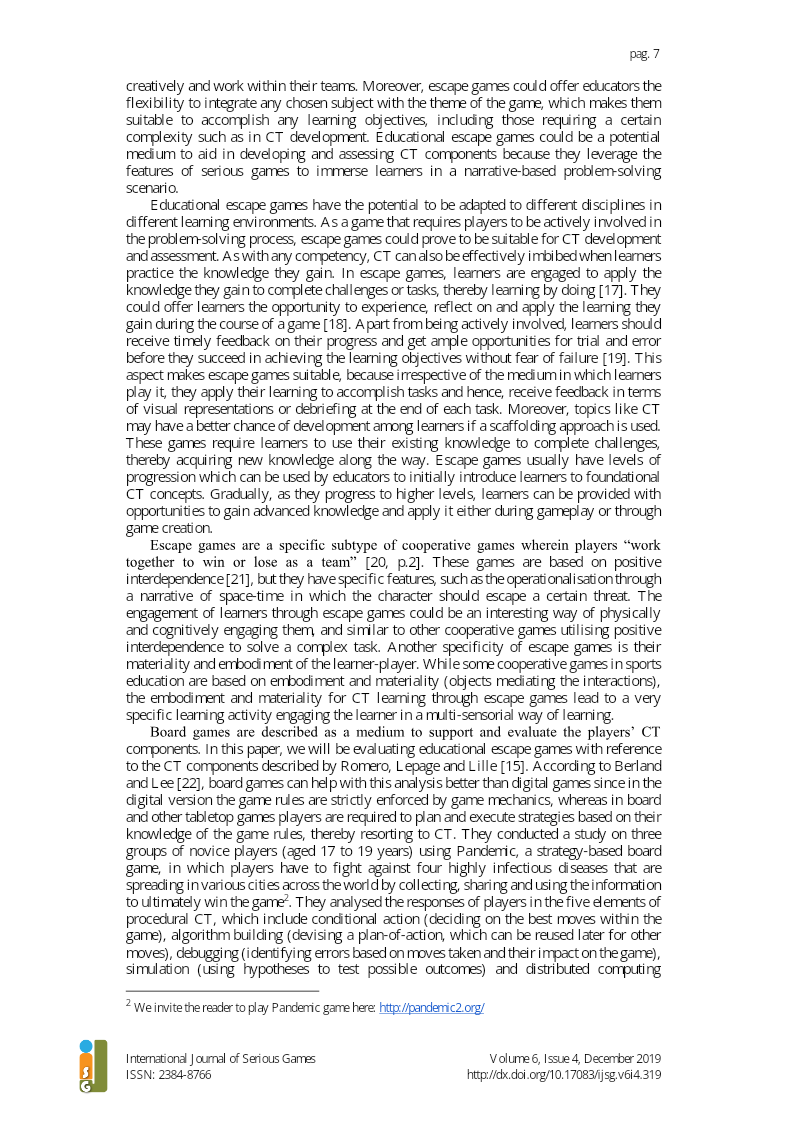
Create free accountWhitepaper International Journal of Serious Games
1 free read left. Create a free account for unlimited reading + AI research.
Create free accountWhitepaperInternational Journal of Serious Games
Mathematical concepts are often treated as peripheral additions rather than core mechanics.
The integration of mathematics into digital entertainment often suffers from a disconnect between educational objectives and engaging gameplay. To address this, a structured mapping technique has been developed to embed mathematical concepts directly into core game mechanics. By synthesizing mathematics pedagogy, instructional design theories, and established game design patterns, this framework enables developers to decompose complex curricula into manageable subtopics. This systematic approach ensures that learning objectives—such as identification, simplification, or transposition—are not merely peripheral additions but are instead fundamental to the player’s experience and progression.
Preliminary evaluations involving amateur designers demonstrate that this methodology significantly streamlines the development process. Participants reported that the framework removes much of the guesswork associated with balancing educational rigor and entertainment value. Assessments utilizing the GameFlow model confirm that games produced through this method successfully maintain essential elements of player engagement, including appropriate challenge levels and sustained concentration. Most designers expressed a strong preference for the structured guidance provided, noting that it effectively narrows the scope of development while ensuring alignment between mechanics and learning goals.
While the current findings validate the viability of this approach, the scope remains focused on initial testing with amateur cohorts. Future research will expand to include professional designers to determine the scalability and versatility of the framework in commercial environments. Comparative studies will also be necessary to measure the objective effectiveness of games created via this method against those developed through traditional, less structured processes. Ultimately, this technique offers a robust, flexible foundation for creating educational games that prioritize deep integration, providing a reliable pathway for designers to translate abstract mathematical concepts into interactive, high-quality gameplay experiences.
International Journal of Serious Games · 2023
International Journal of Serious Games · 2022
International Journal of Serious Games · 2020
International Journal of Serious Games · 2020
International Journal of Serious Games · 2020



International Journal of Serious Games · 2020
International Journal of Serious Games · 2020
International Journal of Serious Games · 2020


International Journal of Serious Games · 2020
International Journal of Serious Games · 2020


International Journal of Serious Games · 2020
Air Force Institute of Technology · 2020
European Conference on Games Based Learning (ECGBL) · 2025

Western Norway University of Applied Sciences · 2025
European Conference on Games Based Learning (ECGBL) · 2022