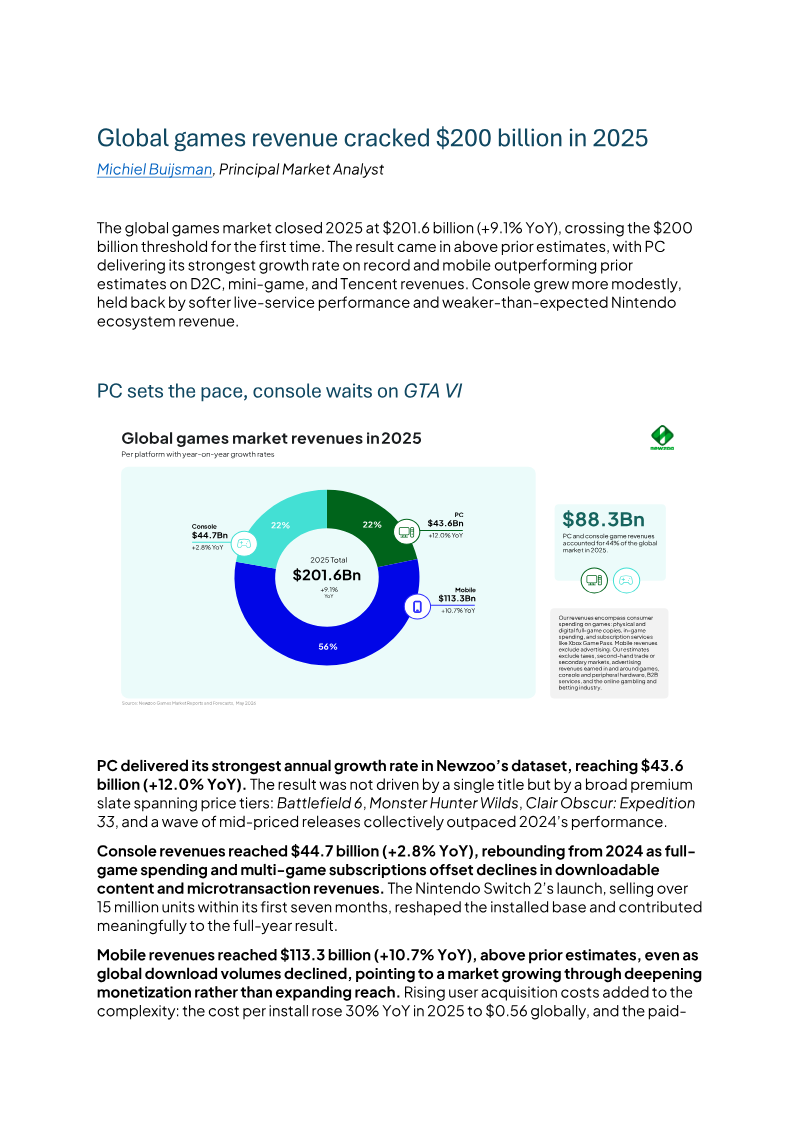
The 2025 games industry review highlights a year of resilient market growth driven by deep player engagement and sustained spending within established ecosystems rather than a simple expansion of the player base. The global games market reached $197 billion in 2025, representing a 7.5% year-on-year increase. This growth was fueled by strong performances across all major platforms: mobile generated $108 billion (+7.7%), console reached $45 billion (+4.2%), and PC achieved $43 billion (+10.4%).
The analysis, covering January through November 2025, utilizes proprietary market intelligence and performance monitoring data to track revenue and engagement across Western markets. Findings indicate that while the industry faced structural challenges such as studio reorganizations, consumer spending remained robust. On PC, a diverse slate of premium releases successfully competed for attention, while console performance was heavily anchored by annualized sports franchises and major AAA titles. Live-service games continued to dominate monthly active user (MAU) rankings, functioning as persistent platforms that command long-term player loyalty.
Key industry developments included the strategic delay of major titles, which shifted the timing of consumer spending without diminishing overall demand, and the launch of the Nintendo Switch 2, which demonstrated that well-optimized third-party content can capture significant market share. Furthermore, the industry saw a trend toward consolidation, exemplified by high-profile acquisitions and a shift toward tighter portfolio management among major publishers. Ultimately, the data suggests that long-term success in the current market is increasingly defined by a game's ability to foster deep, ongoing engagement rather than relying solely on initial release volume or launch-window hype.