Modern Times Group
Game Co.51 documents
Documents
Financial12 pages
Q2 and H1 2026 Performance Report
The Q2 and H1 2026 performance report for MTG highlights a period of stable organic growth and strong operational efficiency. The company reported Q2 net sales of SEK 2,965 million, supported by a 5% year-over-year organic revenue increase. This growth was primarily driven by the performance of key titles such as RAID: Shadow Legends and the PlaySimple portfolio. Adjusted EBITDA for the quarter reached SEK 707 million, representing a 24% margin, while the company maintained an 81% unlevered cash conversion rate over the last twelve months.
The business is divided into two primary segments: the Midcore District and the Casual District. The Midcore segment generated SEK 2,230 million in revenue with 1% organic growth and a 26% EBITDA margin. Conversely, the Casual segment demonstrated higher momentum, achieving SEK 736 million in revenue with 29% organic growth and a 24% EBITDA margin. User acquisition (UA) remains a central strategic pillar, with total UA spend reaching SEK 1,163 million, or 39% of total revenue. This investment reflects a 15% year-over-year increase in constant currency, with significant scaling efforts focused on new casual titles like Crossword Go and Tile Match.
Strategic initiatives for the remainder of the year include a continued focus on direct-to-consumer revenue streams, which now account for nearly 40% of group revenue, and preparations for a potential IPO of the PlaySimple business. Management has reiterated its full-year 2026 outlook, targeting 5% to 8% pro forma revenue growth and an adjusted EBITDA margin between 22% and 24%. With a clean balance sheet and consistent cash flow generation, the company maintains a stable financial foundation to support its ongoing transformation and future value-creation projects.
- MTG reported Q2 2026 net sales of SEK 2,965 million, reflecting a 5% year-over-year organic revenue increase driven by RAID: Shadow Legends and the PlaySimple portfolio.
- The Casual segment is the primary growth engine, achieving 29% organic growth and SEK 736 million in revenue, compared to 1% organic growth and SEK 2,230 million in the Midcore segment.
- User acquisition (UA) spend reached SEK 1,163 million, representing 39% of total revenue and a 15% year-over-year increase in constant currency to support titles like Crossword Go and Tile Match.
- The company achieved an adjusted EBITDA of SEK 707 million for Q2, maintaining a 24% margin and an 81% unlevered cash conversion rate over the last twelve months.
- Direct-to-consumer revenue streams now account for nearly 40% of total group revenue.
+4
Modern Times Group
Financial12 pages
Conference Call Q4 2024: Modern Times Group
Modern Times Group reported a robust fourth‑quarter 2024 performance, with net sales rising 8 % year‑on‑year and 6 % in constant currencies, translating into a 9 % organic revenue growth. Adjusted EBITDA increased by 4 % YoY to 455 SEKm, achieving a margin of 28 %, and the company delivered on its full‑year outlook with total sales up 3 % for FY 2024. The group’s cash conversion rate reached 71 %, and free cash flow after earnout payments stood at 288 SEKm, underscoring strong liquidity and efficient capital deployment.
Revenue concentration remained diversified across franchises. The flagship “Heroes” line grew 37 % YoY, while the word‑game segment experienced a modest decline of 5 %. New puzzle titles and localized word games drove sequential DAU gains, particularly in Q4 2023 and Q1‑Q4 2024, despite a temporary dip in Q2 24 due to the divestment of Kongregate. The company’s cost structure remained disciplined, with CAPEX margin stabilizing around 25‑26 % and operating expenses controlled to maintain high EBITDA margins.
Geographically, the company operates globally with a focus on European and North American markets; data were presented in constant currencies to neutralise FX effects. The analysis relied on reported financial statements, adjusted EBITDA figures, and user‑engagement metrics sourced from internal dashboards. Overall, Modern Times Group demonstrated resilient growth, healthy cash flows, and a solid balance sheet while navigating strategic divestments and expanding its franchise portfolio.
- Modern Times Group achieved 9% organic revenue growth in Q4 2024, contributing to a 3% total sales increase for the full fiscal year.
- Adjusted EBITDA for Q4 2024 rose 4% year-on-year to 455 SEKm, maintaining a strong 28% margin.
- The flagship 'Heroes' franchise served as a primary growth driver, recording a 37% year-on-year revenue increase.
- The company maintained robust liquidity with a 71% cash conversion rate and 288 SEKm in free cash flow after earnout payments.
- Word-game revenue experienced a 5% decline, while the broader portfolio saw sequential DAU gains driven by new puzzle titles and localized games.
+2
Modern Times Group
Financial12 pages
Modern Times Group MTG AB: Q2 2025 Conference Call Presentation
Modern Times Group (MTG) reported a 117 % increase in net sales on a constant‑currency basis for Q2 2025, with reported revenue up 103 % despite a –14 % negative foreign‑exchange impact. The growth was driven by the consolidation of Plarium and organic expansion within key franchises such as Word Games, Heroes of History, Warhammer 40k, Tacticus and F1 Clash. Word Games alone contributed a 9 % organic rise, while Plarium’s addition doubled MTG’s revenue year‑on‑year. Franchise performance data show that the Racing and Plarium titles were the largest contributors, with revenue growth rates ranging from +5 % to +18 % across top titles.
Operating performance remained robust, with an adjusted EBITDA margin of 22 % in Q2 2025 versus 20 % in the prior year, and a 50 % YoY increase in adjusted EBITDA (63 % on constant currencies). CAPEX as a percentage of revenue fell to 20 %, supporting the margin expansion. Cash flow metrics indicate strong liquidity: free cash flow of SEK 280 m in Q2 2025 against a leverage ratio of 4.6, and an unlevered cash conversion rate approaching 48 %. The company’s earnings before interest, tax, depreciation and amortisation (EBITDA) for the trailing twelve months reached SEK 2.1 bn, up 23 % YoY.
MTG’s outlook for 2025 remains unchanged: full‑year organic sales growth of 3–7 % in constant currencies, an operating margin target of 23 %, and a full‑year adjusted EBITDA margin projected between 21–24 %. The strategy focuses on continued organic acquisition of Plarium, disciplined marketing spend and leveraging the expanded portfolio to sustain growth across its gaming segments.
- MTG reported a 117% increase in net sales on a constant-currency basis for Q2 2025, primarily driven by the consolidation of Plarium and organic growth in key franchises.
- Adjusted EBITDA grew 50% year-on-year to reach a trailing twelve-month total of SEK 2.1 bn, with the adjusted EBITDA margin improving to 22% from 20% in the prior year.
- The company maintained a strong liquidity position in Q2 2025, generating SEK 280 m in free cash flow with an unlevered cash conversion rate of approximately 48%.
- Key franchises including Word Games, Heroes of History, Warhammer 40k, Tacticus, and F1 Clash drove performance, with top titles achieving revenue growth rates between 5% and 18%.
- CAPEX as a percentage of revenue decreased to 20%, contributing to the company's overall margin expansion during the quarter.
Modern Times Group
Report64 pages
Oświadczenie dotyczące zrównoważonego rozwoju: Polska 2025
The statement establishes MTG’s commitment to a comprehensive sustainability agenda for 2025, integrating environmental stewardship, social responsibility and robust governance across its entire value chain. The company’s board maintains a 29 % female composition, and ESG oversight is embedded in the audit/ESG committee with executive pay linked to performance. Science‑Based Targets drive a 46.2 % reduction in Scope 1–2 GHG emissions by 2031 and a 20‑point rise in the S&P Global CSA score by 2027, while a 5 % executive pay linkage to ESG outcomes reinforces accountability.
Operationally, MTG targets Scope 1–3 emissions through energy‑efficiency upgrades, renewable procurement and low‑carbon digital services. Climate risks are quantified via IEA/IPCC scenarios, revealing significant temperature rises in India, Israel and Spain but no severe droughts or flooding; indirect Scope 3 emissions dominate the materiality assessment. The company’s 2031 decarbonisation roadmap aligns with EU Fit for 55, and a 40 % GHG cut in scopes 1–2 and 25 % in scope 3 by 2030 is monitored annually against a 2024 baseline.
Human‑capital strategies emphasize flexible work, DE&I, health and safety, and AI‑driven productivity. Annual engagement surveys, performance reviews (93 % participation) and a 22.7 % gender‑pay gap are tracked, with no discrimination incidents reported. Governance frameworks address anti‑corruption, whistleblowing and cyber‑security, while data privacy is upheld through GDPR‑compliant DPIAs, “privacy by design” and age‑gating mechanisms for digital titles.
Geographically, the focus spans Poland with operations in India, Israel and Spain; temporally, the scope covers 2025 with forward‑looking targets to 2031. The statement aligns with CSRD/ESRS requirements, mapping disclosures and ensuring compliance across environmental, social and governance dimensions.
- MTG has committed to a 46.2% reduction in Scope 1–2 greenhouse gas emissions by 2031, with a 2030 target of a 40% cut in Scopes 1–2 and 25% in Scope 3 against a 2024 baseline.
- Executive accountability is reinforced by linking 5% of executive pay to ESG performance outcomes, overseen by a board committee with 29% female representation.
- The company aims to increase its S&P Global CSA score by 20 points by 2027 while aligning its decarbonization roadmap with the EU Fit for 55 framework.
- Materiality assessments indicate that indirect Scope 3 emissions are the primary environmental impact, with climate risk modeling identifying potential temperature rises in India, Israel, and Spain.
- Human capital management includes tracking a 22.7% gender pay gap and maintaining a 93% participation rate in annual performance reviews, with no reported discrimination incidents.
Modern Times Group
Presentation16 pages
AI in MTG: Moving Beyond Theory
The document argues that artificial intelligence has become a strategic asset in mobile game development, transforming every phase of the lifecycle from ideation to live operations. It claims that AI enables teams to prototype, test, and launch content at a fraction of the time previously required, citing examples such as concept‑art generation in days instead of months and single‑person prototype teams that reduce sunk costs. The thesis emphasizes that the combination of trillions of player data points, world‑class creative teams, evergreen intellectual property, and AI as a workflow enabler creates a competitive moat that is difficult to scale for rivals.
Key findings include a 99 % cost reduction in marketing asset creation, an 80 % time saving on influencer spotlights, and a 75 % reduction in analyst turnaround times when querying data through AI agents. The document reports that five new games launched in 2026 adopted an “AI‑first” approach, allowing rapid iteration and simultaneous development of specialized content. It also highlights that AI agents can analyze A/B tests, suggest optimizations, and generate localized UGC‑style assets to lower CPI and improve player engagement.
The scope covers the global mobile gaming market, focusing on mid‑core titles with large player bases. Methodology is implied through internal tooling: 50+ AI platforms (e.g., Claude, Cursor, ComfyUI) and BigQuery‑based agents that process terabytes of data daily. The analysis suggests that AI integration not only accelerates production but also democratizes data insights, freeing analysts to tackle higher‑level strategic questions.
- Adopting an 'AI-first' development approach enabled the launch of five new mobile games in 2026, facilitating rapid iteration and simultaneous production of specialized content.
- AI integration has achieved significant operational efficiencies, including a 99% reduction in marketing asset costs and an 80% time saving on influencer spotlight production.
- Data analysis turnaround times have been reduced by 75% by utilizing AI agents to query large-scale datasets, allowing analysts to focus on high-level strategy.
- AI tools, including Claude, Cursor, and ComfyUI, have transformed production timelines, enabling concept art generation in days rather than months.
- The combination of AI-driven workflows, proprietary player data, and evergreen intellectual property creates a significant competitive moat in the mid-core mobile gaming market.
+2
Modern Times Group
Report45 pages
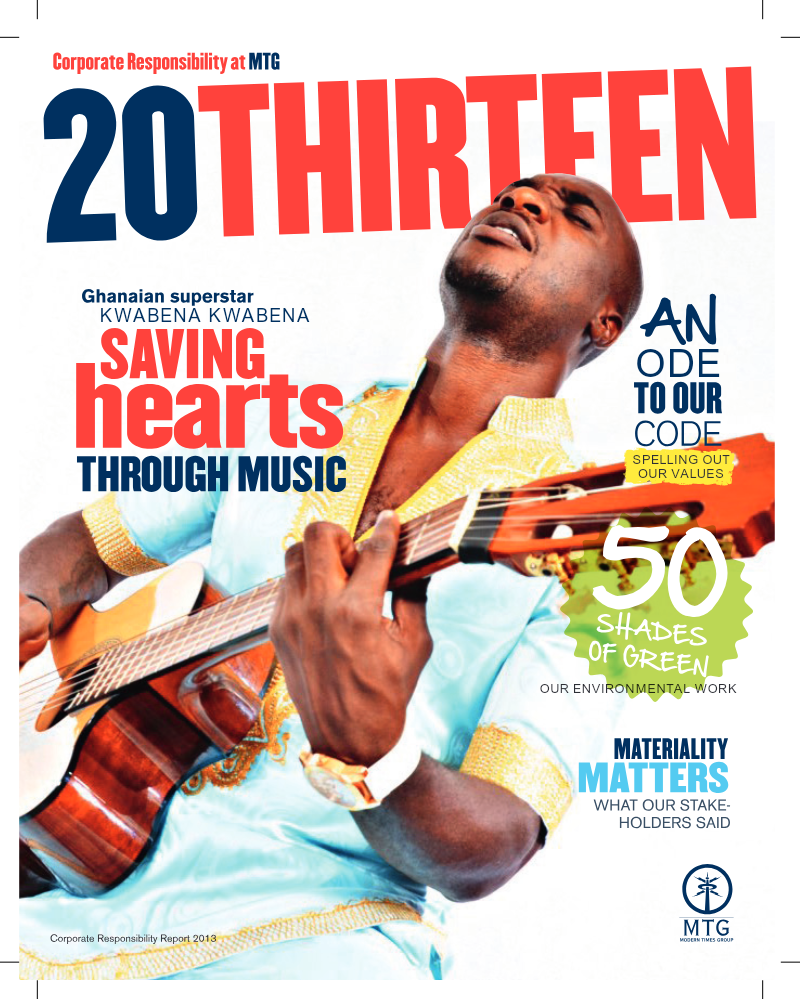
Corporate Responsibility Report 2013
Modern Times Group (MTG) maintains a comprehensive corporate responsibility strategy centered on media integrity, employee welfare, environmental stewardship, and ethical business governance. During the 2013 fiscal year, the organization prioritized digital development and the protection of young audiences, achieving recognition in the Dow Jones Sustainability Europe Index. With a workforce of 3,361 employees and net sales reaching 14,129 MSEK, the company leveraged its extensive media reach to contribute over 42 million TSEK in combined financial and media-time donations to charitable causes, most notably through the Reach for Change social entrepreneurship foundation.
Operational performance in 2013 reflected a mix of progress and systemic challenges. Environmental efforts yielded a strong score of 88 out of 100 in the CDP report, supported by energy-efficient infrastructure and carbon disclosure initiatives, despite a 7% rise in total carbon emissions linked to corporate expansion. Internally, the company implemented rigorous anti-bribery policies and updated editorial standards. However, workforce metrics revealed persistent disparities, including a gender pay gap where female remuneration averaged 70% of male earnings, alongside a decline in return-to-work rates following parental leave.
The reporting process, conducted in accordance with GRI G4 Core standards and independently assured by Ethos International, identified customer data integrity and child protection as the most material issues for the business. While the company successfully established a new Corporate Responsibility Advisory Group to oversee governance, auditors noted significant limitations in existing data collection systems. Future strategic objectives focus on harmonizing human resources data, improving supply chain management, and refining internal reporting mechanisms to better track labor and training metrics across the company’s global operations.
- MTG achieved 14,129 MSEK in net sales while contributing 42 million TSEK in financial and media-time donations, primarily through the Reach for Change foundation.
- The company reported a significant gender pay gap in 2013, with female remuneration averaging only 70% of male earnings.
- MTG earned a score of 88 out of 100 in the CDP environmental report, though total carbon emissions increased by 7% due to corporate expansion.
- Materiality assessments identified customer data integrity and child protection as the primary strategic risks for the business.
- The organization maintained a workforce of 3,361 employees while experiencing a decline in return-to-work rates following parental leave.
+1
Modern Times Group
Report13 pages
Modern Responsibility Report 2008
The Modern Times Group (MTG) 2008 Modern Responsibility Report outlines the company’s strategic commitment to integrating social, environmental, and ethical considerations into its international broadcasting and entertainment operations. The primary thesis posits that sustainable and responsible business practices are essential for long-term commercial success and community development. By formalizing its corporate responsibility program, which was originally introduced in 2004, the company seeks to maximize the positive influence of its media platforms while minimizing potential negative societal impacts.
The report covers MTG’s diverse operations across 30 countries, including Scandinavia, the Baltics, Central and Eastern Europe, Africa, and North America. The company’s business segments—Viasat Broadcasting, MTG Radio, Online, and Modern Studios—reach an audience of 125 million viewers and over three million daily radio listeners. Key performance data for 2008 highlights significant charitable engagement, with the company donating 78 million Swedish krona in airtime and helping to raise 56 million Swedish krona for various social causes. Environmental initiatives included the implementation of a strict travel policy, the adoption of energy-efficient office practices, and the calculation of carbon emissions for operations in Scandinavia and the UK, which totaled 4,223 tonnes of CO2.
Methodologically, the report relies on internal data collection, including employee training metrics, carbon footprint calculations based on the Greenhouse Gas Protocol, and stakeholder engagement feedback. The company maintains a workforce of 2,810 employees, with 46% of staff receiving formal training through the internal MTG Academy in 2008. Governance is managed by senior leadership, supported by a central coordinator and local ambassadors, with a newly established committee tasked with overseeing future objectives. The report serves as a foundational disclosure of the company’s commitment to transparency, with plans to expand reporting scope and data collection systems in subsequent years.
- MTG formalized its corporate responsibility program in 2008 to integrate ethical and environmental standards across its broadcasting operations in 30 countries.
- The company reached an audience of 125 million viewers and over three million daily radio listeners through its Viasat Broadcasting, radio, online, and studio segments.
- MTG contributed 78 million Swedish krona in airtime and facilitated the raising of 56 million Swedish krona for various social causes during 2008.
- Carbon emissions for operations in Scandinavia and the UK totaled 4,223 tonnes of CO2, tracked using the Greenhouse Gas Protocol.
- The company employed 2,810 staff members in 2008, with 46% of the workforce completing formal training through the internal MTG Academy.
Modern Times Group
Report52 pages
Modern Responsibility Report 2011
MTG’s 2011 corporate responsibility strategy centers on integrating ethical business practices, environmental stewardship, and social engagement across its operations in 39 countries. By aligning its governance with the Global Reporting Initiative framework and securing a position in the FTSE4Good Index, the company demonstrates a commitment to transparency and high-level sustainability standards. The primary objective is to balance commercial success with a robust social mandate, ensuring that broadcasting and production activities contribute positively to the diverse markets in which the company operates.
Operational performance in 2011 was marked by the successful achievement of 14 out of 15 short-term sustainability goals. Environmental efforts proved particularly effective, as the company exceeded its carbon reduction target by achieving a 6% decrease in emissions per employee through enhanced energy efficiency and facility management. Simultaneously, the company prioritized internal governance by updating anti-bribery and corruption policies and ensuring 100% employee participation in regulatory training. Workforce development was further bolstered by the launch of the Modern People career platform and expanded training through the MTG Academy, which aims to address gender representation in management and foster professional growth.
Social impact remains a core pillar of the company’s mission, evidenced by significant charitable contributions and community-focused programming. In 2011, the company donated 146 million SEK in airtime and raised 37 million SEK for health and welfare initiatives. Beyond financial support, the company utilized its media reach to promote social cohesion through projects like the United for Peace football tournament. Furthermore, the organization maintained a strong focus on consumer protection, particularly regarding child safety in digital and traditional media, while increasing accessibility through expanded subtitling services. These combined efforts reflect a comprehensive approach to corporate citizenship that emphasizes both internal compliance and external community development.
- MTG achieved 14 out of 15 short-term sustainability goals in 2011 while maintaining its position in the FTSE4Good Index and aligning with Global Reporting Initiative standards.
- The company exceeded its carbon reduction target by achieving a 6% decrease in emissions per employee through improved energy efficiency and facility management.
- MTG donated 146 million SEK in airtime and raised 37 million SEK for various health and welfare initiatives during the 2011 fiscal year.
- Internal governance was strengthened by updating anti-bribery and corruption policies and achieving 100% employee participation in regulatory training.
- Workforce development efforts included the launch of the Modern People career platform and expanded training via the MTG Academy to improve gender representation in management.
+1
Modern Times Group
Report24 pages
Modern Responsibility Report 2010
MTG’s 2010 Modern Responsibility initiative establishes a comprehensive framework for integrating economic, environmental, and social accountability across its global media operations. Spanning 33 countries, the company’s strategy centers on four pillars: responsible business conduct, broadcasting integrity, employee relations, and community engagement. By adopting the Global Reporting Initiative framework and conducting a formal materiality analysis, the organization has aligned its internal governance with stakeholder priorities, specifically emphasizing anti-corruption, regulatory compliance, and fair employment practices.
Operational performance in 2010 reflects a dual focus on professional development and social impact. The company invested heavily in human capital through the MTG Academy, which emphasizes leadership and sales training, while simultaneously promoting diversity and female representation in management. Beyond internal operations, the company leveraged its media influence to drive social change, donating 111 million SEK in airtime to charitable causes and launching foundations such as MTG United for Peace and Playing for Change. These efforts underscore a commitment to using broadcasting platforms to support disaster relief, cancer research, and youth development.
Environmental stewardship remains a critical, albeit challenging, area of focus. Total climate impact reached approximately 15,000 tons of CO2e in 2010, driven largely by business travel and facility energy consumption. Despite a 36 percent increase in travel-related emissions, the company has implemented rigorous mitigation strategies, including the adoption of ISO 14001 standards and a mandate to reduce CO2 emissions per employee by 5 percent by early 2012. Through the integration of green training for 59 percent of its staff and the expansion of video conferencing, the organization seeks to balance its international growth with a measurable reduction in its corporate carbon footprint.
- MTG established a 2010 corporate responsibility framework across 33 countries, utilizing the Global Reporting Initiative to prioritize anti-corruption, regulatory compliance, and fair employment.
- The company donated 111 million SEK in airtime to charitable causes in 2010, supporting initiatives like MTG United for Peace and Playing for Change.
- MTG’s total climate impact reached approximately 15,000 tons of CO2e in 2010, with business travel-related emissions increasing by 36 percent.
- To mitigate environmental impact, the company mandated a 5 percent reduction in CO2 emissions per employee by early 2012 and provided green training to 59 percent of its staff.
- Human capital investment in 2010 focused on leadership and sales training through the MTG Academy, alongside efforts to increase female representation in management.
+1
Modern Times Group
Report42 pages
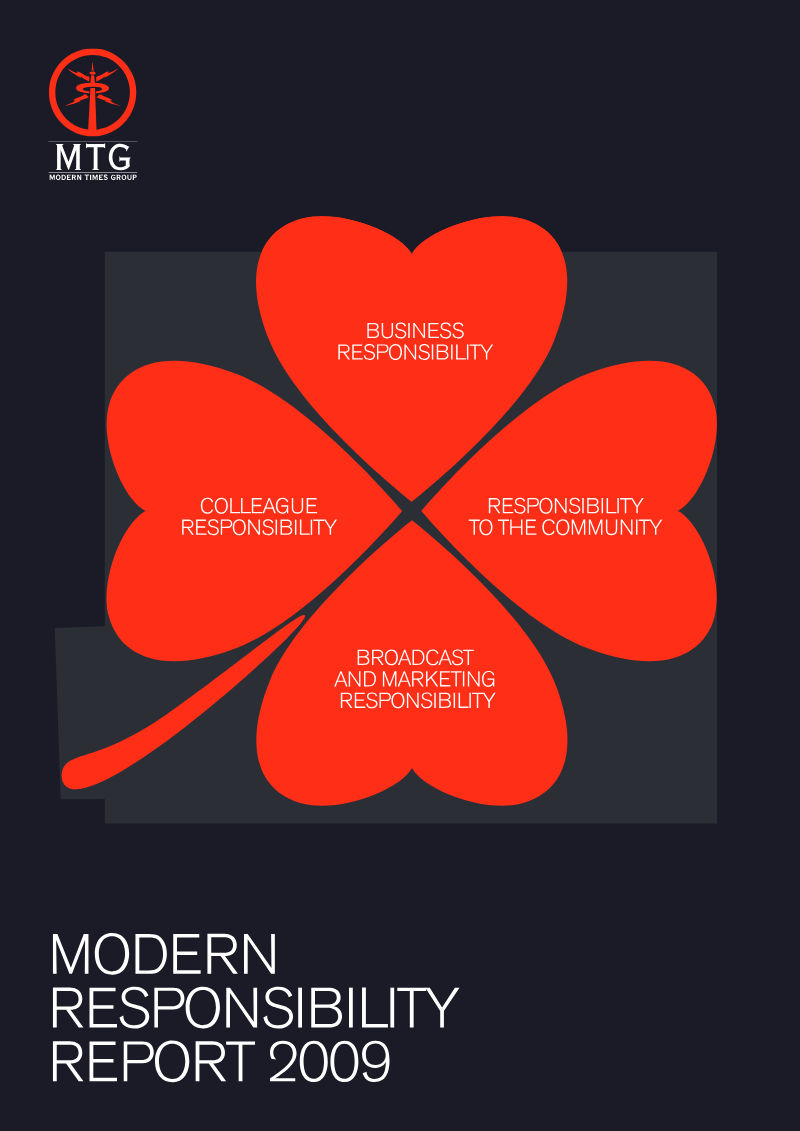
Modern Responsibility Report 2009
Modern Times Group (MTG) maintains a comprehensive commitment to integrating corporate responsibility into its broadcasting and entertainment operations across 31 countries. The primary objective of its 2009 strategic framework is to ensure sustainable business growth through rigorous governance, ethical conduct, and social accountability. By formalizing environmental policies and establishing a structured oversight committee, the company seeks to balance its commercial objectives with its impact on society and the environment, even amidst the challenging economic climate of the late 2000s.
Operational performance is anchored by a robust governance model that emphasizes transparency, fair competition, and strict adherence to a global code of conduct. Key initiatives include the implementation of a whistleblower policy, mandatory compliance training, and the protection of minors through regulated content and parental controls. The company’s focus on human capital is evidenced by the MTG Academy, which provided training to 81 percent of permanent staff, and a diverse workforce spanning 38 nationalities. These efforts are supported by internal audits and key performance indicators designed to enhance the measurability of ethical and social initiatives.
Environmental stewardship remains a central pillar of the company’s strategy, with carbon footprint audits now covering operations in 19 countries. In 2009, the organization recorded a total climate impact of approximately 13,000 tons of CO2e, prompting investments in energy-efficient infrastructure and reduced travel requirements. Beyond internal reductions, the company leverages its media platforms to drive social change, notably through the "Playing for Change" initiative and the donation of airtime to support environmental and social causes. By aligning its broadcasting reach with philanthropic goals, the company reinforces its position as a responsible stakeholder in the global media landscape.
- MTG established a formal corporate responsibility framework in 2009 to integrate governance, ethical conduct, and social accountability across its broadcasting operations in 31 countries.
- The company recorded a total climate impact of approximately 13,000 tons of CO2e in 2009, leading to the implementation of carbon footprint audits across 19 countries and investments in energy-efficient infrastructure.
- Human capital development was prioritized through the MTG Academy, which provided training to 81 percent of the company's permanent staff.
- MTG maintains a diverse workforce representing 38 nationalities, supported by a governance model that includes mandatory compliance training and a formal whistleblower policy.
- The company utilizes its media reach for philanthropic purposes, specifically through the 'Playing for Change' initiative and the donation of airtime to support social and environmental causes.
+1
Modern Times Group
Report51 pages
Modern Responsibility Report 2012
Modern Times Group (MTG) integrates sustainability and ethical governance into its core business strategy to drive long-term growth across its global entertainment operations. During the 2012 fiscal year, the company maintained a workforce of 3,012 employees and generated net sales of 13,336 MSEK. Operating across more than 30 broadcast markets, the organization utilizes a four-pillar framework—business, colleague, broadcast/marketing, and community responsibility—to ensure regulatory compliance, promote diversity, and uphold editorial integrity.
The company’s commitment to corporate responsibility is evidenced by measurable progress in environmental and social performance. In 2012, MTG achieved a 6% reduction in CO2 emissions per employee and secured a "B" rating from the Carbon Disclosure Project. Social impact initiatives were equally prominent, with the company raising 49 million SEK for charitable causes and supporting programs such as "Reach for Change" and the "School of Tolerance." Furthermore, the organization prioritized consumer safety through enhanced parental controls and expanded accessibility services, including subtitling and audio descriptions, to better serve its diverse audience.
Adhering to the Global Reporting Initiative (GRI) G3.1 guidelines at a C+ application level, the company maintains a transparent approach to its operations, supported by independent assurance from Ethos International. While the 2012 performance reflects significant advancements in anti-corruption training, internal communication, and community engagement, the organization acknowledges the necessity for future improvements in supply chain management and human resources data collection systems. By aligning its broadcasting reach with strategic sustainability goals, MTG continues to leverage its media platforms to promote social awareness and mitigate climate-related business risks.
- In 2012, Modern Times Group (MTG) generated 13,336 MSEK in net sales while employing 3,012 staff across more than 30 broadcast markets.
- The company achieved a 6% reduction in CO2 emissions per employee and earned a 'B' rating from the Carbon Disclosure Project.
- MTG raised 49 million SEK for charitable causes in 2012, supporting initiatives such as 'Reach for Change' and the 'School of Tolerance'.
- The organization reported its sustainability performance using the Global Reporting Initiative (GRI) G3.1 guidelines at a C+ application level, with independent assurance provided by Ethos International.
- MTG implemented enhanced parental controls and expanded accessibility services, including subtitling and audio descriptions, to improve consumer safety and service inclusivity.
Modern Times Group
Report43 pages
Corporate Responsibility Report 2014
MTG’s 2014 operational strategy centered on the integration of corporate responsibility into its core business model, prioritizing digital data protection, the rights of minors, and the preservation of freedom of expression. By aligning operations with UN Global Compact and OECD guidelines, the company achieved net sales of 16,746 MSEK while maintaining a rigorous ethical framework. This governance structure included the implementation of a new supplier code of conduct, mandatory anti-bribery training, and the introduction of an external whistleblower system, resulting in zero confirmed cases of corruption during the fiscal year.
The company’s commitment to social and environmental stewardship was evidenced by a 33% reduction in energy consumption per employee since 2010 and an improved CDP score of 90B. Beyond internal efficiency, MTG leveraged its media platforms to double donated airtime for social and environmental causes. HR initiatives focused on decentralizing operations to empower local markets, fostering a diverse workforce of 4,111 employees representing 44 nationalities. While the company successfully promoted initiatives like Women in Tech, it acknowledged ongoing challenges regarding gender pay parity and high turnover rates in sales-intensive roles, leading to the restructuring of certain internal development goals.
Operating across diverse geographic regions, MTG maintained strict neutrality and regulatory adherence through robust content rating systems and parental controls. Independent assurance provided by Ethos International confirmed that the company’s performance indicators met the Core level of the Global Reporting Initiative G4 guidelines. While the organization successfully met most targets regarding data protection and environmental impact, auditors recommended the adoption of advanced digital management systems to enhance the accuracy of future human resource data collection, ensuring continued transparency and operational efficiency in subsequent reporting periods.
- MTG achieved net sales of 16,746 MSEK in 2014 while maintaining zero confirmed cases of corruption through the implementation of mandatory anti-bribery training and an external whistleblower system.
- The company reduced energy consumption per employee by 33% since 2010 and achieved a CDP score of 90B, reflecting its commitment to environmental stewardship.
- MTG employed 4,111 people across 44 nationalities, though the company identified ongoing challenges regarding gender pay parity and high turnover rates in sales-intensive roles.
- Operational governance was aligned with UN Global Compact and OECD guidelines, with independent assurance from Ethos International confirming compliance with the Global Reporting Initiative G4 Core level.
- The company prioritized digital safety by implementing robust content rating systems and parental controls to protect minors and preserve freedom of expression.
+1
Modern Times Group