Updated Apr 30, 2026 by Modern Times Group
Report
Published by Modern Times Group
Modern Times Group (MTG) integrates sustainability and ethical governance into its core business strategy to drive long-term growth across its global entertainment operations. During the 2012 fiscal year, the company maintained a workforce of 3,012 employees and generated net sales of 13,336 MSEK. Operating across more than 30 broadcast markets, the organization utilizes a four-pillar framework—business, colleague, broadcast/marketing, and community responsibility—to ensure regulatory compliance, promote diversity, and uphold editorial integrity. The company’s commitment to corporate responsibility is evidenced by measurable progress in environmental and social performance. In 2012, MTG achieved a 6% reduction in CO2 emissions per employee and secured a "B" rating from the Carbon Disclosure Project. Social impact initiatives were equally prominent, with the company raising 49 million SEK for charitable causes and supporting programs such as "Reach for Change" and the "School of Tolerance." Furthermore, the organization prioritized consumer safety through enhanced parental controls and expanded accessibility services, including subtitling and audio descriptions, to better serve its diverse audience. Adhering to the Global Reporting Initiative (GRI) G3.1 guidelines at a C+ application level, the company maintains a transparent approach to its operations, supported by independent assurance from Ethos International. While the 2012 performance reflects significant advancements in anti-corruption training, internal communication, and community engagement, the organization acknowledges the necessity for future improvements in supply chain management and human resources data collection systems. By aligning its broadcasting reach with strategic sustainability goals, MTG continues to leverage its media platforms to promote social awareness and mitigate climate-related business risks.
LET’S START A FEW WORDS FROM OUR CEO Sustainability. In 1994, when I joined MTG, sustainability wasn’t a word you heard that often. Now, during my first year as President and CEO of MTG, it’s a fundamental part of our vocabulary and how we view the world. Sustainability is no longer on the sidelines. We may talk about growth, profitability and business development opportunities, but the success of our long term growth is fundamentally connected to sustainability, and that’s why Modern Responsibility exists. Passion. We’re big on passion at MTG. It flows from within each and every one of us, and our employees form the beating heart of our company. Our goal is to engage our employees and to create an environment where they can leverage their talent and competence to move us along. But at the same time, we also want to provide an environment where our employees can develop and flourish. In 2012 one of our short-term targets, was to benchmark and report on industry standards, to ensure we are where we need to be in terms of training and development.
mpetence to move us along. But at the same time, we also want to provide an environment where our employees can develop and flourish. In 2012 one of our short-term targets, was to benchmark and report on industry standards, to ensure we are where we need to be in terms of training and development. Listening. We pay close attention to both global industry concerns and the issues that are specific to our industry. MTG is a modern entertainment company, in an industry that is changing at a very fast pace. Established business models are evolving, and the ever growing digital environment presents both opportunities and challenges, when it comes to quality control, products and customer safety. Within that framework, the 2010 materiality analysis and subsequent stakeholder surveys help us both define and navigate on our sustainability voyage. We are convinced that Modern Responsibility is both strong enough to get us there, and flexible enough to properly deal the challenges that we will face on our journey. Learning. 2012 has also been another year of extensive learning within our Modern Responsibility work. While 2011 saw the re-working and rolling out of a new Code of Conduct. In 2012, one our targets was to re-examine our Supplier Policy and Self Check Documents. At the end of the process, we had evaluated the whole structure of our corporate policy making and how we establish guidelines for processes and work streams. This work takes time, but the results enable us to work faster, simpler and more efficiently.
our Supplier Policy and Self Check Documents. At the end of the process, we had evaluated the whole structure of our corporate policy making and how we establish guidelines for processes and work streams. This work takes time, but the results enable us to work faster, simpler and more efficiently. The future. We strive to be adaptable, but also have clear short, mid and long term targets in place for our future development, and the targets take the global environment, our industry and our stakeholder groups into consideration. We are also fully committed to contribute to a better environment and to optimize our impact on the world. We work towards making the online environment as safe as possible for young viewers, and we continue to address corruption, human and labour rights issues and climate change in our daily work in order to make MTG a long term, sustainable and positive place to work.
> **[Chart page]** This page contains visual data — view in PDF for the best experience. The work. MTG is Made To Grow, and that growth implies an ability not only to adapt to, but to embrace fundamental change, as well as the need to harness the opportunities and to minimize the risks inherent in our sustainability work. Our business has changed shape before, and will do so again, and our future work must strike the balance between doing what we do best and abandoning old truths and limitations to benefit from how the world around us has changed. We may have started out as a broadcaster, but today we are an entertainment company. Our goal is to provide our customers with the best entertainment and the best experiences we can. We’re in this for the long term, we’re in it to grow, and we will do so responsibly and sustainably, so that the MTG we see today continues to evolve and transform into the media group of the future. — Jørgen Madsen Lindemann, CEO and President, Modern Times Group SNAPSHOT 2012 KEY FIGURES FROM THE PAST FIVE YEARS 2008 2009 2010 2011 2012 Net sales (MSEK) 11,880 12,427 13,101 13,473 13,336 Operating income (MSEK) 3,671 -1,428 2,355 2,567 2,124 Basic earnings per share (SEK) 43.25 -30.86 53.34 -19.98 22.93 Average number of employees 2,644 2,906 3,069 3,031 3,012
HOT 2012 KEY FIGURES FROM THE PAST FIVE YEARS 2008 2009 2010 2011 2012 Net sales (MSEK) 11,880 12,427 13,101 13,473 13,336 Operating income (MSEK) 3,671 -1,428 2,355 2,567 2,124 Basic earnings per share (SEK) 43.25 -30.86 53.34 -19.98 22.93 Average number of employees 2,644 2,906 3,069 3,031 3,012 FINANCIAL POSITION 2008 2009 2010 2011 2012 Shareholders' equity 8,980 5,680 6,239 4,350 5,134 Long-term liabilities 5,263 4,175 3,311 2,168 1,751 Short-term liabilities 4,989 4,796 4,452 4,763 4,808 Total shareholders' equity and liabilities 19,232 14,651 14,002 11,281 11,692
MTG HEADQUARTERS, STOCKHOLM VIASAT BROADCASTING HEADQUARTERS, LONDON COUNTRIES WITH OFFICES COUNTRIES WITH OPERATIONS BUT NO OFFICES 102 CHANNELS IN 36 COUNTRIES ARMENIA GUINEA ¹ POLAND AZERBAIJAN HUNGARY ROMANIA BELARUS KAZAKHSTAN RUSSIA BOSNIA AND HERTZEGOVINA KENYA SERBIA BULGARIA KYRGYZSTAN SLOVAKIA CENTRAL AFRICAN REPUBLIC ¹ LATVIA SLOVENIA CROATIA LITHUANIA SWEDEN CZECH REPUBLIC MACEDONIA TANZANIA DENMARK MOLDOVA UGANDA ESTONIA MONTENEGRO UKRAINE FINLAND NETHERLANDS ² UNITED KINGDOM ² GEORGIA NIGERIA UNITED STATES GHANA NORWAY 1New in 2012 2MTG has no media channels in these countries Removed from the list: Uzbekistan, Spain, Malta
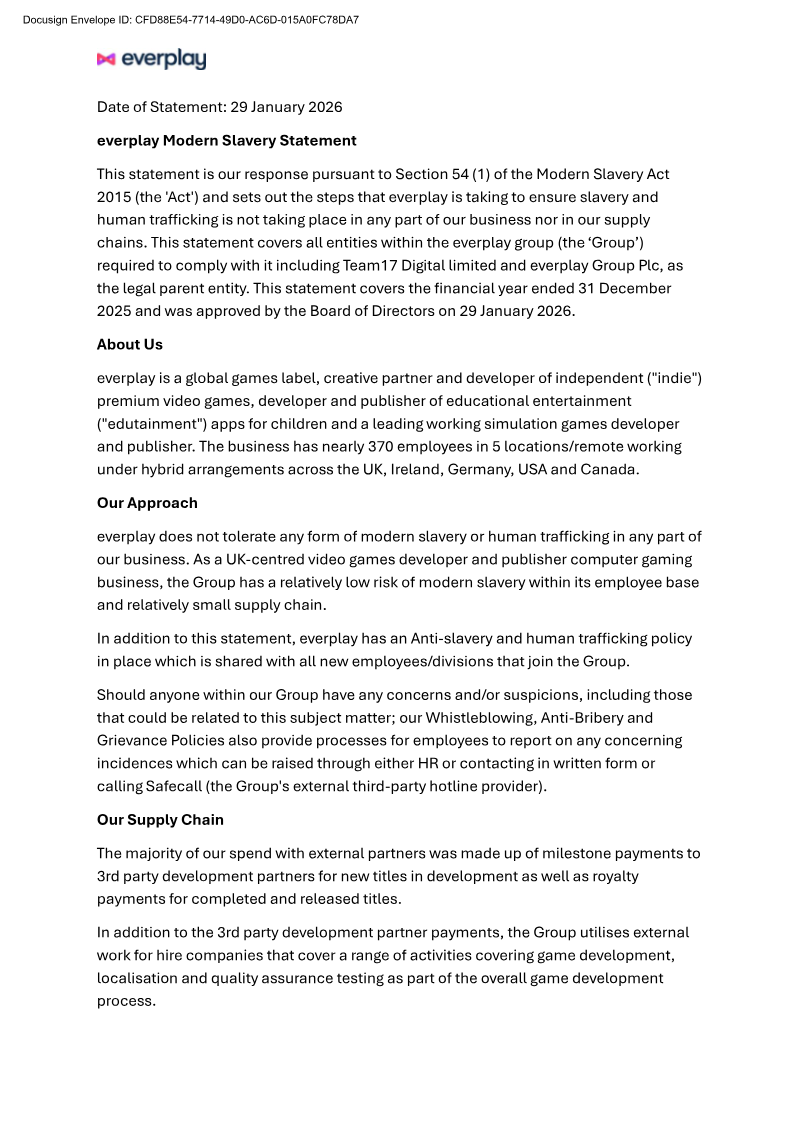
Everplay maintains a zero-tolerance stance toward modern slavery and human trafficking across its global operations and supply chains. As a UK-centered video games developer and publisher, the organization identifies as having a relatively low inherent risk due to the nature of the digital entertainment industry. The operational scope covers the financial year ending December 31, 2025, and encompasses approximately 370 employees working across the United Kingdom, Ireland, Germany, the United States, and Canada. The primary supply chain expenditures involve milestone and royalty payments to third-party development partners, alongside work-for-hire contracts for game development, localization, and quality assurance testing. While the overall risk profile remains low, the organization identifies localization and quality assurance as areas carrying a slightly higher risk. To mitigate these concerns, all new and renewing contracts include mandatory compliance clauses regarding the Modern Slavery Act 2015, granting the company the right to terminate agreements in the event of a breach. Governance is managed through the Audit Committee, which reports to the Board of Directors at least twice annually. Due diligence efforts include a risk-based approach to supplier assessment and the implementation of internal policies such as whistleblowing, anti-bribery, and grievance procedures. Employees and third parties are provided with confidential reporting channels, including an external hotline. The effectiveness of these measures is tracked through an annual risk register assessment, which currently reports zero incidents of modern slavery. Training and awareness initiatives are provided to ensure that employees and stakeholders can identify and report potential risks effectively.
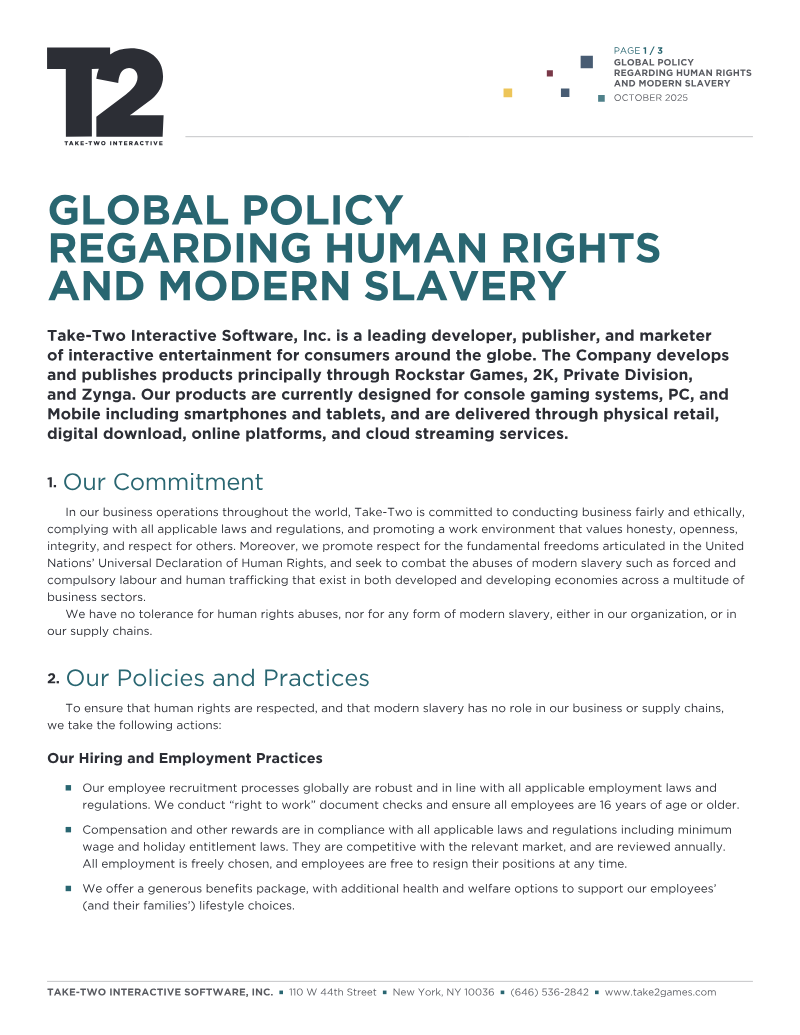
Take-Two Interactive Software establishes a comprehensive framework for maintaining ethical business practices and safeguarding human rights across its global operations as of October 2025. The primary objective is to eliminate modern slavery, forced labor, and human trafficking within the organization and its extensive supply chains. This commitment extends across all major publishing labels, including Rockstar Games, 2K, Private Division, and Zynga, covering the development and distribution of interactive entertainment for console, PC, and mobile platforms. The policy outlines rigorous hiring and employment standards, mandating that all employees be at least 16 years of age and that employment is strictly voluntary. Compensation and benefits are reviewed annually to ensure they meet or exceed legal minimums and market standards. Furthermore, the company enforces a strict non-discrimination policy, ensuring that recruitment and career advancement are based solely on ability and merit rather than protected characteristics. These internal standards are reinforced by a Global Code of Business Conduct and Ethics that applies to all directors, officers, employees, and contractors. To ensure compliance throughout the supply chain, which includes disc replicators, printers, and logistics providers in regions such as North America, Europe, and Japan, the company utilizes a dedicated Supplier Code. This requires third-party partners to represent that they do not utilize child, prison, or slave labor. Oversight is maintained through biennial training for employees and targeted training for consultants. Additionally, the company provides a confidential reporting hotline managed by an independent third party, protecting whistleblowers from retaliation. Key suppliers are also expected to conduct periodic internal or independent audits to verify adherence to labor, health, and safety standards.
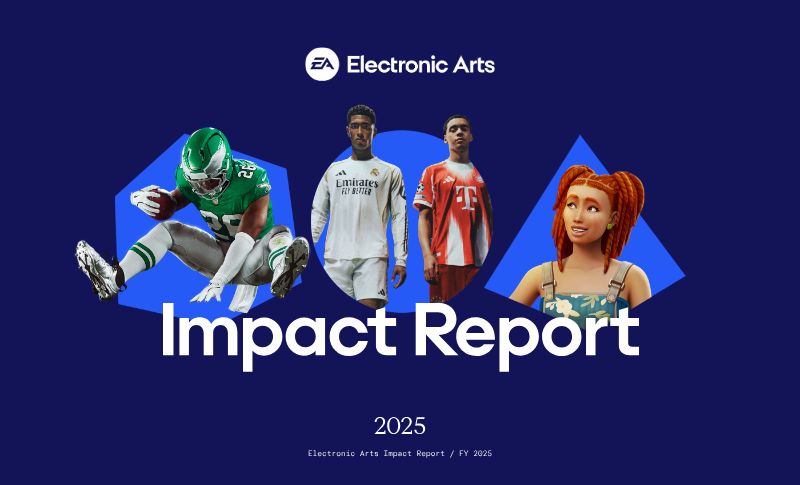
The FY 2025 impact analysis presents Electronic Arts’ comprehensive ESG strategy, arguing that responsible stewardship of people, planet, and data is integral to sustainable growth in the interactive‑entertainment sector. By quantifying progress across talent, climate, privacy and security, the report demonstrates how the company translates corporate responsibility into measurable outcomes while maintaining its global market position. Across a workforce of more than 6,000 employees worldwide, 83 % now have access to internal AI tools, and 17 % of new hires are returning staff, contributing to an industry‑leading attrition rate of –0.1 %. Expanded benefits—including paid parental leave and bereavement support—paired with a balanced gender composition, underpin the talent‑focused results. Community engagement generated 18,000 volunteer hours and $5.9 million in investments, reinforcing the social dimension of the strategy. Environmental performance shows a clear downward trajectory: total operational emissions fell to 6.6 Mt CO₂e in FY25, down from 7.3 Mt in FY24 and 10.6 Mt in FY23, with Scope 1 emissions at 2.98 Mt and Scope 2 (market‑based) comprising the remainder, while energy consumption reached 380,859 GJ, fully sourced from office operations. The company’s carbon‑neutral status and renewable‑energy initiatives address identified climate risks such as acute physical events, volatile energy prices, rising carbon costs and emerging reporting regulations. Data‑privacy and security are governed by a privacy‑by‑design framework overseen by the Audit Committee, delivering explicit player notice, consent and control, data‑minimisation, and partner‑risk contracts. The security management system aligns with ISO, NIST and CIS standards, undergoes annual independent validation, operates a 24‑hour SOC and mandates annual training for all staff. An articulated AI governance model completes the governance pillar, ensuring responsible deployment of emerging technologies. Collectively, these initiatives illustrate a holistic, globally scoped commitment to ESG excellence throughout FY 2025.
This research examines the professional landscape of the global gaming industry, drawing on a survey of over 160 professionals conducted during Gamescom 2025. The sample represents a diverse geographic spread, with significant participation from Europe and North America, alongside emerging representation from Latin America, Asia-Pacific, and Africa. Demographically, the industry remains male-dominated (65%), though women (30%) and non-binary individuals (6%) constitute a notable portion of the workforce. The data highlights a mid-career-heavy industry, where nearly half of the respondents possess six to ten years of experience, while newcomers are increasingly rare due to slowed recruitment and a preference for senior talent. The central thesis identifies a stark paradox: while 76% of professionals report high job satisfaction driven by a deep passion for creative expression, trust in the industry as a sustainable career path has collapsed, evidenced by a Net Promoter Score (NPS) of -40. This disillusionment is most pronounced among veterans aged 45 and older. While the "spark of passion" remains the primary motivator for joining and staying in the field, it is increasingly undermined by systemic issues. Key deterrents include low compensation (54%), unstable employment (43%), and burnout (30%). The findings conclude that the industry is at a critical juncture. Professionals envision a future defined by player-centric design, cross-platform development, and increased diversity. However, they warn that the current model—characterized by "suits" maximizing short-term profits and frequent layoffs—is unsustainable. The research suggests that a "Golden Age" of gaming can only be achieved by shifting from profit-driven exploitation of passion toward structural stability, fair compensation, and genuine collaboration. Without these changes, the industry risks a continuous drain of the talent required to sustain its creative output.