
Telltale Games
CompanyUnited States · Founded 2004
Documents about Telltale Games
Article
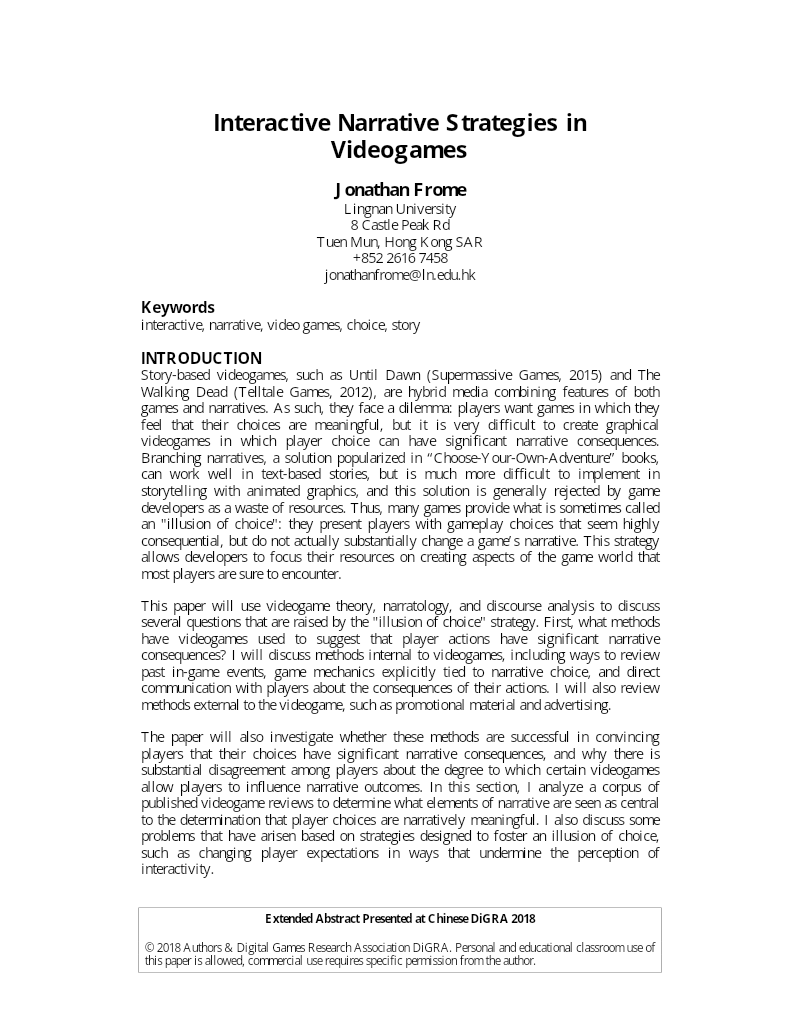
Interactive Narrative Strategies in Videogames
This paper examines the "illusion of choice" strategy in story-based videogames, where developers present player decisions that appear consequential without substantially altering the narrative.
- The 'illusion of choice' is a design strategy in story-based games where player decisions appear consequential without substantially altering the narrative, driven by the high cost of producing branching storylines with animated graphics.
- Developers often regard branching narratives as an inefficient use of resources, creating a core dilemma in hybrid media between players' desire for meaningful choices and the production costs of delivering them.
- Illusion-of-choice techniques are divided into internal methods (reviewing past events, mechanics explicitly tied to narrative choice, and direct communication of action outcomes) and external methods (promotional material framing a game as highly responsive to player decisions).
DiGRAJun 2025
Article
"No Going Back": The Telltale Model as Thought Experiment
Sarian's "No Going Back" argues that Telltale Games' choice-driven narratives, despite offering little ludic consequence, generate genuine meaning by functioning as philosophical thought experiments that confront players with moral dilemmas and expose their underlying values.
- Sarian argues that Telltale Games' choice-driven narratives generate genuine meaning as philosophical thought experiments, even though their choices carry little ludic (gameplay) consequence.
- The serial, television-like structure of these games defers consequences and keeps narratives largely linear, while end-of-episode survey screens compare individual choices against community data.
- The analysis links the model's limitations to the ELIZA effect, where an illusion of complexity dissolves under scrutiny, but contends that this illusion is not disqualifying.
Eludamos: Journal for Computer Game CultureSep 2018

