TecToy
Company
2 documents in the library are about TecToy, from writers such as DiGRA. Each has a summary and key insights with the page they come from.
Connections
Each row is a game or company named alongside TecToy, each column a document, oldest first. A mark means that document names it. Select a row to see those documents.
Documents about TecToy
Trajectories of Professionalization as Game Developer in 2000s Brazil: Stories from Tectoy Digital/Zeebo Interactive Studios/Tectoy Studios
This paper examines how individuals became professional game developers in 2000s Brazil, a context where professional opportunities were volatile and formal training pathways were scarce.
- The study examines three defunct mid-sized Brazilian studios, Tectoy Digital, Tectoy Studios, and Zeebo Interactive Studios, all linked to Tectoy, a 1990s and 2000s local partner of SEGA.
- Precarious and volatile professional conditions in 2000s Brazil tended to produce versatile, generalist developers who specialized only later in their careers.
- The research challenges the assumption that game-development innovation flows one way from the Global North to the Global South, arguing that Brazilian production practices produced distinct knowledge and skills.
East Meets South: The Creative Appropriation of Nintendo and Sega Videogames in Brazil
This paper, presented at DiGRA 2020 by Mariana Amaro and Suely Fragoso of the Federal University of Rio Grande do Sul, examines how Brazilian companies creatively appropriated Japanese and American videogames during the country's protectionist period, roughly 1984 to 1992, and in the years that followed.
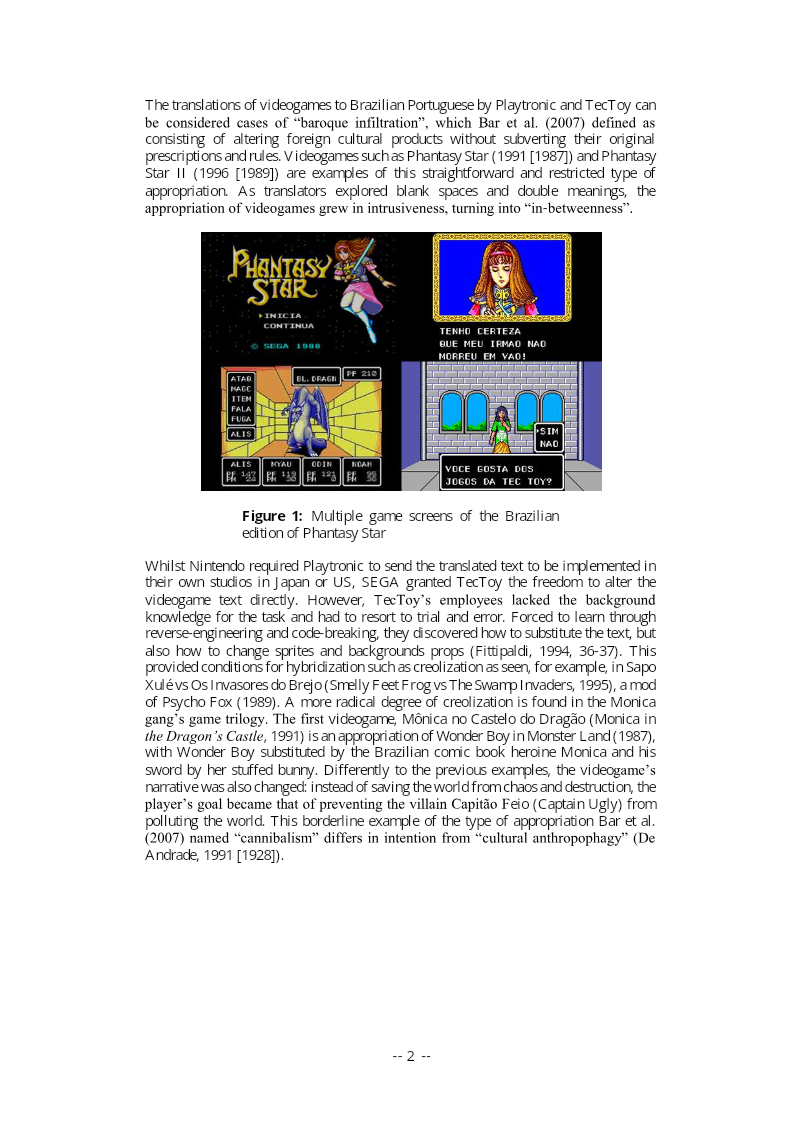
- The paper argues that Brazilian localizations of Japanese and American games during the protectionist era (roughly 1984–1992 and after) illustrate five Latin American forms of appropriation, ordered from least to most radical: baroque infiltration, in-betweenness, creolization, cannibalism, and cultural anthropophagy.
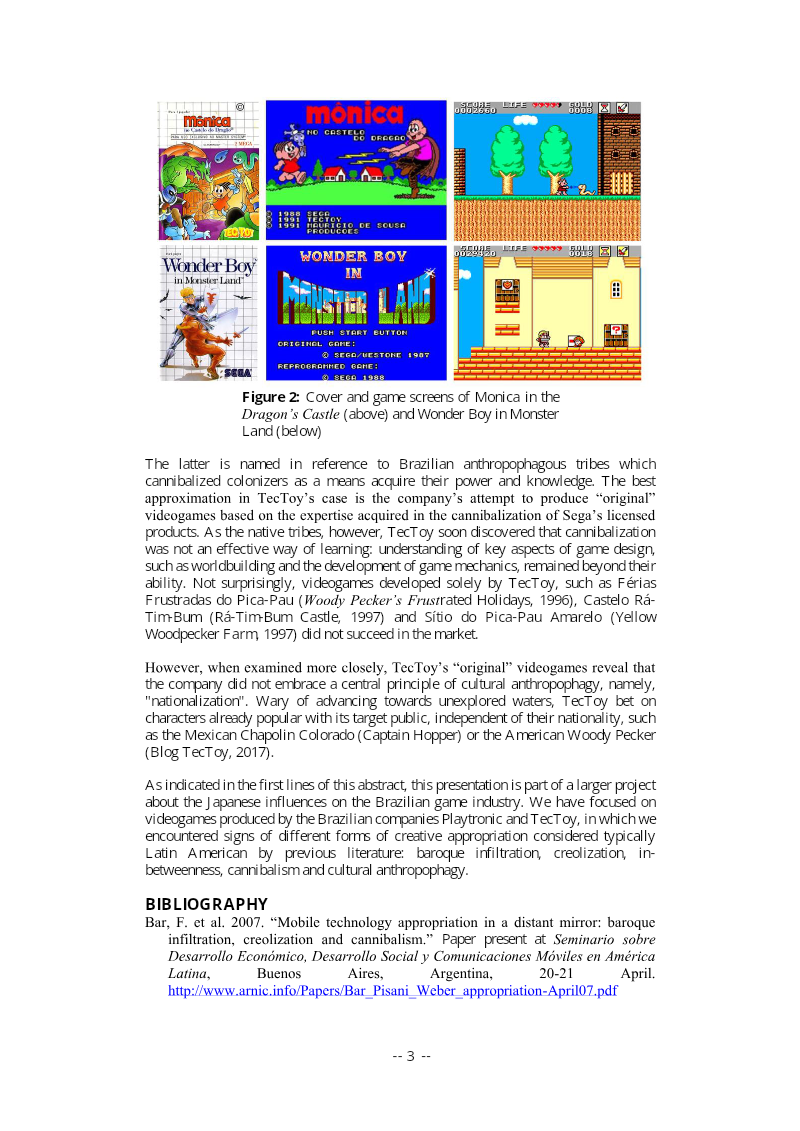
- Nintendo's Brazilian arrangement with Playtronic, a joint venture of Gradiente and Estrela, was tightly controlled, with translation sent to Japan or the United States and only a handful of titles localized.
- The Sega partnership with TecToy was far less restrictive, producing more than 500 titles from the late 1980s to 2000 and allowing Brazilian staff to alter on-screen text, sprites, and backgrounds.