Playdemic
Company
Documents about Playdemic
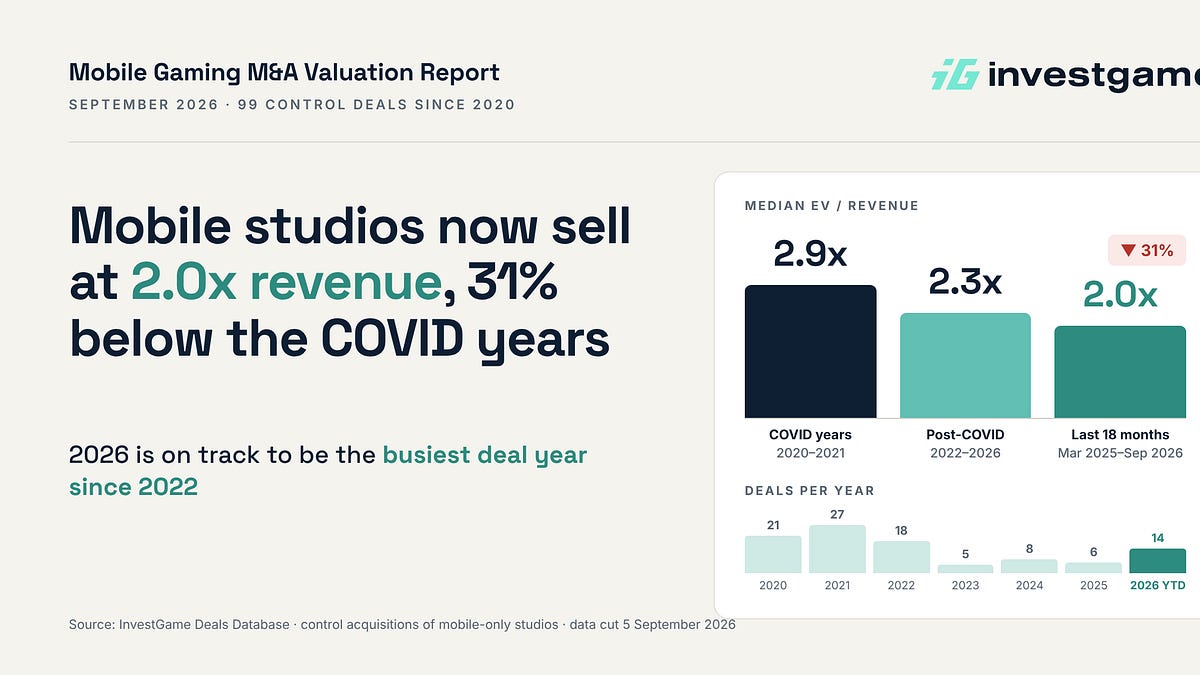
Mobile Studio M&A: Revenue and EBITDA Multiples
The mobile gaming industry is experiencing a notable shift in valuation dynamics, characterized by a decline in acquisition multiples alongside a resurgence in deal volume.
- Mobile gaming studio acquisitions are currently valued at a median of 2.0x revenue and 8.6x EBITDA, representing a 31% and 14% decline respectively compared to the 2020–2021 COVID-era peaks.
- Deal activity is accelerating in 2026, with 14 recorded transactions by September 5, making it the busiest year for mobile studio M&A since 2022.
- Large-cap acquisitions valued at $1bn+ command a significant premium, trading at a median of 3.9x revenue and 19.7x EBITDA, compared to 2.1x and 9.1x for mid-cap deals between $100m and $1bn.

The Turf War Between Golf Clash & Golf Rival
The mobile golf simulation market is currently defined by a high-stakes competitive landscape between two dominant titles: Playdemic’s Golf Clash and StarLark’s Golf Rival.
- Golf Clash and Golf Rival demonstrate high profitability in the mobile sports genre, with RPDs of $12.32 and $6.59 respectively, significantly outperforming franchise-led titles like FIFA Soccer ($1.31) and NBA LIVE ($0.90).
- Golf Rival is successfully challenging Golf Clash’s market dominance by removing the wager-based entry fee system, allowing for unlimited session play compared to Golf Clash’s coin-gated progression.
- Golf Rival has achieved parity with Golf Clash in Monthly Active Users (MAU) by leveraging Zynga’s robust live-ops calendar and more experimental user acquisition strategies.

Why EA Saw Decline in Mobile Revenue Despite Obtaining Big Hits Through Acquisitions
Electronic Arts experienced a significant decline in mobile revenue during early 2022 despite investing $3.5 billion in the acquisitions of Glu Mobile and Playdemic in 2021.
- Electronic Arts saw a 23% year-over-year decline in mobile revenue for the first quarter of 2022, despite a 22% increase in total downloads.
- In 2021, EA invested $3.5 billion to acquire Glu Mobile and Playdemic, yet all major acquired IPs—including Kim Kardashian: Hollywood and Golf Clash—experienced revenue declines post-acquisition.
- The primary cause of the performance decline is attributed to EA's decision to force the integration of acquired studios into its corporate structure rather than maintaining their autonomy.
How the Games Industry M&A Frenzy is Making New Genre Leaders in Mobile
The mobile gaming industry is experiencing a significant transformation driven by aggressive merger and acquisition activity, which is enabling major publishers to rapidly secure leadership positions across diverse genres.
- The mobile gaming industry is experiencing a significant M&A frenzy, driven by a maturing market, a lockdown-induced bump, and intense competition, allowing major publishers to quickly become genre leaders.
- EA became the No. 1 mobile Sports games publisher by U.S. revenue ($176 million) and the No. 1 Lifestyle games publisher ($123 million) between January 1 and August 31, 2021, largely due to its acquisitions of Glu Mobile and Playdemic.
- Activision Blizzard (including King) maintained its position as the No. 1 publisher in the Puzzle genre, generating approximately $873 million in U.S. player spending from January 1 to August 31, 2021, with Candy Crush Saga performing strongly.

GameMakers Games Radar
This industry update provides a snapshot of the mobile gaming landscape as of August 2021, focusing on major acquisitions, emerging trends in blockchain gaming, and the evolving discourse surrounding the metaverse.
- Zynga acquired the mobile game developer StarLark and its title 'Golf Rival' for $525 million, consisting of $315 million in cash and $210 million in common stock.
- Golf Rival is currently positioned as the second-largest mobile golf game, with Zynga management characterizing it as a casual, social-focused PvP experience.
- The acquisition valuation for StarLark reflects EBITDA multiples in the mid-to-high teens, consistent with the $1.4 billion acquisition of Playdemic by EA.
Zuck's Achilles Heel: Disney's Renewed Interest in Games and EA's Spending Spree
The gaming industry is currently defined by aggressive intellectual property (IP) licensing, rapid consolidation, and a contentious push for new monetization models.
- Electronic Arts spent $4.7 billion over a twelve-month period to acquire studios including Playdemic, Codemasters, and Glu Mobile to expand its mobile gaming footprint and gain leverage against platform holders like Apple.
- Disney has pivoted its interactive strategy to a licensing-heavy model, offloading the operational risks of game development by granting third-party developers like Ubisoft and Square Enix access to its franchise portfolio.
- Facebook’s attempt to integrate advertisements into its Oculus VR platform failed due to community backlash, forcing developers to withdraw from ad-testing programs and highlighting the incompatibility of current ad models with immersive environments.

Golf Clash: A Case Study in Free-to-Play Monetization
Golf Clash, a mobile golf simulation game developed by Playdemic, serves as a primary example of successful free-to-play monetization through the strategic adaptation of established mechanics.
- Golf Clash monetizes through a 'pay-to-play' entry fee where players wager soft currency (gold) on matches, creating a direct incentive for players to upgrade their gear to avoid losing their entry stakes.
- The game successfully adapted the Clash Royale chest-and-card upgrade economy, but differentiated itself by gating match access with gold rather than just time-based chest unlocks.
- Playdemic introduced consumable golf balls with varying stats as a secondary monetization layer, allowing players to reduce risk and gain strategic advantages without creating a purely 'pay-to-win' dynamic.