Papergames
Company
7 documents in the library are about Papergames, from writers such as DiGRA and National Coalition of Independent Scholars. Each has a summary and key insights with the page they come from.
Connections
Each row is a game or company named alongside Papergames, each column a document, oldest first. A mark means that document names it. Select a row to see those documents.
Documents about Papergames
Affective Predation: Gendered Play, Monetisation, and Precarity in Otome Gacha Games
This paper examines how Love and Deepspace (LADS), a popular female-oriented otome gacha game launched by Papergames/Infold Games in January 2024, uses romance conventions and gacha mechanics to monetise players' emotional attachment.
- The authors frame otome gacha as "affective predation": romantic progression in Love and Deepspace (LADS) is structured so it can only advance through continued emotional and financial investment, creating a loop where desire, intimacy, and spending reinforce one another.
- LADS, developed by Papergames/Infold Games and launched in January 2024, reportedly surpassed US$750 million in spending by August 2025, excluding mainland China, illustrating the large commercial stakes of this design approach.
- Unlike prior gacha research that focused mainly on gambling-adjacent behaviour, the paper foregrounds the affective bonds players form with characters, drawing on Ahmed's affective economies and Chess's "player two" concept to explain how industry builds profitable gendered audiences.
The Husbando Super-App: Tracing Player Investment with Love and Deepspace
This work-in-progress paper examines how players become invested in Papergames' Love and Deepspace (2024), a free-to-play mobile otome and gacha game, and uses it as a case study for a broader argument about player investment.
- The paper uses Papergames' Love and Deepspace (2024), a free-to-play mobile otome and gacha game, as a case study for how player investment operates both materially and affectively.
- It proposes five non-exhaustive dimensions of investment (monetary, temporal, storage, affective, and fandom) as a lens for understanding how neoliberal capitalism structures leisure, particularly women's leisure.
- The monetary dimension centres on crystals, a currency obtainable only through microtransactions, which offer the easiest route to otherwise time-limited romantic content.

Leaving Teyvat: Gendered Expectations and Exit Discourses
This paper examines why players quit or disengage from Genshin Impact and migrate to Love and Deepspace, framing player exit as a form of critical commentary rather than a rejection of the gacha genre itself.
- The study frames players intentionally quitting Genshin Impact and moving to Love and Deepspace as a form of critical commentary, not a rejection of the gacha genre itself.
- The analysis is a thematic study (after Braun and Clarke) of roughly 400 comments from a single Reddit thread, so its findings are explicitly preliminary and not generalizable.
- Key complaints about Genshin Impact include the scarcity of male five-star characters, the perceived prioritization of sexualized female characters aimed at a male audience, and weaker storylines and writing in the Natlan expansion compared with earlier content.
Constructing Parasocial Intimacy in Otome Games: A Data-Driven and Autoethnographic Study Based on Love and Deepspace
This study examines how parasocial intimacy between players and virtual characters is constructed and sustained in otome games, using Love and Deepspace as a case study.
- Player emotional investment in Love and Deepspace is strongly character-centered: references to individual characters far outnumber discussions of world-building or settings in the Reddit data.
- The study proposes a 'player-avatar-character' ternary model, framing parasocial intimacy as a dynamic, continuously reinforced process rather than one-directional emotional projection.
- Relationship construction follows a deepening trajectory: from initial emotional stance to personality matching and self-identification, and finally to exclusive fantasy and imagined future scenarios, with the Reddit community acting as a channel for affective circulation.
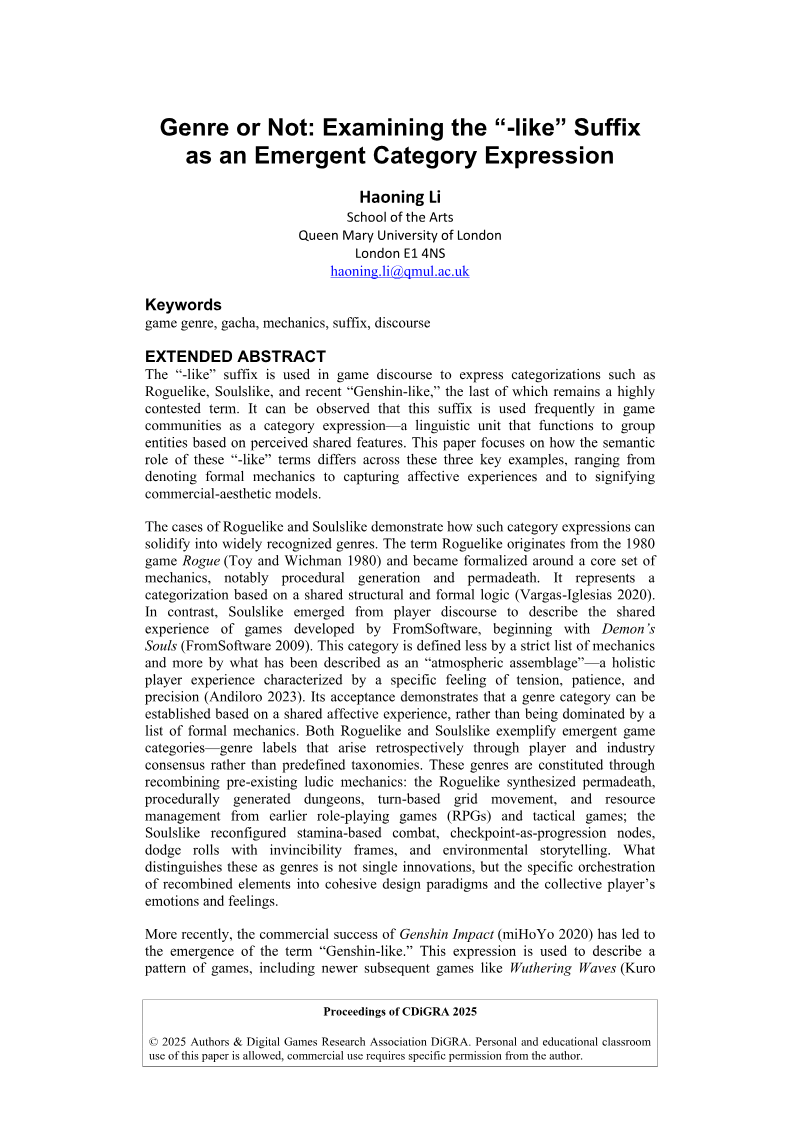
Genre or Not: Examining the "-like" Suffix as an Emergent Category Expression
This paper examines the "-like" suffix in video game discourse as a linguistic device for grouping games by perceived shared features, with a focus on how its meaning shifts across three examples: Roguelike, Soulslike, and the contested "Genshin-like."
- The "-like" suffix functions as a retrospective labeling device: genre status is conferred through player and industry consensus rather than a single innovation, and validation depends on how recombined mechanics are orchestrated into a cohesive design paradigm and felt experience.
- The "-like" suffix carries different meanings across cases: Roguelike denotes formal mechanics (procedural generation and permadeath, traced to the 1980 game Rogue), Soulslike denotes a shared affective experience (an "atmospheric assemblage" of tension, patience, and precision, beginning with FromSoftware's Demon's Souls), and Genshin-like denotes a commercial-aesthetic formula.
- Genshin-like is defined by a high-production anime aesthetic, open 3D worlds, expansive storyworlds, and gacha monetization, with examples including Genshin Impact, Wuthering Waves, and Infinity Nikki.
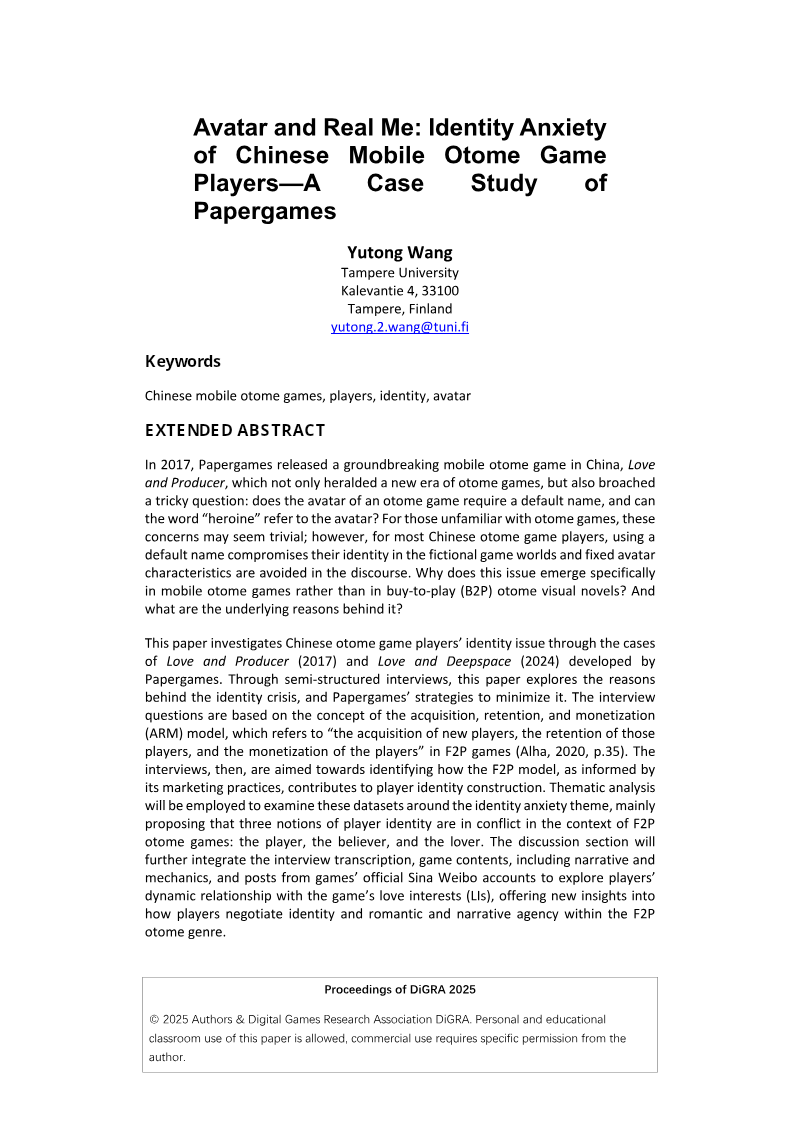
Avatar and Real Me: Identity Anxiety of Chinese Mobile Otome Game Players: A Case Study of Papergames
This paper examines identity anxiety among Chinese players of free-to-play mobile otome games, using Papergames' Love and Producer (2017) and Love and Deepspace (2024) as case studies.
- The paper argues that existing otome game scholarship, which treats avatars as stable and players as closely identifying with them, fails to explain mobile players, who often reject or feel unease toward their avatar's presence in the two-dimensional game world.
- Within free-to-play otome games, the paper proposes that three identities, the player, the believer, and the lover, come into conflict, and it distinguishes mobile otome games from buy-to-play otome visual novels in how player identity is constructed.
- The study uses semi-structured interviews with thematic analysis organized around the acquisition, retention, and monetization model, supplemented by game narrative and mechanics and official Sina Weibo posts from the developers; the interview sample size is not specified in the extended abstract.
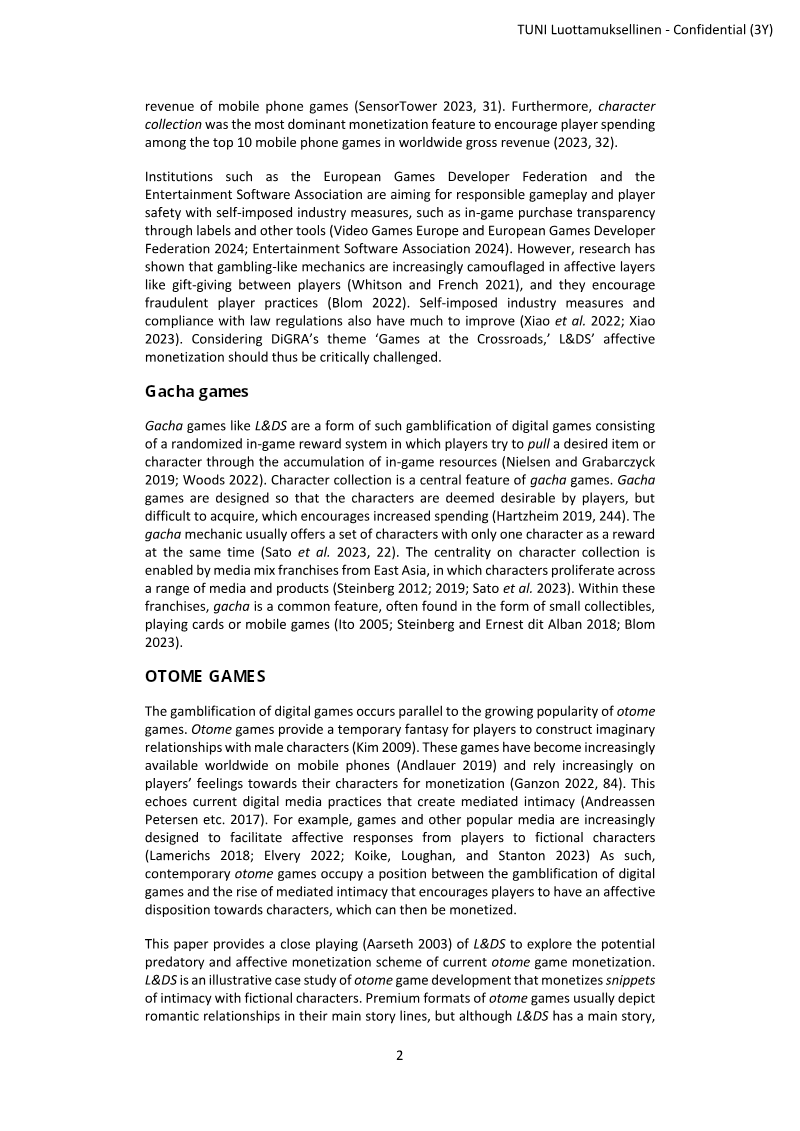
Love as a Service in Otome Games
This paper, by Joleen Blom of Tampere University and presented at DiGRA 2025, is a qualitative work-in-progress that examines monetization in otome games, a subgenre that offers players imaginary romantic relationships with fictional male characters.
- The paper argues that free-to-play otome games fuse affective romantic engagement with gacha mechanics, turning romance itself into a paid service rather than a free narrative experience.
- Using Love and Deepspace (Papergames, released January 2024) as a close-play case study, the author reports it became the fastest-growing title in Japan by revenue shortly after release and drove a global revenue surge for mobile interactive story games.
- The most desirable romantic content, including fully visual scenes and story-supplementing rare five-star cards, is randomized, paywalled, time-limited, and sometimes gated behind matching card pairs, so players must either grind extensively or spend money to access it.
