
DMA Design
CompanyUnited Kingdom · Founded 1987
Documents about DMA Design
Article
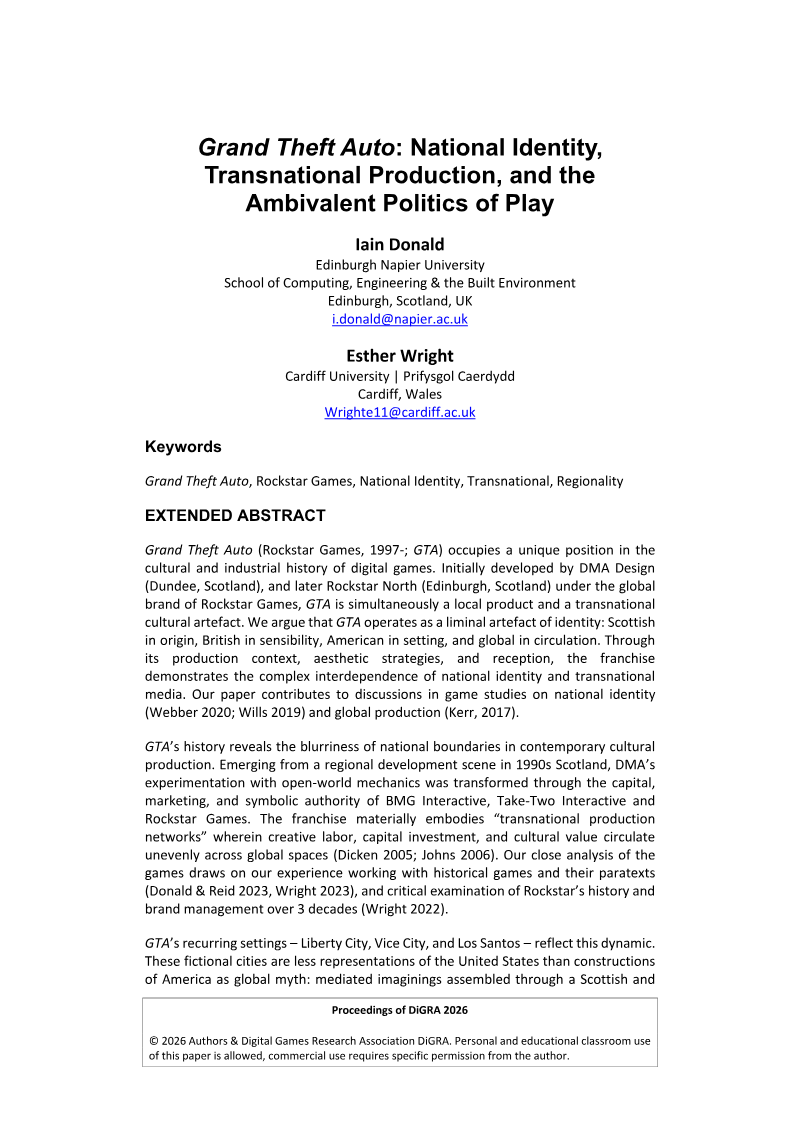
Grand Theft Auto: National Identity, Transnational Production, and the Ambivalent Politics of Play
The document analyzes the Grand Theft Auto (GTA) franchise as a liminal cultural artifact, exploring its complex relationship with national identity, transnational production, and the ambivalent politics of play.
- The Grand Theft Auto franchise is a transnational product, originally developed by DMA Design in Dundee and later by Rockstar North in Edinburgh, with creative labour, capital, and cultural value moving unevenly across borders.
- The authors argue that the series' fictional America is a constructed myth assembled through a Scottish and British lens and drawn largely from mass media imagery, rather than a faithful representation of the United States.
- The paper's central thesis is that the game's appeal lies in ambivalence: players can inhabit an outlaw fantasy of entrepreneurial freedom and transgression while the game simultaneously mocks that fantasy's moral emptiness.
DiGRAJun 2026
Article
How Rockstar Fit an Entire City into PlayStation 2 Memory
Mark Brown of Game Maker's Toolkit explains how Rockstar North (then DMA Design) fit Grand Theft Auto III's roughly 130MB Liberty City, about 77MB of models and 45MB of textures, into the PlayStation 2's 32MB of memory.
- Rockstar North enabled a 130-megabyte city to run on the PlayStation 2’s 32-megabyte RAM by implementing a streaming system that loads and unloads assets based on the player's immediate proximity.
- To manage memory efficiency, the engine utilizes level-of-detail (LOD) models that swap low-poly imposters for high-detail assets as the player approaches.
- Dynamic entity memory is controlled by pooling assets, such as restricting the game to only eight resident vehicle types at any given time.
Game Maker's ToolkitMay 2026
Article
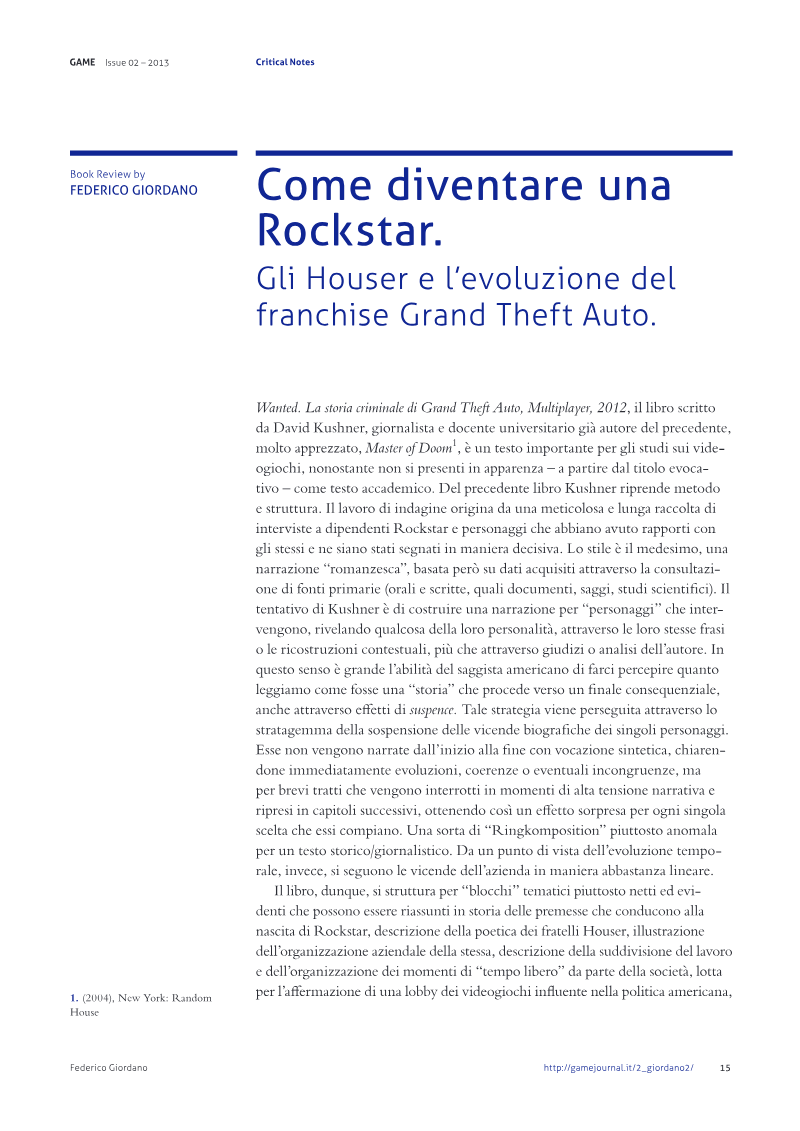
Come Diventare Rockstar: Gli Houser e l'Evoluzione del Franchise Grand Theft Auto
Federico Giordano's 2013 review of David Kushner's Wanted. La storia criminale di Grand Theft Auto (2012) argues that the book, though not framed as academic work, is a valuable contribution to video game studies.
- The review assesses David Kushner's 2012 book "Wanted: The Criminal History of Grand Theft Auto," which examines Rockstar Games, the Houser brothers Sam and Dan, and the development of the GTA franchise, and argues it is an important text for video game studies despite its non-academic framing.
- Kushner's method relies on extensive interviews with Rockstar employees and people affected by the company, combined with primary written sources, and uses a novelistic, character-driven narrative rather than explicit authorial judgment.
- The book identifies two sides to Rockstar's ethos: an idealistic push for artistic freedom, mature realism, a distinctive New York-inflected brand identity, and guerrilla marketing, alongside harsh management, schedules of up to sixteen hours a day, favoritism, and a lawsuit from Rockstar San Diego workers.
G|A|M|E – The Italian Journal of Game StudiesMar 2013