Adventure Sandbox reports and market data
3 game industry reports, presentations and talks about adventure sandbox from writers such as DiGRA and backbone.interactive, newest from 2020. Every document has a summary and key insights with the page they come from.
Documents
"Sometimes I Like Killing as a Treat": Children's Transgressive Play in Minecraft
This study examines how six- to eight-year-old children play Minecraft, drawing on recordings from ten families totaling 10.5 hours of play sessions.
- The study is a qualitative observation of ten families' Minecraft play totaling 10.5 hours, focusing on six- to eight-year-old children, and its authors describe it as exploratory and descriptive rather than generalizable.
- Most observed play fit established categories such as creative and socio-dramatic play, but the authors found a violent pattern that existing frameworks could not classify, which they name "Transgressive Play": pleasure from breaking moral and social norms where no one faces real physical harm.
- The central case study is a seven-year-old who repeatedly killed non-threatening villagers and a zombie in Creative mode while his younger brother watched and laughed, behavior the authors argue does not fit Hughes' Rough and Tumble Play or Deep Play because it lacks a shared two-way contest and carries no risk.
On the Border: Pleasure of Exploration and Colonial Mastery in Civilization III Play the World
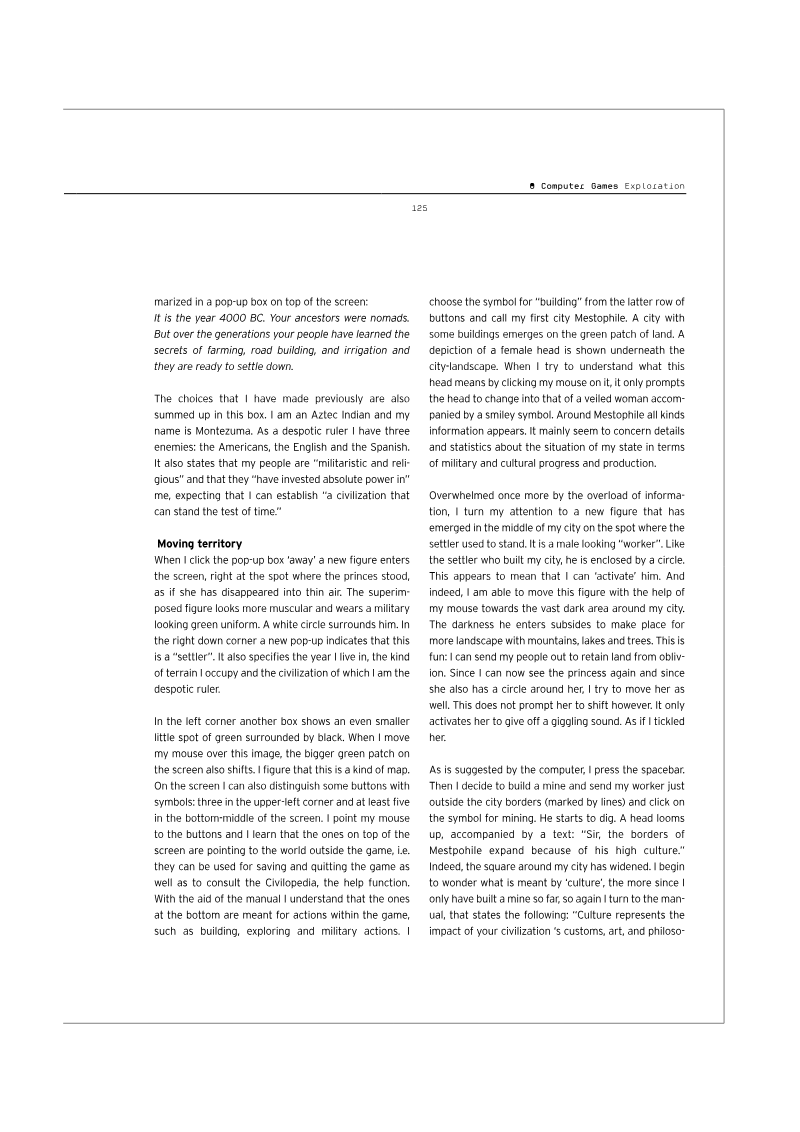
Sybille Lammes's analysis of Civilization III: Play the World argues that the game presents exploration and expansion as a colonialist progression, moving from "nature" toward a Western, white, male-centred "civilization."
- Sybille Lammes argues that Civilization III: Play the World frames exploration and expansion as a colonialist progression from "nature" toward a Western, white, male-centred "civilization," drawing on postcolonial and science studies.
- The analysis reads the game's intro cinematics (such as the Tower of Babel imagery) and setup options, including the framing of "Barbarians" as nature-bound and non-Western cultures as rivals, as naturalising links between expansionism, science, masculinity, and whiteness.
- The core claim is that the game's border expansion mirrors European colonial attitudes, with colonies serving as resource extraction zones for the homeland and "othered" peoples and territories subject to control.
Myzel: Selforganization in Networked Worlds
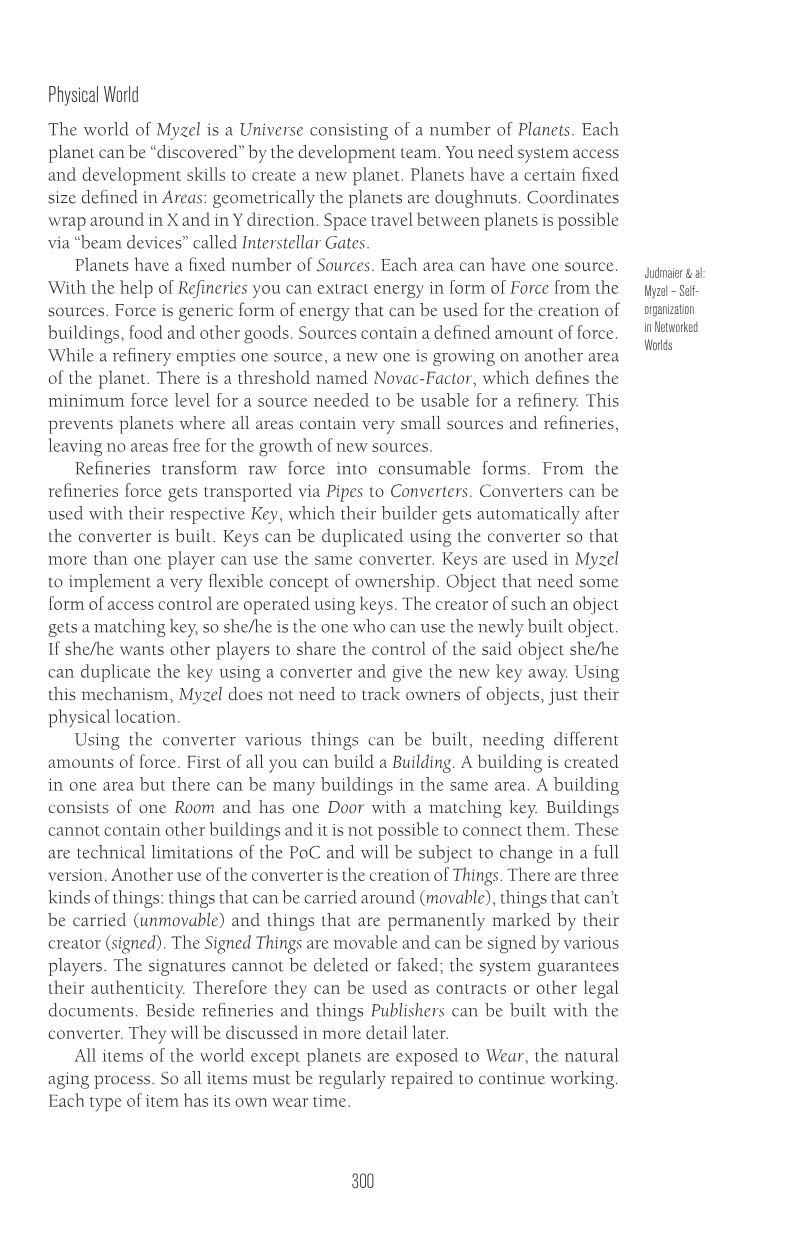
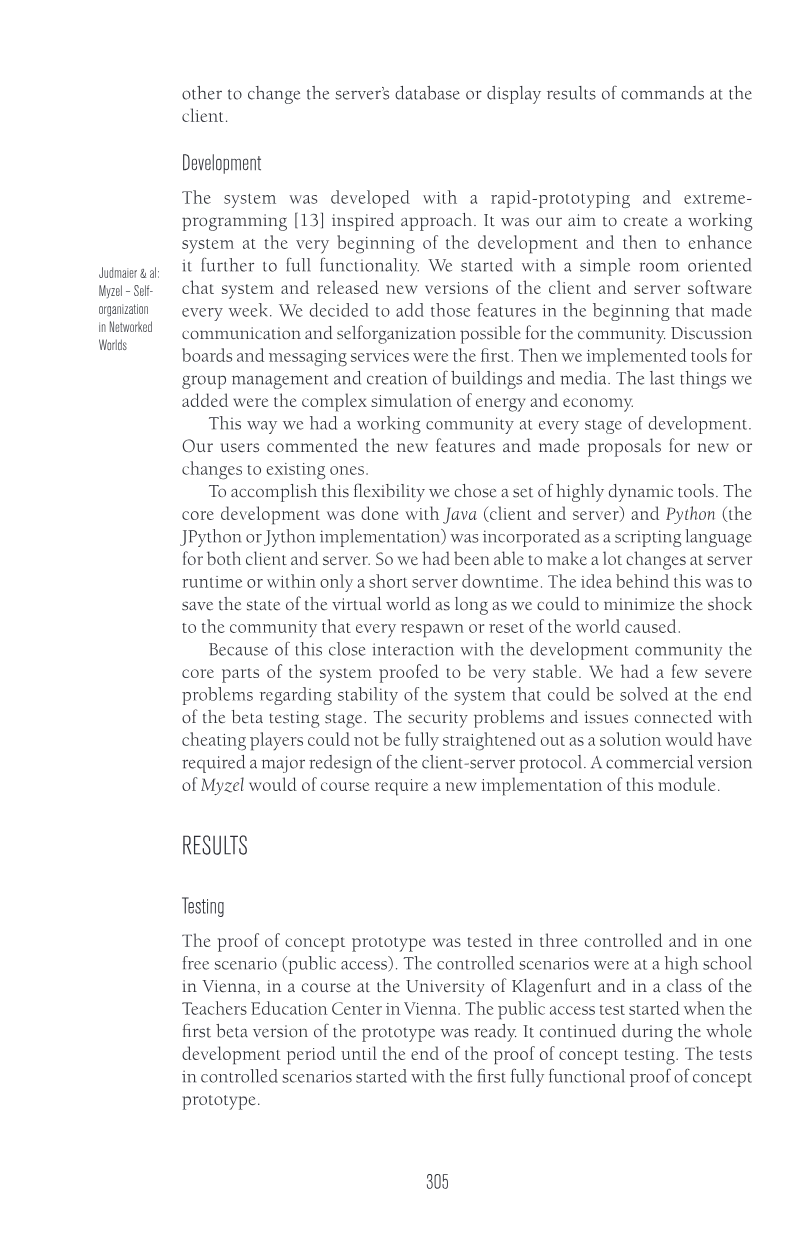
Myzel: Selforganization in Networked Worlds presents the design and proof-of-concept evaluation of an online community game developed at Vienna University of Technology by backbone.interactive.
- Myzel is an educational online community game developed at Vienna University of Technology by backbone.interactive, in which players negotiate and create their own rules, economy, and political organizations to learn how modern societies function.
- The Vienna proof of concept (2000–2001) drew roughly 1,000 registrations, about 150 active players, a core group of around 50, and a peak of about 30 concurrent participants.
- Energy and information systems, especially refineries and the publisher/eZine structure, drove gameplay, and players spontaneously formed company-like clusters.