1 free read left. Create a free account for unlimited reading + AI research.
Create free accountArticleSpiel|Formen
The Signallabor at the Humboldt-Universität zu Berlin served as a critical nexus for media archaeology, technical research, and public engagement between 2012 and 2022. Established as a specialized research space within the Department of Media Studies, the laboratory functioned as both an academic facility and a semi-public retro-hackerspace. Its primary objective was to facilitate an object-oriented understanding of media history, focusing on the material analysis of historical computing hardware, game consoles, and electronic systems.
Over its decade of operation, the laboratory curated a collection of over 300 media-historical objects, including 4-bit to 16-bit computers, analog systems, and early gaming hardware. The methodology centered on "hands-on" research, where the repair and restoration of defective equipment served as a core epistemological practice. By integrating these technical activities into the curriculum, the laboratory successfully bridged the gap between non-technical disciplines, such as cultural studies, and STEM fields. Students engaged in programming, hardware maintenance, and the development of interactive exhibits, which provided a practical framework for analyzing the genealogy of digital technologies.
Beyond its internal academic function, the Signallabor acted as a hub for the Berlin hacker community and a resource for external institutions. It hosted regular research colloquia, such as the "Game Circuits" series, and provided expertise for public exhibitions, including contributions to the Humboldt Forum and the MS Wissenschaft touring exhibition. By documenting its activities through workshops, seminars, and media productions, the laboratory established a model for how retrocomputing and hardware-focused research can inform contemporary media theory and public historical discourse.
Spiel|Formen · 2025
Spiel|Formen · 2025
Spiel|Formen · 2025
Spiel|Formen · 2025
Spiel|Formen · 2025
Spiel|Formen · 2025
Spiel|Formen · 2025
Spiel|Formen · 2025
Spiel|Formen · 2025
Spiel|Formen · 2024
Spiel|Formen · 2024
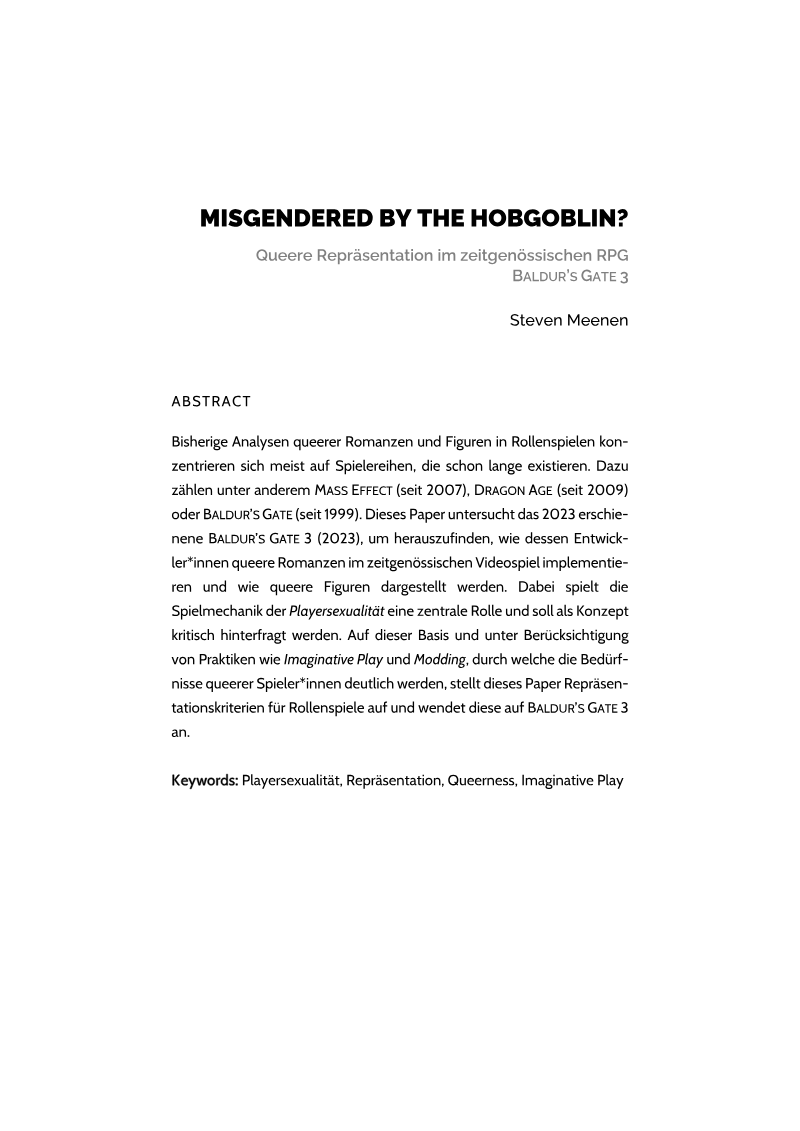
Spiel|Formen · 2024
Japanese Association for Role-Playing Game Studies (JARPS) · 2025
Comments