Modern Times Group
Game Co.51 documents
Documents
Financial118 pages
Annual Report 2009
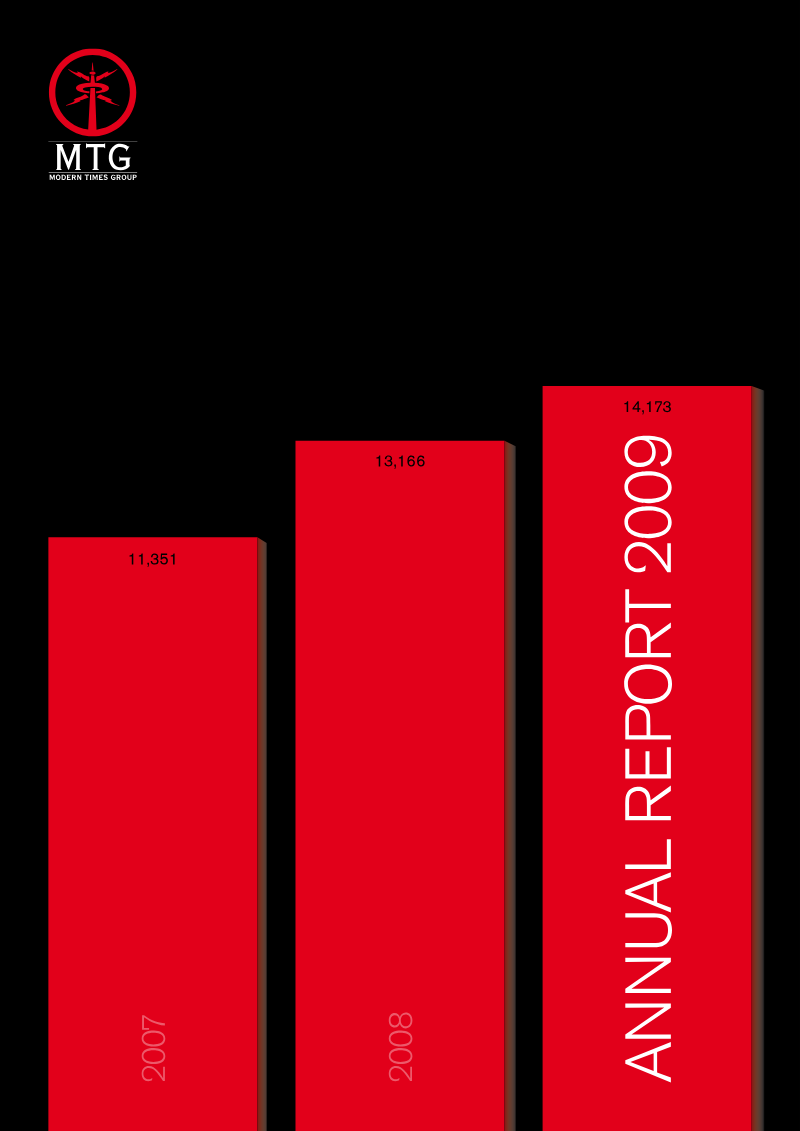
Modern Times Group’s 2009 annual report presents a year of contrasting outcomes, combining modest revenue growth with a substantial net loss driven primarily by non‑recurring impairments. Net sales rose to SEK 14.2 billion, up from SEK 13.2 billion the prior year, while operating income before exceptional items reached SEK 1.65 billion. A goodwill and asset‑impairment charge of roughly SEK 3.35 billion turned operating results negative, producing a consolidated net loss of SEK 2.0 billion and a loss per share of SEK 30.97. Despite the loss, the group generated SEK 1.5 billion of net operating cash flow, reduced net debt to SEK 2.7 billion (1.1 × EBITDA), and retained SEK 3.8 billion in liquid funds, supporting a proposed dividend of SEK 5.50 per share and authorization to repurchase up to 10 % of outstanding shares.
The report underscores a strategic shift toward emerging‑markets pay‑TV, where revenue grew 33 % to SEK 875 million and operating profit increased 59 % to SEK 168 million, while subscriber numbers expanded across premium, basic and mini‑pay services. Digital retail sales also rose 26 %, reflecting diversification beyond traditional broadcasting. Governance is highlighted through a board of eight non‑executive directors, active remuneration and audit committees, and a Modern Responsibility framework that integrates employee development, carbon‑footprint auditing, ISO 14001 certification and green‑building standards. Approximately 86 % of staff completed performance surveys and 61 % of permanent employees received training, indicating strong internal engagement.
Financial risk management remains a priority, with the group maintaining sufficient credit facilities, modest exposure to transaction‑level hedges, and an unhedged translation risk profile. IFRS updates slated for 2010 are expected to affect disclosures but not the core financial position. Overall, the 2009 performance reflects a resilient cash position and growth in high‑margin emerging markets, offset by significant impairment charges and a need for continued debt discipline.
- Modern Times Group reported a net loss of SEK 2.0 billion in 2009, driven by SEK 3.35 billion in non-recurring goodwill and asset-impairment charges.
- Despite the net loss, the company achieved net sales of SEK 14.2 billion and generated SEK 1.5 billion in net operating cash flow.
- The group maintained a strong liquidity position with SEK 3.8 billion in liquid funds and reduced net debt to SEK 2.7 billion, representing a 1.1x EBITDA ratio.
- Emerging-markets pay-TV operations showed strong growth, with revenue increasing 33% to SEK 875 million and operating profit rising 59% to SEK 168 million.
- The board proposed a dividend of SEK 5.50 per share and requested authorization to repurchase up to 10% of outstanding shares.
Modern Times GroupJan 2009
Report13 pages
MTG Corporate Responsibility Report 2008
Modern Times Group’s Modern Responsibility programme, launched in 2004, is presented as a strategic framework for leveraging entertainment to create social and environmental value across the company’s global operations. The initiative is positioned as core to MTG’s mission to “maximise the power of entertainment,” with responsibility articulated through five measurable pillars: community, environment, colleagues, broadcasting standards, and marketing.
In 2008 the group reached 125 million viewers in 30 countries, operating 70 brands across television, radio, online retail and production. Financial performance showed net sales rising to SEK 13.2 billion and operating income to SEK 2.6 billion, while basic earnings per share more than doubled to SEK 43.25. Employee data indicate an average workforce of 2 810, with 35 % female representation, a 22 % turnover rate and 461 training days delivered to 46 % of staff. Community engagement generated 78 million SEK of donated airtime and raised 56 million SEK for charities, while environmental actions reduced office energy use by 28 % relative to national standards and produced a total carbon footprint of 4 223 tonnes CO₂ (3.0 t per employee), calculated under the Greenhouse Gas Protocol with external verification.
Stakeholder governance is overseen by senior management, a dedicated coordinator and a Modern Responsibility Committee, supported by local ambassadors in each market. Reporting draws on internal data, carbon accounting from Tricorona Climate Partner, and regular stakeholder feedback through surveys and focus groups. The 2008 snapshot underscores MTG’s expanding footprint, its commitment to ethical broadcasting, and its ambition to deepen responsibility reporting in subsequent years.
- In 2008, MTG achieved strong financial growth with net sales of SEK 13.2 billion, an operating income of SEK 2.6 billion, and basic earnings per share of SEK 43.25.
- MTG’s community engagement efforts in 2008 resulted in SEK 78 million worth of donated airtime and SEK 56 million raised for charitable causes.
- The company maintained a workforce of 2,810 employees across 30 countries, with 35% female representation and a 22% staff turnover rate.
- MTG reduced office energy consumption by 28% relative to national standards and recorded a total carbon footprint of 4,223 tonnes of CO2, averaging 3.0 tonnes per employee.
- The Modern Responsibility programme is governed by a dedicated committee and senior management, utilizing external verification from Tricorona Climate Partner to track carbon accounting.
+1
Modern Times GroupJan 2008
Financial116 pages
Annual Report 2008
Modern Times Group recorded a landmark fiscal year in 2008, delivering a 16 percent increase in net sales to SEK 13.2 billion and a 28 percent rise in underlying operating profit to SEK 2.6 billion, lifting the operating margin to 20 percent. Diluted earnings per share more than doubled to SEK 43.25, supporting a proposed cash dividend of SEK 5 per share, although the Class B share price fell sharply during the same period. The Group’s four core segments—Viasat Broadcasting, Radio, Online and Modern Studios—generated the bulk of the revenue and operating income, with external sales of SEK 13.2 billion and operating income of SEK 3.7 billion, both markedly higher than the prior year.
Governance structures were reinforced through the re‑election of most non‑executive directors and the addition of two new members, while the board’s remuneration and audit committees oversaw investment approvals, acquisitions and major programming spend. A noted breach of the corporate‑governance code involved the appointment of a committee chair, prompting heightened oversight. The report also highlighted a suite of operational risks, including the continual need for attractive programming, limited control over associated companies, reliance on satellite and third‑party cable networks, and challenges in attracting and retaining skilled personnel.
Financial reporting adhered to IFRS, employing the purchase method for consolidation and rigorous impairment testing of tangible and intangible assets. Financial assets were classified as available‑for‑sale, with foreign‑exchange exposure hedged via forward contracts under IAS 39. Cash‑flow analysis revealed a substantial non‑operating adjustment of –SEK 1,009 million, offset by a one‑off divestment gain of SEK 1,905 million and a corresponding cash influx of SEK 1,948
- Modern Times Group achieved strong financial growth in 2008, with net sales rising 16 percent to SEK 13.2 billion and underlying operating profit increasing 28 percent to SEK 2.6 billion.
- Diluted earnings per share more than doubled to SEK 43.25, leading to a proposed cash dividend of SEK 5 per share despite a sharp decline in the Class B share price.
- The Group's four core segments—Viasat Broadcasting, Radio, Online, and Modern Studios—collectively generated SEK 13.2 billion in external sales and SEK 3.7 billion in operating income.
- Cash flow was significantly impacted by a one-off divestment gain of SEK 1,905 million and a corresponding cash influx of SEK 1,948 million, which helped offset a non-operating adjustment of –SEK 1,009 million.
- Operational risks identified by the company include reliance on third-party satellite and cable networks, the necessity of securing attractive programming, and challenges in talent retention.
+1
Modern Times GroupJan 2008